HCPCS code C1731: Catheter billing, OPPS reimbursement, and denial guide
HCPCS code C1731: Official descriptor and code series context HCPCS code C1731 i...

Last Updated: Oct 8, 2026
E1432 is the CCSD code for bilateral functional endoscopic sinus surgery (FESS). It covers excision of the uncinate process and anterior ethmoid bulla, antrostomy or antral puncture, simple polypectomy and attention to the turbinates. Surgeons use it for chronic sinusitis or nasal polyps that haven't settled with medical treatment.
Bupa lists E1432 in its MAJOR 3 fee category, at £575. The descriptor names a bilateral operation, so one line covers both sides. Antrostomy, polypectomy and turbinate work sit inside the code, so they can't be billed alongside it.
Let Pabau's smart automation suggest the right codes, reduce claim denials, and keep your practice compliant—effortlessly.
Automate repetitive tasks and focus on what matters most—your patients.
Reduce coding errors and ensure compliance with the latest regulations.
Clean claims, fewer denials, and faster reimbursements.
Powerful insights and reporting to help your practice thrive.
HIPAA compliant SOC 2 certified GDPR-compliant Trusted by 4,000+ clinics worldwide

CCSD code E1432 covers bilateral FESS, a nasal sinus operation listed in Chapter 5, Ear, nose and throat.
Bupa places E1432 in its MAJOR 3 fee category at £575, though your own contract rate may differ.
The descriptor names a bilateral operation, so a second E1432 line for the other side is a duplicate.
Antrostomy, simple polypectomy and turbinate work sit inside the descriptor and can’t be billed alongside E1432.
Image-guided FESS has its own code, E1260, so check whether navigation was used before you code.
CCSD code E1432 is the code for bilateral functional endoscopic sinus surgery, usually shortened to FESS. The official descriptor reads: FESS: excision uncinate process and anterior ethmoid bulla, antrostomy/antral puncture, simple polypectomy and attention to turbinates (bilateral).
In plain terms, the surgeon works through the nose with an endoscope to open the sinus drainage pathways. They remove the uncinate process and the ethmoid bulla, the largest air cell at the front of the ethmoid. Next, they widen or puncture the opening of the maxillary sinus. Small polyps and the turbinates are dealt with in the same sitting.
E1432 sits in Chapter 5 of the CCSD schedule, Ear, nose and throat, under Nasal sinuses. The CCSD Group, whose members include Aviva, AXA Health, Bupa and Vitality, maintains the codes and their wording. Each insurer then sets its own fee. Our CCSD billing guides cover several of its neighbors in the same chapter.
Because the descriptor ends in “(bilateral)”, one E1432 line covers an operation on both sides. If the surgeon treats one side only, check with the insurer before you code.
The nasal sinus section holds several codes that read alike on a busy list. They differ by technique, extent and fee, so the wrong pick changes what you’re paid.
The fee ladder below shows how far apart these codes sit in Bupa’s CCSD fee bands. A slip between E1432 and E1330 halves the fee, while a slip up to E1260 overbills.
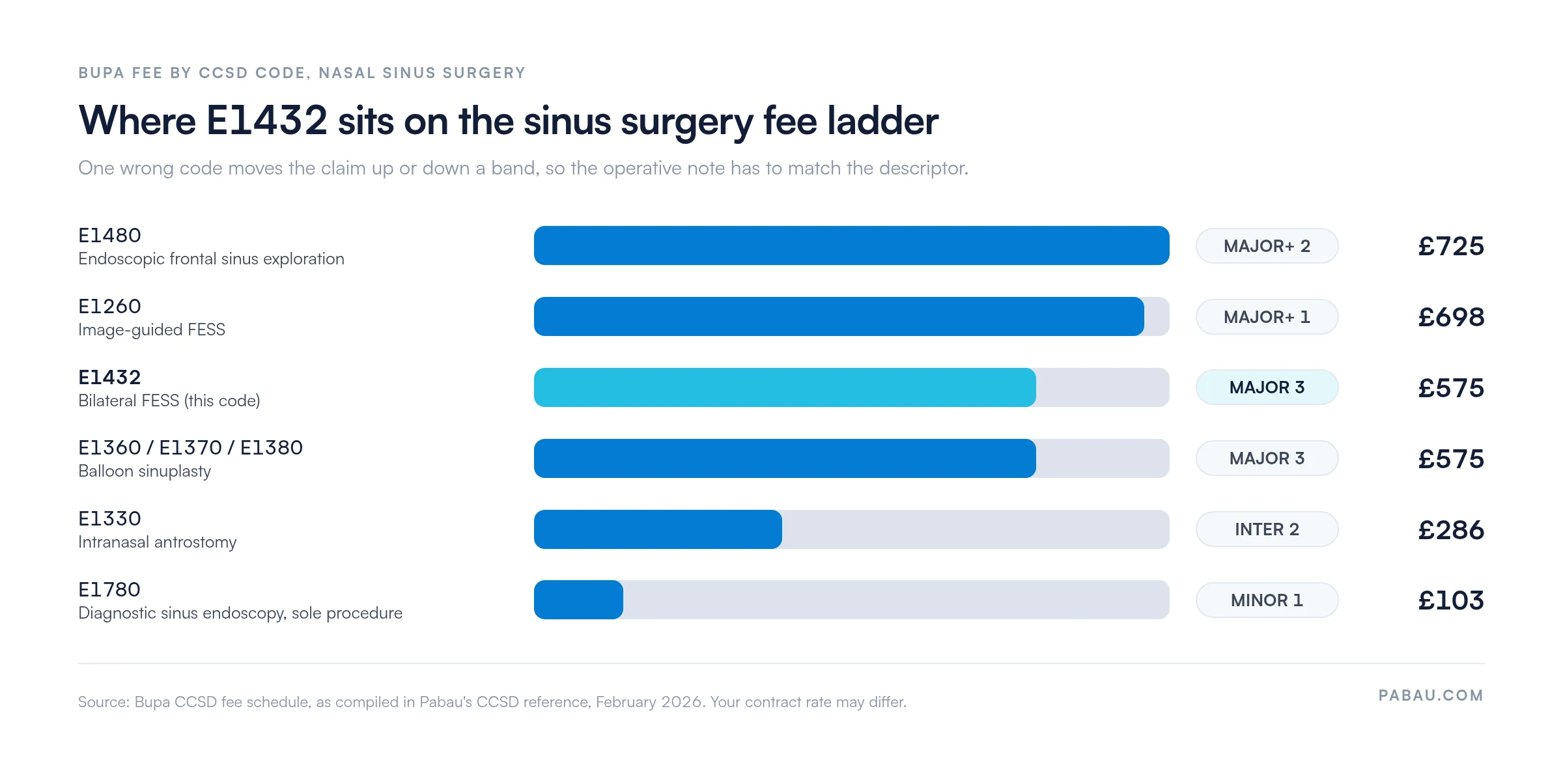
Other nearby codes describe different operations. E1410 is an external frontoethmoidectomy, and E1450 is a bone flap to the frontal sinus. E1435 covers cryotherapy of the posterior nasal nerve, and E1441 an ethmoid sinus stent. They rarely compete with E1432, but a quick scan of the list prevents a typing slip.
The E1432 descriptor bundles four steps that could otherwise look like separate codes:
The CCSD schedule backs this up with a list of unacceptable combinations. These codes can’t appear on the same claim as E1432 for the same operation. The list includes:
Most of these codes repeat a step the E1432 descriptor already names. Check the full list in the CCSD schedule before you add a second ENT code to the claim.
Read the operative note against the four parts of the descriptor before you code. If the note records image guidance, E1260 replaces E1432 rather than joining it on the claim.
Insurers check the claim against the note, so the note should describe the operation in the descriptor’s own terms. A complete E1432 note records:
Then add the pre-authorization reference, the date of surgery and the consultant’s details to the claim file. Keep the signed consent form with the patient record too.
UK private medical insurers generally ask members to get pre-authorization before planned surgery. For an elective operation like FESS, assume you need it unless the insurer says otherwise.
Usually, the patient calls their insurer and quotes the procedure code you give them. The insurer confirms cover and issues an authorization number. Later, that number, the code and the date should all match the claim.
Authorization confirms cover, not payment. Suppose the code changes after surgery, for example from E1432 to E1260. Contact the insurer and ask them to update the authorization before you bill.
Here is the usual path for an insured FESS case, from the first consultation to payment.
Take a worked example. A consultant performs bilateral FESS for nasal polyps, without navigation. Your team bills one E1432 line and adds no separate polypectomy code. Had the note recorded image guidance, the claim would go out as E1260 instead.
Run through this list for every E1432 claim before it leaves the practice:
Most E1432 queries trace back to a handful of avoidable errors:
In many ENT practices, the same claim gets typed twice. The details go into the practice system first, then into Healthcode, with the authorization number copied from an email.
Pabau, the practice management platform we build, connects to Healthcode, so the claim builds from the patient record instead. With error-checked claims management, the CCSD code, membership number and authorization reference carry across. Pabau checks the required fields before the claim can be sent.
You then follow each claim’s status and payment in one place. A missing authorization number gets caught before the insurer sees it.

Pabau builds CCSD claims like E1432 from the patient record and checks required fields before submission. You can then track every claim’s status in one place.

E1432 is one of the easier ENT codes to bill, once you know what it already contains. Most queried claims add a step the descriptor covers, or bill the second side.
So treat the descriptor as a checklist for the operative note. When the note shows each step and states whether navigation was used, the code choice settles itself.
Book a demo to see how Pabau carries an E1432 claim from the operative note to Healthcode without retyping.

Billing other Bupa procedures? Bupa CCSD codes guide explains how the schedule is organized and how Bupa fee bands work.
Did the surgeon use navigation? CCSD code E1260 covers image-guided FESS and how it bills against E1432.
Coding other ENT work? CCSD code E4100 walks through voice prosthesis insertion claims.
Want fewer queried claims? Pabau claims management sends CCSD claims to insurers from the patient record.
Treating turbinate adhesions on their own? CCSD code E0440 covers division of turbinate adhesions as a separate operation.
Usually, if the policy covers surgery and the insurer agrees the operation is medically needed. Cover still depends on the policy, its exclusions and any pre-existing conditions. The patient should get pre-authorization before the date is booked.
FESS removes tissue to open the sinus drainage pathways. Balloon sinuplasty widens the opening with an inflated balloon instead. In CCSD, balloon dilation has its own codes, E1360 to E1380, and they can’t be billed with E1432.
The anesthetist bills their own fee, separately from the surgeon. Your E1432 line covers the surgeon’s fee only. The hospital also bills separately for operating room time and the stay.
Often, yes. Many patients go home the same day, though some stay overnight. Check how the insurer authorized the stay, because the hospital bills a day case and an overnight stay differently.
It’s the fee category Bupa assigns to E1432, linked to a fee of £575. Bupa groups procedures into bands such as MINOR, INTER, MAJOR, MAJOR+ and CMO. Other insurers use their own fee schedules.