CPT code 40819: Labial and buccal frenectomy billing guide
CPT code 40819 covers lip and cheek frenectomies CPT code 40819 is the procedure...

Last Updated: Oct 8, 2026
E1480 is the CCSD code for endoscopic exploration of the frontal sinus beyond the frontoethmoid recess. It covers one side or both. Ear, nose and throat (ENT) surgeons bill it when they work through the nose, past the frontal recess and into the frontal sinus itself. It sits in Chapter 5 under section 5.5 Nasal sinuses.
UK private medical insurers band it as a major procedure, and the anesthetist bills separately. The claim turns on extent, so the operative note has to show dissection beyond the recess. AXA Health also bars E1480 alongside image-guided functional endoscopic sinus surgery (FESS, E1260) or balloon frontal sinuplasty (E1360).
Let Pabau's smart automation suggest the right codes, reduce claim denials, and keep your practice compliant—effortlessly.
Automate repetitive tasks and focus on what matters most—your patients.
Reduce coding errors and ensure compliance with the latest regulations.
Clean claims, fewer denials, and faster reimbursements.
Powerful insights and reporting to help your practice thrive.
HIPAA compliant SOC 2 certified GDPR-compliant Trusted by 4,000+ clinics worldwide

CCSD code E1480 covers endoscopic frontal sinus exploration beyond the frontoethmoid recess, on one side or both.
It sits in section 5.5 Nasal sinuses. AXA Health rates it Xmajor, and Bupa places it in fee category MAJOR+ 2.
AXA Health bars 12 codes from an E1480 claim, including image-guided FESS (E1260) and balloon sinuplasty (E1360).
The operative note must show an endoscopic route, dissection past the frontal recess, and findings for each side treated.
Get pre-authorization before surgery, then match the code, reference and membership number on the Healthcode claim.
CCSD code E1480 pays for endoscopic exploration of the frontal sinus beyond the frontoethmoid recess. The frontoethmoid recess is the narrow channel that drains the frontal sinus into the nose. E1480 applies once the surgeon works past that channel and into the sinus itself.
The surgeon reaches the sinus through the nose with an endoscope. Typical indications include chronic frontal sinusitis and a frontal mucocele. ENT surgeons bill the code, and the anesthetist sends a separate invoice for the same episode.
The full descriptor ends with “and bilateral.” That wording means one E1480 covers one side or both. A bilateral operation still goes on the claim once.
The CCSD Group sets the CCSD codes and descriptors, while each insurer sets its own fee. Check the current figure in the payer’s schedule, such as the Bupa code search, before you quote the patient.
Section 5.5 holds several codes for the same anatomy. The right one depends on the route, the technique and how far the surgeon went. The diagram sorts them by route first, and the table gives each official descriptor.
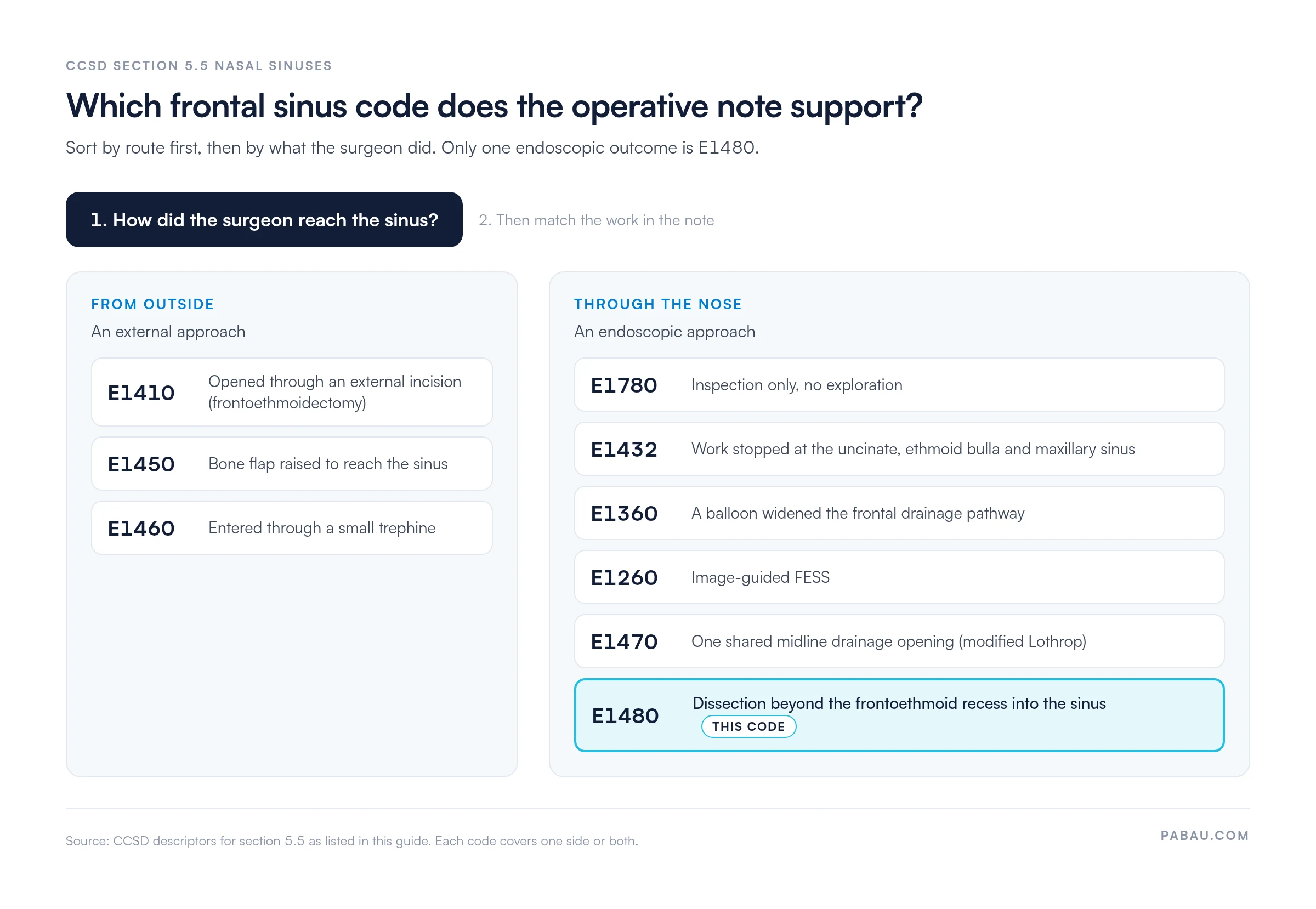
If a note could fit two rows, ask the surgeon to add the detail that settles it. Our guides to CCSD code E1260 and CCSD code E1450 cover two of these neighbors in depth.
CCSD marks some code pairs as unacceptable combinations. Those pairs can’t be billed for the same episode. Pairs listed against one code can still be refused when billed from the other, so check both.
AXA Health’s Chapter 5 schedule lists these codes against E1480:
The E1260 pairing deserves the closest look, because frontal work often happens during wider FESS. In that case the episode takes one of the two codes. Bill the code the operative note supports, and leave the other off.
Some insurers add chapter rules of their own. Freedom Health Insurance’s Chapter 5 schedule says polyp removal, antrostomy and turbinate reduction come within FESS. They should not be charged on top.
Combination lists change between schedule updates. Recheck the list in the insurer’s portal whenever you bill a new pairing.
The insurer reads the note to confirm three facts: the route, the extent and the sides treated. A line such as “frontal sinus surgery performed” proves none of them.
A complete note covers these points:
Ask for the note before the claim is built. A coder working from the operating list alone can only guess at the extent. Keep the referral letter and signed consent on file too, because insurers may ask for both.
Ask surgeons to state the furthest landmark reached in the frontal sinus. That one sentence separates E1480 from recess-level work and saves a query later.
Most UK insurers ask for pre-authorization before planned sinus surgery. Many consultants then send the claim through Healthcode, the electronic billing hub for UK private medical insurers.
The steps below keep the reference, the code and the note in step:
If a second, permitted sinus code goes on the same episode, the insurer applies its own rules to that fee. Check the payer’s guidance before you submit.
A two-minute check before submission catches most avoidable queries. Confirm each point against the operative note and the authorization:
Each problem below starts in the note or the authorization. Settle those two first, and the claim usually follows.
Sinus claims often get typed twice. The details go into the practice system first, then into Healthcode, with the authorization reference copied from an email.
Pabau, the practice management platform we build, connects to Healthcode, so the claim builds from the patient record instead. With claims management, the CCSD code, membership number and authorization reference carry across without retyping.
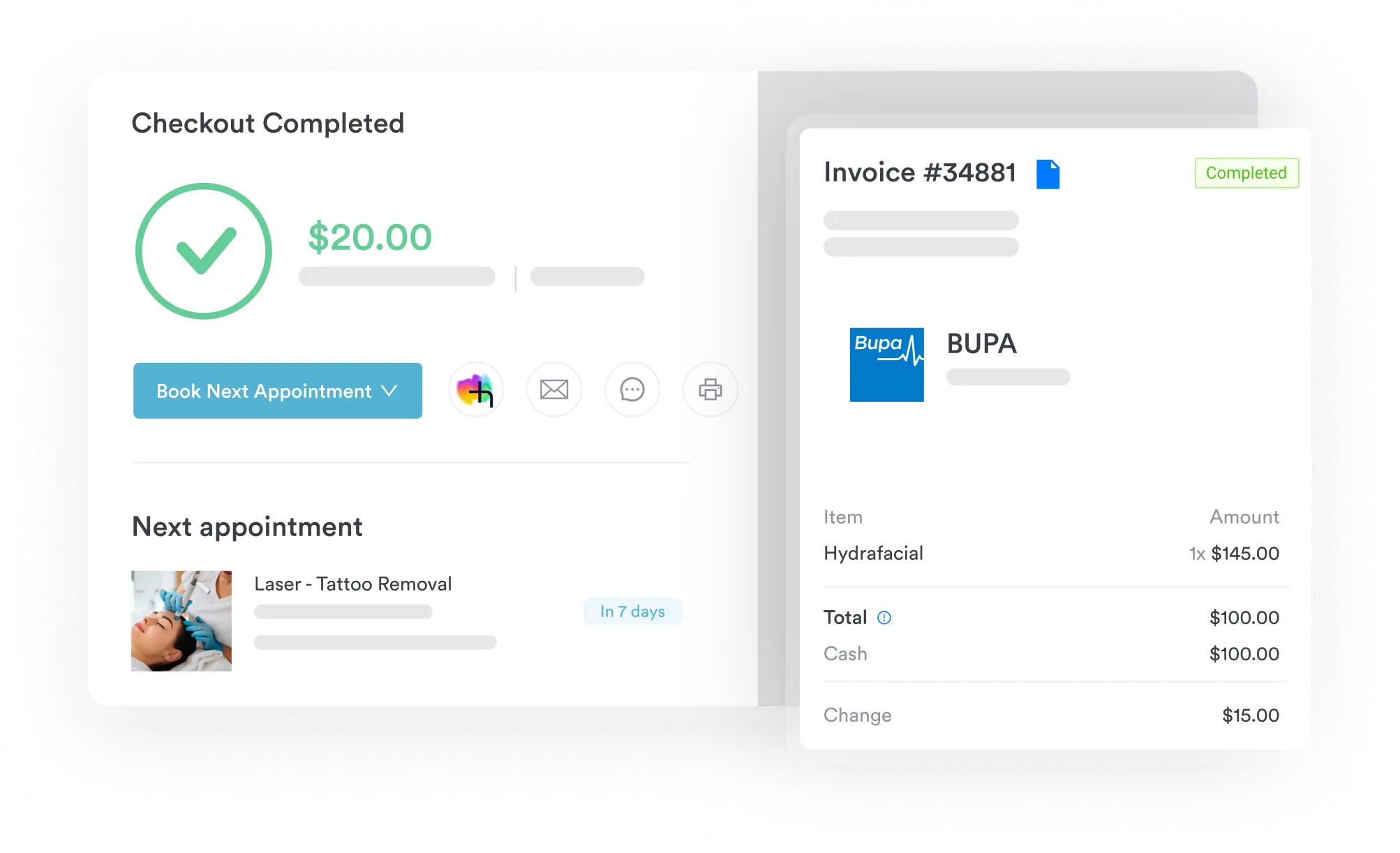
Consent and medical history forms are completed before surgery and saved to the same record. When an insurer asks for evidence, your team finds it in one place.
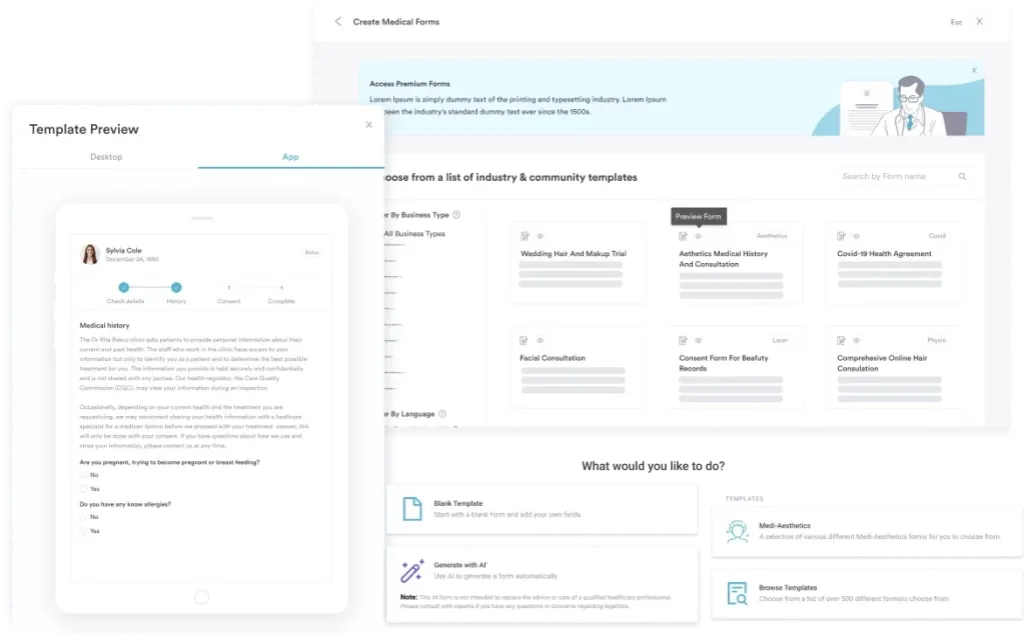

Pabau builds CCSD claims like E1480 from the patient record, with the authorization reference attached. Then you can track every claim in one place.

E1480 rewards precision. It covers one depth of frontal sinus work, and several neighbors share the same anatomy.
So settle the operative note first, then the code, then the claim. Once the note names the route, the extent and the sides, the code choice is quick. The combination list then shows what must stay off the claim.
Book a demo to see how Pabau carries an E1480 claim from the patient record to Healthcode without retyping.

Billing image-guided sinus surgery? CCSD code E1260 covers image-guided FESS and the pairing rule that blocks E1480.
Reaching the frontal sinus from outside? CCSD code E1450 explains how a bone flap to the frontal sinus is coded.
New to the CCSD schedule? CCSD codes sets out how the chapters and code structure work.
Want every Bupa code in one place? Bupa CCSD procedure codes lists the schedule and its fee categories.
Comparing fees across procedures? Bupa procedure codes fee schedule shows how fee bands shape what each code pays.
E1480 is the CCSD code for endoscopic exploration of the frontal sinus beyond the frontoethmoid recess. It sits in Chapter 5, section 5.5 Nasal sinuses. One code covers one side or both.
No. The descriptor ends with “and bilateral,” so one E1480 covers both sides. Record the findings for each side in the operative note instead.
No. AXA Health lists E1260, image-guided FESS, as an unacceptable combination with E1480. Bill the one code the operative note supports.
E1360 covers balloon dilation of the frontal sinus drainage pathway. E1480 covers endoscopic exploration beyond the frontoethmoid recess. AXA Health lists E1360 as an unacceptable combination with E1480, so bill only one.
Most UK insurers ask for pre-authorization before planned sinus surgery. Request it with the proposed code and diagnosis, and record the reference before the operation date.
Chronic frontal sinusitis (ICD-10 J32.1) is a typical indication. A frontal mucocele codes to J34.1. Record the diagnosis and the CT findings in the operative note, because insurers check the indication.
No. NHS hospitals record procedures with OPCS-4 codes. CCSD codes such as E1480 are used for claims to UK private medical insurers.