CPT code 40819: Labial and buccal frenectomy billing guide
CPT code 40819 covers lip and cheek frenectomies CPT code 40819 is the procedure...

Last Updated: Oct 8, 2026
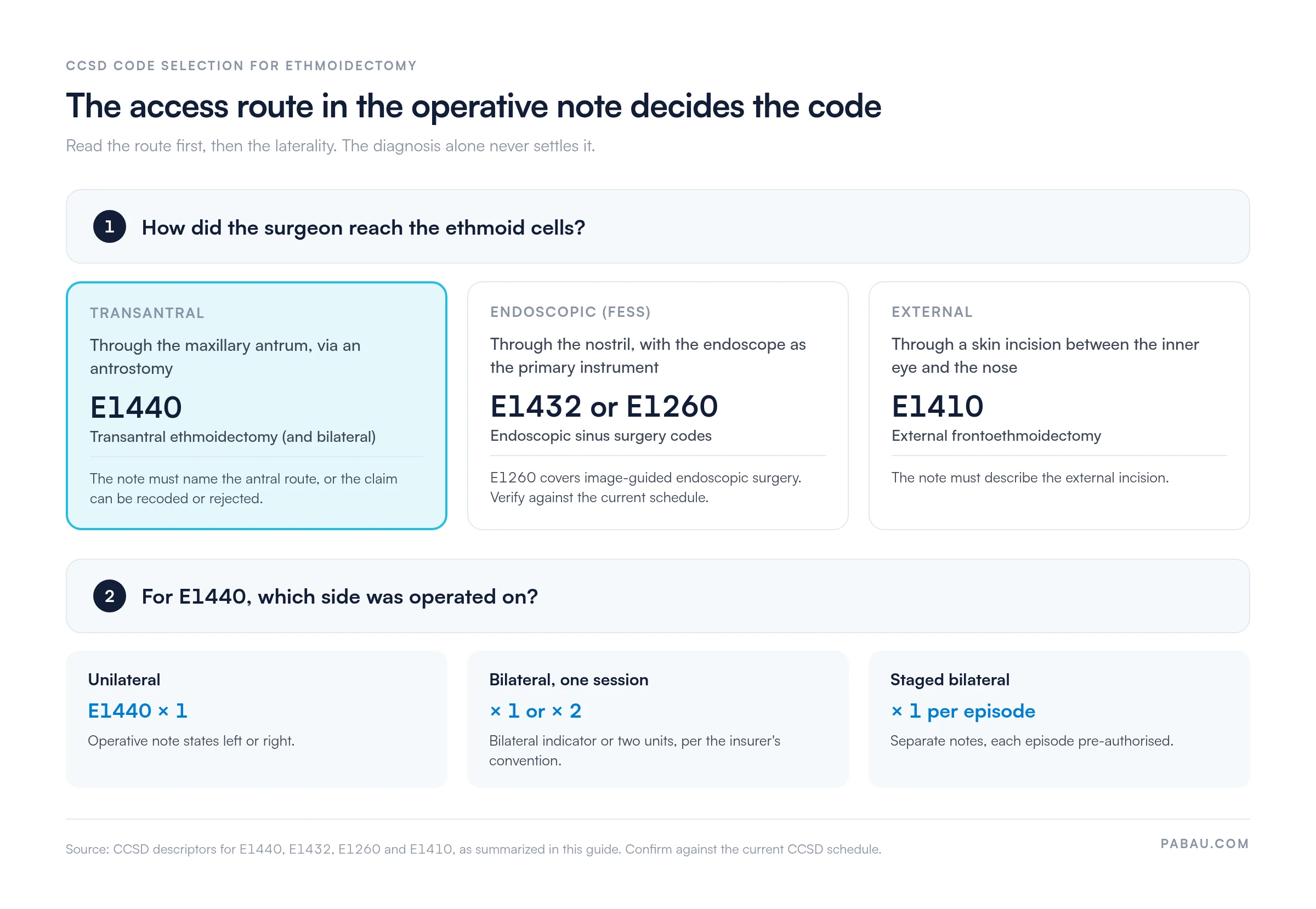
E1440 is the CCSD code for transantral ethmoidectomy (and bilateral). The surgeon reaches the ethmoid cells through the maxillary antrum via an antrostomy, rather than endoscopically through the nostril. One code covers one side or both.
E1440 sits in Chapter 5 (Ear, nose and throat), section 5.5.0 Nasal sinuses. UK private medical insurers such as Bupa, AXA Health and Aviva pay against CCSD codes. The operative note must state the antral route and the side treated.
Let Pabau's smart automation suggest the right codes, reduce claim denials, and keep your practice compliant—effortlessly.
Automate repetitive tasks and focus on what matters most—your patients.
Reduce coding errors and ensure compliance with the latest regulations.
Clean claims, fewer denials, and faster reimbursements.
Powerful insights and reporting to help your practice thrive.
HIPAA compliant SOC 2 certified GDPR-compliant Trusted by 4,000+ clinics worldwide

CCSD code E1440 covers transantral ethmoidectomy performed via the maxillary antrum, including both unilateral and bilateral cases within a single code descriptor.
The transantral approach is largely superseded by FESS in modern ENT. E1440 remains in the CCSD schedule for cases where the transantral route is clinically indicated.
Failure to document laterality in the operative note and failure to obtain pre-authorisation are common reasons E1440 claims are denied by UK private insurers.
Pabau, the practice management platform we build, supports private ENT practices with structured clinical documentation, pre-authorisation tracking, and integrated CCSD billing workflows.
CCSD code E1440 is the Clinical Coding and Schedule Development procedure code for transantral ethmoidectomy, including bilateral performance. The official descriptor reads: transantral ethmoidectomy (and bilateral). It is published and maintained by the CCSD, the body that produces the procedure code schedule used by UK private health insurers. Those insurers include Bupa, AXA Health, and Aviva. For a broader view of how CCSD codes work in private billing, see the Bupa CCSD code guide.
Transantral ethmoidectomy removes diseased ethmoidal cells by accessing the ethmoid labyrinth through the maxillary antrum. The surgeon enters the antrum via an antrostomy, then breaks through the inferior wall of the ethmoid labyrinth from below. The ethmoid cells are cleared under direct vision. In functional endoscopic sinus surgery (FESS), by contrast, the surgeon approaches the ethmoid sinuses endoscopically through the nostril without opening the antrum.
The code covers both unilateral and bilateral performance within the same descriptor. Check the current CCSD schedule edition to confirm whether bilateral cases need one line item with a bilateral indicator or two separate line items. Billing conventions can change between schedule editions.
Understanding the procedure helps coders verify that the operative note supports E1440 rather than an endoscopic sinus code. The transantral approach follows this sequence.
The operative note must explicitly state that the ethmoid cells were reached via the maxillary antrum. Without this, a claims assessor cannot confirm the transantral route and may recode the claim to an endoscopic ethmoidectomy or reject it entirely.
E1440 applies when a surgeon performs a transantral ethmoidectomy for a documented clinical indication, backed by evidence of failed conservative management. The code is not appropriate when an endoscopic (FESS) approach was used, even if the clinical indication is identical.
Common indications recorded in the clinical record to support medical necessity include the following.
Private insurers require documented evidence that medical therapy was attempted and failed before authorising surgical intervention. Verify current ICD-10 UK edition codes with NHS Classifications or your insurer portal before citing specific codes on the claim form. Code pairings can change in annual updates.
The E1440 descriptor explicitly states “and bilateral,” so bilateral transantral ethmoidectomy is within the code’s scope. How bilateral cases are billed depends on the current CCSD schedule rules and the insurer’s own billing conventions. The table below sets out the three scenarios you’re likely to meet.
Submitting two line items for a bilateral case without confirming the insurer accepts them is a common denial trigger. Always check the insurer’s current billing guide before submitting bilateral CCSD claims. Document both sides of the procedure explicitly in the operative note.
The operative approach determines which CCSD code applies. Coding a FESS procedure under E1440, or vice versa, is miscoding and a legitimate denial reason. The table below sets out the key distinctions for code selection.
The operative note is the definitive record for code selection, and it must state that the ethmoid sinuses were accessed via the antrum. A note that describes endoscopic instrumentation without the antral access route won’t support E1440. Code it to an endoscopic sinus code instead, such as E1432 for bilateral FESS or E1260 for image-guided endoscopic surgery.
A third route exists as well. When the ethmoid cells are cleared through a skin incision between the inner eye and the nose, the procedure is an external frontoethmoidectomy, coded E1410. The diagram below runs the two checks a coder makes, starting with the access route and then the laterality.
A complete clinical record supporting an E1440 claim contains five core components. Missing any one of them is enough to trigger a claim review or denial.
Digital clinical documentation that prompts for laterality, surgical approach, and pre-operative diagnosis as the note is written lowers the risk of a missing element. The check happens before the claim is submitted, not after a denial.
Transantral ethmoidectomy is an inpatient or day-case surgical procedure. UK private health insurers typically require pre-authorisation before it is performed. The documentation each insurer asks for varies and changes periodically, so check the current provider portal before submitting a pre-auth request.
Turnaround for pre-auth decisions varies by insurer, so check the provider portal for current timescales. Urgent cases can be fast-tracked. Sending the request with complete documentation the first time avoids information requests, which can push the procedure date back.
Claims for E1440 are commonly denied for a small number of preventable reasons. The table below maps the most common denial reasons to their fixes.
Each of these triggers can be checked before the claim leaves the practice. Building those checks into the billing workflow is how a practice raises its first-submission acceptance rate.
Transantral ethmoidectomy is frequently performed at the same operative session as other ENT procedures. Whether those co-procedures can be billed separately depends on the CCSD schedule edition in force and the insurer’s unbundling policy. The principles below reflect standard CCSD bundling logic, but always verify them against the current schedule and your insurer’s billing guide.
Each co-procedure has its own entry among our CCSD codes guides, so check the descriptor of every code on the claim before you submit it.
Run a co-billing check before submitting any E1440 claim that includes additional CCSD procedure codes. Compare the planned code combination against the current insurer fee schedule and schedule notes. Insurers including Healix and Cigna publish specific unbundling guidelines for ENT procedures that are worth bookmarking for your billing team.
Transantral ethmoidectomy is routinely performed under general anaesthetic in a private hospital or day-case unit. In UK private practice, the anaesthetist bills independently using their own CCSD anaesthesia codes. The operating ENT surgeon does not bill a separate anaesthesia code.
UK private insurers use varying conventions for anaesthesia reimbursement. Some use a time-based model, where the anaesthetic fee is calculated from induction to extubation. Others use a flat-rate fee tied to the surgical procedure’s complexity band.
The anaesthetist should confirm the applicable convention with the insurer’s provider portal before billing. Practices co-ordinating billing for both surgeon and anaesthetist should keep the two billing streams separate and ensure each is pre-authorised where required.
Private ENT practices billing CCSD codes like E1440 often run clinical documentation, pre-authorisation tracking, and claim submission in disconnected systems. Errors introduced at any stage compound by the time the claim reaches the insurer.
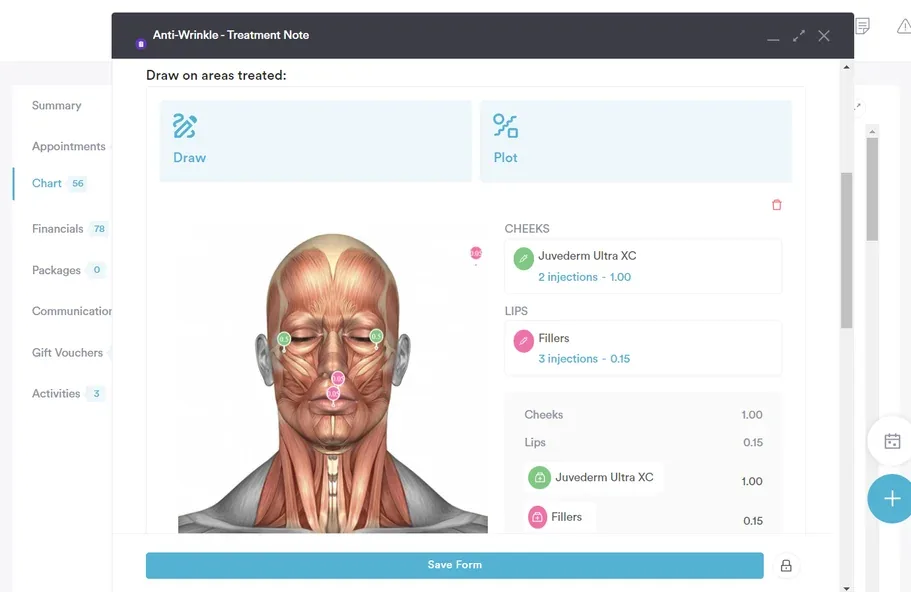
Pabau’s practice management platform brings these workflows into one place. The private insurance claims management tools let billing staff track which procedures are pre-authorised and attach supporting clinical documents to the claim. Missing fields are flagged before submission. Operative notes created in Pabau can be structured to capture laterality, surgical approach, and pre-operative diagnosis before the note is signed off.
Pabau also keeps an audit trail across the claim lifecycle. For practices billing a mix of ENT codes, it shows whether denials cluster around one code, documentation step, or insurer. That makes it easier to fix patterns rather than individual claims.

Pabau helps private ENT practices manage CCSD coding, pre-authorisation tracking, and clinical documentation in one place, reducing E1440 claim denials before they happen.

E1440 claims succeed or fail on the operative note, not on the diagnosis. A note that names the antral route and the side treated makes the code defensible. Without both, an assessor can recode the claim as endoscopic surgery or hold it for review.
Settle the bilateral question before surgery, because insurer conventions differ and a new schedule edition can change them. Confirming it up front costs one portal check. Correcting it after a denial costs a resubmission and a delayed payment.
Pabau keeps the operative note, the pre-auth status, and the claim in one patient record, so each check happens before submission. Book a demo to see how that works in a private ENT billing workflow.

Need to understand the broader CCSD framework? Bupa CCSD codes guide explains how private insurers use the CCSD schedule for procedure billing in UK private practice.
Billing the endoscopic version instead? CCSD code E1432 covers bilateral FESS, the approach that has largely replaced transantral surgery.
Was the image-guided system used? CCSD code E1260 explains billing for image-guided endoscopic frontal, sphenoid and ethmoid sinus surgery.
Was the ethmoid reached through an external incision? CCSD code E1410 walks through external frontoethmoidectomy and the documentation its claims turn on.
Coding open frontal sinus surgery? CCSD code E1450 covers the bone flap approach to the frontal sinus, another code in the nasal sinuses section.
CCSD code E1440 covers transantral ethmoidectomy, a surgical procedure in which the ethmoid sinuses are accessed and cleared through the maxillary antrum rather than endoscopically. The descriptor includes both unilateral and bilateral performance within the same code.
The billing convention for bilateral E1440 claims varies by insurer and CCSD schedule edition. Some insurers accept one line item with a bilateral indicator. Others require two units. Check the current provider billing guide and confirm with the insurer before submitting a bilateral claim, so it isn’t denied automatically.
The access route determines the code. Transantral ethmoidectomy (E1440) reaches the ethmoid sinuses through the maxillary antrum via an antrostomy. Endoscopic ethmoidectomy (FESS) reaches them through the nostril using an endoscope. The operative note must clearly state which approach was used, because coding a FESS under E1440 is miscoding and grounds for denial.
Most UK private insurers require an ENT consultant outpatient letter and CT sinus imaging confirming the extent of disease. They also want evidence that medical therapy (antibiotics and nasal corticosteroids) was tried and failed. Submit all of it with the pre-auth request to avoid information delays. Requirements vary by insurer, so always check the current provider portal.
Septoplasty and turbinate reduction codes are commonly co-billed with E1440, because they address separate anatomical sites. Caldwell-Luc and standalone antrostomy codes require care. An antrostomy that serves as the access route for E1440 is bundled into E1440 and cannot be billed separately. Verify current CCSD schedule bundling notes for any multi-code submission.
The anaesthetist bills independently using their own CCSD anaesthesia codes, and the ENT surgeon does not include a separate anaesthesia code. UK private insurers use either time-based or flat-rate anaesthetic fee conventions, depending on the insurer. The anaesthetist should confirm the applicable model with the insurer’s provider portal before billing.