CCSD code H4430: Examination of rectum under anaesthetic
CCSD code H4430 pays for the examination alone CCSD code H4430 is the UK private...

Last Updated: Oct 20, 2026
B0100 is the CCSD code for open hypophysectomy (including total). It covers partial or complete removal of the pituitary gland through a craniotomy, most often a subfrontal transcranial approach.
Transsphenoidal and endoscopic pituitary surgery carries a separate CCSD code. UK private insurers expect pre-authorization before surgery and an operative note that confirms the open approach and the extent of resection.
Let Pabau's smart automation suggest the right codes, reduce claim denials, and keep your practice compliant—effortlessly.
Automate repetitive tasks and focus on what matters most—your patients.
Reduce coding errors and ensure compliance with the latest regulations.
Clean claims, fewer denials, and faster reimbursements.
Powerful insights and reporting to help your practice thrive.
HIPAA compliant SOC 2 certified GDPR-compliant Trusted by 4,000+ clinics worldwide

CCSD code B0100 covers open hypophysectomy, including total hypophysectomy, performed through a transcranial surgical approach.
Open (craniotomy) and transsphenoidal (endoscopic) approaches carry different CCSD codes, so the operative note must confirm the approach used.
UK private insurers typically require pre-authorization before B0100 is performed, and a missing reference is the most common denial trigger.
Pair B0100 with ICD-10 codes D35.2, E22.0 or E24.0, depending on the clinical indication documented.
CCSD code B0100 is the official CCSD procedure code for open hypophysectomy, including total hypophysectomy. “Open” here means a transcranial surgical approach, most commonly a subfrontal craniotomy, through which the surgeon reaches the sella turcica and the pituitary gland directly.
Endoscopic and transsphenoidal routes carry a separate code. The descriptor “including total” confirms that B0100 applies whether the surgeon removes part or all of the gland, provided the open approach is used throughout.
Within the CCSD schedule, B0100 sits in chapter 2, which covers the brain, cranium and other intracranial organs. Coders working across NHS and private systems may cross-reference OPCS-4 category B01 (excision of pituitary gland) when reviewing operative documentation. For private healthcare claims, CCSD B0100 is still the code to submit.
Descriptors and chapter allocations are updated periodically, so check each code against the current edition of the schedule. Our CCSD code library collects billing guides for the neighboring procedures in one place.
Open hypophysectomy reaches the pituitary via a craniotomy rather than through the nasal passages. The surgeon elevates a bone flap, retracts the frontal lobe, and approaches the sellar region from above or in front. Once the sella turcica is exposed, the gland or tumor is resected under direct vision.
Surgeons choose this approach when tumor anatomy, size, or prior failed transsphenoidal surgery makes a skull-base route the safer or only option.
The operative note must make the approach unambiguous. It should document the craniotomy, the subfrontal or transcranial corridor, sella turcica exposure from above, and the extent of resection. Those four details separate open hypophysectomy from a transsphenoidal procedure.
A note that does not specify the surgical corridor cannot reliably support a B0100 claim. It may instead prompt a payer to ask whether a lower-value transsphenoidal code should have been used.
The primary indication for open hypophysectomy is a pituitary macroadenoma with suprasellar extension that cannot safely be reached transsphenoidally. According to the NHS clinical coding guidance, the clinical indication must be clearly documented in the referral and operative record for private insurance purposes.
Each of these indications maps to a specific ICD-10 code. The insurer will check that the diagnosis code on the claim is consistent with a clinical need for open (rather than endoscopic) pituitary surgery.
When Cushing’s disease stays active after failed pituitary surgery, the next step is often removal of both adrenal glands. That rescue procedure takes B2223 when the surgeon works laparoscopically, and the earlier operative note belongs in the pre-authorization request.
The most common coding error on pituitary surgery claims is applying the wrong approach code. Open and transsphenoidal hypophysectomy are not interchangeable under the CCSD schedule. The table below summarizes the key distinctions for billing purposes.
Suppose the operative note records a transsphenoidal or endoscopic approach, but the claim uses B0100. The insurer will likely reject it for an incorrect procedure code. Always verify the approach documentation before selecting the code.
Yes. The official CCSD descriptor for B0100 explicitly states “open hypophysectomy (including total).” Total hypophysectomy, meaning complete surgical removal of the pituitary gland, falls within the scope of this single code. Billing teams do not need a separate code to reflect a total resection when the open approach is used.
However, the operative note must document the extent of resection. Insurers may request it during pre-authorization review or when the claim arrives.
A note that says only “hypophysectomy performed” confirms neither the extent of resection nor the open approach. That leaves the claim exposed to a documentation denial. Record how much of the gland was removed, any residual tissue deliberately left, and the reasoning where relevant.
B0100 shares CCSD chapter 2 with other intracranial procedure codes, such as B0610 for excision of the pineal gland. Coders moving from NHS to private practice coding sometimes find the adjacent codes in this chapter confusing. The table below covers the codes most often confused with B0100.
When in doubt, verify against the current CCSD schedule. The code descriptor, not the surgical approach alone, determines correct code selection.
UK private insurers expect each procedural claim to carry a corresponding ICD-10 diagnosis code that supports the medical necessity of the procedure. For B0100, the diagnosis code should reflect the confirmed pituitary pathology. The table below lists the ICD-10 codes most often used alongside B0100.
Verify each one against the current NHS Digital ICD-10 fifth edition release before submission, as codes are updated annually.
Submit the most specific code supported by the clinical documentation. Avoid D35.2 if a functional diagnosis such as E22.0 or E24.0 has been confirmed, since functional adenomas affect medical necessity arguments and pre-authorization approval.
Open hypophysectomy is a major elective neurosurgical procedure. UK private insurers require pre-authorization before the surgery takes place. Submitting a B0100 claim without a valid pre-authorization reference is the single most common denial reason for this code. Consult our Bupa CCSD code guide for insurer-specific submission steps alongside this general framework.
Pre-authorization requirements vary by insurer and policy, but major UK payers typically require the following bundle of evidence. Always verify current requirements directly with each insurer before submission.
Bupa, AXA Health, Aviva, and Vitality Health each have their own authorization portals and submission timelines. Check the Bupa code search portal and the Aviva fee schedule for procedure-specific pre-authorization policies. Pre-authorization does not guarantee claim payment, but its absence guarantees denial.
Request pre-authorization as soon as the surgical date is confirmed rather than after the procedure. Most insurers will not retrospectively approve open hypophysectomy, and a missing pre-auth reference cannot be added to a claim once submitted. Build a pre-auth checklist into your neurosurgery booking workflow so every case has its reference before surgery.
Inadequate operative documentation is the second most common reason for B0100 claim rejections. Billing teams should check each operative note for the elements below before submitting the claim. Building this checklist into the post-operative process means notes are complete before the claim goes out.
A note that uses only “pituitary surgery performed” or “tumor removed” is not sufficient for a B0100 claim. Payers reviewing the claim cannot confirm the open approach, the extent of resection, or the anatomical target without specific language in the operative report.
Open hypophysectomy is performed under general anesthesia and commonly includes intraoperative neuromonitoring. These services are billed separately from B0100 using their own CCSD codes. Billing them correctly prevents bundling edits from the insurer.
Do not add IONM or imaging codes to the surgeon’s claim without confirming that the insurer allows them as unbundled additions to B0100. Bundling rules differ across Bupa, AXA Health, Aviva and other payers. Check each insurer’s current guidance before submitting add-ons, starting with the Bupa fee schedule.
Most B0100 denials fall into a small number of predictable categories. Finding the root cause quickly matters because UK private insurers typically allow a fixed appeal window, often 90 days. After that, the right to appeal lapses. Use private claims management software to track denial reasons, so patterns show up across cases.
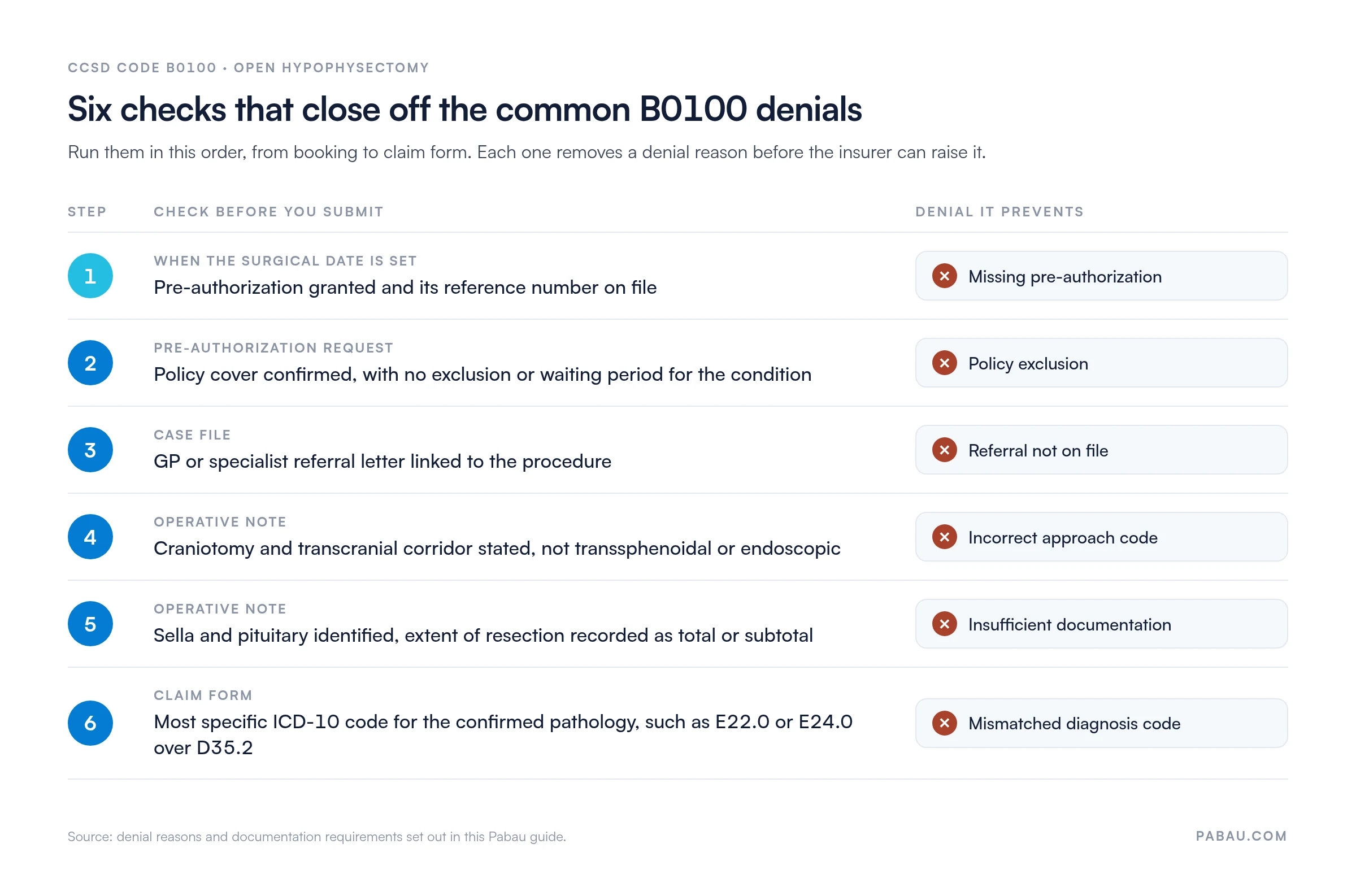
Each of those denial reasons maps to a check your team can run before the claim leaves the practice. The sequence below puts them in order, from the surgical booking to the claim form.
A denial is not a final decision. Most UK private insurers have a formal appeal process, and a clear denial management process keeps each case moving. Work through these steps promptly once a denial arrives.
Keep a copy of every pre-authorization reference number and the date it was granted. Attach this to the surgical booking record so it is immediately available if the claim is queried. A single missing reference number is often all that separates an approved B0100 claim from a lengthy appeal process.
On a B0100 case, the pre-authorization reference, the referral letter and the operative note often sit in three different places. When one falls out of step, the claim goes out without the evidence the insurer asks for.
Pabau, the practice management platform we build, keeps all three on the patient record next to the surgical booking. Your billing team can confirm the reference, the approach and the extent of resection in one view before anyone submits.
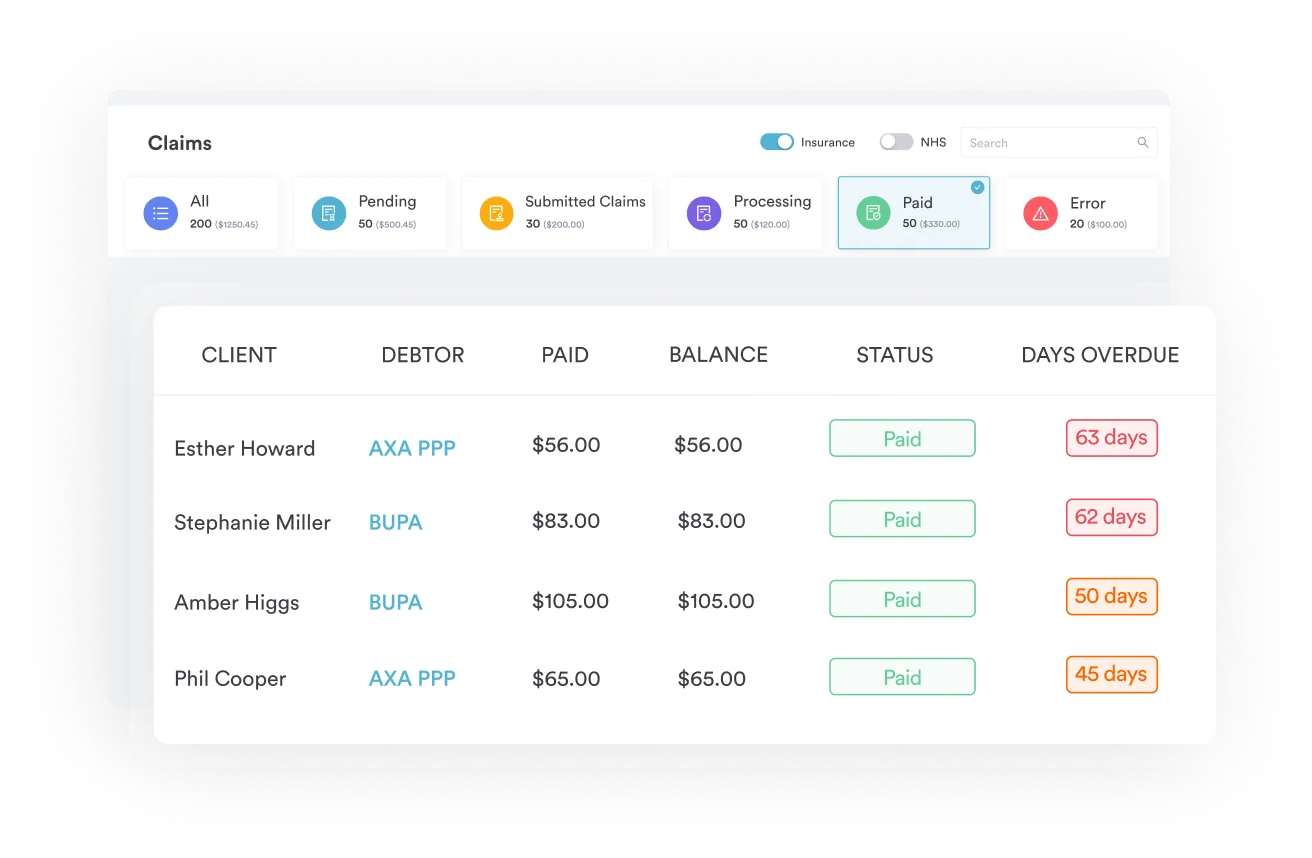
Once the claim is sent, Pabau’s claims management tracks it through pending, processing and paid. A rejected claim shows up as an error straight away, so your team can start the appeal while the window is still open.

Pabau keeps pre-authorization references, referral letters and operative notes on the patient record, then tracks each CCSD claim through to payment.

Most B0100 claims are decided before the patient reaches theater. Secure the pre-authorization reference as soon as the date is set. Then ask the surgeon to name the craniotomy and the extent of resection in the operative note.
That adds a few minutes of admin at booking. Skipping it tends to cost far more later, because an appeal needs a full evidence bundle and runs against a deadline.
Book a demo to see how Pabau keeps pre-authorization references and operative notes together for every B0100 claim.

Is the pituitary being reached through the nose instead? CCSD code B0410 covers transsphenoidal hypophysectomy, the code to use when no craniotomy is performed.
Billing a return to the operating room after open pituitary surgery? CCSD code A4080 covers a craniotomy to treat bleeding after an earlier operation.
Coding the workup for a growth hormone-secreting adenoma? CCSD code 0014B covers the acromegaly tolerance test that often confirms the diagnosis before surgery.
Working on other craniotomy claims? CCSD code A3200 explains how the craniotomy approach decides the code for cranial nerve decompression.
CCSD code B0100 covers open hypophysectomy, including total hypophysectomy, performed via a transcranial or craniotomy approach. It does not cover transsphenoidal or endoscopic pituitary surgery, which carries a separate CCSD code.
Open hypophysectomy (B0100) requires a craniotomy and transcranial surgical corridor. Transsphenoidal hypophysectomy uses a nasal or sphenoidal route without a craniotomy and is billed under a different CCSD code. The operative note must confirm the approach, and billing the wrong code is a common denial trigger.
Yes. The descriptor “including total” is part of the B0100 code definition. Total (complete) hypophysectomy via the open approach falls within the scope of this single code. No additional code is needed to reflect total resection.
The most commonly paired codes are D35.2 (benign neoplasm of pituitary gland), E22.0 (acromegaly), E24.0 (Cushing’s syndrome, pituitary-dependent), and E22.1 (hyperprolactinaemia). Use the most specific code supported by the confirmed histopathological or biochemical diagnosis.
Yes, in practice all major UK private insurers including Bupa, AXA Health, Aviva, and Vitality Health require pre-authorization before open hypophysectomy is performed. Submitting a claim without a valid pre-authorization reference is the most common denial reason for this code. Verify current requirements with each insurer, as policies are updated periodically.
The most frequent denial reasons are missing pre-authorization, an incorrect approach code (transsphenoidal billed as open), insufficient operative documentation, and a mismatched ICD-10 diagnosis code. Most are preventable with a pre-submission documentation checklist.