CCSD code H4430: Examination of rectum under anaesthetic
CCSD code H4430 pays for the examination alone CCSD code H4430 is the UK private...

Last Updated: Oct 20, 2026
A3200 is the CCSD code for decompression of a cranial nerve through a craniotomy. It is most often billed for microvascular decompression (MVD) in trigeminal neuralgia or hemifacial spasm. The surgeon opens the skull and separates a compressing blood vessel from the nerve root.
The code turns on the approach. Percutaneous, radiosurgical and other non-craniotomy treatments of the same nerves are not coded A3200. UK private insurers expect pre-authorisation before the operation and an operative note that confirms the craniotomy.
Let Pabau's smart automation suggest the right codes, reduce claim denials, and keep your practice compliant—effortlessly.
Automate repetitive tasks and focus on what matters most—your patients.
Reduce coding errors and ensure compliance with the latest regulations.
Clean claims, fewer denials, and faster reimbursements.
Powerful insights and reporting to help your practice thrive.
HIPAA compliant SOC 2 certified GDPR-compliant Trusted by 4,000+ clinics worldwide

A3200 covers cranial nerve decompression through a craniotomy. Percutaneous and radiosurgical treatments of the same nerves are billed under other CCSD codes.
Trigeminal neuralgia (ICD-10 G50.0) is the most common supported diagnosis. Hemifacial spasm (G51.3) and glossopharyngeal neuralgia (G52.1) also qualify.
All major UK private medical insurers (PMIs), including Bupa, AXA Health, Aviva and Vitality, require pre-authorisation before A3200 is performed. A missing pre-authorisation number is the leading denial trigger.
The operative note must state that a craniotomy was performed, or a reviewer cannot confirm A3200 and may pend the claim.
Pabau’s practice management software supports CCSD code entry and claim submission workflows for UK private neurosurgery practices.
CCSD code A3200 covers decompression of a cranial nerve performed via craniotomy. For a procedure to fall under this code, the surgeon must open access through the skull. According to the CCSD schedule, the official descriptor is “Decompression of cranial nerve (craniotomy)”. That wording draws a hard boundary. Any treatment of the nerve without a craniotomy, whether percutaneous, stereotactic or radiosurgical, is coded differently.
The code is used in private healthcare billing by consultant neurosurgeons operating in independent hospitals and private wings of NHS Trusts across the UK. It maps to the most technically demanding end of cranial nerve surgery. The operation requires general anaesthesia, an overnight hospital stay and, in most centers, intraoperative neurophysiological monitoring. Billing staff unfamiliar with neurosurgery will encounter A3200 most often as the primary procedure code on invoices from centers performing microvascular decompression (MVD).
Understanding the surgical steps matters for coding because A3200 is defined by approach. A procedure that achieves the same clinical endpoint by a different route is not coded A3200. Balloon compression of the trigeminal ganglion, glycerol rhizotomy and radiosurgery are all examples.
The standard technique for most A3200 cases is microvascular decompression (MVD), also called the Jannetta procedure. The operative sequence runs as follows:
Not every A3200 case is MVD. Other cranial nerve decompressions via posterior fossa craniotomy also fall under this code, provided the approach is craniotomy-based. Vestibular nerve decompression for vestibular paroxysmia, where a vessel compresses cranial nerve VIII, is one example. The key coding question is always: Was a craniotomy performed?
A3200 is not restricted to a single diagnosis. This code may apply to any condition in which a blood vessel (or other structure) compresses a cranial nerve. The surgical solution must be a posterior fossa craniotomy. The table below lists the principal supported diagnoses with their ICD-10 equivalents, as used in UK private practice documentation.
Insurers will match the diagnosis code on the claim against the procedure code. G50.0 paired with A3200 is a well-established combination that major payers recognize. G51.3 and G52.1 are less common and may attract clinical review requests, particularly if conservative treatment history is not clearly documented.
Of all the CCSD codes, A3200 is the only one for cranial nerve decompression. There is no separate code for a non-craniotomy approach, and published insurer schedules run straight from A3000 to A3200, then on to A3300. The codes on either side cover different operations on the same nerves. Picking one of them in error leaves a claim that no longer matches the operative note.
CCSD does not split A3200 by nerve. A trigeminal, facial or glossopharyngeal decompression through a craniotomy bills as A3200, whichever nerve is treated. OPCS-4 separates the same operation by nerve under its A32 subcodes. A hospital record may therefore look more detailed than the CCSD claim, and that is expected. If the operative note does not explicitly record that a craniotomy was performed, a reviewer cannot confirm A3200 and may pend the claim.
Open pituitary surgery rests on the same documentation point. A claim for B0100 needs the operative note to confirm a craniotomy rather than a transsphenoidal route.
Several procedures are frequently confused with A3200 but are never coded under it. They include percutaneous glycerol rhizotomy, balloon compression of the Gasserian ganglion, radiofrequency thermocoagulation, and Gamma Knife radiosurgery. These are minimally invasive or non-invasive and have their own CCSD codes. A3200 does not cover nerve ablation, denervation, or radiosurgical approaches of any kind. The chart below maps each operation to its code.
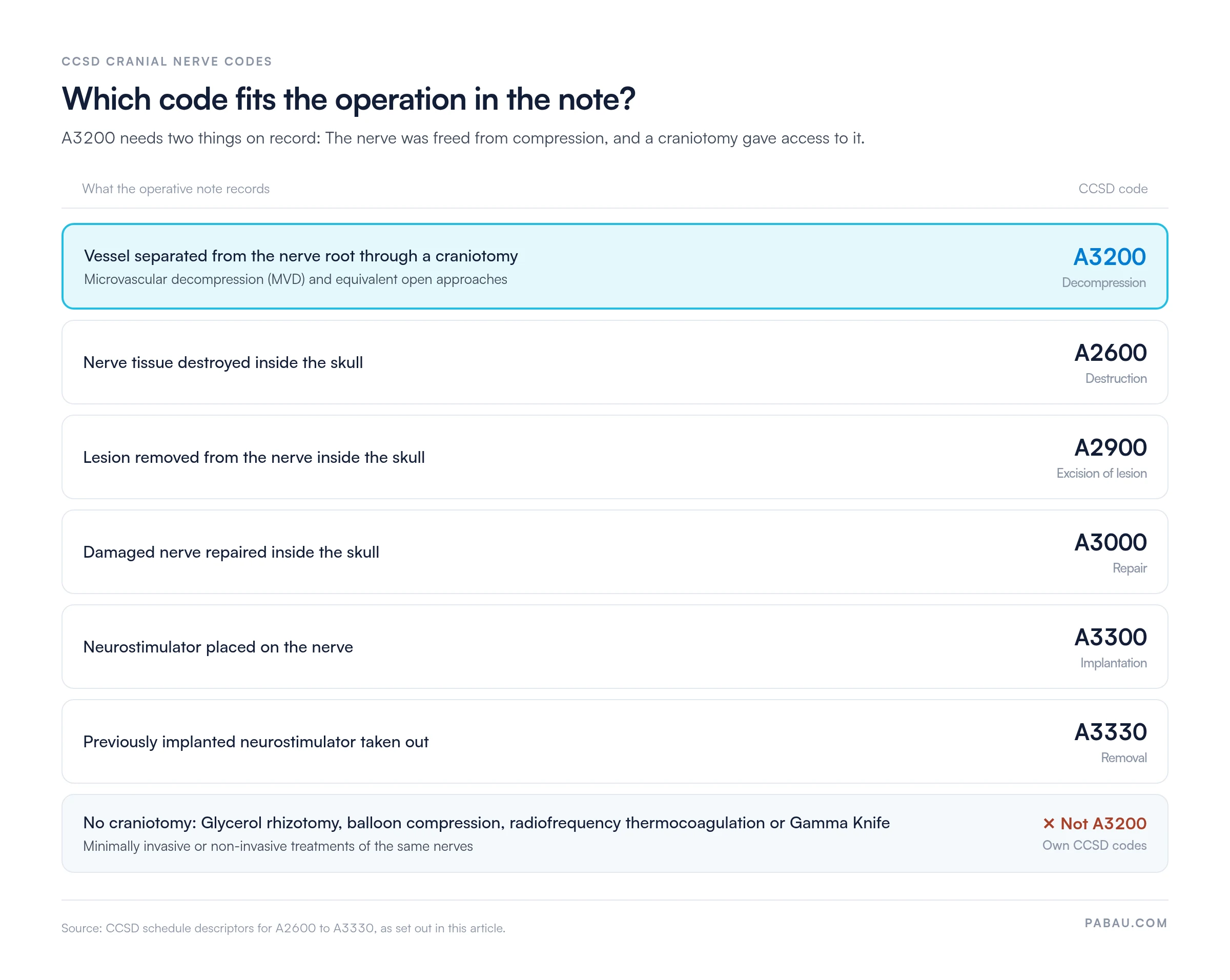
Check the operative note before selecting A3200. The word ‘craniotomy’ must appear. Phrases like ‘small craniectomy’ or ‘keyhole approach’ are ambiguous and may need clarification from the surgical team before submission.
Sound documentation is the most reliable protection against A3200 claim rejection. The operative report and the pre-authorisation trail together form the complete submission record. Maintaining medical billing compliance for neurosurgery requires both to meet insurer standards before the invoice is raised.
The operative report must contain all of the following for the claim to be defensible:
Patient records should also contain evidence that conservative or less invasive management was attempted first, or that it was contraindicated. Major PMIs, particularly Bupa and AXA Health, may request treatment history as part of clinical review for high-value craniotomy claims. Digital clinical records with structured fields for previous treatments, medication trials, and imaging findings make this evidence faster to retrieve at the point of submission.
All elective craniotomy procedures, including A3200, require pre-authorisation from the insurer before they are performed. Submitting a claim for A3200 without a valid pre-authorisation number is the leading cause of rejection across all major UK PMIs. The table below summarizes typical requirements. Always verify them on the insurer’s current provider portal, because policies change regularly.
Turnaround for pre-authorisation decisions on neurosurgical procedures is typically 3 to 10 working days. Complex or high-value cases may trigger a medical officer review that extends the timeline. For urgent cases, most insurers have expedited clinical review pathways. Contact the provider services team directly rather than submitting through the standard portal.
Pre-authorisation covers the procedure, not the total episode. The surgical plan may change intraoperatively and add further procedures. Supplementary authorisation may then be needed before those codes go on the final invoice.
Most A3200 rejections fall into a small number of recurring patterns. Effective denial management for neurosurgery billing starts with recognizing these patterns before submission rather than appealing after the fact.
A3200 covers the surgical procedure only. Anaesthesia, intraoperative neurophysiological monitoring, and hospital stay are billed separately.
Unbundling means splitting a single procedure into component codes to inflate reimbursement. It is a compliance risk in neurosurgery billing. If the primary procedure is A3200, do not also bill a separate craniotomy code for the access component. The craniotomy is integral to A3200 and is included in its fee.
In practice management software, CCSD code A3200 follows a standard submission workflow. The steps below apply whether the software is Pabau, the practice management platform we build, or any other CCSD-capable system.
Bupa publishes its own submission rules and fee limits, and our guide to Bupa CCSD codes walks through them.
In many neurosurgery practices, the pre-authorisation number sits in an email and the operative note sits in the hospital system. The invoice is typed up separately. When an insurer pends an A3200 claim, the billing administrator has to rebuild that trail by hand.
Pabau keeps the invoice on the same patient record as the appointment and clinical notes. Practices can enter CCSD codes directly within the invoicing workflow and attach the pre-authorisation reference to each procedure. They can also monitor claim status from within the platform.
That matters most for consultant neurosurgeons running lean administrative teams, where one billing administrator may manage claims across several insurers. A pended claim can be answered with its evidence already in place, so fewer A3200 invoices age while someone chases paperwork.

Pabau helps UK private practices track pre-authorisation numbers, enter CCSD procedure codes, and submit clean claims. Your billing team spends less time chasing insurers and more time on patient care.

CCSD code A3200 is a high-value procedure code with a narrow, precisely defined scope: Open craniotomy-based decompression of a cranial nerve. Before any A3200 invoice goes out, confirm two details. The operative note must name the craniotomy, and the invoice must carry the pre-authorisation number.
Those two checks prevent the rejections that cost the most time to reverse. A G51.3 or G52.1 claim also needs the conservative treatment history attached before submission, not after a reviewer asks for it.
For UK private neurosurgery practices, a clean A3200 claim and a rejected one usually differ in documentation quality and pre-authorisation discipline. Book a demo to see how Pabau keeps CCSD codes, pre-authorisation references and claim follow-up on one patient record.

Billing Bupa patients for neurosurgery? Bupa CCSD codes and fee schedule guide walks through how CCSD procedure codes are structured and submitted to Bupa.
Operating to repair a damaged cranial nerve? CCSD code A3000 covers intracranial cranial nerve repair and how it differs from decompression.
Destroying nerve tissue rather than freeing it? CCSD code A2600 explains the code for other intracranial destruction of a cranial nerve.
Concerned about private practice billing compliance? Medical billing compliance guidance covers the documentation and process standards that reduce claim risk across specialties.
CCSD code A3200 covers decompression of a cranial nerve performed via craniotomy. In practice, that means open posterior fossa surgery that relieves a neurovascular compression by separating an offending vessel from the nerve root. The code applies only when a craniotomy is performed. Minimally invasive or percutaneous treatments are billed under different CCSD codes.
Yes. Microvascular decompression (MVD), also known as the Jannetta procedure, is the most common procedure billed under CCSD code A3200. MVD uses a posterior fossa (retrosigmoid or suboccipital) craniotomy to access and decompress the affected cranial nerve root. That is precisely the approach the A3200 descriptor requires.
No. A3200 is the only CCSD code for cranial nerve decompression, and published insurer schedules go straight from A3000 to A3200 and then A3300. A decompression through a craniotomy bills as A3200 whichever cranial nerve is treated. Percutaneous and radiosurgical treatments for trigeminal neuralgia are not decompressions, so they are never coded as A3200.
Yes. All major UK private medical insurers require pre-authorisation before an A3200 procedure is performed, including Bupa, AXA Health, Aviva and Vitality Health. Submitting a claim without a valid pre-authorisation reference number is the leading cause of rejection for this code. Obtain authorisation before the admission date, not after.
The three principal supporting ICD-10 codes are G50.0 (trigeminal neuralgia), G51.3 (hemifacial spasm), and G52.1 (glossopharyngeal neuralgia). Vestibular nerve compression cases may use H81.3 or H93.1, though insurer acceptance for this indication varies and clinical review is more likely. Always use the most specific diagnosis code that matches the documented condition.
The most common rejection reasons are a missing pre-authorisation number and an operative note that does not explicitly confirm a craniotomy. Others are an unsupported or generic ICD-10 diagnosis code and no documented conservative treatment history. Less frequently, claims are rejected for unbundling errors where a separate craniotomy access code has been added alongside A3200.
Potentially, but this is insurer-dependent and should not be assumed. Brainstem auditory evoked potential (BAEP) or EMG monitoring during MVD may attract a separate CCSD monitoring code. That applies when a dedicated neurophysiologist is present and records their own report. Verify the applicable fee schedule with each insurer before adding a monitoring code, as some insurers consider this included within A3200.
A3200 sits within Section A (Nervous System) of the CCSD schedule, which covers neurosurgical procedures across cranial and spinal surgery. Within Section A, it belongs to the intracranial cranial nerve codes alongside A2600, A2900, A3000 and A3300. A3200 is the only one of them that covers decompression.