

CCSD code G5100: Bypass of duodenum billing guide
CCSD code G5100 bills a bypass that leaves the duodenum in place CCSD code G5100...

Last Updated: Oct 16, 2026
A4080 is the CCSD code for craniotomy – postoperative haemorrhage, the return-to-theatre operation that evacuates a haematoma after earlier brain surgery. CCSD stands for Clinical Coding and Schedule Development, the group that maintains the procedure schedule UK private medical insurers use. The code applies only when the skull is re-opened or a new craniotomy is made.
A4080 sits in Chapter 2 of the CCSD schedule, section 2.5 Vessels. Burr-hole drainage alone takes a different code, and a bleed managed without surgery takes no procedure code. Every A4080 claim should reference the original craniotomy admission.
Let Pabau's smart automation suggest the right codes, reduce claim denials, and keep your practice compliant—effortlessly.
Automate repetitive tasks and focus on what matters most—your patients.
Reduce coding errors and ensure compliance with the latest regulations.
Clean claims, fewer denials, and faster reimbursements.
Powerful insights and reporting to help your practice thrive.
HIPAA compliant SOC 2 certified GDPR-compliant Trusted by 4,000+ clinics worldwide

CCSD code A4080 covers surgical evacuation of a postoperative intracranial haematoma after a prior craniotomy, not a first-time craniotomy for haemorrhage.
A return to theatre with cranial re-opening or a new craniotomy is required, and burr-hole drainage alone maps to a different CCSD code.
Every A4080 claim must link the haemorrhage episode back to the original craniotomy admission and include a clearly distinct operative note.
Pair A4080 with an ICD-10 code for the haematoma type, plus G97.5 to show its postprocedural origin.
Practice management software like Pabau helps UK private neurosurgery practices structure CCSD submissions, track pre-authorizations, and reduce denials.
CCSD code A4080 is the procedure code for a craniotomy to treat postoperative haemorrhage in UK private healthcare. The CCSD schedule defines it as Craniotomy – postoperative haemorrhage. CCSD stands for Clinical Coding and Schedule Development, the group that publishes and maintains the CCSD schedule.
A4080 sits in Chapter 2 of the schedule, section 2.5 Vessels, within the A40xx block of major cranial procedures. Billing teams can look up the neighboring entries in the CCSD code library.
A4080 can be claimed as a standalone surgical episode. It applies when a patient develops an intracranial haematoma after a craniotomy and returns to theatre for its evacuation. The earlier craniotomy may fall in the same admission or a prior one. The CCSD schedule is revised annually, so check the current descriptor and fee against the live schedule before submission.
That earlier operation keeps its own code on the first claim. A cranial nerve decompression performed through a craniotomy, for example, is billed as A3200.
A4080 applies to one clinical scenario. A haematoma forms after a craniotomy and is evacuated surgically, through a re-craniotomy or by re-opening the original bone flap. The table below sets out the main inclusions and exclusions.
Billing A4080 does not imply the original craniotomy caused the haemorrhage. Postoperative bleeding is a recognized complication of intracranial surgery. The code reflects the surgical work performed, not a statement of liability.
The operative note has to capture each stage an insurer checks against an A4080 claim. Once the decision to return to theatre is made, the procedure runs in six stages.
Document each of these steps in the operative note, because insurers cross-reference the note against the A4080 claim. The Care Quality Commission holds independent hospitals to the same operative documentation standards as any other provider. Missing steps in the note are a common trigger for claim query letters.
The A40xx neurosurgery block contains several codes with overlapping clinical territory. The table below separates A4080 from the codes most often confused with it, per the CCSD technical guide.
Always check A4085 and adjacent descriptors against the current CCSD schedule. Code numbers in the A40xx block are stable, but descriptors are updated annually. Billing A4080 when only burr holes were made is upcoding. It will trigger a denial and can prompt an audit of the practice’s billing history.
The same access test applies to a subdural tap. Percutaneous needle or trocar aspiration of the subdural space is coded A4180, because no bone flap is raised.
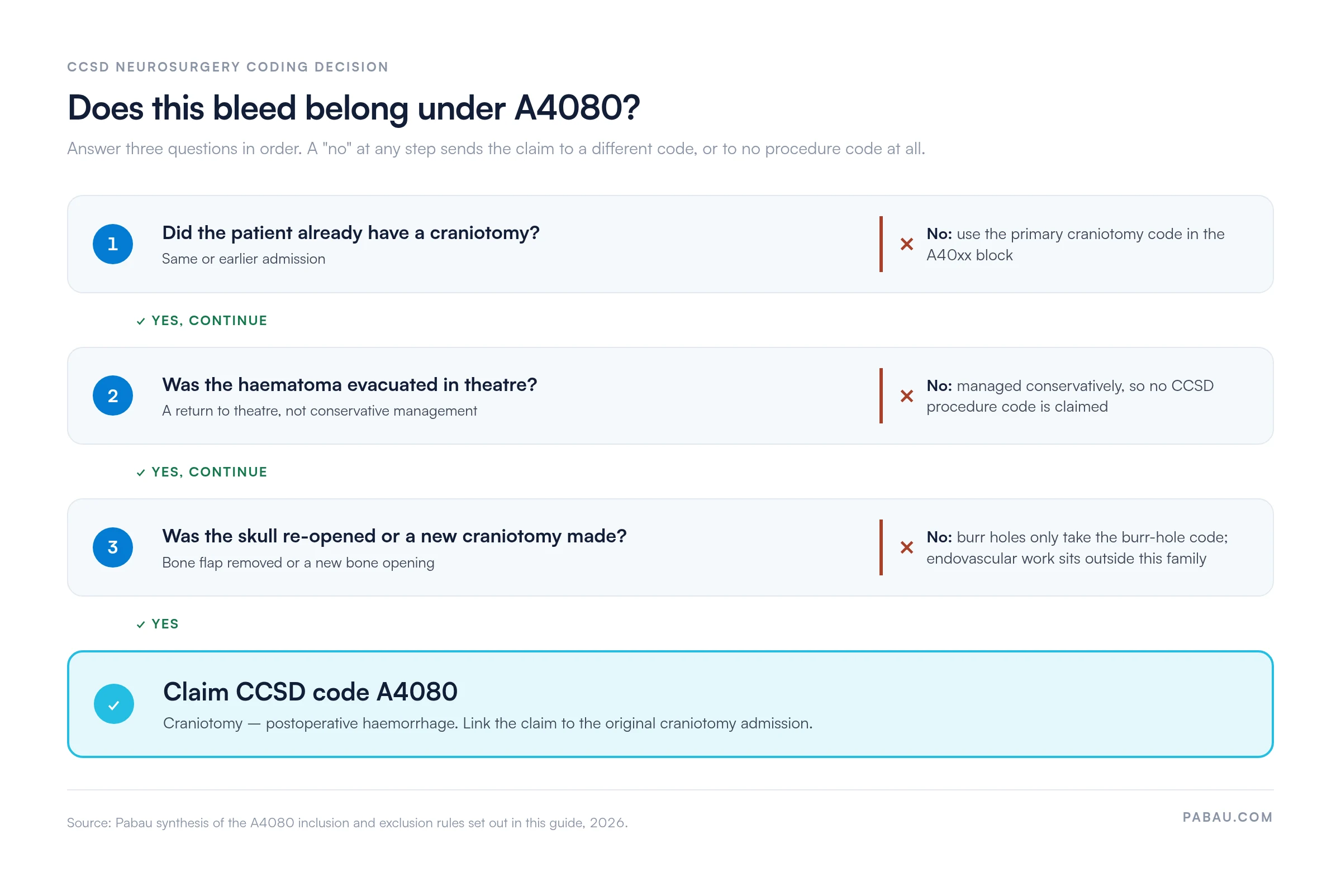
The decision flow below puts the three questions that separate A4080 from these codes in the order a coder should ask them.
Incomplete documentation is the most preventable cause of A4080 claim denial. Confirm each element below before submission.
Keeping operative documentation digital makes it easier to attach every supporting record to the claim at submission, which cuts the back-and-forth that delays payment. For Bupa members, the Bupa fee schedule sets out the evidence Bupa expects alongside CCSD-coded neurosurgery claims.
Before closing the admission record, check five items. The operative note is signed and names the haematoma type. The original surgery is cross-referenced, the pre-authorization number is on file, and imaging reports are attached. A fix before discharge takes minutes, while correcting a denied claim takes days.
A4080 covers the neurosurgeon’s work only. Other CCSD codes can be submitted alongside it, provided each one represents separate work by a different clinician or a separately identifiable service.
Clinicians moving from NHS work into private practice often find neurosurgery co-billing the hardest set of rules to learn. The surgeon’s claim covers only the neurosurgical work. Facility fees, implants, and consumables are the hospital’s responsibility. Patient records that separate each clinician’s contribution support correct unbundling at claim stage.
Insurer guidance on unplanned returns to theatre varies, so confirm requirements with each provider portal before submission. The table below maps the major UK private medical insurers against their general approach to A4080 claims, based on publicly available provider guidance. Policies change without notice, so check current portal documentation too.
For an unplanned, high-acuity procedure like A4080, a short call to the insurer’s provider team before submitting often prevents a denial. Resolving that denial later can take weeks.
A4080 denials follow recognizable patterns. The table below maps the most common denial reasons to their corrective action, drawn from standard UK private billing practice and CCSD coding convention.

UK private insurers increasingly expect an ICD-10 diagnosis code alongside CCSD procedure codes on neurosurgery claims. The NHS Classifications Browser is the authoritative source for checking UK ICD-10 codes. For A4080, the appropriate ICD-10 codes fall into two families, set out below.
For intracranial haemorrhage, the usual convention is to code the type and location of the haematoma alongside the postprocedural complication code. ICD-10 pairings carry clinical specificity requirements. Check sub-code selection against the current NHS ICD-10 edition rather than memory or last year’s lookup. Do not treat any pairing as mandatory without cross-checking current NHS England classification guidance.
When pairing ICD-10 codes with A4080, code the haematoma type first (subdural, extradural, or intracerebral). Then add G97.5 to record its postprocedural origin. An insurer querying the clinical necessity of the return procedure sees both facts at once: The type of bleed and the surgery that preceded it.
An A4080 claim depends on records from two admissions: The original craniotomy and the unplanned return to theatre. In many practices those records sit in separate folders, inboxes, and insurer portals, so the billing team rebuilds the link by hand.
Pabau keeps both episodes on one patient record. The operative note, imaging reports, signed consent, and pre-authorization reference sit together, ready to attach at submission. Pabau’s claims software for surgeons tracks submission dates and flags claims approaching insurer timescales.
The result is fewer query letters on a procedure that already puts the patient and the team under pressure. Your billing team spends its week on new claims instead of chasing denied ones.

Pabau helps private neurosurgery practices manage CCSD claim submissions, track pre-authorization references, and keep operative documentation organized in one place. See how it works for your practice.

An A4080 claim turns on one question: Can the insurer see two separate operations? When the operative note, the episode link, and the imaging all describe the return to theatre on its own terms, the code rarely gets challenged.
The cost is paid at the worst moment. The documentation has to be finished during an emergency admission, while the details are fresh and before any query letter arrives. Build the checklist into your discharge routine now, and the next unplanned return to theatre will bill cleanly.
Book a demo to see how Pabau links return-to-theatre records to the original surgery and keeps A4080 claims moving.

Billing other CCSD neurosurgery codes for Bupa patients? Bupa CCSD procedure codes provides a structured reference to the CCSD codes Bupa recognizes and their submission requirements.
Need guidance on CCSD fee schedules by insurer? Bupa procedure codes and fee schedule covers how Bupa structures its CCSD-based fees for private healthcare procedures.
Evacuating an extradural haematoma instead? CCSD code A4010 explains the extradural evacuation code and how it differs from subdural code A4110.
Coding a brain abscess excision? CCSD code A0180 covers open excision through a craniotomy and the ICD-10 code it pairs with.
CCSD code A4080 covers the surgical evacuation of a postoperative intracranial haematoma after a prior craniotomy. It requires a return to theatre with re-opening or a new craniotomy. It applies to extradural, subdural, and intracerebral haematomas, provided the evacuation uses a craniotomy approach rather than burr holes alone.
Yes, a return to theatre is required. A4080 covers a postoperative haematoma managed surgically, so the patient must undergo a second operation specifically for haematoma evacuation. A haematoma managed conservatively, with no surgical intervention, does not generate an A4080 claim.
A4080 covers postoperative haemorrhage specifically. A4085, where it exists in the A40xx block, covers craniotomy complications of a different nature, such as wound dehiscence or infection requiring cranial re-entry. Check the current descriptor of A4085 in the live CCSD schedule, as adjacent descriptors are updated annually.
No, not for the same operative episode. The original craniotomy is billed at the first admission. A4080 is billed as a separate, subsequent procedure episode. Submitting both codes for the same operation is an unbundling error and will result in denial.
All major UK private medical insurers accept CCSD-coded claims, including A4080. That covers Bupa, AXA Health, Aviva, Vitality, Cigna, and Healix. Each insurer’s pre-authorization and documentation requirements vary. Retrospective notification is typically required for unplanned returns to theatre, so confirm current requirements with each insurer’s provider team before submission.
Five reasons cover most A4080 denials. They are missing pre-authorization, an operative note that does not distinguish the second episode, and burr-hole drainage coded as A4080. An absent or mismatched ICD-10 code and a late submission complete the list. Each has a documented corrective pathway through the insurer’s appeals process.
An A4080 claim needs a distinct operative note describing the haematoma type, evacuation approach, and haemostasis achieved. It also needs a reference linking the episode to the original craniotomy admission, plus the pre-authorization number or retrospective authorization record. Add the imaging reports confirming the haematoma and a signed consent form or best-interests decision record.



