CCSD code H4430: Examination of rectum under anaesthetic
CCSD code H4430 pays for the examination alone CCSD code H4430 is the UK private...

Last Updated: Oct 20, 2026
AA609 is the CCSD code for peripheral bone density measurement performed by a physician. It covers a reading the consultant takes personally at a limb site, such as the heel, wrist or finger. A central DXA scan of the hip and spine is a different service.
AA609 sits in chapter 16, for bones, joints and connective tissue, and Bupa grades it Minor. Despite the AA prefix, it isn't an anesthesia code and carries no anesthetist fee. H3 pays up to £84, but some insurer schedules don't list it, so confirm the code first.
Let Pabau's smart automation suggest the right codes, reduce claim denials, and keep your practice compliant—effortlessly.
Automate repetitive tasks and focus on what matters most—your patients.
Reduce coding errors and ensure compliance with the latest regulations.
Clean claims, fewer denials, and faster reimbursements.
Powerful insights and reporting to help your practice thrive.
HIPAA compliant SOC 2 certified GDPR-compliant Trusted by 4,000+ clinics worldwide

CCSD code AA609 covers peripheral bone density measurement performed by a physician, and the consultant who takes the reading bills it.
The AA prefix doesn’t mean anesthesia. AA codes were created by the CCSD Group and appear across unrelated specialties.
No anesthetist bills for AA609. Neither the H3 nor the Bupa schedule lists an anesthetic fee or category for it.
H3 Insurance pays a maximum of £84 for AA609, and Bupa’s schedule grades it Minor for both the surgeon and the hospital.
Bupa’s online code search and Freedom’s May 2026 schedule don’t list AA609, so confirm the code with the insurer first.
Pabau, the practice management platform we build, pre-fills the claim from the patient record and holds it back until required fields are complete.
CCSD code AA609 is the Clinical Coding and Schedule Development (CCSD) procedure code for a physician-performed peripheral bone density measurement. The descriptor reads “Peripheral bone density measurement performed by physician.” UK private medical insurers use it for a reading taken at a limb site, such as the heel or wrist. A central DXA scan of the hip and spine is a different service.
Both the H3 Insurance and Bupa schedules place it in the chapter for bones, joints and connective tissue/tendon muscle. They differ on the section beneath it. H3 lists it under Connective Tissue / Tendon Muscle, while Bupa lists it under Bone (Non-Specific).
The code describes a measurement a consultant takes personally during an outpatient appointment. The words “performed by physician” matter, because the consultant billing AA609 must be the one who performed it.
The AA prefix marks a code the CCSD Group created for its own schedule. It doesn’t mark an anesthesia code, and the schedule has no AA series of anesthetic services.
Most CCSD procedure codes follow a pattern. The CCSD Technical Guide explains that each code has five characters, usually a letter followed by four numbers. The letter tells you which chapter the code sits in.
Chapter 16, for bones, joints and connective tissue, uses codes that start with T or W for its procedures, such as W8782. AA609 sits in that chapter anyway, so its prefix tells you nothing about where it belongs. Other AA codes show how wide the spread is:
Anesthetists don’t bill an AA code of their own. When a procedure needs an anesthetic, they bill against the surgeon’s procedure code, and the insurer pays a separate anesthetist fee. AA609 needs no anesthetic, so neither schedule sets an anesthetist fee for it.
A peripheral measurement assesses bone at a limb site, such as the heel, wrist or finger. Common methods are peripheral DXA and quantitative ultrasound, usually on a small device used in the consulting room.
Central DXA of the hip and spine remains the diagnostic standard. The 2024 UK clinical guideline from the National Osteoporosis Guideline Group (NOGG) bases diagnosis on central DXA, with the femoral neck as the reference site. It doesn’t recommend quantitative ultrasound for diagnosing osteoporosis.
A peripheral reading therefore rarely settles the diagnosis alone. It helps the consultant decide who needs a central scan, and that shapes how the claim is billed:
Insurer schedules disagree on AA609, and some leave it out. The table sets out what each source showed when we checked in September 2026.
H3’s £84 is a benefit maximum. Its guidance notes say the published prices are the most it will pay for each procedure. Where a practice charges more, the patient pays the shortfall, so tell them before the test. Our patient self-pay guide covers how to quote and collect that balance.
Bupa insures many UK private patients, so its missing listing affects the most claims. Our guide to Bupa CCSD codes explains how Bupa applies the schedule and handles codes it doesn’t list.
Before the first appointment, ask the insurer two questions in writing. Does the policy cover a peripheral bone density measurement, and which code should the consultant bill? Save the reply on the patient record, so the answer is there when the claim goes out.
Every PMI claim for AA609 needs an ICD-10 diagnosis code. UK insurers use the WHO ICD-10 classification. Code the condition or risk that prompted the measurement, as the consultation note records it.
Avoid an unspecified code, such as M81.9, where the notes name the type of osteoporosis. Check every code against the current NHS Classifications Browser release before you submit.
Insurers may ask for the consultation note at audit or after a query. If the note doesn’t support the code, the claim can be reversed. For AA609, it has to show that a physician took a peripheral reading, not a central scan.

AA609 produces one professional invoice, from the physician who took the reading. There is no anesthetist invoice to align with it. Three checks decide whether a reading can go out as AA609 at all.
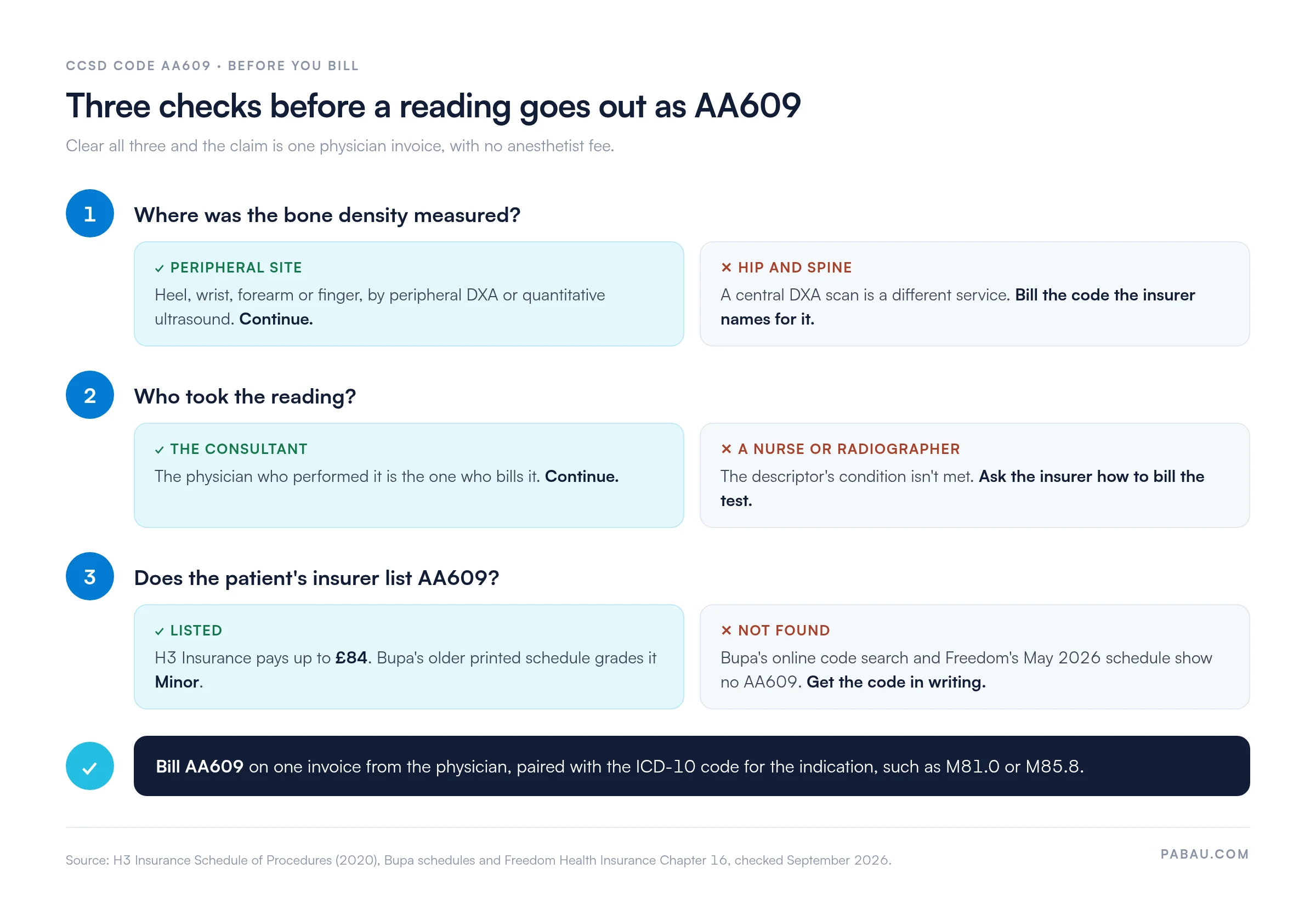
H3 also asks for your H3 registration number on every invoice. Check each insurer’s provider terms for its own deadline and invoice fields, since they differ between payers.
Many AA609 problems trace back to the code itself. It gets mistaken for anesthesia, confused with a central scan, or sent to an insurer that doesn’t list it. The table pairs each common cause with its fix.
An AA609 claim is a small invoice, but a rejected one takes as long to chase as a large one. Keying the same patient and policy details into each insurer’s route by hand adds that risk to every claim.
Pabau’s claims management software submits claims to Healthcode from inside the practice’s own system. It pre-fills each submission with the patient, treatment and insurer details held on the patient record, so nobody types them twice.
Before a claim goes out, Pabau checks that required details, such as the membership number and authorization code, are in place. If one is missing, the claim can’t be sent until someone adds it, so the error is fixed before the insurer sees it.

Pabau pre-fills Healthcode claims from the patient record and checks required details, such as membership numbers, before any claim can be sent.

AA609 looks like an anesthesia code, and that misreading is where the errors on it start. Read it by its descriptor instead: a peripheral bone density measurement, performed and billed by one physician, with no anesthetist fee.
The harder question is whether the insurer will pay it at all. H3 lists it at £84, but Bupa’s online search and Freedom’s current schedule don’t include it. Settle the code in writing before the appointment, and the claim has little left to go wrong.
Book a demo to see how Pabau sends complete AA609 claims, from the patient record to payment.

Billing another procedure from the bones and joints chapter? CCSD code W8782 explains how to bill a flexible arthroscopy.
Looking for the Bupa fee schedule? Bupa procedure codes and fee schedule explains how Bupa reimburses CCSD-coded procedures.
Comparing billing systems for a UK private practice? Best medical billing software in the UK compares billing platforms built for UK private practices.
CCSD code AA609 covers peripheral bone density measurement performed by a physician. It applies to a reading at a limb site, such as the heel or wrist, not a central DXA scan of the hip and spine.
No, AA609 is a bone density measurement code. The AA prefix marks codes the CCSD Group created itself, across many specialties. Neither the H3 nor the Bupa schedule lists an anesthetist fee for it.
H3 Insurance’s schedule sets a maximum procedure fee of £84, with no anesthetic fee. Other insurers set their own rates, and some don’t list the code, so check each insurer’s schedule.
No. The AA609 descriptor specifies a peripheral measurement. A hip and spine DXA scan is a different service, so bill it under the code the insurer names for it.
No. Bupa’s online code search returned no result for AA609 in September 2026, and Freedom’s May 2026 bones chapter has no AA609 line. Confirm the code in writing before the appointment.
Pair AA609 with the indication in the consultation note. Common choices are M81.0 for postmenopausal osteoporosis, M81.4 for drug-induced osteoporosis and M85.8 for osteopenia.