CCSD code H4430: Examination of rectum under anaesthetic
CCSD code H4430 pays for the examination alone CCSD code H4430 is the UK private...

Last Updated: Oct 20, 2026
V2710 is the HCPCS Level II code for slab off prism, glass or plastic, per lens. It covers a bicentric grind that adds base-up prism to the reading area of one multifocal lens, billed with an RT or LT modifier.
Practices use it for anisometropic patients who feel vertical imbalance when reading through the segment. It is an add-on to the base lens code. Medicare pays only when that lens is covered for aphakia or pseudophakia.
Let Pabau's smart automation suggest the right codes, reduce claim denials, and keep your practice compliant—effortlessly.
Automate repetitive tasks and focus on what matters most—your patients.
Reduce coding errors and ensure compliance with the latest regulations.
Clean claims, fewer denials, and faster reimbursements.
Powerful insights and reporting to help your practice thrive.
HIPAA compliant SOC 2 certified GDPR-compliant Trusted by 4,000+ clinics worldwide

HCPCS code V2710 bills a slab-off prism, a bicentric grind that corrects vertical prism imbalance at near, per spectacle lens.
V2710 is an add-on code, so it always sits beside a base lens code, usually a bifocal or trifocal code from V2200 to V2399.
Slab-off is usually ground on one lens only, the more minus or less plus lens, so most claims carry a single V2710 line.
Medicare pays for V2710 only when the lens it modifies is covered, which limits it to aphakia and pseudophakia.
Anisometropia (H52.31) explains why the slab-off is needed, but it is not a Medicare covered diagnosis on its own.
HCPCS code V2710 is the Level II code for a slab-off prism added to a spectacle lens, billed one unit per lens. It sits in the V2700-V2799 miscellaneous vision section of the HCPCS Level II code set.
The Centers for Medicare and Medicaid Services (CMS) maintains that code set. The official descriptor reads “Slab off prism, glass or plastic, per lens.”
Slab-off, also called bicentric grinding, adds base-up prism to the reading area of one multifocal lens. It offsets the vertical prism a patient with anisometropia meets when both eyes look down to read. Always check the current descriptor on the CMS HCPCS overview page, because CMS releases updates every quarter.
V2710 bills the prism modification alone. The code applies when a lab grinds a slab-off prism into the lower part of a spectacle lens.
Included under V2710:
Excluded from V2710:
The descriptor does not separate ground slab-off from molded reverse slab-off designs. Confirm the payer’s view before billing a reverse slab-off lens as V2710.
V2710 is medically necessary when anisometropia creates enough vertical imbalance at the reading level to cause strain or double vision. Prentice’s rule gives the numbers: Prism equals the distance from the optical center, in centimeters, times the lens power.
Take a patient who wears -1.00 D in the right eye and -4.00 D in the left, in the vertical meridian. Reading 10 mm below the optical centers induces 1 prism diopter base-down on the right and 4 on the left. The slab-off on the left lens removes that 3 prism diopter difference.
The chart should record the vertical power of each lens and the reading depth used for the calculation. That record is what a reviewer uses to separate a medical need from a lab preference.
Slab-off claims go wrong when the prism type, the lens type, or the code family is misread. An accessory or service component billed with another vision code goes on V2797, which never stands alone on a claim. The table sets V2710 against the codes most often billed in its place.
The V2715 choice needs the most care, because both codes describe prism. HCPCS code V2718 is the stick-on alternative, and HCPCS code V2700 covers the balance lens. A lens can carry prescribed prism and a slab-off together, and each is then billed on its own line.
Every V2710 line needs a linked ICD-10-CM code. For Medicare, policy article A52499 lists six covered codes, all for aphakia or pseudophakia. The refractive codes explain the slab-off but do not create coverage.
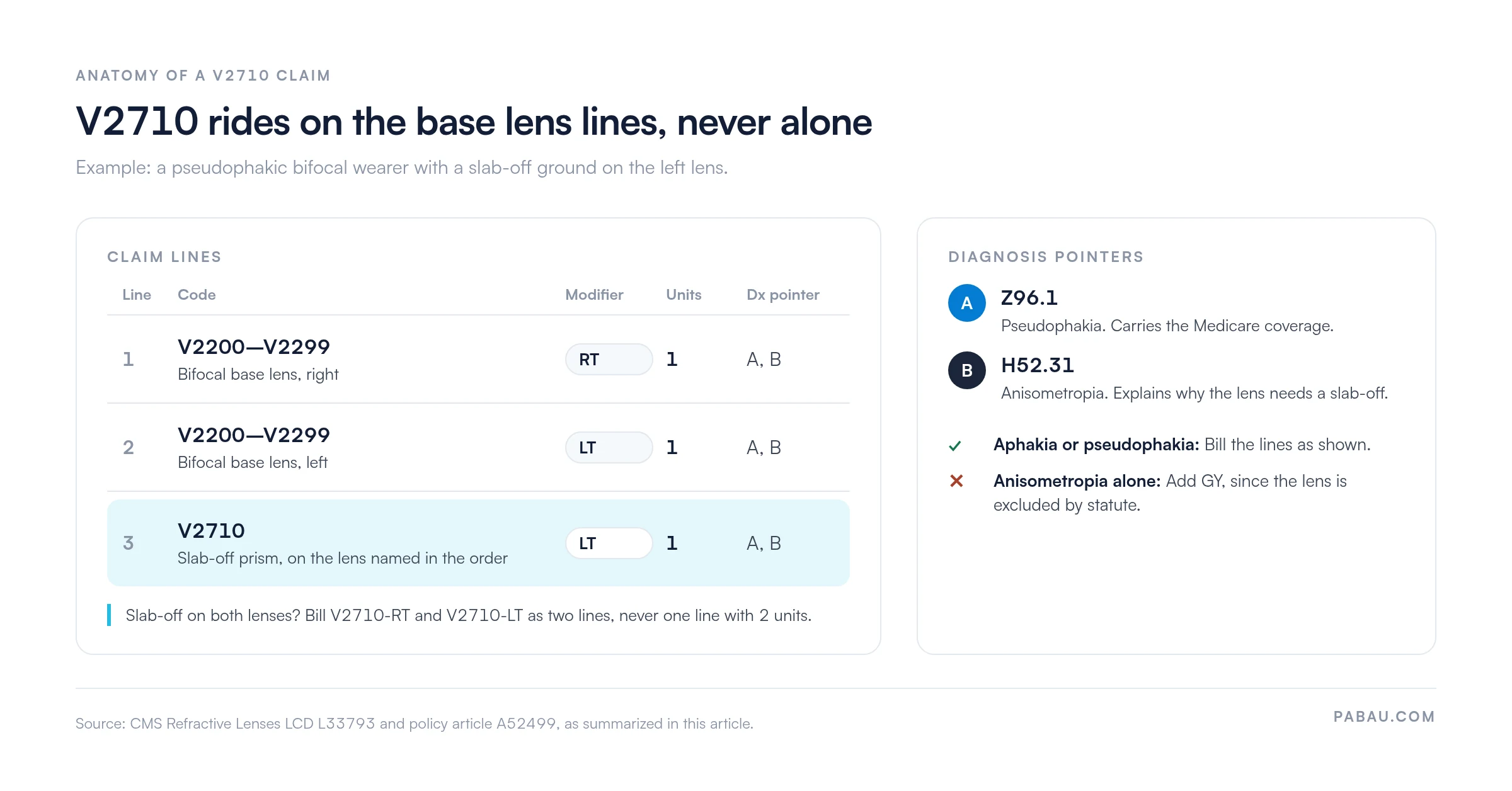
On a Medicare claim for a pseudophakic patient, list Z96.1 first and add H52.31 as a secondary code. Z96.1 carries the coverage, and H52.31 tells the reviewer why the lens needs a slab-off.
Medicare covers refractive lenses under the prosthetic device benefit, and only when they replace a missing natural lens. The Refractive Lenses policy article (A52499) adds the rule that decides every V2710 claim. It states that “there is no coverage for frames or lens add-on codes unless there is a covered lens(es).”
The policy article sets no KX rule for V2710. KX applies only to anti-reflective coating, tints, oversized lenses, and polycarbonate lenses for monocular vision.
Outside Medicare, V2710 is often paid through a vision benefit rather than the medical benefit. Coverage varies by plan and by state, so check each one before the lenses are ordered.
Confirm the benefit before the order goes to the lab, so the patient hears the cost of the slab-off up front.
Policy article A52499 requires RT or LT on every code in the policy except V2020, V2025, and V2600. Because slab-off usually goes on one lens, most claims carry a single V2710 line with one modifier.
When both lenses carry a slab-off, bill two lines, V2710-RT and V2710-LT, each with 1 unit. A single RTLT line with 2 units is rejected as incorrect coding. If the frame also needs an oversize lens, bill V2780 on its own line, one unit per lens, with RT or LT.
Name the slab-off lens on the prescription, not only the prism amount. The lab needs it to grind the right lens, and billing needs it to pick RT or LT. A lab order that names one eye and a claim that names the other is an easy audit finding.
The chart has to show why the slab-off was needed and which lens carries it. Keep these records on file before the claim goes out:
Practices that use a structured superbill workflow capture most of these at the dispensing visit. That shortens the billing cycle and cuts the back-and-forth with payers during review.
V2710 billing comes down to clean line items on the CMS-1500 or the 837P. Follow these steps for each dispensing encounter.
Put together, a Medicare claim for a pseudophakic bifocal wearer with a left-lens slab-off carries three lens lines. Each one points to the same two diagnosis codes.
Our CPT 92340 guide explains the monofocal fitting code and how it sits beside the lens codes on a claim.
Medicare prices V2710 through the DMEPOS fee schedule, which CMS updates quarterly and sets by state. Look up the allowed amount for the jurisdiction and date of service on the claim. A figure quoted in any article, this one included, can be out of date by the next quarter.
Commercial and vision plan rates are set in each contract and often differ from the Medicare schedule. Some plans pay a set allowance for the slab-off, while others treat it as a patient-paid option. Confirm the contracted rate before quoting the patient.
Most V2710 denials trace back to the base lens line or the modifier. Each item below names the cause and the fix.
A denied V2710 line can often still be paid. A correctable error goes back as a resubmission, and a coverage decision goes to appeal.
Structured denial management workflows flag lens add-on denials when they arrive, which shortens the time to resubmission.
Review V2710 denials beside the base lens lines on the same claims. A V2710 denial often follows a base lens denial, so the fix usually sits on the other line.
Slab-off claims draw on three records that rarely sit together. The refraction lives in the exam note, the slab-off lens sits on the lab order, and the delivery receipt sits in a paper file. Billing staff then rebuild the claim by hand and miss a modifier or the base lens line.
Pabau, the practice management and billing platform we build, keeps the prescription, diagnosis codes, and dispensing record in one patient file. Your team builds the claim from that file, with the base lens, V2710, and each modifier on its own line. That gives you cleaner claims management, with each claim tracked from submission to payment.
The result is fewer returned lens lines and a clear patient cost estimate before the order reaches the lab. Your team also spends less time chasing paperwork when an audit request arrives.


Pabau helps eye care practices track HCPCS lens codes, RT and LT modifiers, and diagnosis links in one workflow, so V2710 claims go out clean.

V2710 never stands alone on a claim. It rides on a base lens code, goes on the lens named in the order, and inherits that lens’s coverage.
For Medicare patients, settle the route before the lab grinds the lens. Anisometropia alone does not create coverage, so the claim needs aphakia, pseudophakia, or GY. Book a demo to see how Pabau keeps the prescription, modifiers, and lens lines in one record, so your slab-off claims go out clean.

Trialing a stick-on prism first? HCPCS code V2718 covers the press-on Fresnel prism lens and how to bill it.
Fitting an eye with no useful vision? HCPCS code V2700 explains the balance lens and how it replaces a base lens code.
Coding the bifocal under the slab-off? HCPCS code V2200 covers the low-power spherical bifocal lens code.
Adding a slab-off to a progressive lens? HCPCS code V2781 explains the progressive lens code and how Medicare treats it.
Need a structured approach to claim denials? Denial codes in medical billing explains the CARC and RARC system used across payer types.
HCPCS code V2710 covers a slab-off prism ground into one spectacle lens, billed per lens with an RT or LT modifier. It corrects vertical prism imbalance at near in anisometropic patients who wear multifocals. It is an add-on billed with the base lens code.
Only when the lens it modifies is covered. Medicare covers refractive lenses for aphakia, congenital aphakia, and one pair after each cataract surgery with an intraocular lens. Policy article A52499 allows no coverage for lens add-on codes without a covered lens.
V2710 is a slab-off prism, which corrects only the vertical imbalance induced when a patient reads through the lower part of the lens. V2715 is prescribed prism, per lens, which works at every gaze position.
Usually not. The lab grinds the slab-off on one lens, the more minus or less plus lens in the vertical meridian. Bill one V2710 line with RT or LT to match that lens.
Anisometropia, H52.31, explains why the slab-off is needed. On a Medicare claim it does not create coverage alone, so list the aphakia code or Z96.1 for pseudophakia first.
Every V2710 line needs RT or LT. For Medicare, add GY when the patient has neither aphakia nor pseudophakia, since the lens is statutorily excluded. The policy article sets no KX requirement for V2710.
No. V2710 describes a feature of a spectacle lens made of glass or plastic. Contact lenses have their own codes in the V2500 to V2599 range.