HCPCS Code E0272: Foam rubber mattress billing guide
HCPCS Code E0272: official descriptor and code overview HCPCS Code E0272 is the ...

Last Updated: Nov 6, 2026
CCSD code 0049O is a pathology test code in the UK’s private healthcare billing schedule.
It is the reference a lab or provider puts on an invoice line to bill a private medical insurer for one investigation.
Read the trailing letter correctly and the rest of the code falls into place. It does not mark a rival procedure. In CCSD pathology codes, that letter identifies the specimen the test was run on.
What is not publicly verifiable is the precise clinical descriptor. The schedule entry naming the exact analysis behind 0049 sits behind a registered login. Treat any descriptor you find quoted elsewhere as unconfirmed.
This guide covers what the code type means for billing and what the specimen letter tells you. It also covers which insurers recognize the code, and the checks worth running before you submit.

CCSD code 0049O is a pathology test code in the UK private healthcare billing schedule, not a surgical procedure code.
The letter on the end marks the specimen. CCSD’s technical guide lists O as other body fluid and C as cerebrospinal fluid.
So 0049O and 0049C are not rival procedures. They point at the same 0049 analysis run on a different specimen type.
The exact test descriptor sits behind the CCSD’s registered schedule, so confirm it there or on the insurer’s provider portal.
Bupa, AXA Health, Aviva, Vitality, Cigna, and WPA all recognize CCSD codes, mostly processed through Healthcode.
0049O sits in the CCSD schedule’s Diagnostic Schedule. That half of the schedule covers pathology, imaging, and other investigations. The Procedural Schedule covers surgery, specialist procedures, and consultations instead.
Pathology codes follow their own structure inside that Diagnostic Schedule. CCSD builds them on the NHS National Laboratory Medicine Catalogue, so they read as four digits followed by a specimen letter.
Procedural codes do not look like that. The CCSD technical guide (October 2025) says a procedural code is a letter followed by four numbers, such as B2710 for a radical mastectomy. Investigation and consultation codes run as five numbers with no letter at all.
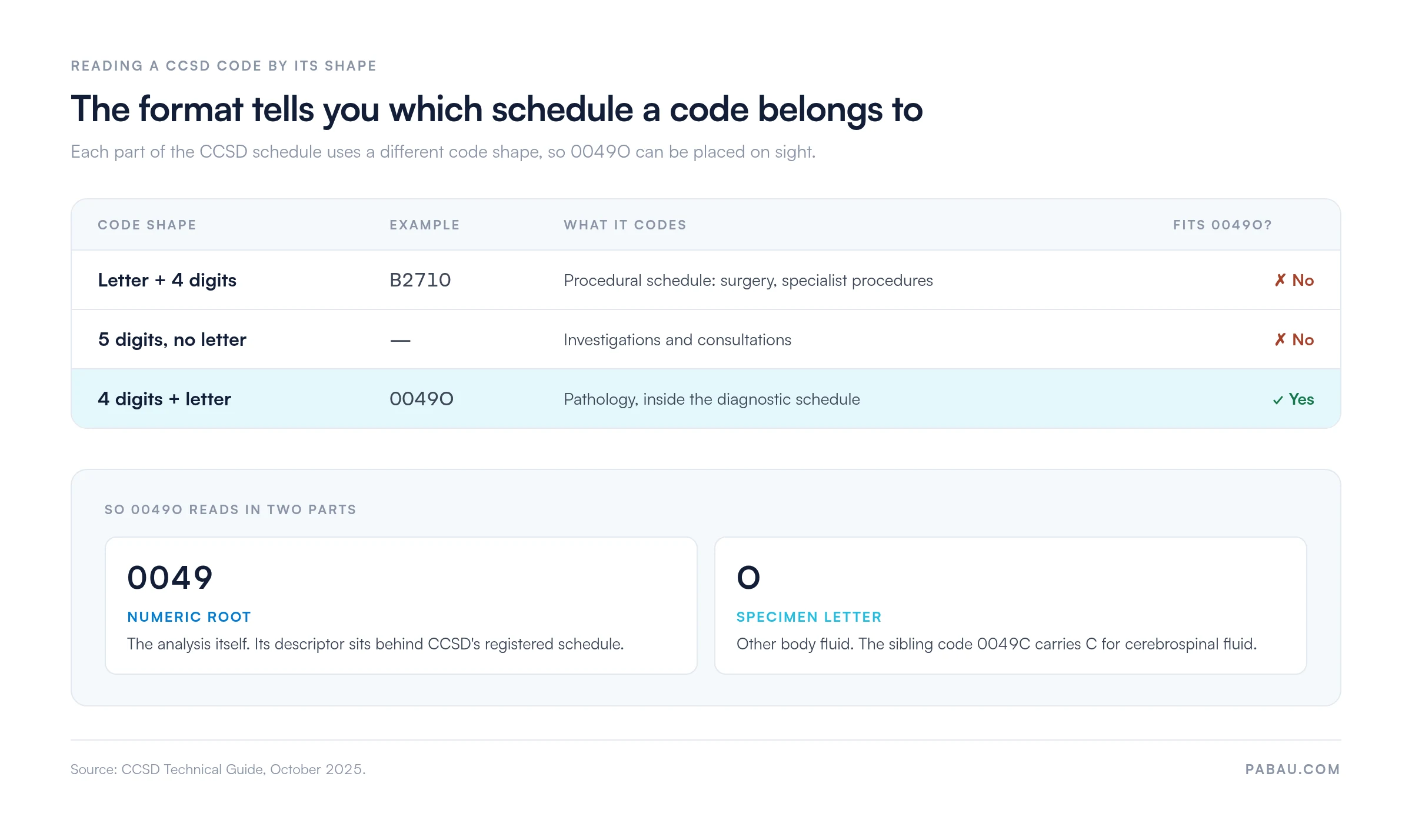
That format rule settles the question on its own. A code shaped as digits with a trailing letter belongs to pathology, so 0049O is not a surgical procedure code.
The specimen letter is documented, and it is worth reading once. CCSD’s technical guide sets out the pathology coding structure and lists the abbreviation used for each specimen type.
The guide describes the letter as an aid to identifying which specimen sample a test can be run on. It is the last character of the code. These are the abbreviations CCSD publishes:
Read 0049O against that list and the code stops being mysterious. The numeric root identifies the analysis, and the O identifies the specimen it was performed on.
It also explains the relationship with CCSD code 0049C. Those two are not competing procedures. They are the same 0049 analysis, one on other body fluid and one on cerebrospinal fluid.
Which one belongs on the claim is therefore a question about the sample, not about clinical preference. Bill the letter that matches the specimen the lab received.
Record the specimen type in the patient’s notes at the point of collection, not at the point of invoicing. On a pathology code the specimen is what selects the trailing letter, and reconstructing it weeks later is how the wrong code reaches the insurer.
CCSD stands for Clinical Coding and Schedule Development. It is both the schedule and the group that maintains it. The group draws on UK private medical insurers and independent providers to keep one shared set of CCSD codes.
Without it, every insurer would run its own coding system. Billing teams working across several payers would spend their day translating between them.
The CCSD Group defines what a code is and where it sits. It does not set the fee attached to it, and its own governance rules keep price setting off the table.
Bupa, AXA Health, Aviva, and every other insurer that recognizes the schedule sets its own reimbursement rate. A code appearing in the schedule is no guarantee that a given insurer covers it under a given policy.
The NHS does not use CCSD. NHS procedure activity is classified under OPCS-4, with diagnoses coded to ICD-10. Private billing runs on CCSD, so a clinician moving between the two works in two coding languages.
Pathology is the one place the systems touch. CCSD builds its pathology codes on the NHS National Laboratory Medicine Catalogue, which is why they look nothing like the rest of the schedule.
US practices use a different system again. Procedures there are billed under CPT codes, maintained by the American Medical Association. The three systems do not map onto each other.
Here is the sequence, from request to remittance:
The friction rarely shows up in the first few steps. It shows up at submission, where one request can generate several CCSD line items. Each line is a separate chance for a mismatch.
Get one field wrong across a bundle of related tests and the whole batch can come back queried. A wrong code, an out-of-date recognition number, or a missing referring clinician detail is usually enough.
Pre-authorization for a pathology test does not always work the way it does for a procedure. Plenty of routine investigations fold into the authorization for the wider consultation they support.
That is not a fixed rule, and some insurers do want a specific reference for specific tests. Confirm what the policy requires before you assume either way. A claim that needs no rework carries the code, the specimen, and the clinical indication in agreement.
Insurers can ask for the paperwork behind a 0049O claim months after the result was reported. A thin file is hard to defend at audit even when the invoice itself was correct.
Insurer details are easiest to capture at registration, before any test is requested. Four items are worth having on record before you bill, not after a query letter arrives.
Turn that documentation habit into a wider pre-submission check. A short review before the claim leaves the practice catches the mismatches that trigger queries. Run through this list:
Bupa, AXA Health, Aviva, Vitality, Cigna, and WPA all recognize CCSD codes as part of their private medical claims process. Most submissions route through Healthcode, the UK’s electronic clearing house for private healthcare billing.
Recognizing the coding system is not the same as guaranteeing payment for one code under one policy. Confirm both coverage and any pre-authorization requirement with the insurer before you bill.
For Bupa specifically, the code search portal above settles a code before the appointment rather than after the claim bounces. Our guide to Bupa CCSD codes walks through that search step by step.
There is no single reimbursement figure for CCSD code 0049O, and the CCSD Group does not publish one. It defines the code, not the fee. Each insurer sets its own rate on its own review cycle.
What Bupa pays for a given code can differ from what AXA Health or Aviva pays for the same one. Treat any specific number quoted secondhand as unreliable until you have checked the insurer’s current portal.
Where a practice’s fee for a test exceeds an insurer’s recognized rate, balance billing rules vary. Some insurers expect providers to bill at the recognized rate. Others allow additional charges provided the patient is told in advance.
Check the terms of recognition before setting a fee for any CCSD-coded test. Keep the patient paperwork in step with whatever that insurer requires.
Most rejection causes for a code like 0049O have nothing to do with clinical judgment. They are data-matching problems, and they show up in predictable places.
Reconcile pathology invoices against the lab’s own report monthly, not only at submission. A line that was submitted but never paid and never queried was usually dropped silently, and that is easy to miss inside a larger panel.
Practices that handle CCSD billing by hand carry compounding risk. Spreadsheets, paper notes, and separate insurer portals each add a step where a recognition number or a clinical indication can drift out of sync.
Pabau keeps the clinical record and the billing record in one system. Staff attach a CCSD code such as 0049O to the appointment and the note it came from.
The itemized, insurer-ready invoice is generated from that same record. Claim status and remittances are then tracked against each submitted line, so an unpaid line surfaces instead of disappearing.
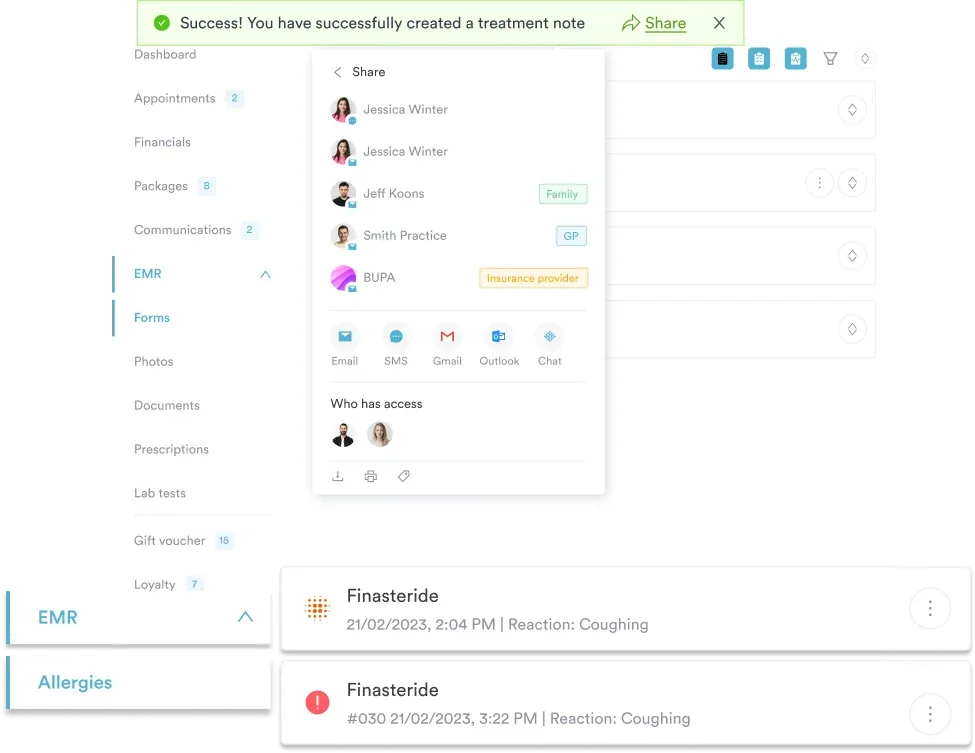
That matters most on pathology claims, where one request can produce several code lines. Keeping the specimen, the requesting clinician, and the code together is what keeps the batch payable on first submission.
It holds whether you run a single-handed private GP practice or a multi-site diagnostic service. Pabau’s claims management software supplies the audit trail insurers ask for when they review a claim.

Pabau lets UK private practices attach CCSD codes to appointments, generate insurer-ready itemized invoices, and track claim status and remittances in one workflow. See how it fits the way you bill today.

Treat CCSD code 0049O as a specimen question first. The letter on the end marks the sample the lab tested, and that decides how the code is requested, documented, and billed.
The exact analysis behind the 0049 root sits inside the CCSD’s registered schedule. Confirm it there, or on the insurer’s provider portal, rather than trusting a descriptor quoted secondhand.
The operational side needs no login at all. Match the letter to the specimen and document the clinical indication. Keep the recognition number current, and check coverage with the insurer before the claim goes out.
A pathology claim is easiest to get paid on first submission when the specimen, the code, and the invoice sit in one record. Book a demo to see how Pabau does that for every CCSD-coded test.

Billing the cerebrospinal fluid sibling? CCSD code 0049C covers the same analysis on a different specimen, with the same insurer and panel rules.
Want a worked pathology example? CCSD code 0048C follows one confirmed test from request through to remittance.
Confirming a code with Bupa? Bupa CCSD codes walks through the code search portal before the appointment.
Looking to understand Bupa’s fee structure? Bupa procedure codes fee schedule explains how Bupa attaches reimbursement amounts to CCSD codes.
Need a quick reference at the coding desk? Medical coding cheat sheet collects the code sets and modifiers billing teams reach for most often.
CCSD code 0049O is a pathology test code in the UK private healthcare billing schedule, not a surgical procedure code. The trailing O marks the specimen type, which CCSD lists as other body fluid. Its precise clinical descriptor sits behind the CCSD’s registered schedule, so confirm the exact analysis there or on the insurer’s provider portal before you bill.
It is a diagnostic test code, and specifically a pathology code. CCSD procedural codes are a letter followed by four numbers, such as B2710. A code shaped as four digits with a trailing letter belongs to the pathology part of the Diagnostic Schedule. It is requested and analyzed rather than scheduled and performed.
It identifies the specimen. CCSD’s technical guide sets out the pathology coding structure and lists the specimen abbreviation as the last letter of the code. O stands for other body fluid. The same list gives B for blood, U for urine, T for tissue, and C for cerebrospinal fluid.
The specimen, not the procedure. Both share the 0049 numeric root, which identifies the analysis, and the trailing letter says which sample it was run on. O is other body fluid and C is cerebrospinal fluid. Which one belongs on the claim depends on the specimen the lab received.
Bupa, AXA Health, Aviva, Vitality, Cigna, and WPA all recognize CCSD codes as part of their private medical claims process, mostly processed through Healthcode. Recognizing the coding system does not guarantee that an insurer pays for 0049O under a specific policy, so confirm that directly before billing.
There is no single reimbursement figure. The CCSD Group defines the code, not the fee. Each insurer sets its own rate, publishes it on its own provider portal, and reviews it on its own schedule. Check the current fee with the insurer rather than relying on a previous invoice.
It depends on the insurer and the policy. Some routine investigations fold into the authorization for the wider consultation they support rather than being pre-authorized individually. That is not a fixed rule across every insurer or every test, so confirm the requirement before the appointment.
CCSD codes are used for UK private healthcare billing, maintained by the CCSD Group with input from UK private insurers and providers. CPT codes are the US equivalent, maintained by the American Medical Association. The two systems are separate and should not be used interchangeably.