HCPCS Code Q4185: Cellesta flowable amnion billing guide
HCPCS Code Q4185: definition and official descriptor HCPCS Code Q4185 is the Lev...

Last Updated: Nov 20, 2026
N3030 is the CCSD code for circumcision, the complete surgical removal of the foreskin (prepuce). UK private medical insurers such as Bupa use it for a medically indicated circumcision in a child or an adult.
N3030 sits in sub-chapter 12.6.0, Genitalia, in chapter 12 of the CCSD schedule. Circumcision with a Plastibell device has its own code, N3031, and revision of an earlier circumcision is N3032.
Let Pabau's smart automation suggest the right codes, reduce claim denials, and keep your practice compliant—effortlessly.
Automate repetitive tasks and focus on what matters most—your patients.
Reduce coding errors and ensure compliance with the latest regulations.
Clean claims, fewer denials, and faster reimbursements.
Powerful insights and reporting to help your practice thrive.
HIPAA compliant SOC 2 certified GDPR-compliant Trusted by 4,000+ clinics worldwide

CCSD code N3030 covers circumcision, the complete removal of the foreskin. It sits in sub-chapter 12.6.0, Genitalia, of the CCSD schedule that UK private insurers use.
Circumcision with a Plastibell device has its own code, N3031, and revision of an earlier circumcision is N3032.
A dorsal slit (N3000), a preputioplasty (N3010) and division of preputial adhesions (N3020) are separate codes, so the operation note decides between them.
UK claims pair N3030 with WHO ICD-10 codes such as N47, which has no fourth-character sub-codes. N47.1 is a US ICD-10-CM code.
The CCSD Group sets no fees. Each insurer sets its own, and claims go electronically through Healthcode or direct to the insurer.
CCSD code N3030 is the code UK private insurers use for circumcision, the complete surgical removal of the foreskin (prepuce). It comes from the schedule kept by the Clinical Coding & Schedule Development Group (CCSD). Insurers such as Bupa build their procedure lists on that schedule.
The code applies to children and adults alike, and to any conventional technique, such as a sleeve resection or a guillotine and suture method. A circumcision done with a Plastibell device is the one exception, because it carries its own code.
The CCSD Group updates its schedule over time, so check the edition your insurer works from. Pabau, the practice management platform we build, keeps an index of CCSD codes that lists the other procedure codes we cover.
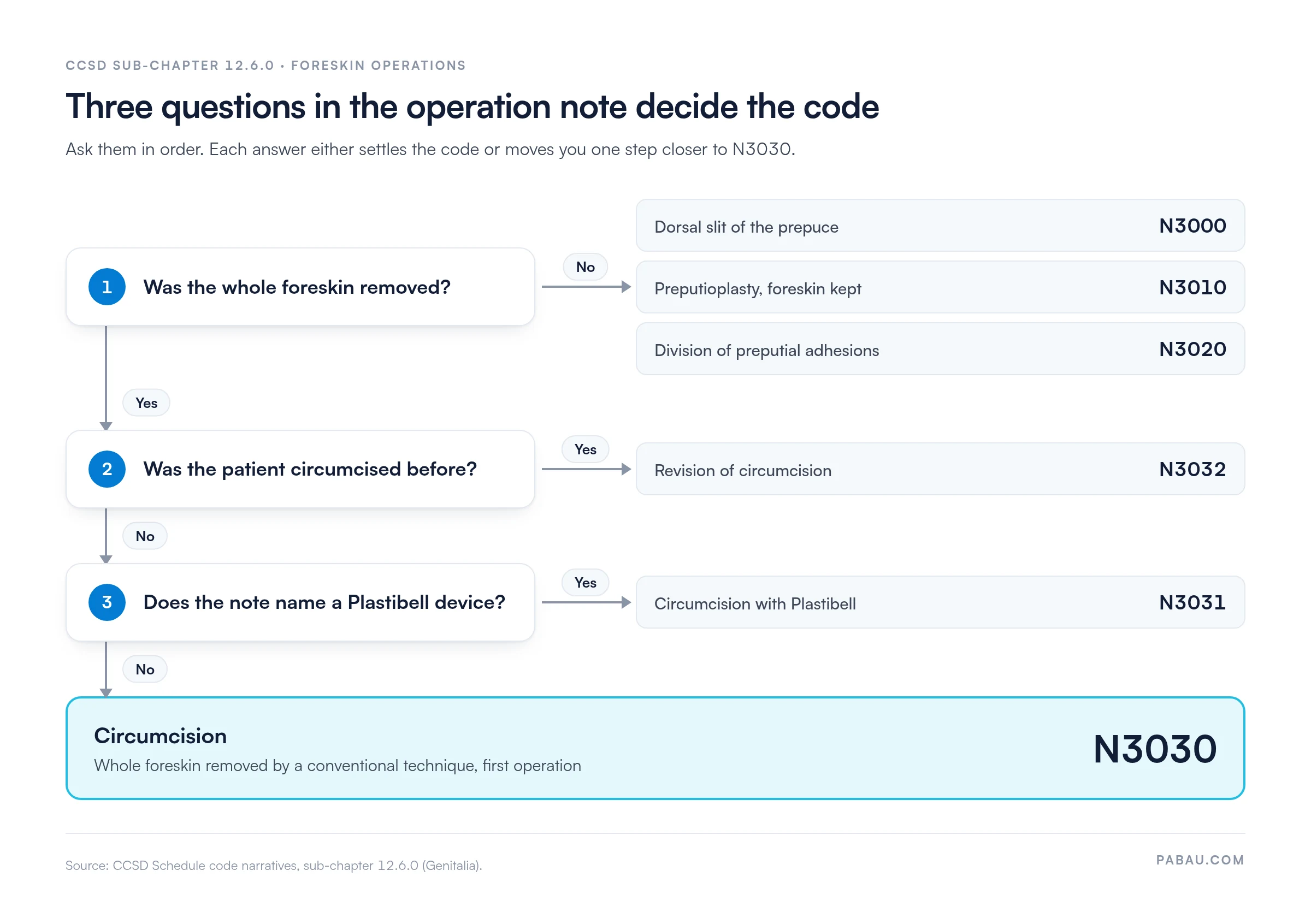
Sub-chapter 12.6.0 holds six codes for operations on the foreskin. They are easy to confuse, and the operation note decides which one fits. Meatoplasty, which widens a narrowed urethral opening, sits in the same sub-chapter under code M8120.
Plastibell circumcision does not bill under N3030. If the note names the Plastibell device, the code is N3031, even when the patient and the indication are the same.
A revision is not a second N3030 either. N3032 was added to the schedule in July 2015 for that operation. On a US claim, a repair that removes foreskin left by an earlier circumcision is reported under CPT code 54163. Our page on CCSD code N3010 covers preputioplasty, the foreskin-sparing option.
Put together, the operation note answers three questions in a fixed order. Each answer either names one of the other five codes or brings you a step closer to N3030.
A claim for N3030 is only as strong as the note behind it. A note that says “foreskin procedure” or “circumcision, Plastibell” leaves the coder choosing between three or four codes.
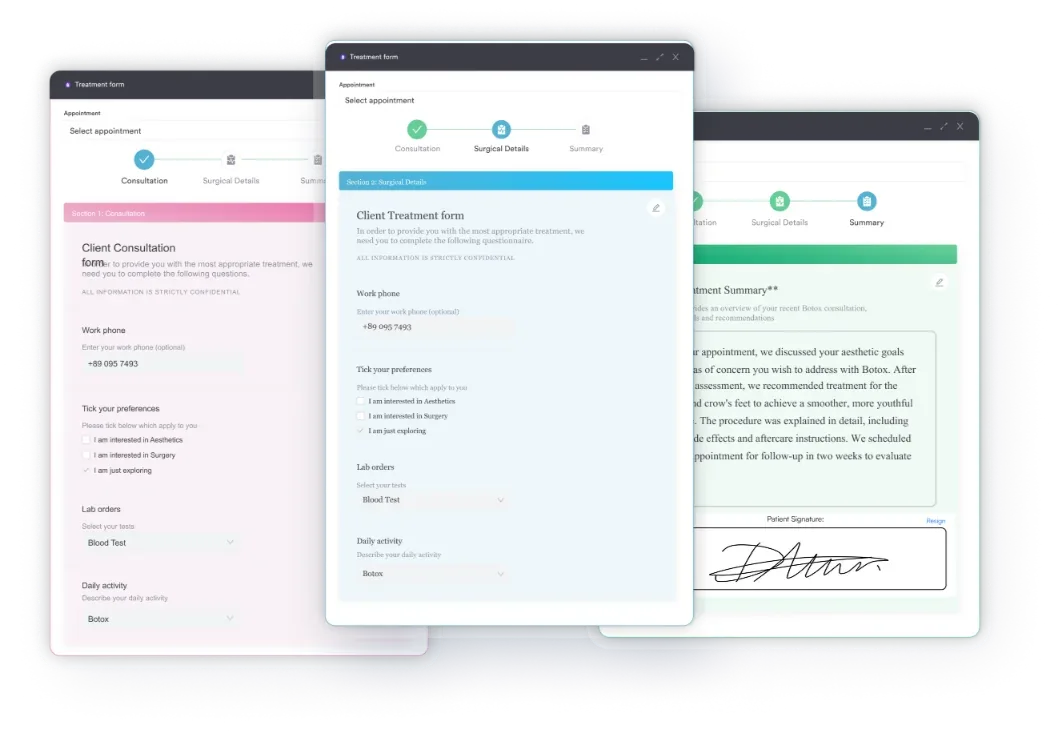
Agree a standard procedure title with your surgeons, such as “Circumcision, sleeve technique, general anesthetic”. When the title carries the technique, the person coding the claim sees it at once.
When an insurer asks for a diagnosis, UK claims use WHO ICD-10 codes, which you can check in the WHO ICD-10 browser. Use the diagnosis the surgeon documented rather than a default.
Write N47 with no fourth character, because WHO ICD-10 has no sub-codes under it. The US edition, ICD-10-CM, splits it into N47.0 to N47.8, such as N47.1 for phimosis and N47.2 for paraphimosis. Those codes belong on US claims.
Lichen sclerosus is L90.0, not L90.4. L90.4 is acrodermatitis chronica atrophicans, a different skin condition.
UK private policies pay for treatment of a medical condition, not for routine or religious circumcision. A claim that carries Z41.2, or a note that gives a cultural reason, will usually be declined.
Cover also depends on the policy. Some plans exclude treatment of conditions the patient had before joining, and a long-standing tight foreskin can fall under that rule. Check the patient’s plan with the insurer before the date is set.
The table below shows what each insurer usually expects, and the payer has the final word on every detail.
Once the operation is done, the claim follows the same five steps whichever insurer pays it.
When an anesthetist gives a general anesthetic, they bill separately for the same operation, under their own fee. The hospital or day-surgery unit sends its own account too.
Circumcision claims are most often held up by a handful of avoidable slips.
If a claim is still refused, check the insurer’s current provider manual for its appeal process. Our guide to denial management in healthcare covers the follow-up work in more depth.
Bupa is one of the UK’s largest private health insurers. Its rules are worth knowing before the first circumcision claim goes out.
Our guide to Bupa CCSD codes explains how Bupa’s procedure list works. For fee tiers, see our guide to the Bupa fee schedule.
On a day-case circumcision, the authorization often sits in an email and the operation note in the hospital system. The claim then gets keyed in by hand, and every handoff is a chance to lose the reference number.
Pabau keeps the billing side of those steps on the patient record. Its claims software for UK practices sends claims electronically through Healthcode and to Bupa. The insurance policy, the case and its authorization code sit on the patient’s file, with a warning when the code is missing.
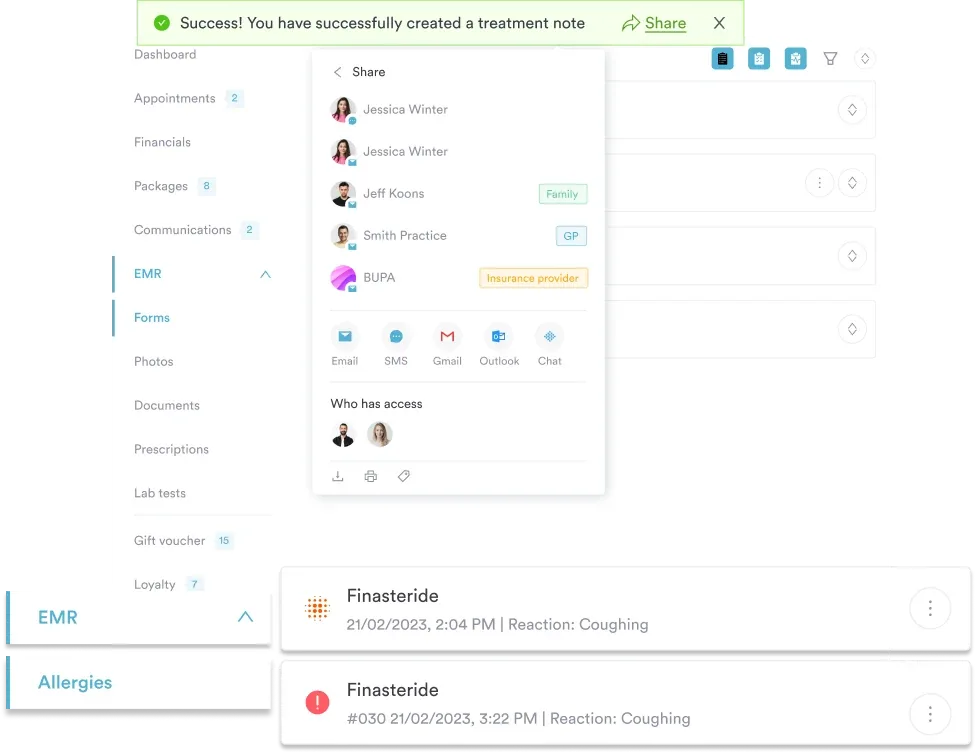
The result is fewer claims bounced for a missing reference, and a clear view of what each insurer still owes. Your billing team stops rebuilding claims from emails and hospital notes.

Pabau tracks authorization codes on the patient’s case and sends claims electronically through Healthcode and to Bupa. You see each claim’s status without phoning the insurer.

N3030 is simple once the note names the technique. Claims stall on a Plastibell case coded as N3030, a missing medical reason, or a US diagnosis code on a UK claim.
Standardize the procedure title with your surgeons, and check each insurer’s current list before you invoice. Those two habits settle the code before the claim leaves. Book a demo to see how Pabau keeps authorizations and Healthcode claims on one patient record.

Coding a foreskin-sparing operation? CCSD code N3010 covers preputioplasty, the alternative to circumcision.
Looking up another procedure code? CCSD codes lists the CCSD procedure codes Pabau covers.
Need a full Bupa CCSD billing reference? Bupa CCSD codes covers Bupa’s procedure list and how its claims work.
Checking Bupa fees before you invoice? Bupa procedure codes and fee schedule walks through Bupa’s recognized codes and fee tiers.
CCSD code N3030 covers circumcision, the complete surgical removal of the foreskin, in children and adults. It sits in sub-chapter 12.6.0, Genitalia, of the CCSD schedule that UK private insurers use.
No. Circumcision with a Plastibell device has its own CCSD code, N3031. Use N3030 only when the note describes a conventional surgical technique.
N3030 removes the whole foreskin. A dorsal slit cuts the foreskin along its upper side and keeps it, and it is coded N3000. Preputioplasty is N3010.
UK claims use WHO ICD-10 codes. N47 covers phimosis, paraphimosis and redundant prepuce, with no sub-codes. N48.1 is balanoposthitis, and L90.0 is lichen sclerosus. N47.1 is a US ICD-10-CM code.
Most UK private policies cover circumcision when there is a medical reason, such as phimosis or recurrent balanoposthitis. Routine or religious circumcision, coded Z41.2, is usually not covered. Check the patient’s policy first.
Most UK insurers expect pre-authorization for planned surgery, and cover depends on the patient’s policy. Get the reference number before the operation and put it on the claim.
Each insurer sets its own fee for N3030. The CCSD Group maintains the codes and their narratives, but it publishes no fees. Check the insurer’s current schedule before you invoice.
A revision of an earlier circumcision is CCSD code N3032, added to the schedule in July 2015. Do not bill it as a second N3030.