HCPCS Code E0215: Electric heating pad (non-moist) billing guide
HCPCS Code E0215: Official description and device definition HCPCS Code E0215 is...

Last Updated: Nov 16, 2026
M4310 is the CCSD code for endoscopic transection of the bladder, including cystoscopy. The urologist reaches the bladder through the urethra and cuts through the bladder wall to treat detrusor overactivity that has not responded to other treatment.
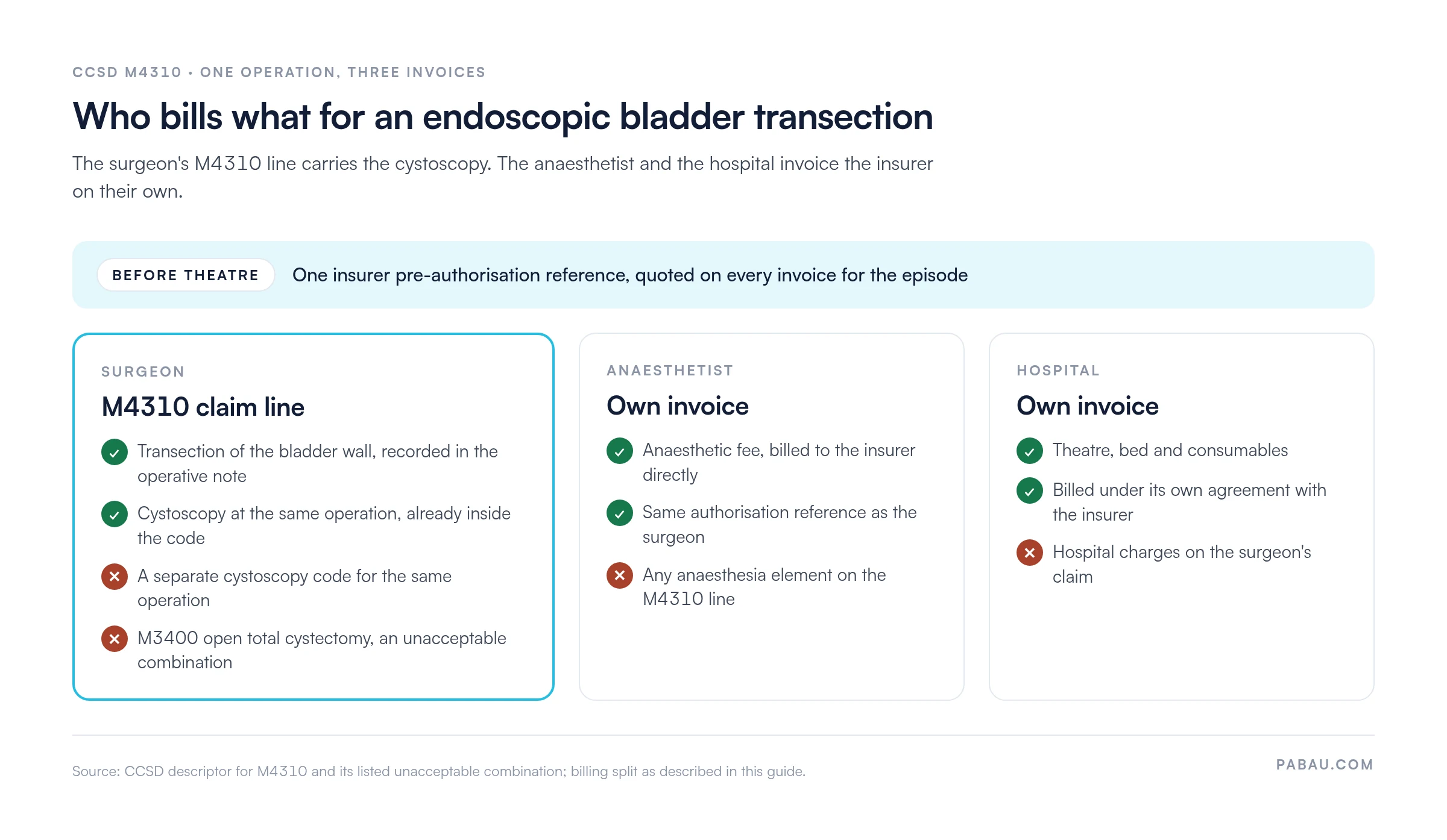
Cystoscopy at the same operation is part of the code, and open total cystectomy (M3400) is an unacceptable combination. UK private insurers set their own fees for M4310, and most require pre-authorisation.
Let Pabau's smart automation suggest the right codes, reduce claim denials, and keep your practice compliant—effortlessly.
Automate repetitive tasks and focus on what matters most—your patients.
Reduce coding errors and ensure compliance with the latest regulations.
Clean claims, fewer denials, and faster reimbursements.
Powerful insights and reporting to help your practice thrive.
HIPAA compliant SOC 2 certified GDPR-compliant Trusted by 4,000+ clinics worldwide

CCSD Code M4310 covers endoscopic transection of the bladder, and the cystoscopy used to perform it is part of the code.
Surgeons use the operation for detrusor overactivity that has not responded to other treatment, and it is now rarely performed.
There is no national fee for M4310, so each UK private insurer sets its own fee and complexity band.
Pair the claim with a UK ICD-10 code such as N32.8 or N39.4, never a US ICD-10-CM code.
Get insurer pre-authorisation before theatre, and send the claim through Healthcode with the authorisation reference attached.
CCSD Code M4310 is the UK private-sector code for endoscopic transection of the bladder, including cystoscopy. The CCSD schedule entry for M4310, which needs a CCSD login to view, lists it in chapter 12, under the bladder sub-chapter.
CCSD stands for the Clinical Coding and Schedule Development group. Its schedule gives UK private medical insurers, hospitals and consultants one shared set of procedure codes. Bupa, AXA Health, Aviva, Vitality and other insurers use it to authorise and pay for private treatment.
The code describes what the surgeon does, not what the insurer pays. CCSD publishes codes and descriptors only. Each insurer then decides its own fee and complexity band for M4310.
The urologist passes a resectoscope through the urethra into the bladder. After inspecting the bladder, the surgeon cuts through the full thickness of the bladder wall from the inside. The aim is to interrupt the nerve pathways that drive involuntary bladder contractions.
Parsons and colleagues first reported the endoscopic operation in 1984 as a replacement for open bladder transection. Later results were weaker. In a Newcastle series of 50 patients, the outcome was satisfactory for only 16%, and symptom relief lasted 17 weeks on average.
The operation is therefore rare in current UK practice. Botulinum toxin injection, sacral neuromodulation and augmentation cystoplasty have largely replaced it. Expect an insurer to look closely at any M4310 request for that reason.
In the Newcastle series, surgeons performed the transection under general anaesthesia, and the mean hospital stay was eight days. So the episode usually involves an anaesthetist and a hospital stay, each billed separately from M4310.
The descriptor answers the most common bundling question. Cystoscopy is part of M4310, so a separate cystoscopy code for the same operation counts as unbundling. The CCSD technical guide explains how CCSD treats procedures named inside a descriptor.
Insurers can apply their own bundling rules on top of the CCSD schedule. Bupa CCSD codes explains how one large insurer applies the schedule to its members’ claims.
Several endoscopic bladder operations sound similar to M4310 but carry their own CCSD codes. Resection of a bladder tumour, hydrostatic distension, and injection of botulinum toxin into the bladder wall all fall outside M4310. Endoscopic hydrostatic distension of the bladder, for example, is M4320.
Do not pick a neighbouring code by its number alone. Look up the exact descriptor in the CCSD schedule, then match it to the operative note. If the note records inspection only, with no transection, M4310 does not apply. Our CCSD code guides cover many neighbouring bladder codes, one page per code.
UK private insurers expect diagnoses coded in the WHO ICD-10 classification used by the NHS, not the US ICD-10-CM. UK ICD-10 codes are mostly four characters, so a US ICD-10-CM code such as N32.81 is invalid on a UK claim.
The diagnosis on the claim should match the authorisation request and the operative note. These pairings reflect clinical fit, not a promise of payment, so confirm each insurer’s rules before you submit.
The operative note has to prove that a transection happened. A note that only describes looking inside the bladder supports a cystoscopy code, not M4310.
Before you submit an M4310 claim, check two lines. The operative note must say the bladder was transected, not only inspected. And the claim must not carry a separate cystoscopy code for the same operation.
M4310 is an elective inpatient operation, so UK private insurers such as Bupa, AXA Health, Aviva and Vitality usually require pre-authorisation. Because the procedure is now uncommon, expect the insurer to ask for more clinical evidence than usual.
The anaesthetist usually needs the same authorisation reference for their own invoice. Share it once the theatre list is confirmed. Policies change, so confirm current requirements with each insurer.
CCSD does not set a fee for M4310, and there is no national tariff for private procedures. Each insurer decides what it pays under its own fee schedule.
So never quote an M4310 fee from memory or from another insurer’s schedule. Check the current figure with the patient’s insurer before you send an estimate.
Insurers refuse M4310 claims for a familiar set of reasons. Each one maps to a check you can run before the claim leaves the practice.
When an insurer refuses a claim, read its stated reason before you resubmit. Sending the same claim back unchanged usually brings a second refusal.
The anaesthetist bills their own fee on a separate invoice, so the surgeon’s M4310 claim carries no anaesthesia element. The hospital also bills its charges separately, which splits one operation into three invoices.
An M4310 claim depends on three records: the insurer’s authorisation reference, the signed operative note and the invoice. When those sit in a portal, a shared drive and a spreadsheet, nobody spots a missing authorisation reference until the insurer refuses the claim.
Pabau, the practice management platform we build, keeps all three on the patient record. Your surgeons can complete the operative note as a digital form, with a field that records the transection. The coder then sees it before choosing M4310.
Pabau’s claims management software records the authorisation code on the patient’s case and warns when one is missing. It sends insurer claims through Healthcode and shows which claims are still unpaid, so your team can chase them early.

Pabau keeps the authorisation reference, the operative note and the invoice on one patient record, then sends insurer claims through Healthcode. Your team spends less time chasing refused claims.

M4310 is easy to assign once the operative note proves a transection. The harder part is the case around it, because insurers rarely see this operation and will want the evidence behind it.
So put the effort into the authorisation request. Send the urodynamics and the treatment history up front, and the claim that follows is routine.
Book a demo to see how Pabau keeps authorisations and operative notes attached to every CCSD claim your practice submits.

Need a broader CCSD billing reference for private practice? Bupa CCSD codes explains how the CCSD schedule applies across private insurer claims in detail.
Want to reduce manual claim errors across your private practice? Claims management software from Pabau handles electronic submission, pre-auth tracking, and remittance reconciliation in one place.
Coding a bladder hydrodistension instead? CCSD code M4320 covers endoscopic hydrostatic distension of the bladder, with its own pre-authorisation and documentation checks.
CCSD Code M4310 covers endoscopic transection of the bladder, including cystoscopy. The urologist reaches the bladder through the urethra and cuts through the bladder wall from the inside. A cystoscopy with no transection does not qualify for M4310.
Yes. The descriptor names cystoscopy as part of M4310, so do not add a separate cystoscopy code for the same operation. A diagnostic cystoscopy at an earlier, separate episode is coded and authorised on its own.
There is no single figure. CCSD publishes codes, not fees, and each UK private insurer sets its own fee and complexity band for M4310. Check the patient’s insurer before you send an estimate.
Common pairings are N32.8 for overactive bladder or detrusor instability and N39.4 for urge incontinence. Where a neurological condition drives the problem, N31.9 can be used with G35 or G20. UK claims use WHO ICD-10, not US ICD-10-CM.
The usual reasons are a separate cystoscopy code, a missing authorisation reference, or a note that records inspection only. Others are a US ICD-10-CM code, weak evidence of failed earlier treatment, or billing M3400 alongside it.
No. The anaesthetist invoices the insurer separately for their own fee, usually quoting the same authorisation reference. The hospital also bills its own charges, so the surgeon’s M4310 claim covers the surgical fee only.