ICD-10 Code R06.02: Shortness of breath billing guide
ICD-10 Code R06.02: Definition and quick-reference details ICD-10 Code R06.02 is...

Last Updated: Nov 9, 2026
Billable Code Specific Code
V58.4XXS is the billable ICD-10-CM code for person boarding or alighting a pick-up truck or van injured in noncollision transport accident, sequela.
It identifies the external cause when a patient is treated for a late effect of that past injury, such as chronic pain or joint instability. The 7th character S marks the sequela encounter. The code is always listed after the residual condition code, never as the principal diagnosis.
Let Pabau's smart automation suggest the right codes, reduce claim denials, and keep your practice compliant—effortlessly.
Automate repetitive tasks and focus on what matters most—your patients.
Reduce coding errors and ensure compliance with the latest regulations.
Clean claims, fewer denials, and faster reimbursements.
Powerful insights and reporting to help your practice thrive.
HIPAA compliant SOC 2 certified GDPR-compliant Trusted by 4,000+ clinics worldwide

ICD-10 Code V58.4XXS describes the sequela of a noncollision boarding or alighting injury involving a pick-up truck or van.
The 7th character ‘S’ is mandatory. It marks a sequela encounter, distinct from ‘A’ (initial) and ‘D’ (subsequent).
V58.4XXS is always a secondary code, listed after the residual condition code that serves as the principal diagnosis.
Pabau, the practice management platform we build, supports ICD-10-CM code pairing so the residual condition goes ahead of V58.4XXS on outgoing claims.
ICD-10 Code V58.4XXS is a valid, billable ICD-10-CM code for the sequela of a noncollision boarding or alighting injury involving a pick-up truck or van.
It appears in the current fiscal-year tabular list maintained by CDC/NCHS and adopted by CMS. The code runs to seven characters, with two X placeholders filling positions 5 and 6 so that S sits in the 7th slot. No further subdivisions sit beneath it.
Check the descriptor wording against the CDC/NCHS ICD-10-CM web tool each fiscal year, because annual updates can revise it. The meaning of V58.4XXS stays stable. The patient was hurt boarding or alighting a pick-up truck or van in a noncollision transport accident. Today’s visit treats a residual condition from that injury.
The 7th character ‘S’ designates a sequela encounter. The patient is being treated for a late effect or residual condition caused by a past injury, and the acute injury has already healed. Under ICD-10-CM Official Guidelines Section I.B.10, sequela coding requires two codes. The residual condition code comes first, followed by the external cause code carrying the ‘S’ character.
Each of the three 7th characters for V58.4XX marks a different encounter type.
No fixed time threshold marks the switch from ‘D’ to ‘S’. The ICD-10-CM Official Guidelines define a sequela by clinical context, and elapsed time plays no part. Once the original injury has healed and the patient presents for a direct consequence of it, ‘S’ applies. A patient seen six months after the accident for chronic nerve pain from the boarding injury takes ‘S’. A patient whose fracture is still being managed takes ‘D’.
The V58 category covers pick-up truck or van occupants injured in a noncollision transport accident. The subcategory V58.4 captures injuries sustained while boarding or alighting from the vehicle. V58.4XXS applies when a residual condition from one of these scenarios is now being treated.
Noncollision is what separates V58 from its neighboring categories. It covers incidents in which the pick-up truck or van struck no other vehicle, object or fixed structure. A collision moves the code into V50-V57.
Several scenarios look similar but require different ICD-10-CM codes. Using V58.4XXS incorrectly triggers payer edits, so confirm the exclusions before coding.
Three questions settle the code before a claim goes out. The flow below walks through each one and shows where V58.4XXS lands on the claim.
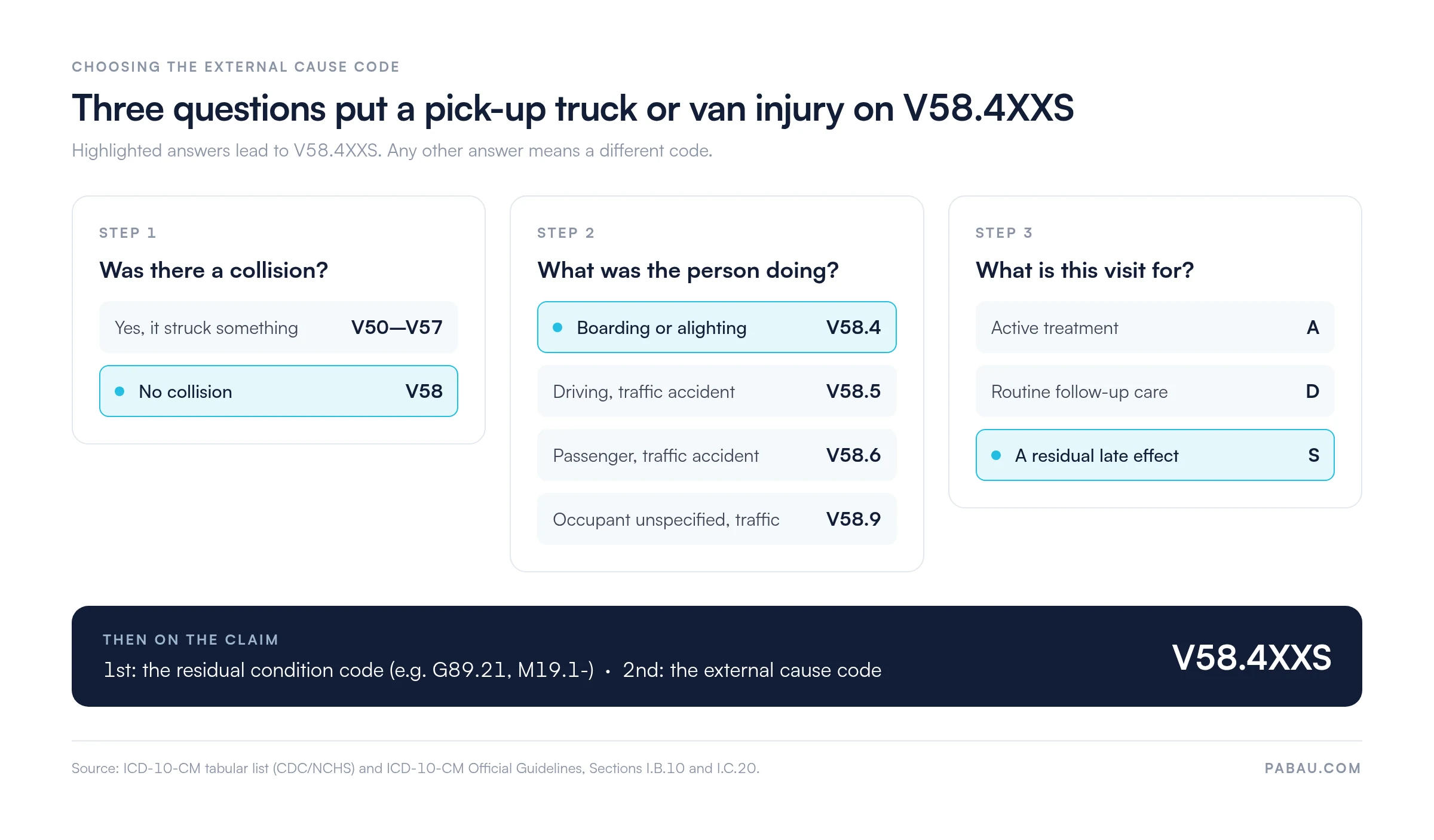
These codes share enough structure with V58.4XXS that billing errors are common. The table below sets out how each one differs.
The AAPC Codify ICD-10-CM lookup and the ICD List code database both show these adjacent codes side by side. Use either to confirm the correct subcategory before billing.
Under ICD-10-CM Official Guidelines Section I.C.20.a, external cause codes, including all V-codes, are never sequenced as the principal or first-listed diagnosis. V58.4XXS must always appear as a secondary code. The residual condition being treated is sequenced first.
The correct sequencing order for a sequela claim is:
The medical record must establish a clear causal chain from the original noncollision transport incident to the current residual condition. Without this chain, payers cannot confirm medical necessity and will deny the claim.
Required documentation elements:
AHIMA and AAPC both emphasize that documentation must distinguish the original injury from the residual condition. Provider attestation in a clinical note linking cause to current presentation is the standard expectation. Maintaining medical billing compliance across sequela cases calls for a documentation workflow that prompts providers to record this causal link at each relevant visit.
Medicare and Medicaid do not require prior authorization specifically for sequela transport codes. Individual carrier local coverage determinations (LCDs) may still impose documentation thresholds for the residual condition being treated. For example, a physical therapy claim for post-traumatic knee instability must meet the payer’s functional limitation criteria, whether or not V58.4XXS is on the claim.
Commercial and liability payers often have distinct requirements for transport injury sequela:
Confirming the primary payer at intake is part of revenue cycle management for practices treating transport injury patients. Verify payer-specific requirements against individual plan policies before billing, as coverage determinations change with plan-year updates. Consult each payer’s LCD or coverage policy directly rather than applying a universal rule.
These are the top denial triggers practices encounter when billing V58.4XXS, along with the corrective action for each. Logging every denial by reason, the core of denial management workflows, shows which of these errors your team repeats.
Reviewing the denial codes on the remittance alongside the encounter documentation before resubmission prevents the same error on the corrected claim. Submitting a clean claim the first time matters for sequela transport codes. Payer audit systems flag V-code sequencing errors automatically, often before a human reviewer sees the claim.
Before submitting a sequela claim with V58.4XXS, run a two-step internal check. First, confirm the residual condition code is listed first as the principal diagnosis. Second, verify the provider note explicitly states the current condition resulted from the original boarding or alighting incident. Both must be present on the claim or in the chart for the submission to hold up under payer review.
A sequela claim depends on three manual checks. The residual condition goes first, the 7th character is ‘S’, and the chart carries the provider’s causal statement. Each one is a denial reason in the table above when it slips.
Pabau, the practice management platform we build, includes error-catching claims management that supports ICD-10-CM code pairing. The residual condition code goes ahead of V58.4XXS on outgoing claims. For practices billing US payers, Pabau integrates with the Claim.MD clearinghouse, which checks claims before submission and flags errors before they reach the payer.
Custom note templates in Pabau can ask the provider for the causal link at every sequela visit. The chart then holds the statement a payer looks for when it reviews the claim.

Pabau’s claims management software helps practices pair ICD-10-CM codes correctly and submit clean claims through the Claim.MD clearinghouse. Sequencing errors get caught before they reach the payer. See how it works for your practice.

V58.4XXS belongs on a claim only when the chart shows three facts. The original injury happened while boarding or alighting a pick-up truck or van, with no collision. That injury has healed, and the provider ties today’s residual condition to it.
If any of those facts is missing, fix the record before you fix the code. A provider addendum takes minutes, while a denied sequela claim has to be reworked and resubmitted.
Pabau’s medical billing workflow lets your team check the code order and the chart note before a claim leaves the practice. Book a demo to see how it handles sequela claims for transport injuries.

Need to understand denial code patterns for sequela claims? Denial codes in medical billing explains the most common CARC codes that appear on rejected transport injury claims and how to respond to each.
Looking to improve claim submission accuracy across your practice? Claim.MD clearinghouse overview covers how the Claim.MD integration validates ICD-10-CM pairings and flags sequencing errors before payers see them.
Want a broader view of insurance billing workflows? Insurance eligibility verification outlines how pre-claim eligibility checks reduce denials on transport injury and sequela encounters.
ICD-10 Code V58.4XXS is the billable ICD-10-CM code for the sequela of a noncollision boarding or alighting injury involving a pick-up truck or van. It is used when the patient is treated for a residual late effect of that injury.
Yes. V58.4XXS is a valid, billable ICD-10-CM code in the current fiscal-year tabular list. It must be paired with a principal diagnosis code for the residual condition being treated, and it is always sequenced second on the claim.
V58.4XXA is for the initial encounter, when active treatment of the acute injury begins. V58.4XXS is for a sequela encounter. The original injury has resolved, and the patient is now treated for a residual condition it caused. Using ‘A’ on a sequela visit is a coding error that triggers claim denial.
Sequela codes (7th character ‘S’) apply when the original injury has healed and the patient presents for a residual condition resulting from it. Initial encounter codes (7th character ‘A’) apply at the first visit for active treatment of the acute injury. The ICD-10-CM Official Guidelines set no fixed number of days for the switch. Clinical context decides it.
No. Under ICD-10-CM Official Guidelines Section I.C.20.a, external cause codes, including all V-category codes, are never sequenced as the principal or first-listed diagnosis. The residual condition code appears first, and V58.4XXS is always the secondary code.
The paired principal diagnosis depends on the residual condition. Common examples include G89.21 (chronic pain due to trauma), M19.1- (post-traumatic osteoarthritis, by joint), L90.5 (scar conditions) and nerve injury codes. The code for the late-effect condition is always sequenced first on the claim.