ICD-10 Code Y76.0: Diagnostic obstetric and gynecological devices
ICD-10 Code Y76.0: Definition and billable status ICD-10 Code Y76.0 is a valid, ...

Last Updated: Oct 23, 2026
Billable Code Specific Code
T87.1X2 is the billable ICD-10-CM code for complications of reattached (part of) left lower extremity. It covers infection, necrosis, wound breakdown, vascular failure, and other problems that follow replantation of the left leg, foot, or ankle.
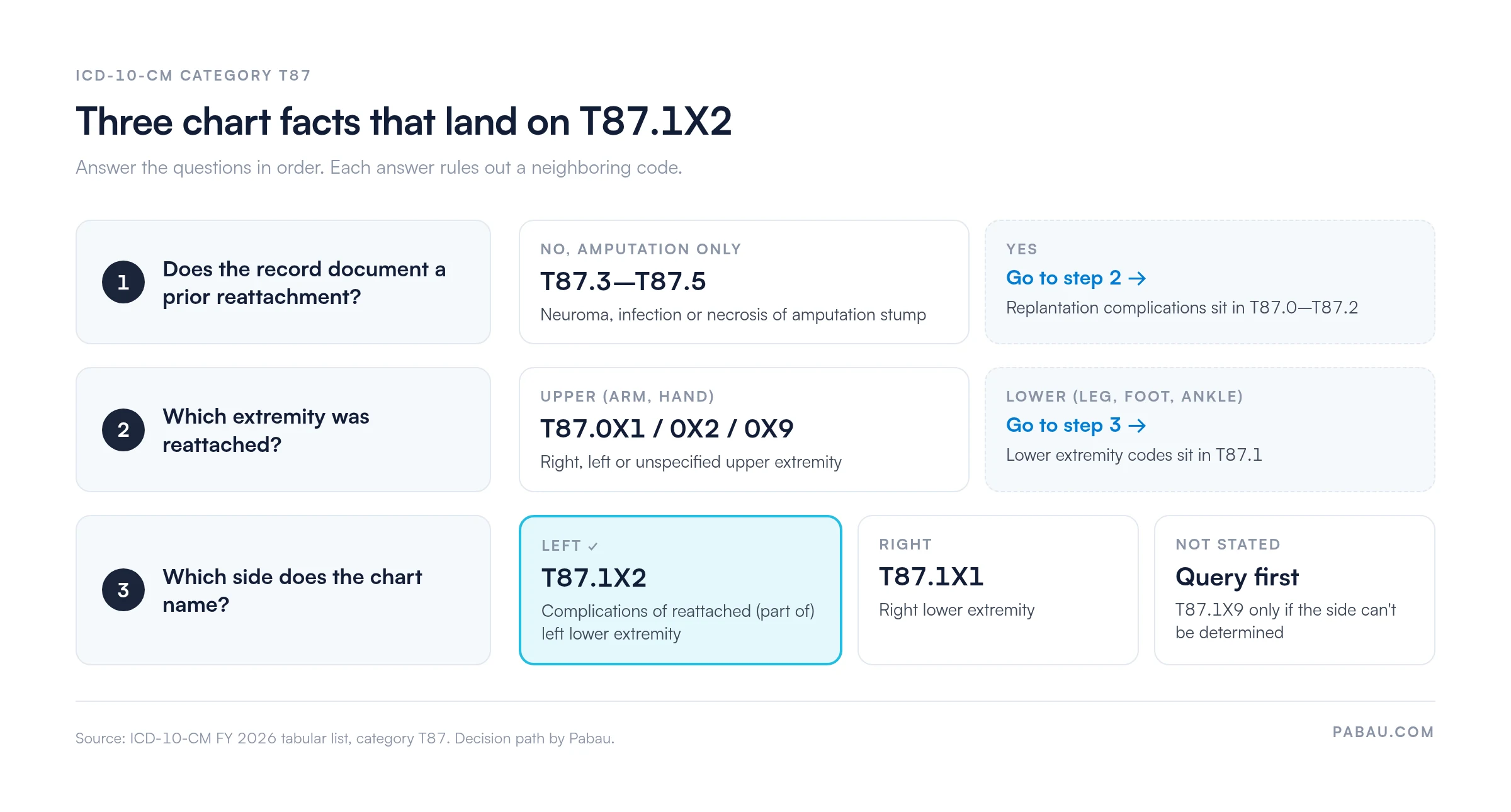
The code sits in category T87, beside T87.1X1 for the right side and T87.1X9 for an unspecified side. The record must show both the earlier reattachment and a complication in the left extremity.
Let Pabau's smart automation suggest the right codes, reduce claim denials, and keep your practice compliant—effortlessly.
Automate repetitive tasks and focus on what matters most—your patients.
Reduce coding errors and ensure compliance with the latest regulations.
Clean claims, fewer denials, and faster reimbursements.
Powerful insights and reporting to help your practice thrive.
HIPAA compliant SOC 2 certified GDPR-compliant Trusted by 4,000+ clinics worldwide

T87.1X2 is a billable ICD-10-CM code, valid in FY 2026, for complications after replantation of the left lower extremity.
Laterality must be documented. T87.1X2 is left only, T87.1X1 is right, and T87.1X9 (unspecified side) invites medical-necessity review.
Infection, necrosis, wound dehiscence, and vascular failure after left limb reattachment are the complication types coded here.
Amputation stump problems with no replantation history belong in T87.3 to T87.9, never in T87.1X2.
Claims management software like Pabau connects to the Claim.MD clearinghouse, so T87.1X2 claims are checked before submission.
ICD-10 code T87.1X2 is a specific, billable ICD-10-CM code for complications of reattached (part of) left lower extremity. It has been valid for discharges and encounters since October 1, 2015, and is unchanged in FY 2026. The table below lists the fields coders need for claim submission.
Check the code’s status each year in the CDC/NCHS ICD-10-CM web tool. It reflects the official tabular list the National Center for Health Statistics releases for each fiscal year.
T87.1X2 captures complications that arise after replantation of the left lower extremity or any part of it, including the foot, ankle, or a leg segment. The code names no single complication type. It groups every complication the provider attributes to the reattachment procedure itself.
Complication types documented under T87.1X2 in clinical practice include:
The operative or progress note must state a causal link: The provider documents that the complication stems from the earlier reattachment, not an unrelated condition.
T87.1X2 is restricted to reattachment complications. It does not apply to amputation stump complications, which have their own T87 subcategories, or to complications of the opposite extremity.
The boundary that matters most for claim integrity is reattachment versus amputation. If the chart documents an amputation stump problem with no history of replantation, T87.1X2 is wrong wherever the stump is. Payer edits expect a replantation history when T87.1 codes appear, so that claim usually ends in a medical-necessity denial.
Stump complications have their own subcategories, so pick the one the chart supports. A documented stump neuroma with no limb named takes T87.30.
T87.1X2 sits within category T87, which covers complications peculiar to reattachment and amputation. Coders need the full map to pick the most specific code and avoid unspecified defaults.
Upper extremity replants follow the same laterality pattern one subcategory above. A right arm, hand or finger complication codes to T87.0X1, and the left side takes T87.0X2.
Category T87 sits near the end of Chapter 19 (S00-T88), which covers injuries, poisoning, and certain other consequences of external causes. Coders new to Chapter 19 sometimes search by body system instead of by injury consequence. That is how T87.1X2 loses out to musculoskeletal or vascular codes that miss the replantation history.
The three lower extremity reattachment codes are identical in clinical scope. Laterality is the only difference, and it decides how the claim is adjudicated. ICD-10-CM guidelines require the most specific code the documentation supports.
A practical point: Laterality for T87.1X2 does not need a formal statement in a single sentence. The operative report names the replanted extremity, and the progress note places the complication at the same site. The coder may build laterality from the two. Together they satisfy the specificity requirement, provided the clinical picture is unambiguous.
Three facts from the chart settle the code. The path below shows how each answer rules out a neighboring T87 code.
Replantation surgery reattaches a completely or partially amputated extremity, using microsurgery to reconnect bone, tendons, nerves, and blood vessels. Lower extremity replantation is rarer than upper extremity replantation. Its functional outcome is less predictable, and the surgery places a higher metabolic demand on the patient. After a left lower extremity replantation, complications during the long recovery are coded under T87.1X2.
Post-replantation care often involves physical therapists and rehabilitation specialists alongside vascular surgeons. Each of them may bill T87.1X2 for their own encounters, so every note needs the same side and procedure history.
The most common complication types in the clinical literature on lower extremity replantation, in rough order of frequency, are:
Each of these maps to T87.1X2 when it occurs in the left lower extremity after reattachment. The code does not separate complication types internally. A second code for the specific complication, such as an infection code, may be added when documentation supports it and sequencing guidelines allow.
Accurate use of ICD-10 code T87.1X2 depends on four documentation elements in the medical record. To meet medical billing compliance requirements for Chapter 19 complication codes, the record must support both the earlier procedure and the current complication.
Turn these four elements into a pre-submission checklist, so a missing side is caught before the claim leaves the practice. Structured note templates for post-replantation visits prompt the provider for each element at the time of writing.
T87.1X2 is a covered diagnosis for several service types under Medicare and certain Medicaid programs. Coverage depends on the service, so check it against the applicable Local Coverage Determination (LCD) for each encounter.
Checking T87.1X2 against payer-specific edits before submission catches coverage mismatches at the eligibility stage. After adjudication, review the remittance advice for repeat T87.1X2 denials and prioritize appeals. The CMS ICD-10 codes page publishes the official code files and annual updates.
Most T87.1X2 denials are preventable. These encounters are low in volume but high in complexity, so a denial workflow built for post-replantation claims cuts rework and speeds up payment.
For denials already received, check the CARC denial reason codes on the remittance advice before drafting an appeal. A clean claim with complete documentation at first pass removes most of the rework these denials create.
Review the operative report from the original replantation surgery and attach a summary to the claim file before submitting any T87.1X2 encounter. Payers rarely hold the replantation history for follow-up visits billed weeks or months later. A missing history is a leading cause of first-pass denials for this code family.
T87.1X2 rarely appears alone on a claim. The procedure code billed with it decides whether the service meets medical necessity under the relevant LCD. An accurate superbill for post-replantation visits depends on knowing which CPT codes payers expect beside this diagnosis.
A pre-submission crosswalk check catches CPT-to-diagnosis mismatches before claims are filed. For debridement claims, always record wound measurements in square centimeters. Payers audit wound size to confirm the CPT level selected.
ICD-10 code T87.1X2 is valid and current in FY 2026, which runs from October 1, 2025 through September 30, 2026. The FY 2026 update left the T87.1 subcategory unchanged. The code entered the classification when ICD-10-CM launched in FY 2016 and has stayed stable since.
Confirm the code’s status before each fiscal year in the AAPC ICD-10-CM code lookup or the CDC/NCHS tabular list. Read each annual update for changes elsewhere in category T87 that could affect your crosswalk decisions.
No 7th character extension applies to T87.1X2. Many Chapter 19 codes need an encounter character, such as A for initial, D for subsequent, or S for sequela. T87.1X2 is complete at six characters and is submitted as written.
Many practices still check T87.1X2 claims by hand. A coder reads the operative report, confirms the side, and hopes the payer already holds the replantation history.
Practice management software like Pabau moves those checks ahead of submission. Its claims management for practices connects to the Claim.MD clearinghouse, which sends claims to thousands of US payers. Real-time eligibility checks cover over 400 payers, so coverage problems surface before the visit is billed.
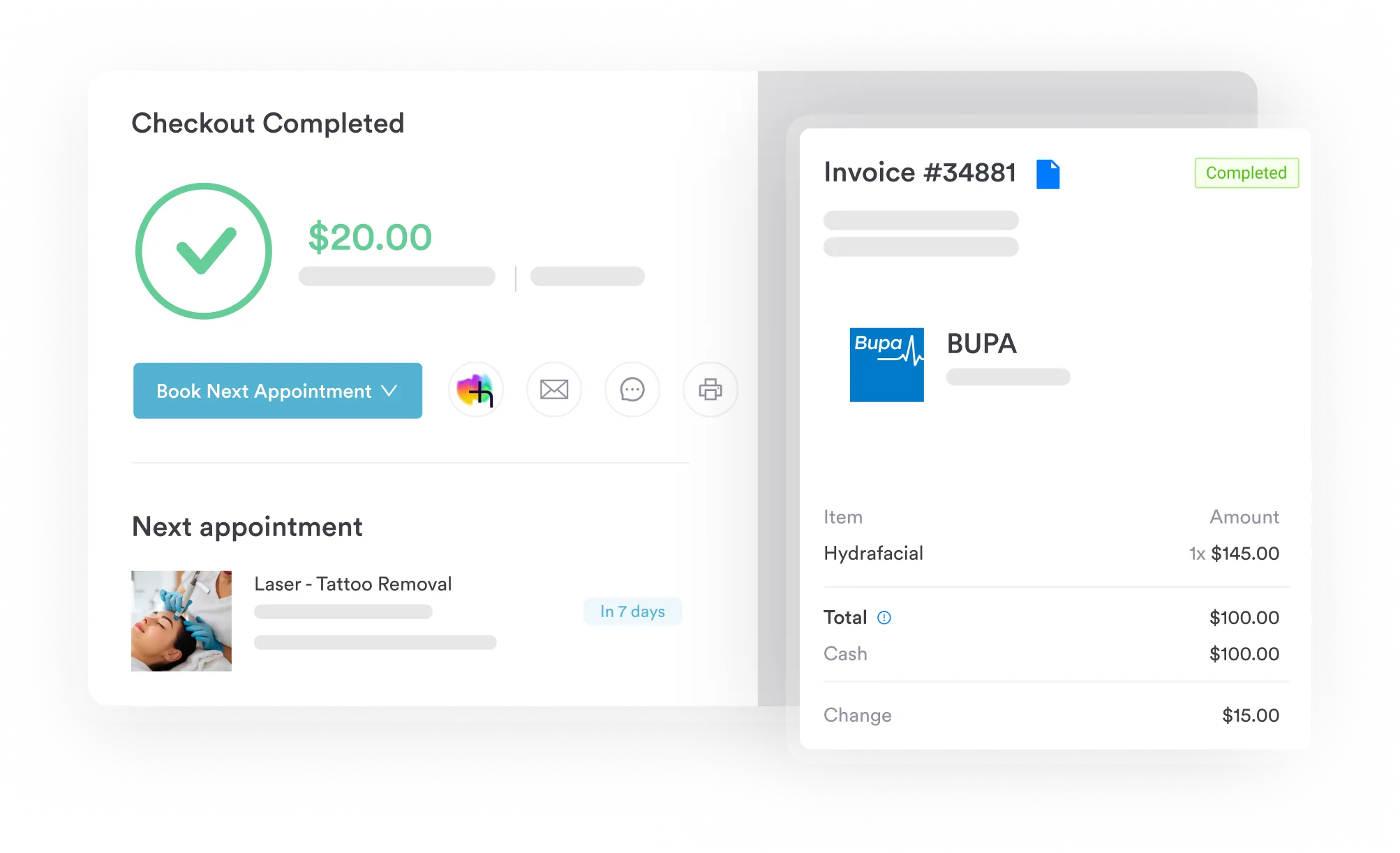
Remittance data comes back into the same workflow. Your billing team can spot repeat T87.1X2 denials and work the appeals without switching systems.

Pabau connects your clinical notes to the Claim.MD clearinghouse and checks diagnosis codes against payer edits before submission. See how practices cut T87.1X2 denials with real-time eligibility checks and automated remittance processing.

ICD-10 code T87.1X2 is a billable, stable code that captures a precise clinical situation: A complication following replantation of the left lower extremity. Its denials almost always trace back to the chart. Either the note never names the left side, or the claim file carries no record of the replantation.
Both failures are cheaper to fix in the note than on appeal. A post-replantation template that asks for the side and cites the original operative report settles most claims before a coder touches them.
To see how Pabau checks T87.1X2 claims against payer edits before you submit them, book a demo.

Need to see how a claim travels from code to payment? Medical claims clearinghouses explains the submission path from diagnosis code through adjudication.
Want the bigger picture behind claim integrity? What is revenue cycle management covers sequencing, claim integrity, and denial reduction for billing teams.
Working through a stack of denied claims? Denial management in healthcare sets out a workflow for tracking, correcting, and appealing denials.
Aiming for first-pass acceptance? What is a clean claim lists the elements payers check before they pay.
Building a superbill for post-surgical visits? The superbill guide explains which codes and fields a superbill needs.
ICD-10 code T87.1X2 is the diagnosis code for complications of reattached (part of) left lower extremity. It applies when a patient develops a complication such as infection, necrosis, or vascular failure after replantation of the left leg or foot. It sits in category T87 in Chapter 19 of ICD-10-CM. The right-side equivalent is T87.1X1.
Yes, T87.1X2 is a specific, billable ICD-10-CM code, valid for claim submission in FY 2026 (from October 1, 2025). It needs no 7th character extension and is complete at six characters. Verify its status each fiscal year in the CDC/NCHS ICD-10-CM tabular list or on the CMS ICD-10 codes page.
T87.1X1 covers complications of reattached (part of) right lower extremity, and T87.1X2 covers the left side. They are identical in clinical scope, covering infection, necrosis, wound dehiscence, and vascular failure. The side documented in the chart decides which code applies.
The most common reason is a chart that says “lower extremity” without naming the left side. Others are a claim file with no record of the reattachment, T87.1X2 used for an amputation stump with no replantation, and incorrect principal diagnosis sequencing. Complete operative history and an explicit side resolve most first-pass denials.
T87.1X2 is likely a covered diagnosis for hyperbaric oxygen therapy under the applicable CMS Local Coverage Determination. Coverage depends on wound type, medical necessity criteria, and the MAC jurisdiction. Some state Medicaid programs also list T87.1-series codes as covered HBOT diagnoses. Check the current LCD before billing rather than assuming coverage.
Yes, T87.1X2 can be sequenced as the principal diagnosis when the complication is the reason for the admission or outpatient encounter. When the complication is incidental to a different chief complaint, list the main reason for the visit first. T87.1X2 then follows as an additional diagnosis, per the ICD-10-CM Official Guidelines for Coding and Reporting.