ICD-10 Code V28.01XD: E-bike driver noncollision accident, nontraffic, subsequent encounter
ICD-10 Code V28.01XD: Definition and billable status ICD-10 Code V28.01XD is the...

Last Updated: Oct 20, 2026
Billable Code Specific Code
Z14.8 is the billable ICD-10-CM code for genetic carrier of other disease. It covers confirmed carrier status for a heritable condition with no dedicated Z14 subcode, such as SMA, PKU or hemophilia B.
Assign it only after ruling out hemophilia A (Z14.01, Z14.02) and cystic fibrosis (Z14.1). The record needs a genetic test result, because family history alone points to Z82 or Z84 instead.
Let Pabau's smart automation suggest the right codes, reduce claim denials, and keep your practice compliant—effortlessly.
Automate repetitive tasks and focus on what matters most—your patients.
Reduce coding errors and ensure compliance with the latest regulations.
Clean claims, fewer denials, and faster reimbursements.
Powerful insights and reporting to help your practice thrive.
HIPAA compliant SOC 2 certified GDPR-compliant Trusted by 4,000+ clinics worldwide

Z14.8 covers confirmed carrier status for heritable diseases without their own Z14 subcode, so check Z14.01, Z14.02 and Z14.1 first.
A genetic test result confirming carrier status must be in the record, because family history codes Z82 or Z84 alone do not support Z14.8.
Z14.8 records carrier status and Z15 records genetic susceptibility, and mixing up the two is a leading cause of rejected genetic Z-code claims.
Hemophilia B has no dedicated carrier code, so a confirmed hemophilia B carrier is coded Z14.8, while a cystic fibrosis carrier takes Z14.1.
Claims management software like Pabau checks ICD-10-CM codes before submission, so a wrong carrier code is caught before the payer sees it.
ICD-10 Code Z14.8 is a valid, billable ICD-10-CM diagnosis code with the official descriptor “Genetic carrier of other disease.” It belongs to the Z14 category (“Genetic carrier”) within Chapter 21 (Factors influencing health status and contact with health services, Z00-Z99).
The code is valid for FY2026 submission according to the CMS ICD-10-CM code files and confirmed in the CDC/NCHS ICD-10-CM web tool.
“Other disease” in the descriptor means any heritable condition for which the patient has confirmed carrier status but which lacks its own dedicated Z14 subcode. This makes Z14.8 the residual code in its parent category. It is correct only after you rule out hemophilia A (Z14.0x) and cystic fibrosis (Z14.1).
Z14.8 applies when a patient has confirmed genetic carrier status for a heritable disease other than hemophilia A or cystic fibrosis. Confirmed means molecular or biochemical testing has identified the gene variant. A carrier state suspected from family history does not qualify. The code turns up most often in genetic counseling encounters, reproductive planning visits, and prenatal genetic consultations.
Typical conditions coded under Z14.8 include autosomal recessive and X-linked carrier states. Examples are carriers of spinal muscular atrophy (SMA), phenylketonuria (PKU), Gaucher disease, hemophilia B, and fragile X premutation.
The key qualifier is always that the condition lacks its own dedicated Z14 subcode. Sickle cell trait is not one of them, because it has its own code, D57.3, outside Z14 entirely.
The encounter reason drives sequencing. When the visit is solely for genetic counseling or carrier testing, Z14.8 may stand as the first-listed code. When the carrier status is incidental to another encounter, sequence it after the primary reason for the visit.
Z14.8 has Excludes1 notes for Z14.0 and Z14.1. An Excludes1 note means the excluded codes can never be used together with Z14.8 for the same condition. They represent the same clinical concept at a more specific level.
A hemophilia A carrier takes Z14.01 or Z14.02, and a cystic fibrosis carrier takes Z14.1. Hemophilia B has no dedicated carrier code in ICD-10-CM, so a confirmed hemophilia B carrier falls under Z14.8 itself. Using Z14.8 for hemophilia A or cystic fibrosis is a coding error that payers detect through edit logic.
Z14.8 also does not cover:
Z14.8 and Z15 codes describe different clinical realities and must never be used interchangeably. Z14.x codes confirm that a patient carries a gene variant for a disease they do not have.
Z15.x codes document elevated genetic susceptibility, usually found through testing that predicts disease risk, such as BRCA1/BRCA2 for breast cancer. That patient is not a “carrier” in the classical inheritance sense. Confusing the two is a leading reason genetic Z-code claims are denied.
The distinction matters clinically. A cystic fibrosis carrier (Z14.1) has one mutated CFTR allele and does not develop CF. A person with high genetic susceptibility to breast cancer (Z15.01) carries a risk allele linked to a higher chance of disease. These lead to different counseling and management pathways, which is why ICD-10-CM separates them.
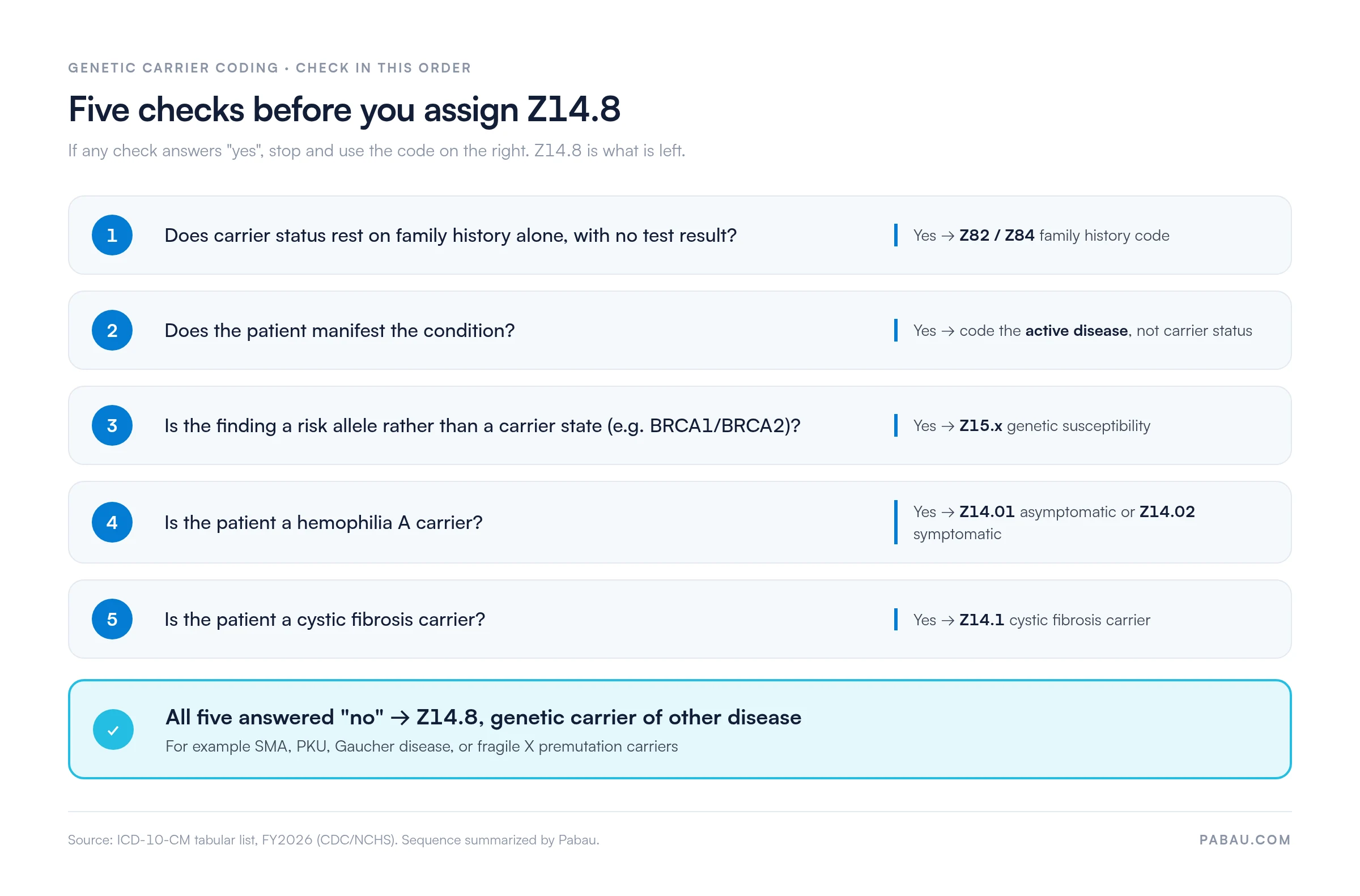
Before assigning Z14.8, verify that no more specific Z14 subcode covers the patient’s condition. The Z14 category contains four billable codes, and Z14.8 is correct only after ruling out the other three. The checks below run in the order a coder should apply them, starting with the ones outside Z14.
Z14.0 is a parent code and is not billable on its own, so always report Z14.01 or Z14.02 for hemophilia A carriers. Check the current AAPC ICD-10-CM code range before each coding cycle, since subcodes can change with the October update.
Correct use of ICD-10 Code Z14.8 follows a five-step verification sequence. Each step rules out a more specific code or a documentation problem before the claim goes out.
Z14.8 can serve as the first-listed diagnosis when the sole reason for the encounter is the carrier status itself. A genetic counseling visit about the reproductive implications of SMA carrier status is one example. Under the ICD-10-CM Section I.C Z-code guidelines, a status code may be principal when the status is the reason for the encounter.
Z14.8 must be secondary when the carrier status is documented for completeness but the encounter addresses another condition. Take a known SMA carrier who comes in for an annual well-visit. The well-visit code is primary, and Z14.8 appears only if the carrier status influenced the encounter.
Payer acceptance of Z14.8 as a standalone primary code varies, so verify it per plan and per LCD. Claims management software with built-in ICD-10 validation catches sequencing mismatches like these before submission.
Strong documentation is the single most controllable factor in Z14.8 claim approval. A confirmed genetic test result alone supports the code, provided it specifies carrier status and the gene or condition involved.
Family history entries in the chart do not substitute for a test result, however detailed they are. The following elements must be present in the record to support Z14.8 upon audit.
Payers running retrospective audits on genetic carrier claims look for each of these elements in the chart. A record that names no specific gene or variant is the one most likely to end in recoupment.
Z14.8 is rarely submitted in isolation. The following codes appear frequently alongside it, covering the counseling services, laboratory work, and relevant family history context that genetic carrier encounters typically generate.
Some commercial payers ask for HCPCS S0265 instead, which bills genetic counseling in 15-minute units. Checking eligibility before the encounter confirms which code the plan covers and whether it needs prior authorization.
Payer policies for genetic carrier codes vary significantly by plan and are not governed by a single universal rule. Medicare coverage for genetic counseling billed with Z14.8 depends on local coverage determinations (LCDs) issued by the applicable Medicare Administrative Contractor.
Always verify the current LCD before submitting. No nationwide Medicare NCD governs routine carrier status counseling, which means coverage is inherently jurisdiction-dependent.
Commercial payers frequently require prior authorization for genetic counseling encounters, particularly when molecular testing is ordered. Medicaid coverage varies by state. Fertility practices, where carrier screening is routine before IVF, meet especially variable payer rules for Z14.8 and the related counseling CPT codes.
Submitting through a clearinghouse that checks payer-specific edits cuts avoidable rejections. A clearinghouse such as Claim.MD can check eligibility and payer acceptance criteria before a Z14.8 claim transmits.
Verify current LCD applicability for your jurisdiction before submitting Z14.8 with genetic counseling CPT codes. MAC-level LCDs differ, so a claim accepted in one region may be denied in another for the same encounter type. Run an eligibility check and confirm authorization requirements at the time of scheduling, not after the visit.
Most Z14.8 denials trace to five root causes. Reading the denial codes on each rejection is the first step toward correcting them. The electronic remittance advice shows the CARC code behind the denial, which tells you which of the five issues below applies. Tracking those patterns over time stops the same denial from recurring.
Family history codes (Z82, Z84) document that a relative had a heritable condition. They say nothing about whether the patient has been tested or confirmed as a carrier.
Z14.8 documents that the patient themselves is a confirmed carrier, identified through genetic testing. Using a family history code when the patient has a confirmed carrier result is an underspecification error. It can affect care coordination and payer reimbursement.
The practical rule: if the patient has not had a genetic test confirming their own carrier status, use Z82 or Z84 for the family history. Once testing confirms the patient’s carrier status, Z14.8 or the applicable Z14 subcode becomes the correct code.
The family history code may still be reported as an additional code if it adds relevant context. Both codes can coexist in the record, because they describe different facts and do not conflict.
Without a check before submission, a wrong carrier code surfaces only when the payer rejects it. A biller then reads the remittance advice, pulls the chart, recodes the claim and resubmits it.
Practice management software like Pabau moves that check to the start of the process. Its claims tools validate ICD-10-CM codes against payer-specific edit rules before submission. The Claim.MD integration then routes each claim through a clearinghouse that screens it against the payer’s requirements.
The genetic test result, the counseling note and the claim sit on the same patient record. When a payer audits a Z14.8 claim, the evidence it asks for is already in one place.

Pabau integrates with Claim.MD to validate ICD-10-CM codes, check payer-specific edits, and submit clean claims. Z14.8 errors get caught at the practice, before the claim reaches the clearinghouse.

Treat Z14.8 as the code you reach last. Rule out family history, active disease, susceptibility, hemophilia A and cystic fibrosis first. Then assign Z14.8 only when a test result in the chart names the gene.
Building those checks into your coding routine stops genetic counseling revenue from disappearing into rework and appeals. The cost is a few extra minutes of documentation per encounter, which is far cheaper than a resubmission.
Book a demo to see how Pabau checks carrier codes and payer rules before your genetic counseling claims go out.

Want to understand how clean claims reduce downstream denials? What makes a clean claim outlines the pre-submission checks that prevent the most common ICD-10 rejection patterns.
Seeing the same rejection more than once? Denial management in healthcare sets out how to track denials and stop them recurring.
Preparing for a payer audit? Medical billing compliance explains the documentation standards auditors check first.
Choosing a clearinghouse for your claims? The Claim.MD clearinghouse shows how eligibility and payer edits get checked before a claim transmits.
ICD-10 Code Z14.8 is the billable ICD-10-CM diagnosis code for “Genetic carrier of other disease.” It describes a patient who carries a confirmed variant for a heritable condition but does not manifest the disease. It applies only where no more specific Z14 subcode, such as Z14.01 for hemophilia A, fits.
Yes. Z14.8 is valid for submission in FY2024, FY2025, and FY2026 with no changes. Z14.8 needs no further characters, so the four-character code is itself the billable form.
Z14 codes document confirmed genetic carrier status. The patient carries a disease gene but does not have the disease. Z15 codes document genetic susceptibility, meaning an elevated risk of developing a condition, typically identified through predictive genetic testing (such as BRCA variants). The two categories are mutually exclusive and must not be used interchangeably.
Yes, when the sole reason for the encounter is the carrier status itself, such as a genetic counseling visit about the patient’s SMA carrier status. When carrier status is incidental to another encounter reason, Z14.8 must be sequenced as a secondary code. Payer acceptance of Z14.8 as a standalone primary varies, so verify it per plan and LCD before submitting.
The medical record must contain a confirmed genetic test result naming the gene variant or mutation and the disease it relates to. It also needs a clinician attestation linking that result to the carrier diagnosis. Family history documentation alone does not support Z14.8, because confirmed molecular or biochemical testing is required.
The five most common are using Z14.8 when Z14.01, Z14.02 or Z14.1 applies, and confusing Z14.8 with Z15 codes. The others are a missing genetic test result, wrong primary-vs-secondary sequencing, and a payer rejecting a standalone Z-code without a procedure code.