ICD-10 Code Y76.0: Diagnostic obstetric and gynecological devices
ICD-10 Code Y76.0: Definition and billable status ICD-10 Code Y76.0 is a valid, ...

Last Updated: Oct 23, 2026
Billable Code Specific Code
Y76.3 is the billable ICD-10-CM code for surgical instruments, materials and obstetric and gynecological devices (including sutures) associated with adverse incidents. It identifies the instrument or material behind a complication of an ob/gyn procedure, such as a retained sponge or a failed suture.
As an external cause code, Y76.3 is always reported after the principal diagnosis describing the patient's condition. The device named in the operative report decides whether Y76.3, Y76.1 or Y76.8 applies.
Let Pabau's smart automation suggest the right codes, reduce claim denials, and keep your practice compliant—effortlessly.
Automate repetitive tasks and focus on what matters most—your patients.
Reduce coding errors and ensure compliance with the latest regulations.
Clean claims, fewer denials, and faster reimbursements.
Powerful insights and reporting to help your practice thrive.
HIPAA compliant SOC 2 certified GDPR-compliant Trusted by 4,000+ clinics worldwide

Y76.3 is a billable ICD-10-CM external cause code for surgical instruments in ob/gyn adverse incidents, always reported as a secondary code.
It sits in Chapter 20 (V00-Y99, external causes of morbidity) under category Y76, which covers obstetric and gynecological devices.
The device type decides the sibling code: Y76.1 for therapeutic nonsurgical devices, Y76.3 for surgical instruments, and Y76.8 for devices not elsewhere classified.
The operative report must name the instrument and link it to the incident before a coder can assign Y76.3.
Practice management software like Pabau helps ob/gyn practices capture the external cause code at the point of documentation.
ICD-10 Code Y76.3 is the external cause code for adverse incidents involving surgical instruments, materials, and devices used during obstetric and gynecological procedures. The full official descriptor is “Surgical instruments, materials and obstetric and gynecological devices (including sutures) associated with adverse incidents.”
According to the CDC/NCHS ICD-10-CM coding tool, Y76.3 is a valid, billable code for fiscal years 2025 and 2026 with no pending revision or retirement. It is classified as a specific code, meaning it contains enough detail to be submitted on a claim without requiring further subdivision.
Among ICD-10-CM codes, Y76.3 sits in Chapter 20, which covers all external causes of morbidity. The hierarchy tells coders how the code behaves at submission. Y codes document the external cause of an injury or condition, not the condition itself.
The WHO ICD-10 browser confirms the full hierarchy chain:
Per the ICD-10-CM Official Guidelines for Coding and Reporting (Section I.C.20), Y codes are always additional codes. A payer will reject any claim that lists Y76.3 as the first-listed diagnosis because it classifies the cause, not the patient’s condition.
The principal code must be an ICD-10-CM diagnosis code describing what happened to the patient as a result of the adverse incident.
Y76.3 covers adverse incidents where the external cause is a surgical instrument, material, or device used during an obstetric or gynecological procedure. This includes sutures explicitly mentioned in the descriptor. The adverse incident is the operative event itself, not the pre-existing condition that prompted the procedure.
A device that is not obstetric or gynecological falls outside category Y76 altogether. Each category in the Y70-Y82 block covers one device specialty, and the fourth character splits it by device type. A therapeutic neurological device, such as an external neurostimulator, takes Y75.1.
A surgical instrument or suture used in a gastroenterology or urology procedure belongs under Y73.3 instead. A device with no specialty category of its own anywhere in the block is coded to ICD-10 Code Y82.8.
Selecting the wrong sibling code is the most common coding error in the Y76 family. The decision turns on one question: what type of device caused the adverse incident? The AAPC ICD-10-CM code reference and the ICD-10-CM tabular list define the distinctions as follows:
The operative report is the deciding document. If it names a surgical instrument (laparoscope, trocar, suture, cautery device, uterine manipulator), Y76.3 applies.
If it names a device inserted for therapeutic purposes rather than used during the procedure (IUD, pessary, catheter), Y76.1 is correct. When the device type is ambiguous or falls outside both categories, Y76.8 is the fallback. The chart below runs the same decision across all five Y76 subcodes.
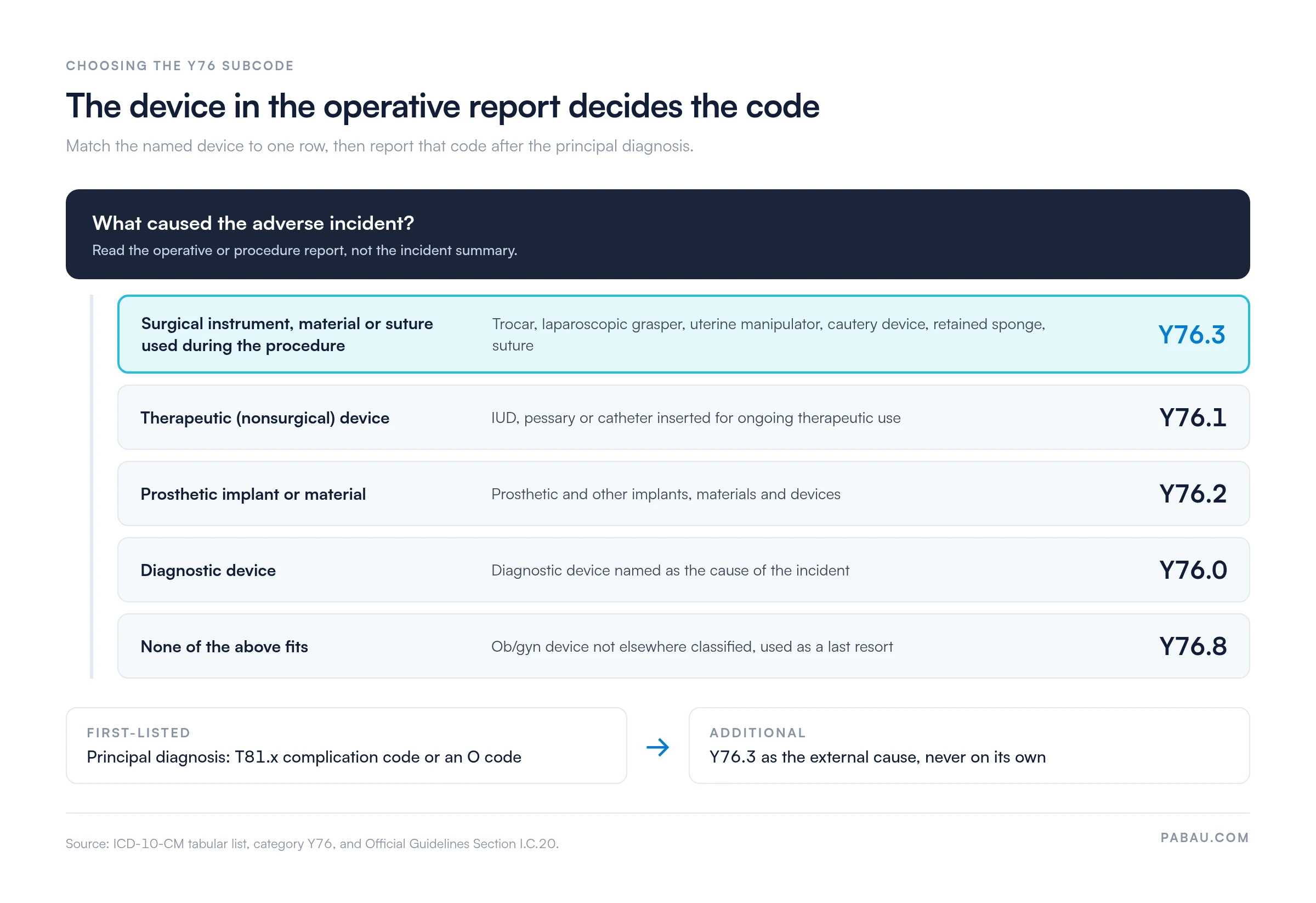
Y76.3 is used across a defined range of obstetric and gynecological procedure types. Each scenario below includes the appropriate principal diagnosis code that must appear alongside Y76.3. Capturing structured procedure data at the point of care makes this pairing more reliable than retrospective chart review.
In all five scenarios, the operative or procedure report must name the specific instrument or material. Without that documentation, the coder cannot select Y76.3 over a sibling code or a non-Y76 external cause code.
ICD-10-CM guidelines require the medical record to support every code submitted on a claim. For Y76.3 specifically, the medical record must contain all of the following before the code can be assigned.
The NCHS ICD-10-CM Official Guidelines (Section I.C.20) say external cause codes apply throughout the episode of care. If the condition from the adverse incident persists across encounters, the code stays on each one. Document Y76.3 on each relevant claim, not only on the initial admission record. Consistent external cause documentation across encounters reduces query rates at audit.
Run a pre-bill documentation check against three questions: (1) Does the operative report name a surgical instrument or material? (2) Does the physician note explicitly link that instrument to the adverse event? (3) Is there a principal diagnosis code that describes what happened to the patient? If any answer is no, query the record before submitting – a denial is cheaper to prevent than to appeal.
Medicare, Medicaid, and commercial payers share one firm rule: Y76.3 is always a secondary code. No payer accepts it as a standalone or first-listed diagnosis. Submitting it without a valid principal ICD-10-CM diagnosis code results in a denial. Check the payer-specific rules below before submission.
The CMS ICD-10 coding page points facilities to their own external cause reporting policy alongside the official guidelines. Check whether your facility mandates Y-code reporting on every applicable claim or only on inpatient encounters.
Denials on Y76.3 claims cluster around six recurring patterns. Each has a specific corrective action. Ob/gyn denial workflows should include a Y76 audit trigger for any claim that returns with an external cause code edit.
Clean claim checks before the initial filing prevent most of these. A coding audit that cross-checks the operative report against the submitted codes catches the sibling-code and missing-pair errors before the claim leaves the practice.
Pairing Y76.3 correctly starts with the patient’s resulting clinical condition. Y76.3 then goes on the claim as the external cause.
Follow this sequence:
External cause codes like Y76.3 operate under a specific set of rules in the ICD-10-CM Official Guidelines (Section I.C.20). Coders applying Y76.3 should follow these guidelines alongside any facility-specific external cause reporting policy.
External cause codes add context to a claim rather than drive reimbursement. Y76.3 does not change the payment rate; it creates an accurate morbidity record that supports quality reporting, liability documentation, and payer audit defense.
Flag any Y76.3 claim for a secondary review before submission if the operative report uses vague language such as ‘equipment difficulty’ or ‘instrument issue.’ These phrases do not establish sufficient specificity to support the code. Query the surgeon for a documented addendum naming the specific instrument and describing the adverse incident clearly.
In many ob/gyn practices, the coder reads the operative report days after the procedure and keys the principal diagnosis and Y76.3 by hand. That manual step is where the missing-pair and wrong-sibling denials above start.
Practice management software like Pabau keeps the operative note, the patient record and the claim in one system. Its claims management software lets coders build multi-code claim templates, so the principal code and Y76.3 travel together.
Claims then route through Claim.MD, Pabau’s US clearinghouse partner, which connects to more than 4,000 payers. It verifies eligibility in real time and catches missing principal diagnoses and code-year mismatches before submission.

Pabau supports obstetric and gynecological practices with structured clinical documentation, multi-code claim building, and clearinghouse integration through Claim.MD. See how it reduces coding errors at the point of care.

Treat Y76.3 as a documentation job before it becomes a coding job. When the operative report names the instrument and the surgeon links it to the incident, the subcode and the pairing follow from the chart.
The trade-off is a pre-bill query on every vague report. It slows the claim down, but it costs less than appealing a denial on a code that never changes the payment.
Book a demo to see how Pabau keeps ob/gyn operative notes and claims in one record, so Y76.3 leaves the practice correctly paired.

Need to understand how claims reach payers after coding? Medical claims clearinghouse guide covers how clearinghouses validate, route, and confirm electronic claims.
Seeing repeated denials on complication codes? Denial codes in medical billing decodes the most common CARC and RARC codes returned on rejected claims.
Want to understand the full billing compliance framework? Revenue cycle management overview explains how coding, submission, and payment fit together in a compliant workflow.
Building a denial workflow for your team? Denial management in healthcare shows how to track, fix and prevent recurring claim rejections.
Want fewer claims coming back at all? What a clean claim is lists the checks a claim needs to pass on first submission.
ICD-10 Code Y76.3 is the external cause code for adverse incidents involving surgical instruments, materials, and devices (including sutures) used during obstetric and gynecological procedures. It belongs to category Y76 in Chapter 20 (V00-Y99, external causes of morbidity). It documents the cause of a complication, not the complication itself.
Yes, Y76.3 is a billable, specific ICD-10-CM code valid for FY2025 and FY2026. It can’t be a standalone principal diagnosis. It always appears as an additional code after a principal diagnosis describing the patient’s resulting condition.
The device type separates them. Y76.1 covers therapeutic and nonsurgical devices, such as an IUD causing injury. Y76.3 covers surgical instruments and materials used during a procedure, such as a retained sponge or a laparoscopic trocar. Y76.8 is for miscellaneous obstetric or gynecological devices not classified elsewhere. The operative report’s description of the device decides which code applies.
Add Y76.3 whenever the record names a surgical instrument, material, or device from an ob/gyn procedure as the cause of an adverse incident. Report it on each later encounter too if the resulting condition persists, per ICD-10-CM Section I.C.20 guidelines.
There are six common denial reasons. Three are coding errors: Y76.3 listed as the principal diagnosis, the wrong sibling code (Y76.1 or Y76.8), and no paired principal diagnosis at all. The other three are an operative report that doesn’t link the instrument to the event, an outdated code year, and a payer excluding Y-codes. Each has a corrective action in the denial section above.
Yes, always. Y76.3 is an external cause code and can’t be a first-listed diagnosis under any payer policy. The principal position needs an ICD-10-CM diagnosis code, typically a T81 complication code or an obstetric O code. Y76.3 then follows as the external cause.