ICD-10 Code Y76.0: Diagnostic obstetric and gynecological devices
ICD-10 Code Y76.0: Definition and billable status ICD-10 Code Y76.0 is a valid, ...

Last Updated: Oct 23, 2026
Billable Code Specific Code
V02.00XA is the billable ICD-10-CM code for pedestrian on foot injured in collision with two- or three-wheeled motor vehicle in nontraffic accident, initial encounter. It covers a person walking or standing who is struck by a motorcycle, moped or motor scooter anywhere off a public highway.
Assignment turns on three documented facts. The patient was on foot, the vehicle was a motorized two- or three-wheeler, and the collision happened away from a public road. A public-road collision moves to V02.10XA, and a bicycle collision moves to V01.00XA.
Let Pabau's smart automation suggest the right codes, reduce claim denials, and keep your practice compliant—effortlessly.
Automate repetitive tasks and focus on what matters most—your patients.
Reduce coding errors and ensure compliance with the latest regulations.
Clean claims, fewer denials, and faster reimbursements.
Powerful insights and reporting to help your practice thrive.
HIPAA compliant SOC 2 certified GDPR-compliant Trusted by 4,000+ clinics worldwide

V02.00XA is a billable ICD-10-CM external cause code for a pedestrian on foot hit by a motorcycle, moped or motor scooter in a nontraffic accident.
Nontraffic means the collision happened entirely off a public highway, such as in a driveway, parking lot or farm yard. The traffic version is V02.10XA.
The striking vehicle decides the category. A pedal cycle is V01, a car or van is V03, and an animal-drawn vehicle is V06.
A person on foot hit by a standing e-scooter rider is coded V00.031A. A pedestrian riding a standing e-scooter who is hit by a motorcycle is V02.031A.
The seventh character A marks active treatment. Use V02.00XD for routine healing visits and V02.00XS for sequela visits.
V02.00XA is never the first-listed code. Sequence it after the nature-of-injury S-code, then add Y92, Y93 and Y99 codes where documented.
ICD-10 code V02.00XA identifies a pedestrian on foot injured by a two- or three-wheeled motor vehicle in a nontraffic accident, at the initial encounter. It is a valid, billable ICD-10-CM code for dates of service on or after October 1, 2015.
In plain terms, a motorcycle, moped or motor scooter struck someone who was walking or standing somewhere other than a public highway. The table below holds the reference data a coder needs.
Confirm the descriptor in the CDC/NCHS ICD-10-CM web tool, which reflects the current fiscal year’s tabular list.
V02.00XA applies when a motorcycle, moped or motor scooter strikes a person on foot away from a public highway, and the visit involves active treatment. All three elements below must be in the documentation.
Most miscoding starts with the vehicle word in the chart. “Scooter” can mean a seated motor scooter, which is V02, or a standing e-scooter, which ICD-10-CM treats as a pedestrian conveyance. “Bike” can mean a motorcycle or a pedal cycle, and a pedal cycle collision is V01.
ICD-10-CM groups motorcycles, mopeds and motor scooters as two-wheeled motor vehicles, with a sidecar counted as part of the motorcycle. Motorized tricycles and three-wheeled motor cars form the three-wheeled group.
Vehicles without an engine sit in other categories. A pedal cycle collision is V01, and a collision with an animal-drawn or other nonmotor vehicle is V06.
A patient on a skateboard struck by a pedal cycle also lands in V01. At a follow-up visit, with traffic status undocumented, the code is V01.92XD.
V02 only covers the pedestrian, so the rider of that vehicle codes elsewhere. A motorcycle rider hit by a nonmotor vehicle off a public highway, with no driver or passenger detail, takes V26.29XS at a sequela visit.
A nontraffic accident is any vehicle accident that occurs entirely in a place other than a public highway. If any part of the event happened on a public highway, it is a traffic accident and the code becomes V02.10XA.
When the note does not say where the collision happened, V02.90XA covers the unspecified case. Query the provider first, because a one-line location note usually settles the choice.
The seventh character in V02.00XA signals the phase of care, not the severity of the injury. Section I.C.20 of the CMS ICD-10-CM Official Guidelines assigns an external cause code with the seventh character that matches each encounter.
The most common seventh-character error is keeping XA for the whole episode of care. Once active treatment ends and visits shift to healing and recovery care, switch to V02.00XD. The S-code’s seventh character changes at the same point.
Three facts separate V02.00XA from its neighbors. They are the vehicle that struck the patient, whether the patient was on foot, and whether the collision touched a public highway. Ask about them in that order, as the decision path below does, and the table after it gives each neighboring code in full.
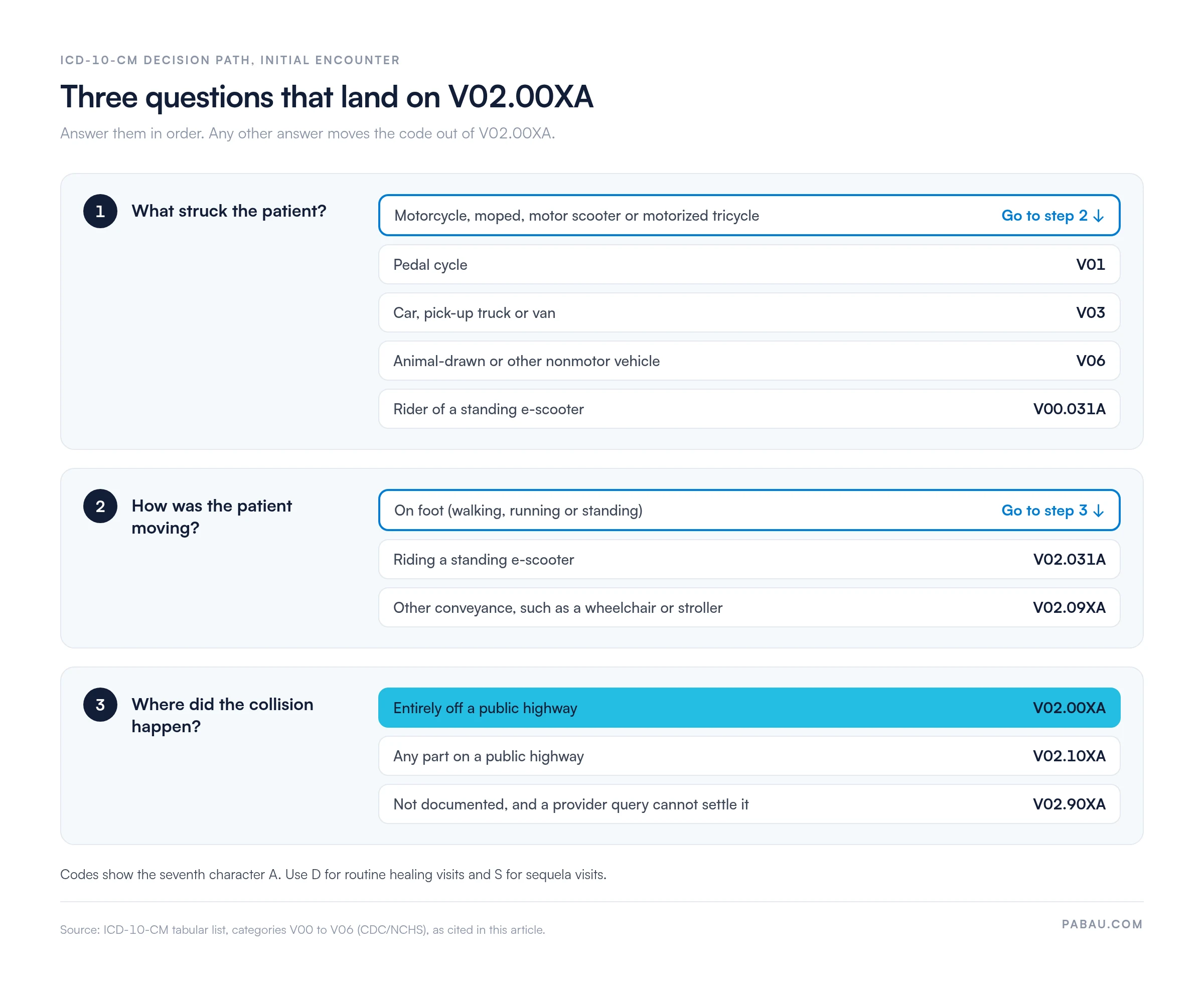
The e-scooter rows cause the most confusion. ICD-10-CM treats a standing e-scooter as a pedestrian conveyance, so its rider is still a pedestrian. A person on foot hit by one is coded in V00, not V02. See the AAPC Codify ICD-10-CM lookup for the full V02 subcategory list.
The V02 category is defined by who was hurt, what hit them and where it happened. Check the boundaries below before you assign V02.00XA, because a mismatch between the note and the code is what auditors flag most often.
A patient riding the animal is not a pedestrian, so neither V02 nor V06 applies. A transport accident with a military vehicle at the initial encounter is ICD-10 code V80.910A.
Location drives more audit findings on this code than the vehicle does. The record should name the place, such as “hit by a motorcycle in the apartment parking lot.” Without it, the nontraffic assignment is hard to defend.
Under Section I.C.20 of the ICD-10-CM Official Guidelines, an external cause code is never the principal or first-listed diagnosis. V02.00XA follows the nature-of-injury code. Build the code set in the order below.
A pedestrian struck while out walking in their free time takes Y99.8 as the status code. There is no national requirement to report external cause codes, but many states and payers mandate them. Never submit V02.00XA alone or first on a claim, because claim edits reject an external cause code in the first-listed position.
Accurate billing for V02.00XA starts in the clinical note. The record must support each element of the code, and missing detail is the usual reason external cause codes fail audit. Capture these elements at the point of care, while the patient can still describe the scene.
Payer handling of V02.00XA varies by program, so check the rules before you submit. Clearinghouse edit checks within your billing workflow catch sequencing errors before the claim reaches the payer.
A clearinghouse that validates ICD-10-CM code sets before transmission catches a missing S-code or an invalid code combination. Review what your claims management software can check for external cause codes.

Filter your remittance reports each month for claims that carry a V-code. Check that an S-code is present and sequenced first on each one. Most external cause rejections trace back to a missing or misordered injury code.
V02.00XA denials follow patterns that a billing team can fix with a targeted workflow. The table maps each denial reason to its root cause and correction. Fix the documentation habit behind each denial as well, or the same rejection comes back on the next accident claim.
The medical billing denial codes reference covers the CARC codes most often returned on these rejections. Those include CARC 16 (claim lacks information) and CARC 11 (diagnosis inconsistent with the procedure). A clean claim for accident-related encounters, with the full code set in order, prevents most of these patterns.
Most V02.00XA errors begin when a note says “hit by a scooter” and a coder has to guess the rest weeks later. The vehicle type, the location and the encounter phase get lost between the exam room and the claim.
Practice management software like Pabau keeps the clinical note and the claim in one patient record. Coders see the documented vehicle and location beside the codes, and Pabau’s Claim.MD integration validates code combinations before submission.
The outcome is fewer rejections for a missing S-code or a traffic status that contradicts the chart. Your billing team spends less time on rework, and accident claims get paid on the first pass more often.

Pabau connects clinical documentation to claims submission, so your team captures the right ICD-10-CM external cause codes at the point of care. Clean claims then go out through Claim.MD’s clearinghouse.

V02.00XA is the right code only when three facts line up in the record. The patient was on foot, a motorized two- or three-wheeler struck them, and the collision happened away from a public highway. Change any one of those facts and the code moves to V02.10XA, V00, V01, V03 or V06.
That makes accuracy on this code a documentation decision, settled when the clinician records the vehicle and the place. Pabau keeps the note and the claim in one record, so those details reach the coder intact. To see how that works for accident-related encounters, book a demo.

Need guidance on ICD-10-CM denial codes returned on accident claims? Denial codes in medical billing covers the CARC and RARC codes most commonly returned on external cause code rejections.
Want to understand how clearinghouse validation catches code errors before submission? Claim.MD pricing and features explains how real-time editing works for ICD-10-CM claim sets.
Looking for a structured overview of accident-related billing workflows? Superbill documentation covers how to build a complete claim package for trauma and accident encounters.
Seeing the same accident claim rejected twice? Denial management in healthcare shows how to trace a rejection back to its documentation cause.
Want accident claims paid on the first submission? What is a clean claim lists the checks a claim should pass before it leaves the practice.
ICD-10 code V02.00XA means a pedestrian on foot was hit by a two- or three-wheeled motor vehicle in a nontraffic accident, at the initial encounter. Typical vehicles are motorcycles, mopeds and motor scooters, and the collision happened off a public highway. It is an external cause code, sequenced after the nature-of-injury S-code.
The seventh character A marks the initial encounter, meaning the patient is receiving active treatment for the injury. Use it for visits such as emergency care, surgery or evaluation by a new physician. Switch to V02.00XD for routine healing and recovery visits, and to V02.00XS when treating a late effect of the injury.
Use V02.00XA when the collision happened entirely off a public highway, such as in a driveway or parking lot. Use V02.10XA when any part of it happened on a public highway. If the record gives no location, query the provider before falling back to V02.90XA.
Add a Y92 place of occurrence code when the record names the location, such as Y92.481 for a parking lot. Y93 activity and Y99 status codes follow where documented. There is no national mandate for these codes, but many states and payers require them.
V02.00XA is always a secondary code. Section I.C.20 of the ICD-10-CM Official Guidelines bars external cause codes from the principal or first-listed position. The nature-of-injury code, such as a fracture or laceration, comes first on the claim.
Motorcycles, mopeds and motor scooters are the two-wheeled motor vehicles in V02, and a sidecar counts as part of the motorcycle. Motorized tricycles count as three-wheeled motor vehicles. Pedal cycles go to V01, animal-drawn vehicles to V06, and a pedestrian struck by a standing e-scooter rider to V00.031A.