ICD-10 Code Y76.0: Diagnostic obstetric and gynecological devices
ICD-10 Code Y76.0: Definition and billable status ICD-10 Code Y76.0 is a valid, ...

Last Updated: Oct 23, 2026
Billable Code Specific Code
Y75.1 is the billable ICD-10-CM code for therapeutic (nonsurgical) and rehabilitative neurological devices associated with adverse incidents. It identifies an external neurostimulator, TMS device, TENS unit, or similar device as the cause of patient harm.
It sits in category Y75, which covers five device sub-types: diagnostic, therapeutic, prosthetic, surgical, and miscellaneous. Y75.1 is always a secondary code, reported after the injury or complication it explains.
Let Pabau's smart automation suggest the right codes, reduce claim denials, and keep your practice compliant—effortlessly.
Automate repetitive tasks and focus on what matters most—your patients.
Reduce coding errors and ensure compliance with the latest regulations.
Clean claims, fewer denials, and faster reimbursements.
Powerful insights and reporting to help your practice thrive.
HIPAA compliant SOC 2 certified GDPR-compliant Trusted by 4,000+ clinics worldwide

Y75.1 is a billable ICD-10-CM external cause code for therapeutic (nonsurgical) and rehabilitative neurological devices associated with adverse incidents.
It is never a principal or first-listed diagnosis. It is always sequenced as a secondary code, after the injury or complication code it explains.
The three most common denial triggers are Y75.1 sent as the primary code, no device named in the medical record, and the wrong Y75 subcategory.
Claims management software like Pabau helps coding teams track Y75-series claims and catch sequencing errors before submission.
ICD-10 Code Y75.1 is a billable external cause code for adverse incidents involving therapeutic (nonsurgical) and rehabilitative neurological devices. It is always reported as a secondary code, after the injury or complication code it explains. Every field below reflects the FY2026 ICD-10-CM Tabular List as published by CMS.
Y75.1 covers adverse incidents caused by neurological devices used for therapeutic or rehabilitative purposes without surgical intervention. The descriptor has four meaningful components, and each one affects subcategory selection.
The test is simple. If a neurological device was in therapeutic or rehabilitative use when the patient was harmed, Y75.1 is the correct external cause subcategory.
Y75.1 sits inside Chapter 20, which covers all external causes of morbidity from V00 through Y99. Understanding the full chain from chapter to subcategory prevents coders from mis-routing claims to the wrong block or category.
The Y70-Y82 block is what matters for day-to-day coding decisions. When an adverse incident involves a medical device used in diagnosis or treatment, the coder first selects the specialty category. For neurological devices that is Y75, and the device-use subcategory comes next. This two-step navigation is where most subcategory errors happen.
A single incident can involve devices from two specialties. When an ENT diagnostic device contributes to the same event, it codes to Y72.0, which is reported alongside Y75.1 rather than replacing it.
The Y75 category contains five subcategories, and each one turns on what the device was doing when the incident happened. The table below covers the full set.
The Y75.1 vs. Y75.2 decision point: A deep brain stimulator (DBS) falls under Y75.2 once implanted, because it is a prosthetic device. Y75.1 applies to external neurostimulation devices used therapeutically without implantation surgery. The chart below runs the same purpose test across all five subcategories.
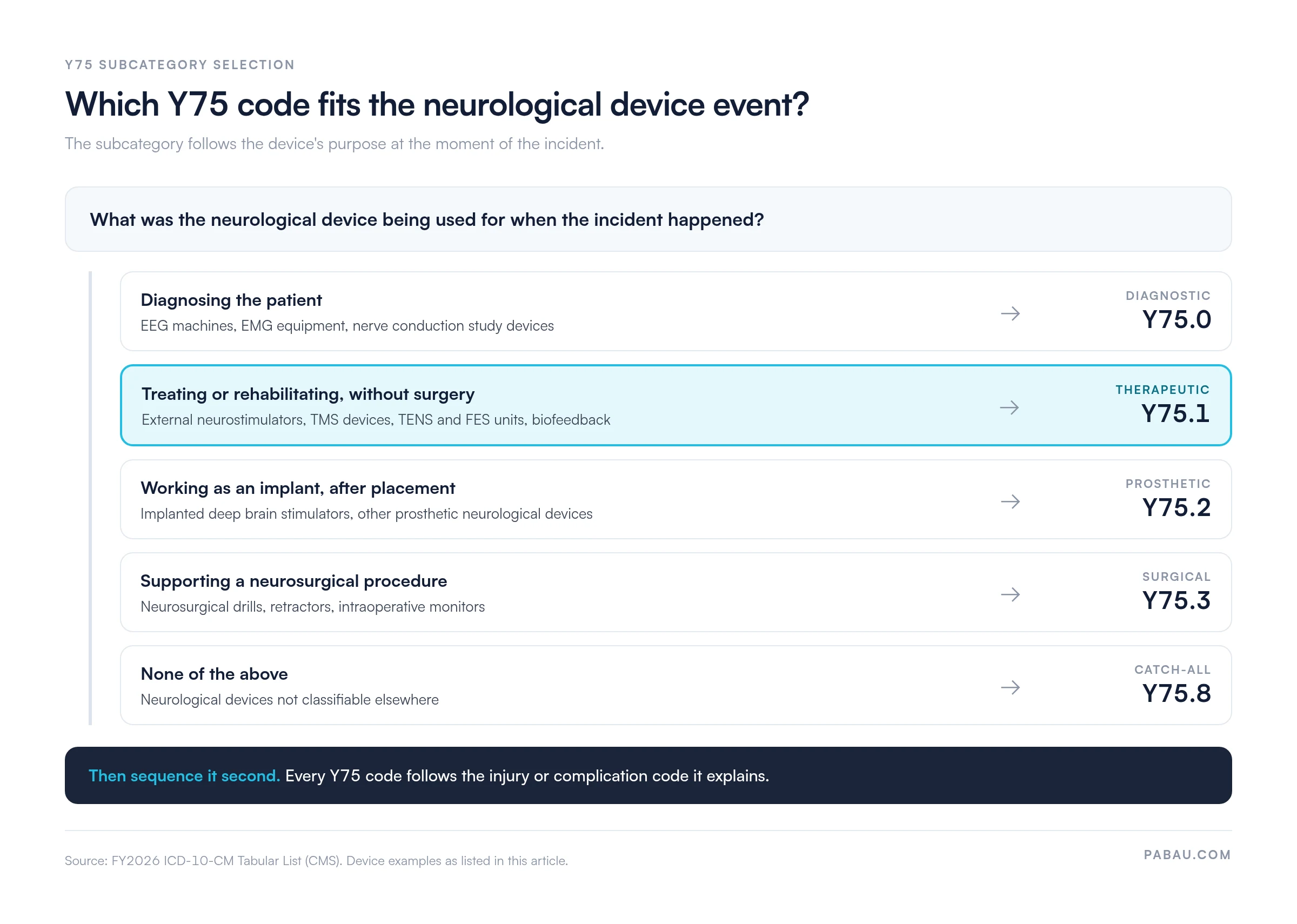
The following device types most commonly generate Y75.1 claims. Each mapping shows the device, the typical adverse incident type, and why Y75.1 applies rather than a sibling code.
What does NOT fall under Y75.1: An EEG device malfunction codes to Y75.0 (diagnostic). A deep brain stimulator migration after implantation codes to Y75.2 (prosthetic implant). A neurosurgical retractor issue codes to Y75.3 (surgical instrument).
The ICD-10-CM Official Guidelines for Coding and Reporting, Section I.C.20, govern all Chapter 20 external cause code assignments. Three rules apply without exception to Y75.1.
When device documentation is incomplete, query the treating provider before you assign any Y75 code. Never assume the device type from context alone.
Five codes and code groups are easy to confuse with Y75.1. The table below gives the decision rule for each one.
There is no official ICD-9-CM equivalent for Y75.1. The CMS General Equivalence Mappings (GEMs) contain no backward crosswalk record for this code, so any ICD-9-CM code presented as its match is unofficial.
Legacy ICD-9-CM data involving a neurological device event has to be recoded from the medical record. Always assign Y75.1 from the chart, using the current-year tabular list.
Verify Y75.1 against the official CMS ICD-10-CM tabular release each October. Annual updates occasionally affect Y-code descriptors and block assignments. Add a calendar reminder for the FY update each fiscal year.
Payers audit Y75.1 against the chart, so the record must support every element of the descriptor. The checklist below reflects the documentation payers expect behind clean claim submission.
Pre-coding chart review shortcut: Ask four questions before assigning Y75.1. If any answer is no, query the provider before coding.
Y75.1 is a supplementary external cause code. No payer, including Medicare, reimburses based on Y-codes alone. Y75.1 generates no direct payment.
Payers use Y75.1 for three purposes:
Several US states require external cause codes on outpatient claims as a condition of Medicaid and commercial payment. Requirements vary by state, so check current state Medicaid rules before treating Y75.1 as optional on outpatient encounters.
Claims involving Y75.1 are denied for predictable reasons. Each denial below has a documented root cause and a corrective action.
A review step that flags Y-code sequencing errors before submission prevents most of these denials. Reviewing medical billing denial codes helps coding teams map payer CARC codes back to the root cause in the original claim.
Without a check before submission, a Y75.1 sequencing error usually comes back as a denial. The coder then reworks the claim, chases the provider for device details, and resubmits.
Practice management software like Pabau includes error-checking claims management software that reviews code pairing and sequencing before the claim leaves your practice. Pabau also connects to the Claim.MD clearinghouse, which screens each claim again before it reaches the payer.
Denials are tracked by root cause. A team that keeps landing on the wrong Y75 subcategory can see the pattern and fix it at the documentation stage.

Pabau’s claims management software validates code sequencing, flags Y-code pairing errors, and tracks denials by root cause. Your team can then fix the patterns behind repeat rejections.

Y75.1 has a narrow job. It tells the payer that a therapeutic or rehabilitative neurological device, used without surgery, caused the harm the primary code describes.
Two habits prevent the costliest Y75.1 errors. Confirm the device and its purpose in the chart before you pick a subcategory, and keep the code out of the first diagnosis position.
Build both checks into claim review and Y75.1 becomes a routine secondary code. Book a demo to see how Pabau catches external cause sequencing errors before your claims go out.

Need to understand how claim denials are categorized? Denial codes in medical billing covers CARC and RARC denial code structures used by payers when rejecting claims with sequencing errors.
Want to understand the clearinghouse role in claim validation? Medical claims clearinghouse explains how clearinghouses screen external cause code pairing errors before claims reach the payer.
ICD-10 Code Y75.1 is a billable external cause code that identifies therapeutic (nonsurgical) and rehabilitative neurological devices as the cause of a patient adverse incident. It is always used as a secondary supplementary code alongside a primary code describing the resulting injury or complication.
Assign Y75.1 when a neurological device in therapeutic or rehabilitative use, without surgery, causes an adverse incident. Sequence the primary complication or injury code first. It applies to external neurostimulators, TMS devices, biofeedback units, and TENS units in neurological applications.
Y75.1 covers therapeutic or rehabilitative neurological devices used without surgery. Y75.3 covers surgical instruments and devices used during a neurosurgical procedure. If the adverse incident occurred during an operative case, use Y75.3. If the device was used non-surgically for treatment or rehabilitation, use Y75.1.
Y75.1 is always a secondary (supplementary) code. Per ICD-10-CM Official Guidelines Section I.C.20, external cause codes in Chapter 20 are never sequenced as the principal or first-listed diagnosis. A primary injury, complication, or adverse effect code must appear before Y75.1 on the claim.
There is no official ICD-9-CM equivalent of Y75.1. The CMS General Equivalence Mappings contain no backward crosswalk record for this code. Code it from the current-year medical record instead of converting from an ICD-9-CM code.
The most common denial reason is sequencing Y75.1 as the principal diagnosis, which external cause codes cannot be. Other triggers include thin device documentation and the wrong Y75 subcategory. A principal diagnosis that does not clinically fit a neurological device adverse incident also gets denied.