ICD-10 Code S42.444P: Medial epicondyle fracture, right humerus
ICD-10 Code S42.444P: full descriptor and code validity ICD-10 Code S42.444P car...

Last Updated: Oct 13, 2026
Billable Code Specific Code
T87.2 is the billable ICD-10-CM code for complications of other reattached body part.
In short, what follows is the hierarchy, the body parts it covers, the documentation a payer expects, and the CPT codes it usually travels with.
Let Pabau's smart automation suggest the right codes, reduce claim denials, and keep your practice compliant—effortlessly.
Automate repetitive tasks and focus on what matters most—your patients.
Reduce coding errors and ensure compliance with the latest regulations.
Clean claims, fewer denials, and faster reimbursements.
Powerful insights and reporting to help your practice thrive.
HIPAA compliant SOC 2 certified GDPR-compliant Trusted by 4,000+ clinics worldwide

ICD-10 Code T87.2 describes complications of other reattached body parts (not upper or lower extremities) and is billable for FY 2026.
T87.2 sits under parent code T87, within ICD-10-CM chapter S00-T88 covering injury and external cause consequences.
Reattachment complications take T87.0 through T87.2, while amputation stump complications take T87.3 through T87.9.
Documentation must specify the body part involved, the nature of the complication, and its relationship to the reattachment procedure.
Practice management software like Pabau keeps the T87.2 documentation and the claim submission on one record.
ICD-10 Code T87.2 is a billable ICD-10-CM diagnosis code. Its full descriptor reads “Complications of other reattached body part.” The word “other” does real work here. Specifically, it rules out upper extremity reattachments (T87.0x) and lower extremity reattachments (T87.1x). Instead, T87.2 covers reattached parts outside those two groups, such as the ear, the nose, or the scalp.
The CDC/NCHS ICD-10-CM web tool confirms T87.2 in the 2026 tabular list. So coders can use it to verify annual validity before submitting any T87 series claim.
T87.2 sits three levels deep in the ICD-10-CM structure. Because of that structure, selecting the most specific available code is a requirement of the ICD-10-CM Official Guidelines. As a result, stopping at a parent-level code is a common trigger for denials.
T87 itself is not billable. So always assign T87.2, or another specific subcategory, rather than stopping at the parent. In other words, use the most granular code the documentation supports. Where the reattached part was a right arm, that code is T87.0X1.
The T87 category carries an Includes note and an Excludes2 note in the tabular list. Together, both shape what you may report alongside T87.2.
Excludes2 means the two conditions can coexist. So a record documenting an amputation status alongside a T87 complication may carry Z89.- as well. Similarly, where the provider documents infection or necrosis as a separate condition, code that separately too.
Verify these notations annually against the CMS ICD-10-CM code files, which are updated each October 1 with the new fiscal year edition.
T87.2 is one of several subcategories under T87. So knowing the sibling set prevents miscoding when the affected part turns out to be an upper or lower extremity. For instance, replanted limbs carry the laterality extensions on T87.0 and T87.1, which T87.2 does not have. A complication of a left leg reattachment takes T87.1X2.
T87.2 carries no laterality extensions, so it does not distinguish right from left. The structures it covers sit outside the extremity subcategories that use those extensions. Even so, document the specific body part in the chart note anyway.
T87.2 covers post-reattachment complications in body parts that fall outside the upper and lower extremity definitions. For instance, the reattachment may follow traumatic avulsion, surgical excision, or replantation after an amputation injury. Complications coded to T87.2 include, but are not limited to:
Body parts coded under T87.2 most often include the ear, the nose, and scalp segments. Additionally, facial structures that don’t map to the extremity subcategories belong here too. Either way, the provider note must name the reattached structure and the complication observed.
Replantation-related complications carry a classification nuance. Not every complication of a replanted part falls under T87. If the complication is infection of a traumatic wound, a different code may apply. Instead, that turns on whether the record ties the infection to the reattachment procedure itself. The WHO ICD-10 browser gives definitional context for telling wound complications from reattachment-specific ones.
When a complication follows ear or nose replantation, read the operative and progress notes together. Confirm they attribute the complication to the reattachment procedure, and document that link before assigning T87.2. A note that says only ‘wound infection’, with no reference to the prior reattachment, will not support the code.
Payer audits on T87 codes frequently cite insufficient documentation as the reason for denial. For ICD-10 Code T87.2, the provider note must contain four elements to support clean claim submission. As a result, getting one of them wrong sends the claim into review, or triggers a denial that someone has to appeal by hand.
Laterality should still appear in the medical record, even though the T87.2 code itself does not capture it. Payers apply analytics to flag records where laterality is absent, so a complete record protects against a retrospective audit. In fact, these habits carry over to every other code in the ICD-10 diagnostic codes library.
Four errors show up repeatedly in the T87 group. Fortunately, each one is catchable before the claim goes out.
The ICD-10-CM Official Guidelines also require correct sequencing of complication codes. When T87.2 is the reason for the encounter, it leads the code string as the principal diagnosis. If the patient presents for another primary reason, T87.2 becomes a secondary diagnosis. As a result, accurate sequencing supports clean claim submission and reduces medical necessity denials.
Because T87.2 describes a complication of a prior reattachment, it appears most often on follow-up and post-surgical encounters. Which procedural codes sit beside it depends on the service performed at that visit. For example, active wound care at a reattachment site is reported under 97597, with the treated surface area documented. The pairings below are commonly observed combinations, not a coverage guarantee, so payer policies and local coverage determinations still decide individual encounters.
Practice management software like Pabau connects to Claim.MD for US payers. That link submits the claim, runs real-time eligibility checks, and returns the electronic remittance advice for reconciliation. As a result, Pabau’s claims management software keeps the diagnosis and the procedure codes for each post-reattachment visit on one record.
The most common selection error in the T87 group is mixing up reattachment codes with amputation stump codes. The diagram below cuts the choice down to two questions. What was the prior procedure, and which body region did it involve?
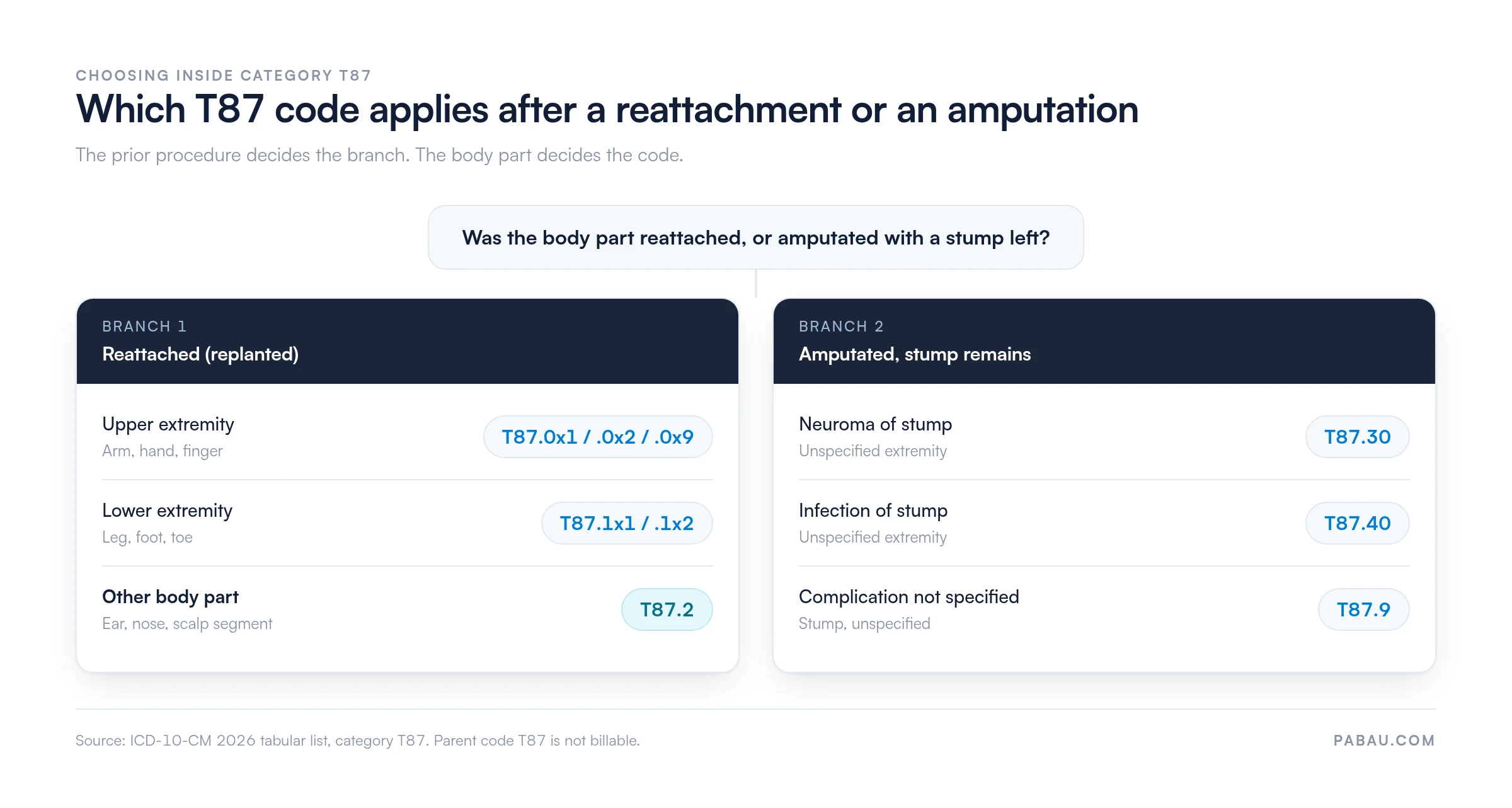
The table adds the laterality rule and the procedure type behind each option.
The clinical distinction rests on the underlying procedure. T87.2 applies when the body part was reattached, or replanted. T87.40 through T87.9 apply when the part was amputated and the residual stump is now giving trouble. So they are not interchangeable.
Build a quick-reference sheet for your coding team. Reattachment, meaning replantation, points to T87.0 through T87.2. Amputation with a retained stump points to T87.3 through T87.9. Pin it up at each coding workstation. That one distinction removes the most common T87 miscoding pattern.
Post-reattachment follow-up visits are usually outpatient encounters billed under evaluation and management (E&M) codes, with T87.2 as the supporting diagnosis. Payers assess medical necessity from the complexity documented, so the note drives the level you can defend. In other words, the diagnosis code is only half of it. Beyond that, the E&M level has to hold up on the documented medical decision-making.
Electronic submission is where the time gets saved. First, a clearinghouse routes the claim to the payer, returns the acceptance or rejection, and posts the remittance back for reconciliation. Then, tracking those responses by code shows which payers question T87.2, and what they ask for when they do.
In most practices the operative note lives in the chart and the claim gets rebuilt somewhere else. A coder reads the note, types the diagnosis and procedure codes into a billing tool, and the two records drift apart. When a payer asks what supported T87.2, someone goes looking in two systems.
Pabau holds the encounter, the clinical note, and the codes on the same client record. Claims go out to US payers through the Claim.MD integration, which also runs real-time eligibility checks and brings the remittance advice back in. As a result, nothing gets retyped between the chart and the claim.
So when a T87.2 follow-up is queried, the documentation behind it is attached to the encounter it came from. Your coder answers from one screen instead of reconstructing the visit.

Pabau stores the clinical note, the diagnosis codes, and the claim on the same client record, then submits to US payers through Claim.MD. Your team answers a payer query without switching systems.

ICD-10 Code T87.2 is a precise code for a narrow situation. It covers complications of a reattached body part outside the upper and lower extremity categories. Still, the hard part is not the code. Instead, it is the note that has to name the structure, the complication, and the link between them.
Ask one question before you assign anything in this category. Was the part reattached, or amputated? Answer that, and the rest of T87 falls into place.
If your coders rebuild claims from notes they cannot see, that is a systems problem rather than a coding one. Book a demo to see how Pabau keeps reattachment documentation and claim submission on the same record.

Need guidance on clean claim submission? Clean claim best practices covers the documentation and coding standards that reduce first-pass denial rates.
Managing post-surgical billing compliance? Medical billing compliance outlines the framework for audit-resistant ICD-10 and CPT coding practices.
Want to understand clearinghouse workflows? Medical claims clearinghouse overview explains how electronic claim validation works before a claim reaches the payer.
ICD-10 Code T87.2 is a billable diagnosis code for complications of other reattached body part. It applies after replantation or reattachment of structures that are not upper extremities (T87.0) or lower extremities (T87.1). Examples include the ear, the nose, and the scalp. The code is valid for fiscal year 2026 under the ICD-10-CM classification maintained by CMS and NCHS.
Yes. T87.2 is a billable ICD-10-CM code that can be used for reimbursement. Its parent category T87 is not billable, so payers accept the subcategory code instead. It has been valid since at least the 2019 edition and remains valid in the 2026 edition, effective October 1, 2025.
T87.2 covers reattached body parts that fall outside the upper and lower extremity definitions in the ICD-10-CM tabular list. This typically includes the ear, nose, scalp, and other facial or truncal structures that were traumatically avulsed and surgically reattached. Fingers, hands, arms, toes, feet, and legs use T87.0 or T87.1 with laterality extensions instead.
T87.2 applies to complications of a reattachment procedure (the body part was replanted). T87.40 applies to infection of an amputation stump (the body part was amputated and not reattached, leaving a residual stump). The distinction turns on whether the prior procedure was replantation or amputation. These codes are not interchangeable and must be selected based on the documented surgical history.