ICD-10 Code S42.444P: Medial epicondyle fracture, right humerus
ICD-10 Code S42.444P: full descriptor and code validity ICD-10 Code S42.444P car...

Last Updated: Oct 13, 2026
Billable Code Specific Code
T87.0X9 is the billable ICD-10-CM code for complications of reattached (part of) unspecified upper extremity.
This page walks the T87 hierarchy, the laterality rules, and the documentation a payer expects behind the claim. It also covers the ICD-9-CM crosswalk that legacy systems still map against.
Let Pabau's smart automation suggest the right codes, reduce claim denials, and keep your practice compliant—effortlessly.
Automate repetitive tasks and focus on what matters most—your patients.
Reduce coding errors and ensure compliance with the latest regulations.
Clean claims, fewer denials, and faster reimbursements.
Powerful insights and reporting to help your practice thrive.
HIPAA compliant SOC 2 certified GDPR-compliant Trusted by 4,000+ clinics worldwide

T87.0X9 is a billable ICD-10-CM code for complications of reattached (part of) upper extremity, unspecified upper extremity, effective October 1, 2025.
Use T87.0X9 only when laterality is genuinely undocumented. If the operative report names the right or left arm, use T87.0X1 or T87.0X2 instead.
T87.0X9 belongs to the T87 group for complications of reattachment and amputation. Sibling codes T87.3 through T87.9 cover complications of an amputation stump.
The FY 2026 tabular list carries no Includes, Applicable To, Excludes1 or Excludes2 note at T87, T87.0 or T87.0X.
Practice management software like Pabau pulls the codes already on the encounter into a pre-filled claim, then tracks the remittance that comes back.
ICD-10 code T87.0X9 describes complications of reattached (part of) upper extremity, unspecified upper extremity. It is a billable, specific ICD-10-CM code that can be reported for reimbursement. The seventh position carries the laterality, which is where most of the assignment decisions in this subcategory are made.
The FY 2026 edition of ICD-10-CM T87.0X9 became effective on October 1, 2025. This is the American ICD-10-CM version. International readers should cross-reference the WHO ICD-10 browser for the equivalent entry.
T87.0X9 belongs to the T87 category, which covers complications peculiar to reattachment and amputation. Understanding the full T87 hierarchy helps coders navigate to the correct code. It also heads off the common error of landing on T87.0X9 when a more specific laterality code exists.
The CMS ICD-10 codes page publishes the full tabular list annually. According to the FY 2026 edition, the T87 group is structured as follows.
T87.1, T87.3, T87.4, T87.5, and T87.8 are non-billable header codes. Coders must drill down to their sub-codes before a claim will pass. Under T87.8, for example, the billable children are T87.81 (dehiscence of amputation stump) and T87.89 (other complications of amputation stump). Verify the current sub-code structure with the CDC/NCHS ICD-10-CM web tool for the applicable fiscal year.
When the replanted limb was a leg rather than an arm, the assignment moves to T87.1. A complication of a reattached left lower extremity is reported as T87.1X2, while the right side takes T87.1X1.
The most common coding error in the T87.0 subcategory is using T87.0X9 when the record already documents which side was reattached. The ICD-10-CM Official Guidelines for Coding and Reporting require the most specific code the documentation supports. T87.0X9 is appropriate only when laterality is genuinely absent.
Use this laterality decision framework before assigning any T87.0X code.
A CDI query to the operating surgeon before the chart is finalized usually removes the need for T87.0X9 altogether. That one query also spares the practice the payer scrutiny that unspecified laterality codes attract. Once the side is confirmed, the claim carries T87.0X1 for the right arm or T87.0X2 for the left.
The FY 2026 ICD-10-CM tabular list carries no instructional notes at T87, T87.0, or T87.0X. There is no Includes note, no Applicable To list, and no Excludes1 or Excludes2 entry anywhere in the subcategory.
That is worth stating plainly, because code-reference sites often publish notes for T87 that the tabular does not contain. An Excludes1 note is what stops two codes appearing on the same claim, and T87 has none to trip over. So nothing in the tabular blocks T87.0X9 from being reported with another code. The documentation is the only constraint on the assignment.
T87.0X9 carries no “Code Also” or “Use Additional Code” instruction in the FY 2026 tabular either. Sequencing still follows the ICD-10-CM Official Guidelines. When the post-replantation complication is the reason for the encounter, it is generally sequenced first.
An underlying condition that complicates healing, such as diabetes, is then reported as an additional diagnosis. Do not infer sequencing rules beyond what the tabular states. Where the documentation supports several codes, check the Official Guidelines for the applicable principal diagnosis logic.
T87.0X9 covers post-replantation complications rather than amputation stump complications, and the two are easy to conflate. T87.3 through T87.9 describe a different clinical situation altogether. They deal with a residual limb after amputation, not with a limb that was put back on. The chart below traces both branches of the category to a billable code.
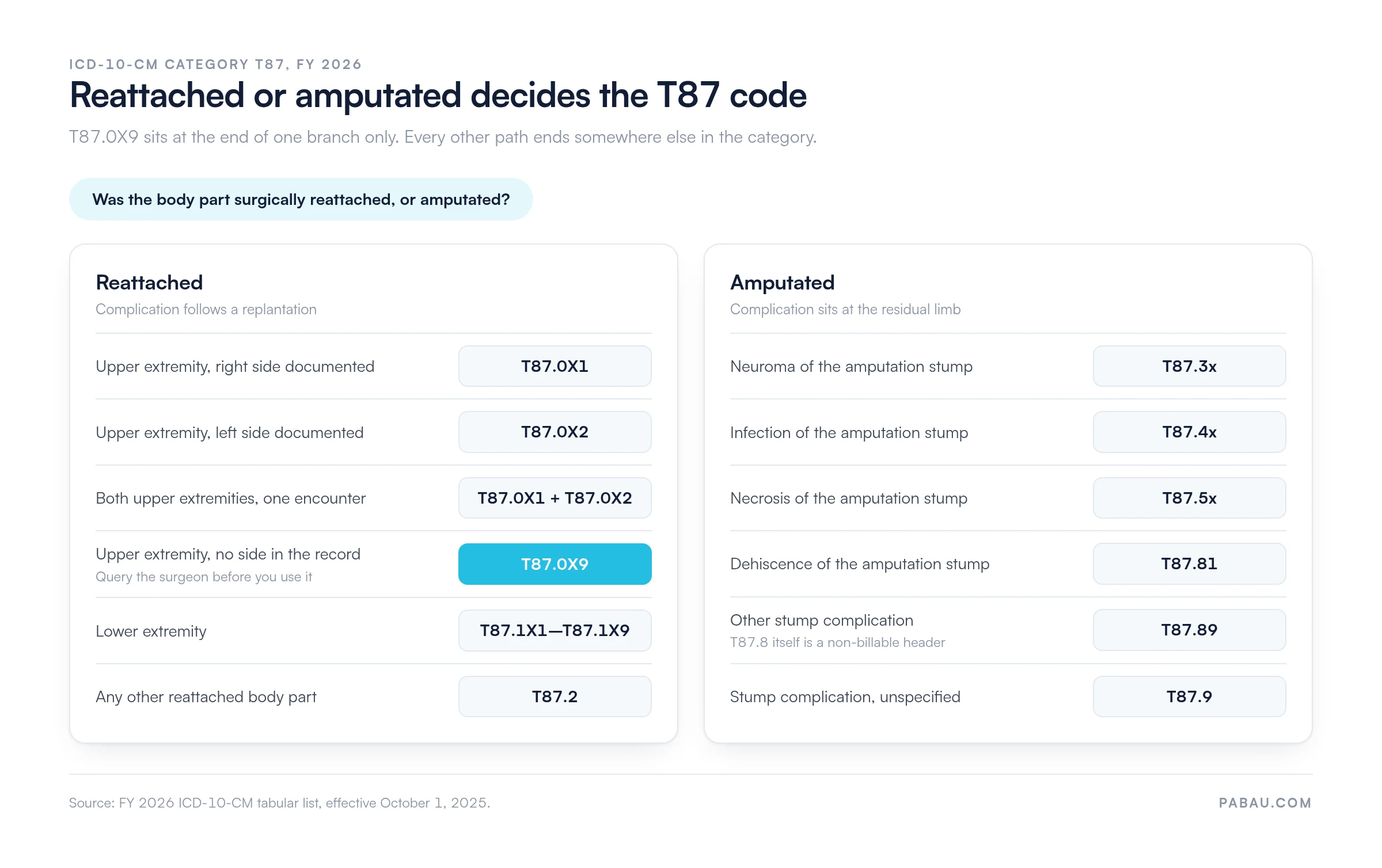
The clinical question to ask is whether the extremity was surgically reattached, or whether the patient has a residual limb from an amputation. If it was reattached, the T87.0 subcodes apply. If it was amputated, navigate to T87.3 through T87.9. Post-surgical rehabilitation caseloads regularly contain both.
Incomplete documentation is the primary driver of T87.0X9 claim denials. The chart has to support every element of the code, not the diagnosis alone. For T87.0X9, these are the minimum documentation requirements.
A coder should never have to assume laterality. When the side is missing, a CDI query to the provider is the correct step rather than a default to the unspecified code. The Official Guidelines put the query first and the unspecified code last.
The same handful of errors turns up across audits and denial reviews of the T87.0 subcategory. Each one below has a corrective action that stops it recurring.
Building these four checks into the pre-submission review reduces rework and protects the practice from retrospective audit risk.
Run a monthly audit of your T87.0X9 claims. Pull the operative report behind each one and check whether the side was documented after all. If a single claim comes back with laterality in the chart, the fix is a CDI query step before coding, not more coder training.
For legacy system mapping and historical record comparison, the approximate ICD-9-CM equivalent of T87.0X9 is 996.94 (Complications of reattached upper extremity, other and unspecified). The official CMS and CDC General Equivalence Mappings send all three T87.0X codes to that one ICD-9-CM code.
Watch for 996.90 in older mapping tables. That code covers a reattached extremity or body part that was never specified, so it is the wrong target for an upper-extremity code. The AAPC ICD-10-CM code lookup is useful for checking a single mapping in both directions.
Crosswalks stay approximate whichever tool produces them. Verify the mapping against the official GEM files, and confirm payer-specific requirements, before you rely on it for billing.
Laterality errors rarely start at the coder’s desk. The operative report sits in one system, the claim is keyed into another, and the remittance lands somewhere else again. By the time a T87.0X9 denial comes back, nobody can see how many other claims went out the same way.
Cutting down on those medical billing denial codes takes a shared record more than it takes another round of coder training. Pabau, our practice management software, keeps the operative note, the coded encounter, and the claim on one patient file.
Its cleaner claims management tools pull the codes already entered on that encounter into a pre-filled claim. Pabau does not pick the code for you, and it will not attach a diagnosis you have not documented. What it removes is the re-keying between the chart and the claim form.
For US practices, those claims go out electronically through Claim.MD, Pabau’s US clearinghouse partner. Claim.MD handles CMS-1500 and 837P submission, real-time eligibility checks, and electronic remittance advice carrying CARC denial reason codes.
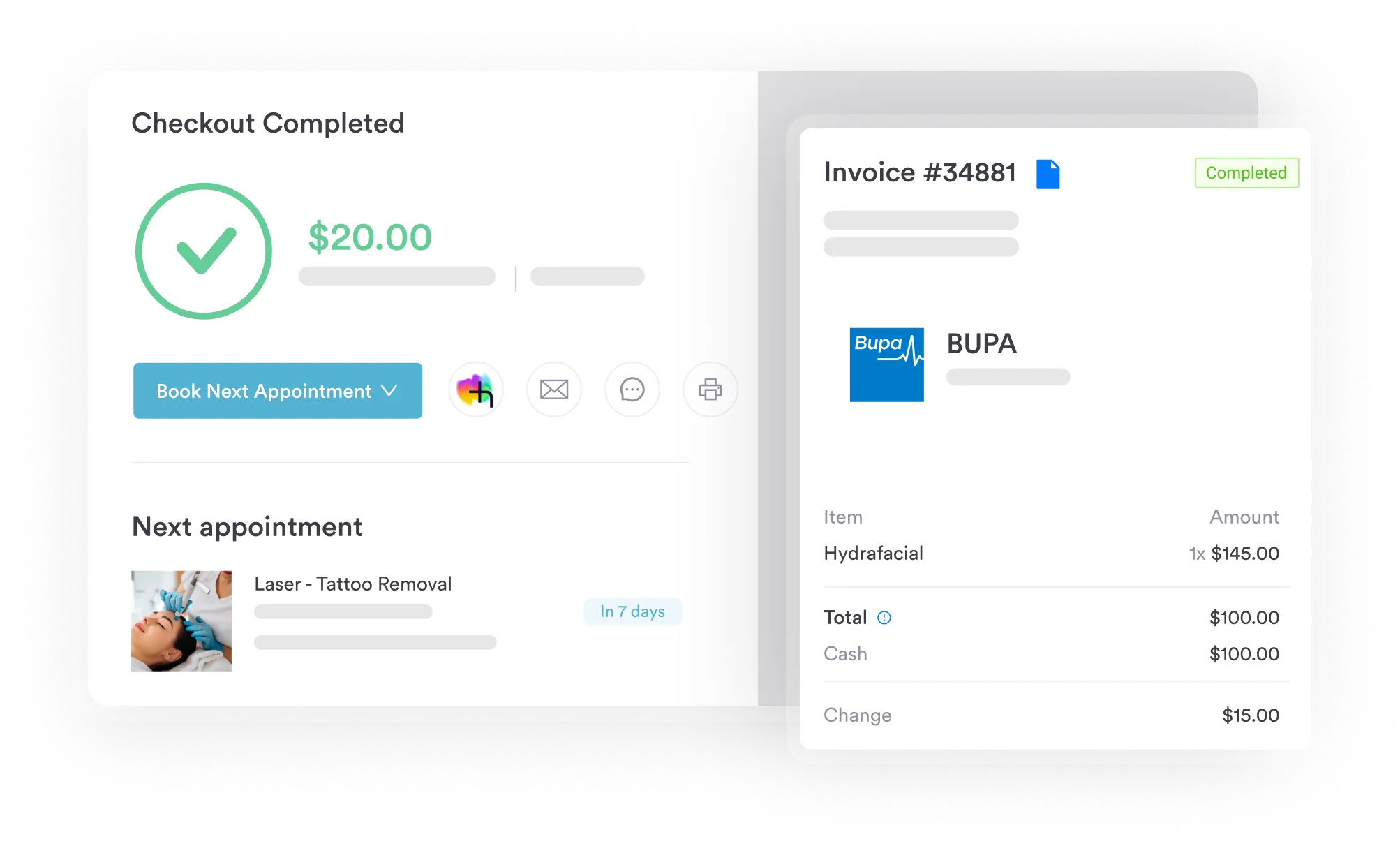
Because the remittance posts back to the same record, a run of T87.0X9 denials shows up against the charts that produced them. Knowing how a medical claims clearinghouse fits into that loop helps a practice decide where its own checkpoints belong.

Pabau pulls the codes already on the encounter into a pre-filled claim, then submits and tracks it through Claim.MD. Remittances post back to the same patient record.

Laterality is the deciding factor for T87.0X9. When the operative record names the arm, T87.0X1 or T87.0X2 is the correct choice every time. T87.0X9 is there for the genuinely undocumented case, not as a shortcut past a chart nobody wants to read.
The practical move is to put the query ahead of the code. A CDI question to the operating surgeon costs a few minutes. A denied claim costs a rework cycle and a resubmission window, and it lands weeks after the encounter closed.
T87.0X9 stays defensible only for as long as the chart backs it up, so the monthly audit habit matters more than any single code choice. Book a demo to see how Pabau keeps the operative note, the coded claim, and the remittance on one patient record.

Need guidance on managing medical billing denials? Denial management in healthcare covers the end-to-end process for tracking, appealing, and preventing claim rejections.
Want to understand the full claims submission workflow? 837 EDI file format explained details how electronic claim files are structured and submitted through a clearinghouse.
Looking for a primer on ICD-10 billing compliance? Medical billing compliance outlines the regulatory requirements practices must meet when submitting diagnosis codes for reimbursement.
ICD-10 code T87.0X9 is a billable ICD-10-CM diagnosis code meaning “complications of reattached (part of) upper extremity, unspecified upper extremity.” It is used when a post-replantation complication affects an upper extremity and the operative documentation does not specify which side (right or left) was involved.
Yes. T87.0X9 is a billable, specific ICD-10-CM code effective from October 1, 2025 (FY 2026 edition). It can be submitted on claims for reimbursement purposes when the documentation supports the diagnosis.
T87.0X1 specifies complications of the reattached right upper extremity; T87.0X2 specifies the left upper extremity; T87.0X9 is used only when the laterality is genuinely undocumented. Always use T87.0X1 or T87.0X2 when the operative report identifies which arm was reattached.
The parent code is T87.0 (Complications of reattached (part of) upper extremity), which is a non-billable header code. T87.0X9 is one of three billable child codes under T87.0, the other two being T87.0X1 (right) and T87.0X2 (left).
The claim must be supported by an operative report confirming reattachment surgery. It also needs clinician documentation of the specific post-operative complication. Laterality must be absent from all available records. If any record specifies right or left, T87.0X9 is not appropriate.
The approximate ICD-9-CM equivalent is 996.94 (Complications of reattached upper extremity, other and unspecified). The official CMS and CDC General Equivalence Mappings send T87.0X1, T87.0X2 and T87.0X9 to that one code, because ICD-9-CM carried no laterality here. 996.90 is the wrong target, since it covers an unspecified extremity or body part.