

ICD-10 Code S53.013D: Anterior subluxation of unspecified radial head
ICD-10 Code S53.013D: Quick reference summary Use the table below as your first ...

Last Updated: Nov 6, 2026
Billable Code Specific Code
T85.692S is the billable ICD-10-CM code for other mechanical complication of permanent sutures, sequela. It applies when a non-absorbable suture complication has resolved but left a residual condition, such as a suture granuloma or a chronic sinus tract.
The seventh character S separates this encounter from initial treatment (A) and follow-up care during healing (D). Under ICD-10-CM Guideline I.B.10, the residual condition is reported first and T85.692S follows it.
Let Pabau's smart automation suggest the right codes, reduce claim denials, and keep your practice compliant—effortlessly.
Automate repetitive tasks and focus on what matters most—your patients.
Reduce coding errors and ensure compliance with the latest regulations.
Clean claims, fewer denials, and faster reimbursements.
Powerful insights and reporting to help your practice thrive.
HIPAA compliant SOC 2 certified GDPR-compliant Trusted by 4,000+ clinics worldwide

T85.692S codes other mechanical complication of permanent sutures at a sequela encounter, separate from T85.692A (initial) and T85.692D (subsequent).
Use the seventh character S only after the suture complication has resolved, never while it is still being actively treated.
Report the residual condition, such as a granuloma or sinus tract, first and T85.692S after it, per ICD-10-CM Guideline I.B.10.
Documentation must name the suture as permanent (non-absorbable) and link the residual condition to the original implanting procedure.
Pabau, the practice management platform we build, scrubs claims for missing or invalid details before submission through its Claim.MD integration.
ICD-10 code T85.692S is the billable ICD-10-CM code for other mechanical complication of permanent sutures, sequela. It covers a residual condition, such as a suture granuloma, left after a non-absorbable suture complication has resolved.
The code is valid for FY2026 and FY2027, and it is listed after the code for that residual condition. The table below gives every field a coder or biller needs to confirm before claim submission.
“Other mechanical complication of permanent sutures, sequela” covers residual conditions arising from a non-absorbable suture that failed mechanically in a prior encounter. The word “other” places this code outside the mechanical failure types already enumerated in the T85 family (breakdown, displacement, leakage). It captures complications such as erosion, irritation, perforation, protrusion and stenosis attributable to a permanent suture.
“Permanent sutures” in ICD-10-CM means non-absorbable suture material. Polypropylene (Prolene), polyester (Mersilene, Ethibond), nylon and braided polyester are the most common. Absorbable sutures (Vicryl, Monocryl, PDS) fall outside this code’s scope.
The sequela encounter type adds the clinical context. The patient is not in the acute or healing phase. The original mechanical complication was treated and resolved, but a residual condition persists or has appeared later.
A suture granuloma appearing eight months after abdominal closure is a sequela. So is a sinus tract draining at a hernia repair site two years after surgery. A patient returning weekly for wound irrigation of an active, open complication is not.
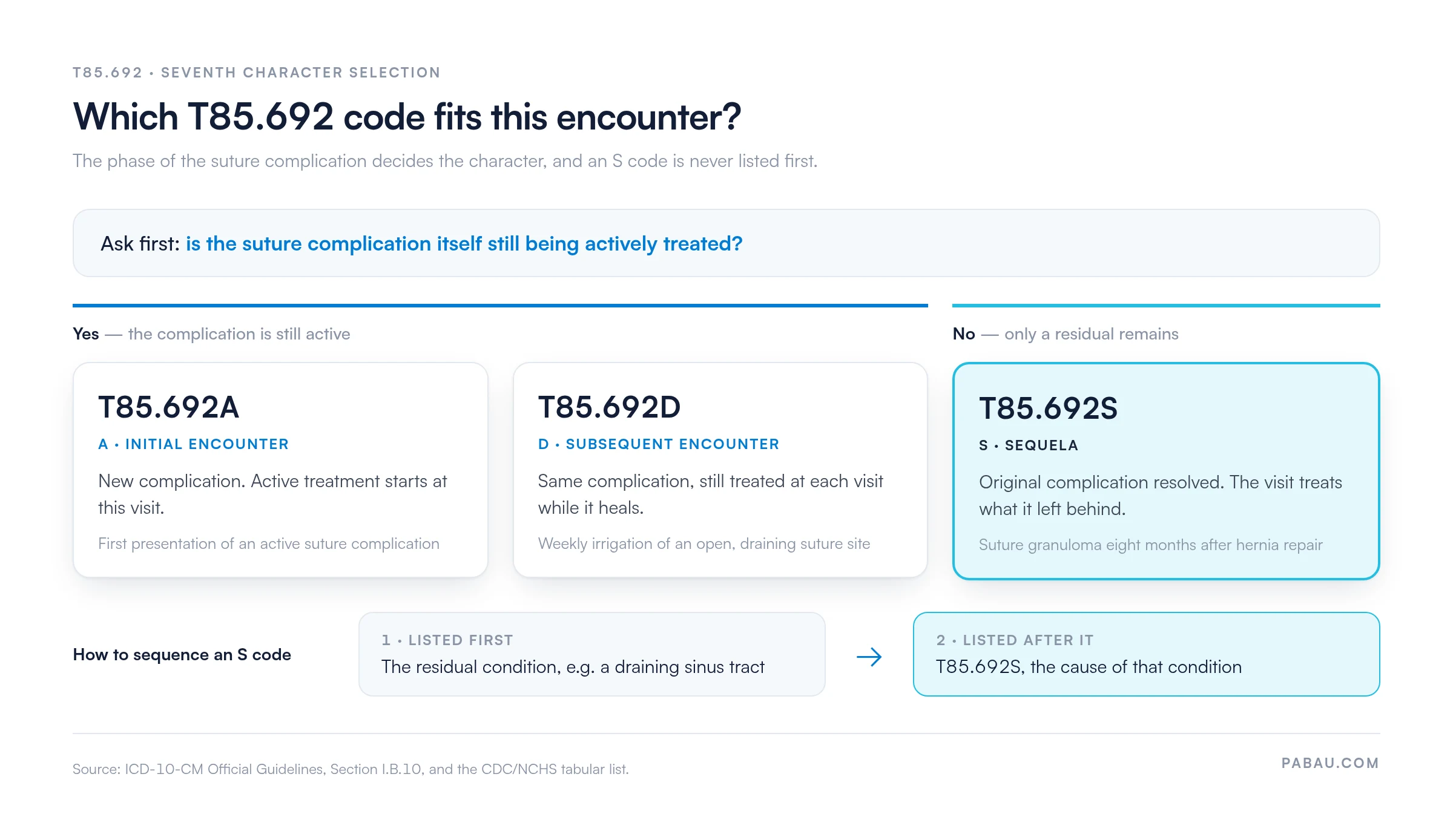
Ask whether the original complication is still active and being treated. If not, the visit is about a residual condition that remained after it resolved. If the complication is still active, use A or D. If the patient carries only the aftereffect, use S.
The three seventh-character options for T85.692 each describe a different phase of the same complication. Selecting the wrong one is a common coding error in this code family.
The ICD-10-CM Official Guidelines for Coding and Reporting (Section I.B.10) define a sequela as the residual effect left after an acute phase has ended. For suture complications, the acute phase ends when the complication itself is treated and no longer actively managed.
What remains, such as scar tissue, a granuloma or a persistent sinus, is the residual condition. Report that condition first, followed by T85.692S, because the guideline sequences the sequela code second.
A frequent error in this family is using T85.692S when T85.692D is correct. If the wound is still open, draining or receiving active treatment at each visit, the encounter is subsequent (D), not sequela (S). Coders should confirm the physician’s note states the original complication is resolved before assigning S.
The whole choice comes down to one question about the complication’s status, and the diagram below adds the sequencing step for an S code.
The parent-to-child structure explains why T85.692 without a seventh character is not billable, and what each ancestor code restricts. The ICD-10-CM Official Guidelines (Section I.A.5) require the applicable seventh character for every code in category T85.
Coders who submit T85.692 without a seventh character receive an edit rejection at the clearinghouse. The parent code sits in the tabular list as a structural node, not a valid claim code. Only T85.692A, T85.692D and T85.692S are billable. If you’re new to how a diagnosis code travels from chart to payer, start with these medical billing fundamentals.
The T85 category carries Excludes2 notes that govern what may be coded alongside T85.692S. An Excludes2 note means the excluded condition is not part of the code. It may still be reported as an additional code when both conditions coexist and both are managed at the same encounter.
Key exclusions at the T85 level include failure and rejection of transplanted organs and tissue (T86 codes). Breakdown of a suture during a procedure is also excluded, because it is coded as an intraoperative complication rather than from T85. Both are distinct from a post-procedural mechanical complication of the suture itself.
Three codes are often confused with ICD-10 code T85.692S.
Four documentation elements support T85.692S when a payer reviews the claim. A note missing any one of them invites a denial or a medical-necessity query. Practices with structured medical billing compliance workflows check for all four before the claim leaves the system.
Medicare and most commercial payers cover services coded with ICD-10 code T85.692S when the claim shows medical necessity for treating the documented residual condition. The payer is paying for treatment of the sequela, such as the granuloma, sinus tract or erosion. A claim that appears to re-treat a resolved primary complication is denied.
Coverage for T85.692S is governed by the Local Coverage Determinations (LCDs) for the procedure performed, not by a diagnosis-specific National Coverage Determination (NCD). Check the applicable LCD for the CPT code billed alongside T85.692S to confirm diagnosis code coverage. The CDC/NCHS ICD-10-CM web tool lists T85.692S as a valid code.
Denials on ICD-10 code T85.692S claims concentrate around four failure patterns. Each has a preventable root cause and a corrective step. The wider process for tracking and appealing denials is covered in this guide to denial management in healthcare.
When a denial does arrive, the guide to medical billing denial codes explains the CARC reason codes on the remittance. It also covers the corrective action for each one.
These clinical vignettes show the correct application of ICD-10 code T85.692S, and one case where T85.692D is the correct choice instead.
Vignette 1: Suture granuloma after abdominal repair (T85.692S correct). A patient presents eight months after an open hernia repair. The wound healed without incident, but a firm, tender nodule has developed at the closure site. The surgeon documents “suture granuloma at hernia repair site, 0 Prolene identified, original wound healed.”
Mechanical irritation from the permanent suture has produced a residual granuloma, and the acute phase is over. Report the granuloma first, followed by T85.692S. A clean claim here also depends on the original operative note being available for payer review.
Vignette 2: Chronic sinus tract from hernia mesh suture (T85.692S correct). Two years after a laparoscopic hernia repair, a patient develops a draining sinus tract. The surgeon documents “chronic sinus tract, anterior abdominal wall, attributed to permanent suture from prior hernia repair, now healed otherwise.” The original complication has evolved into a chronic sequela. For today’s surgical exploration, report the residual condition (the draining sinus tract) first, followed by T85.692S.
Vignette 3: Active wound irrigation visits (T85.692D correct, NOT T85.692S). A patient is seen weekly for wound irrigation of a dehisced closure around a permanent suture. The wound is open and actively draining. The surgeon documents “ongoing wound care for suture site breakdown.”
The original complication is not resolved and is still being treated, so T85.692D (subsequent encounter) is correct. Using T85.692S would misrepresent the encounter type. It also risks a denial, because sequela coding requires the acute phase to be over.
Each denial pattern above starts with a claim that left the practice missing a detail. It might be the suture material, the link to the original surgery or the right seventh character. Checking every claim by hand means rereading the note before each submission.
Pabau, the practice management platform we build, turns the invoices you already raise into electronic claims through its claims management software. Through the Claim.MD integration, it scrubs claims for missing or invalid details before submission and sends them to thousands of US payers. Real-time eligibility checks confirm coverage before the patient is treated.
Once the payer responds, electronic remittance advice is matched back to the claims and invoices it settles. Pabau shows the rejection reason so you can correct and resubmit.

That leaves your coders free to focus on the documentation questions T85.692S raises, instead of chasing claim statuses across portals.

Pabau scrubs claims for missing or invalid details before submission. Electronic remittance advice is then matched back to the claims and invoices it settles.

T85.692S turns on one judgment: whether the suture complication has resolved and the visit treats only what it left behind. Make that call from the physician’s note, not from the time since surgery. A sequela has no time limit, and an active complication stays A or D however old it is.
When the code fits, list the residual condition first and T85.692S after it. A note that names the permanent suture, the residual condition and the original procedure lets the claim stand up at audit.
The trade-off is a physician query before submission, which is usually quicker than reworking a denied claim. Book a demo to see how Pabau scrubs claims for missing or invalid details before they reach a payer.

Need a full framework for managing claim denials across code families? Denial management in healthcare covers the end-to-end process for identifying, appealing, and preventing denials.
Want to understand how ICD-10 codes move through the billing cycle? What is revenue cycle management explains how diagnosis coding connects to claim submission and payment collection.
Looking for the definitive guide to clean claim submission with ICD-10? Submitting a clean claim details every field, format, and documentation requirement payers check before processing.
ICD-10 code T85.692S means other mechanical complication of permanent sutures, sequela. It is a billable ICD-10-CM diagnosis code for a residual condition left by a permanent suture complication that has fully resolved. It is valid for FY2026 and FY2027.
Yes. T85.692S is a billable leaf code in the CDC/NCHS ICD-10-CM tabular list. The parent code T85.692 is not billable without a seventh character. Only T85.692A, T85.692D and T85.692S are valid for claim submission.
T85.692A is the initial encounter code, used when the patient presents for the first time with an active permanent suture mechanical complication. T85.692S is the sequela code, used when that complication has resolved and left a residual condition. The acute complication must be documented as resolved before T85.692S is appropriate, and T85.692S is listed after the residual condition.
The physician note must name the suture as permanent or non-absorbable and describe the specific mechanical complication, such as a granuloma, sinus tract or erosion. It must also link the residual condition to the original implanting procedure and state that the original complication has resolved. Missing any of these four elements creates audit exposure.
Medicare covers services coded with T85.692S when medical necessity is established for treating the documented residual condition. Coverage is governed by the LCD for the accompanying CPT code, not by a diagnosis-specific NCD. The claim must show that treatment targets the sequela condition, not the original resolved complication.
Four patterns come up most often. The first is an incorrect seventh character, such as S where D applies because the complication is still active. The others are missing documentation of permanent suture type, weak linkage to the original surgery, and miscoding as wound dehiscence (T81.31XS). Also check the AAPC Codify crosswalk for the CPT codes billed alongside T85.692S.



