









ICD-10 code S53.442D: UCL sprain of left elbow, subsequent encounter
ICD-10 Code S53.442D is a valid, billable ICD-10-CM diagnosis code effective Oct...

Last Updated: August 10, 2026


T43.225A is the billable ICD-10-CM code for an adverse effect of a selective serotonin reuptake inhibitor, initial encounter. It is also valid for FY2026.
SSRIs such as fluoxetine and sertraline sit under subcategory T43.22. The SNRI family, including venlafaxine and duloxetine, sits under T43.21, so T43.215A is a different code.
An adverse effect means a correctly prescribed drug, correctly taken, caused harm. In contrast, poisoning means an overdose or an error occurred. Meanwhile, underdosing means the patient took too little.
The 7th character A marks the initial encounter. Similarly, use D for a subsequent encounter and S for a sequela. In every case, the code is invalid without one of the three.
Sequence the nature of the adverse effect first and T43.225A second. Practice management software like Pabau keeps the drug, the reaction, and the encounter type in the note. Coders then stop chasing the prescriber for detail.
T43.225A is the billable ICD-10-CM code for the adverse effect of selective serotonin reuptake inhibitors at the initial encounter. Specifically, coders, billers, and prescribers assign it when an SSRI that was prescribed correctly and taken as directed causes a harmful reaction. The code is valid for FY2026.
In fact, one digit separates T43.225A from the code most people reach for by mistake. Subcategory T43.21 belongs to the SNRIs, such as venlafaxine and duloxetine, while subcategory T43.22 belongs to the SSRIs. Both names open with the word selective, so the two codes are easy to swap, and nothing on the claim flags it.
The FY2026 code set took effect on October 1, 2025 and runs through September 30, 2026, per the CMS ICD-10-CM code update files. As a result, psychiatry EMR software with built-in ICD-10 lookup removes much of the swap risk at the documentation stage.
The table below holds the reference data for T43.225A. Code status is reviewed every fiscal year, so verify the code against the current tabular list before you submit.
The 7th character is not optional on a T43.225 code. In fact, it records the stage of care, and the code is not billable until you add it. A claim carrying the wrong 7th character is a rejection risk, because payers and auditors match this field against the clinical note.
In practice, the most common slip is carrying T43.225A into every visit that touches the SSRI reaction. Once the patient moves into follow-up care, with the dose adjusted and symptoms monitored, the correct code is T43.225D. In other words, initial encounter describes active management of the reaction, not the first time anyone wrote it down.
ICD-10-CM Official Guidelines Section I.C.19.a sets out that difference, and it holds across Chapter 19. For example, T63.064D puts the same D character on a toxic effect code. In addition, the CDC and NCHS ICD-10-CM web tool lets you browse each annual edition with the full tabular structure.
These three types share the T43.22 subcategory but describe different situations. Picking the wrong one is the most costly error in SSRI coding, both for the claim and for the medical record. Specifically, the 6th character carries the difference. Characters 1 through 4 are poisoning by intent, 5 is adverse effect, and 6 is underdosing.
That intent axis runs through every substance in the T36-T50 block, as T38.802D shows for a different drug family. Learn the pattern once and it transfers.
First, Guidelines Section I.C.19.e.5.a sets the adverse effect rule. Assign the code for the nature of the adverse effect, then the T-code that names the substance. In contrast, poisoning reverses that order under Section I.C.19.e.5.b, where the T-code leads.
Also, the block note at T36-T50 says the same thing. For adverse effects, code first the nature of the effect. As a result, coders who invert the sequence tend to see medical necessity edits come back from the payer.
Knowing the full path helps when a payer asks for more detail or when you need a nearby code. For example, the AAPC Codify ICD-10-CM lookup shows the same structure for any code. Here is where T43.225A sits, from chapter level down to the billable code:
In fact, T43.2 splits four ways, and the four look almost the same on screen. T43.20 covers unspecified antidepressants, T43.21 covers SNRIs, T43.22 covers SSRIs, and T43.29 covers other antidepressants. Read the subcategory title in full before you pick, rather than trusting the code number.
T43 codes live in Chapter 19, while the psychiatric diagnoses behind the prescription sit in Chapter 5. Both chapters usually appear on the same claim, with a code such as F33.9 naming the condition under treatment.
T43.225A covers the SSRI class as a whole. Instead, ICD-10-CM does not give each molecule its own adverse effect code inside T43.22. These agents are classified as SSRIs and map to this code when a correctly prescribed dose causes harm:
The lookup path runs through the ICD-10-CM Table of Drugs and Chemicals, not the alphabetic index. Find the substance, then read across to the adverse effect column. For example, fluoxetine, citalopram, and fluvoxamine each carry their own row pointing to T43.225, and brand names cross-reference to the generic entry.
When an agent has no row of its own, classify it by drug class and use the SSRI row. Guidelines Section I.C.19.e.1 then requires you to verify the result in the tabular list before coding it.
First, three nearby subcategories catch the drugs that are not SSRIs. SNRIs such as venlafaxine and duloxetine belong to T43.21, so their adverse effect code is T43.215A. Meanwhile, other antidepressants belong to T43.29, and an antidepressant the record never names belongs to T43.20. As a result, a mental health EMR with medication-specific fields keeps the drug name in the note, which is what stops class confusion at coding time.
Serotonin syndrome got its own ICD-10-CM code on October 1, 2024. In fact, G90.81 covers serotonin syndrome and serotonin toxicity, and it changed how SSRI reactions are sequenced. Before that date, coders built the picture from symptom codes. Since then, G90.81 has carried instructional notes that name the SSRI subcategory directly.
The direction of the pairing depends on what happened to the patient:
The use additional note at G90.81 lists the substance codes by name. Specifically, it cites T43.225 for SSRIs and T43.215 for SNRIs as separate entries, which is a useful check that the two families are distinct. It also lists T43.1X5 for MAOI antidepressants and T36.8X5 for linezolid, both known triggers for the syndrome.
In most cases, a rejected T43.225A claim traces back to a thin note rather than a coding slip. The record has to support four things before a coder can assign this code with confidence.
In practice, Digital intake forms that capture current medications, adherence, and presenting symptoms at check-in give coders that raw material without a query to the prescriber. For practices working through HIPAA compliance for medical offices, structured intake also supports audit readiness.
For example, prescribers who see a steady SSRI caseload can standardize the drug fields with a psychiatric evaluation template applied at every encounter.
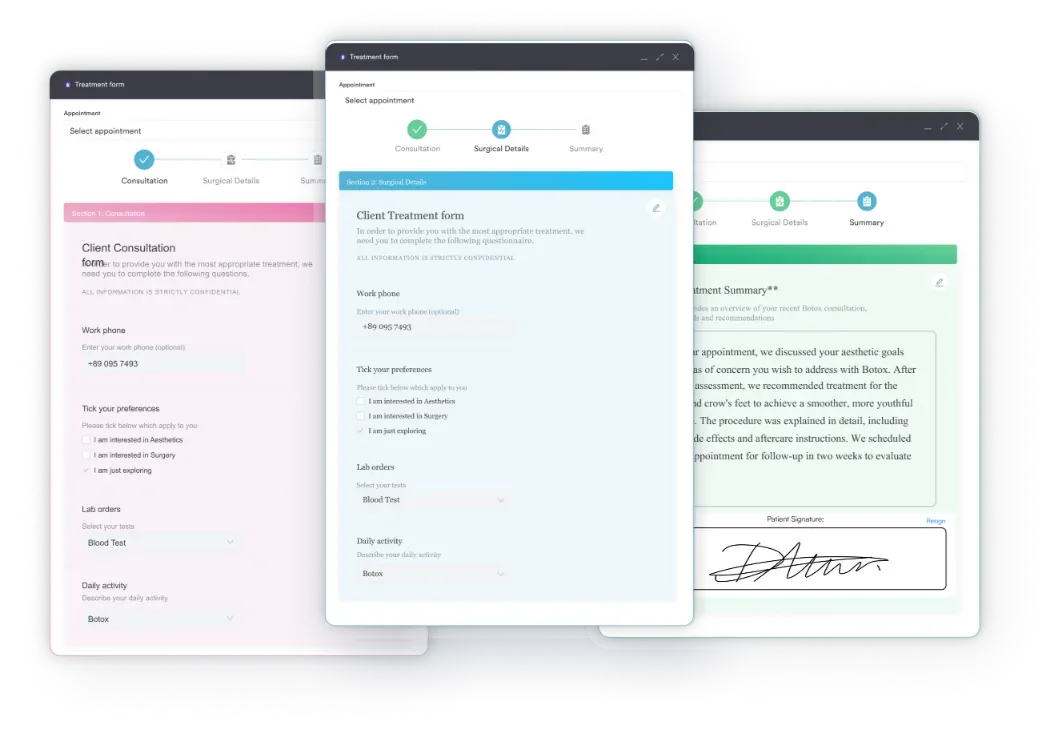
Record the SSRI by name, describe the reaction, and state whether this visit is active treatment or follow-up. Coders cannot invent detail the note leaves out. Therefore, check that your intake form captures medication adherence at every appointment, not just at registration.
These three examples show the code logic, the first-listed diagnosis, and the documentation signal that supports each choice.
A 38-year-old on sertraline 100 mg daily for major depressive disorder reports persistent nausea and diarrhea. In this case, the prescription is appropriate and the patient is adherent. Symptoms began after last month’s dose increase. First-listed diagnosis: R11.0 for nausea, or R11.2 where vomiting is documented as well. Add R19.7 for the diarrhea, then T43.225A as the secondary code. The reaction is being evaluated and managed at this visit, so the 7th character is A.
In this scenario, a 45-year-old takes fluoxetine 20 mg for obsessive-compulsive disorder, coded F42. New erectile dysfunction appears six weeks after starting the drug, and the prescriber confirms correct dosing. First-listed diagnosis: N52.9 for male erectile dysfunction, or F52.21 where the note supports it. Secondary code: T43.225A. As a result, the reaction is the reason for the visit, which makes this an initial encounter.
The patient from Scenario 2 returns two weeks later. The dose has been reduced and symptoms are improving. This is a subsequent encounter, so the code is T43.225D. Consequently, coders who keep assigning T43.225A at follow-up build an inaccurate record and invite scrutiny from payers reviewing encounter patterns. The first-listed code still describes the condition being monitored, which is the sexual dysfunction.
In all three, the nature of the adverse effect leads and the T-code follows. In short, flipping that order is what triggers most edits on these claims.
In total, subcategory T43.22 holds six codes. Each one takes a 7th character (A, D, or S). In addition, the table maps the full sibling set, followed by the nearby antidepressant subcategories that coders confuse with it. Every code below is shown at the initial encounter unless the row says otherwise.
Above all, T43.215A is the row worth marking. It reads almost the same as T43.225A but belongs to the SNRIs, and it is the single most common substitution error in this family.
An ICD-10-CM diagnosis code carries no payment rate of its own, so T43.225A is not priced by a fee schedule. On an inpatient claim it feeds the MS-DRG grouper. In contrast, on an outpatient claim it supports medical necessity for the services billed, including behavioral health codes such as H2019.
Under the FY2026 grouper, version 43.0, T43.225A groups to MDC 21. Specifically, it lands in MS-DRG 917 for poisoning and toxic effects of drugs with MCC, or 918 without MCC. Neonatal cases can group to 791 or 793 instead.
Grouping rarely turns on T43.225A alone. Instead, adverse effect codes are never first-listed, so the principal diagnosis driving the admission usually decides the DRG, and T43.225A acts as a secondary code. Therefore, confirm the assignment against the CMS MS-DRG definitions manual for the right version.
CMS released grouper version 43.1 on April 1, 2026, so check which version covers the discharge date. For example, practices tracking submission status across encounters may find claims management software useful for keeping code pairings and outcomes in one view.
The MS-DRG for an inpatient stay follows the principal diagnosis, not T43.225A. Instead, confirm the grouping in the CMS definitions manual for the version that covers the discharge date. In short, never assume one admission’s DRG carries over to the next.
In fact, T43.225A has no single ICD-9-CM match. ICD-9 split the reaction from the substance across two codes, so the backward GEM maps T43.225A to a pair:
The mapping is approximate rather than exact, because ICD-9 had no SSRI-specific adverse effect code. Specifically, E939.0 covers the whole antidepressant class. GEMs were frozen after the transition and now serve legacy data analysis only, so never code a current claim from them.
EHR search boxes and coding tools reach T43.225A through several phrasings. For example, knowing them saves time and confirms you have landed on the right code. The tabular list carries one inclusion term at the subcategory level, and coding software adds the rest:
Inclusion terms live in the tabular list. In contrast, the Official Guidelines set rules and carry none of their own. If a note uses one of these phrases without stating the encounter type, the coder decides between A and D from the clinical context.
In most practices the evidence for T43.225A is spread across three places. For instance, the prescription sits in one system, the intake answers in another, and the reaction in a free-text note. As a result, a coder reading all three a week later ends up querying the prescriber.
Practice management software like Pabau holds the prescription record, the intake responses, and the clinical note in one patient file. In addition, medication fields carry the drug name and the dose. Intake forms capture adherence at every visit, not only at registration.
The coder opens the encounter and sees the SSRI, the reaction, and whether this visit is active treatment or follow-up. As a result, that is enough to choose between T43.225A and T43.225D without a query. ICD-10 lookup sits inside the same record, so the code reaches the claim straight from the note.

Pabau gives mental health and primary care teams structured intake, prescribing records, and clinical notes in one place. Coders get the drug name, the reaction, and the encounter type without chasing the prescriber.

SSRI adverse effect coding fails at three predictable points. First, coders reach for T43.215A when the drug is an SSRI and the correct subcategory is T43.22. They also choose poisoning when the record describes a correctly taken dose. Finally, they carry the initial encounter character into follow-up visits where D belongs.
All three are documentation problems before they are coding problems. In short, get the drug name, the reaction, the adherence status, and the encounter type into the note, and T43.225A becomes a straightforward assignment.
Pabau keeps those fields in front of the prescriber during the visit, which is where the coder’s evidence comes from. To see how that works across intake, charting, and billing, book a demo.

Structuring a psychiatric assessment? The psychiatric evaluation template gives you a place to record drug history and adverse reactions at every visit.
Billing behavioral health prevention sessions? H0025 sets out the service definition, the units, and the payer rules that apply.
Coding a day treatment program? H2012 explains how the per-diem service is documented and billed.
Working with patients on thought patterns? The negative self-talk worksheet gives clinicians a structured exercise to use between medication reviews.
T43.225A is the billable ICD-10-CM code for an adverse effect of a selective serotonin reuptake inhibitor at the initial encounter. It applies when an SSRI that was prescribed correctly and taken as directed causes a harmful reaction. Specifically, the code sits in Chapter 19 of ICD-10-CM, under subcategory T43.22, and is valid for FY2026.
The two codes cover different drug families. T43.225A is the adverse effect of a selective serotonin reuptake inhibitor, such as fluoxetine, sertraline, or escitalopram. In contrast, T43.215A is the adverse effect of a selective serotonin and norepinephrine reuptake inhibitor, such as venlafaxine or duloxetine. Both names begin with the word selective, which is why they are swapped so often.
T43.225A covers the initial encounter, while the provider is actively evaluating or treating the SSRI reaction. T43.225D covers subsequent encounters, once the patient has moved into the healing or follow-up phase. As a result, using T43.225A for a routine follow-up visit is a coding error that can trigger payer edits.
T43.225A covers the SSRI class as a whole, including fluoxetine, sertraline, paroxetine, escitalopram, citalopram, and fluvoxamine. In fact, ICD-10-CM does not assign a separate adverse effect code to each molecule within T43.22. SNRIs such as venlafaxine and duloxetine fall outside this code and use T43.215A instead.
Specifically, serotonin syndrome has its own code, G90.81, effective October 1, 2024. When a correctly taken SSRI causes it, G90.81 is the nature of the adverse effect and is sequenced first, with T43.225A second. When an overdose or an error caused it, the poisoning code from T43.221A through T43.224A is sequenced first, followed by G90.81.