ICD-10 Code S53.013D: Anterior subluxation of unspecified radial head
ICD-10 Code S53.013D: Quick reference summary Use the table below as your first ...

Last Updated: Nov 6, 2026
Billable Code Specific Code
S72.365C is the billable ICD-10-CM code for nondisplaced segmental fracture of shaft of left femur, initial encounter for open fracture type IIIA, IIIB, or IIIC.
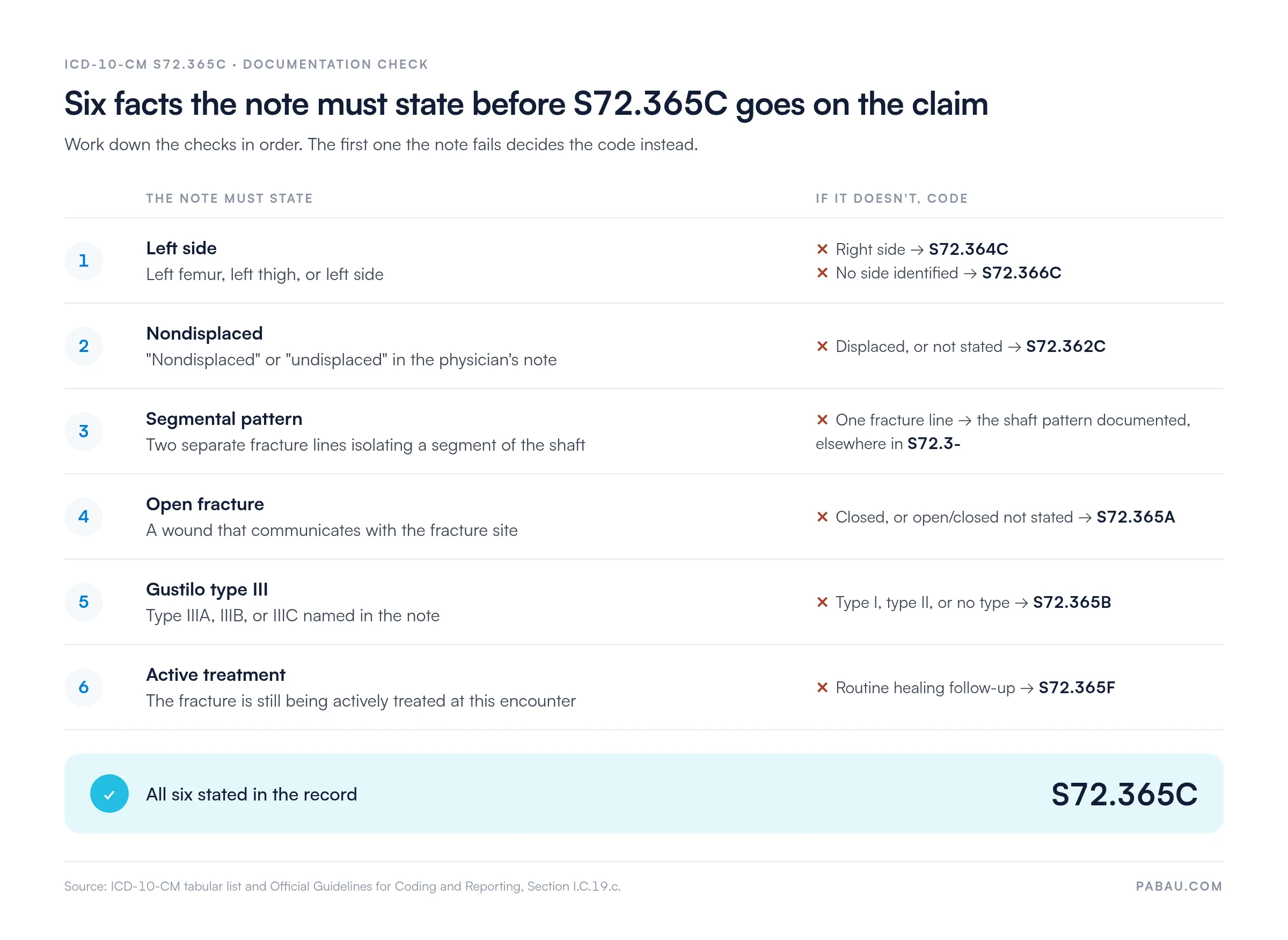
The 7th character C applies only when the note documents Gustilo type IIIA, IIIB, or IIIC. An open fracture of type I or II, or one with no type recorded, is coded S72.365B instead. Before the claim goes out, confirm the note states the left side, nondisplaced status, and a segmental pattern with two separate fracture lines. Without a displacement statement, the Official Guidelines code the fracture as displaced.
Let Pabau's smart automation suggest the right codes, reduce claim denials, and keep your practice compliant—effortlessly.
Automate repetitive tasks and focus on what matters most—your patients.
Reduce coding errors and ensure compliance with the latest regulations.
Clean claims, fewer denials, and faster reimbursements.
Powerful insights and reporting to help your practice thrive.
HIPAA compliant SOC 2 certified GDPR-compliant Trusted by 4,000+ clinics worldwide

S72.365C is a billable ICD-10-CM code for a nondisplaced segmental fracture of the shaft of the left femur. It covers the initial encounter for an open fracture of type IIIA, IIIB, or IIIC.
A segmental fracture has two separate fracture lines that isolate a free segment of the femoral shaft. It is not a joint-surface fracture.
The 7th character C covers only Gustilo types IIIA, IIIB, and IIIC. Open type I or II, or an open fracture with no Gustilo type documented, takes B (S72.365B).
The note must state left side, nondisplaced, segmental pattern, open wound, and a type III Gustilo grade. Without a displacement statement, guidelines default to displaced (S72.362C).
Pabau, the practice software we build, keeps the fracture note and the insurance claim in one record. The coder bills from the surgeon’s own entries.
ICD-10 code S72.365C is the billable ICD-10-CM code for a nondisplaced segmental fracture of the shaft of the left femur. It applies at the initial encounter for an open fracture documented as Gustilo type IIIA, IIIB, or IIIC.
S72.365C has been a valid, billable ICD-10-CM code since ICD-10-CM took effect in the US on October 1, 2015. The table below gives coders the core facts before the clinical and billing detail. For current-year validity, check the CDC/NCHS ICD-10-CM web tool, which is updated each October 1.
S72.365C encodes five clinical facts, each carried by a character position. S72 is the category (fracture of femur), and .3 narrows it to the shaft. The 6 in .36 specifies a segmental fracture of the shaft. The 5 in .365 adds displacement status (nondisplaced) and laterality (left). C sets the encounter as initial, for an open fracture of Gustilo type IIIA, IIIB, or IIIC.
A segmental fracture breaks the femoral shaft at two levels, leaving a separate segment of bone between the two fracture lines. It differs from a transverse, oblique, or spiral fracture, which has one fracture line. It also differs from a comminuted fracture, which shatters into multiple fragments at one site. Nondisplaced means the fragments have not shifted out of anatomical alignment. Both findings must appear in the physician’s documentation, not only in the imaging report. The same segmental pattern on the tibial shaft, displaced and at an open type III follow-up, takes S82.263F.
The 7th character C designates an initial encounter for an open fracture of Gustilo-Anderson type IIIA, IIIB, or IIIC. It does not cover type I or II fractures, which take B in place of C for this code. An open fracture has a skin wound that communicates with the fracture site. That wound carries an infection risk closed fractures do not. The 7th character also drives payer edits and tells the next coder which character the follow-up visits need.
For femur fractures, the Official Guidelines base the open fracture designations on the Gustilo classification. Grade I is a wound smaller than 1 cm with minimal contamination. Grade II is a larger wound with moderate soft-tissue damage. Grade III injuries have extensive soft-tissue disruption. IIIA still has adequate soft-tissue cover of the bone, IIIB needs soft-tissue reconstruction, and IIIC involves an arterial injury that needs repair. When the note does not state a Gustilo type, the guidelines assign the type I or II character, which is B.
Check the encounter type before assigning the 7th character. ‘Initial encounter’ means the patient is receiving active treatment for the fracture, not that it is the first visit. A patient transferred to another facility for surgical management still takes character C while active treatment continues. Routine follow-up for this fracture moves to F, and complications move to J, N, or R.
The codes below sit closest to S72.365C and trip coders most often. Each differs by one element: the open fracture grade, displacement, laterality, or fracture pattern. Sending the wrong one to the payer means a denial and a resubmission cycle that delays payment.
Category S72 carries Excludes1 and Excludes2 notes that govern when this code cannot be used and when another code may sit beside it. Ignoring them creates compliance risk and audit exposure. The CMS ICD-10 codes page provides the current tabular list where these notes appear in full.
Excludes1 (never coded together with S72.365C):
Excludes2 (may be coded together when both conditions are present):
The practical impact: Before assigning S72.365C, confirm the fracture is traumatic in origin. The Official Guidelines send a fracture from minor trauma in a patient with known osteoporosis to category M80 instead. That question belongs on every trauma documentation checklist.
Medicare and commercial payers adjudicate S72.365C claims against the documentation in the medical record. Coders must code from provider documentation and cannot infer clinical findings the note does not state.
The following elements must all appear in the medical record to support S72.365C:
Taken in order, those checks work as a decision path. The first one the record fails decides which code the claim carries instead.
Open femoral shaft fractures are usually treated as emergencies, so surgery is rarely held for authorization. Commercial plans still differ on notification windows and on staged procedures scheduled after the index operation. Check each payer’s policy before booking planned returns to the operating room, such as definitive fixation after external fixation.
External cause codes for the mechanism, place, activity, and status of the injury describe how it happened. The Official Guidelines set no national requirement to report them. Add them where your state or payer requires them, as a secondary code after S72.365C.
S72.365C claims are denied more often than coders expect because trauma codes carry more conditions than most diagnosis categories. The table below maps the common denial triggers to their corrective actions. Most clearinghouses, Claim.MD among them, run front-end edits that reject an invalid or missing 7th character before the payer sees it.
Reviewing denial management workflows for trauma cases as a standing protocol reduces rework across the S72 family. A quarterly audit of S72 denials shows which documentation element keeps going missing, so the note template or query process gets fixed first.
Type III open femoral shaft fractures nearly always need surgery. S72.365C therefore appears beside procedure codes for open fracture debridement, internal fixation, and external fixation in staged care. The right CPT code depends on the approach and implant the operative note documents. When the note records intramedullary nailing, the procedure line is 27506.
Payer policies may restrict certain pairings, so verify the applicable MAC and commercial policies before submitting. For practices using electronic submission, the clean claim submission checklist for trauma cases should include CPT/ICD pairing as a standard step.
These pairings reflect general practice patterns. Payer policies and National Correct Coding Initiative (NCCI) edits can change which combinations clear. Verify with the AAPC Codify ICD-10-CM lookup and your payer’s policy before finalizing a pairing. Practices with high trauma volume can use medical billing denial codes to track which pairing edits trigger rejections most often.
Several sections of the ICD-10-CM Official Guidelines for Coding and Reporting bear directly on S72.365C. Review the current fiscal year version on the CMS ICD-10 codes page each October.
Run a physician query for every open femur fracture where the operative note lacks a Gustilo grade. Record the query and the answer before finalizing the code. Without a documented type III grade, the claim belongs on S72.365B, not S72.365C.
In many practices, the fracture details make two trips. The surgeon writes the side, displacement, pattern, and Gustilo grade into the operative note. Days later, someone at the billing desk reads that note and picks a code. If the narrative leaves the Gustilo grade vague, the coder has to guess between B and C.
In Pabau, the clinical record and the claim sit in one system. Your team can build a trauma note form with fields for each detail S72.365C depends on. Pabau supports insurance billing and claims management in the US, UK, Australia, and Canada.
The coder reads the grade from the same record the surgeon completed, rather than from a scanned note. Every Pabau plan includes the core features, and add-ons enhance the experience, so documentation, billing, and reporting share one patient record.

Pabau supports insurance billing and claims management in the US, UK, Australia, and Canada. See how your team can document trauma cases and bill complex codes like S72.365C from the same patient record.

S72.365C rests on five documented facts: left side, nondisplaced, segmental pattern, open wound, and a type III Gustilo grade. Lose the grade and the claim belongs on S72.365B. Lose the displacement statement and the guidelines move it to S72.362C. The code is only as accurate as the operative note behind it, so the fix belongs at the point of documentation.
Strong trauma billing starts with the medical billing fundamentals behind every clean claim. To see how Pabau keeps the fracture note and the claim in one record, book a demo with the Pabau team.

Need a denial management framework for trauma codes? Denial management in healthcare covers systematic approaches to reducing claim rejections across complex diagnosis categories.
Looking for clearinghouse submission guidance? Claim.MD clearinghouse overview explains how electronic claims reach payers and where they get rejected along the way.
Want to understand 837 file submission for trauma claims? 837 file submission guide breaks down the electronic claim format requirements that govern how diagnosis codes like S72.365C are transmitted to payers.
ICD-10 code S72.365C is the billable ICD-10-CM code for a nondisplaced segmental fracture of the shaft of the left femur. It covers the initial encounter for an open fracture of type IIIA, IIIB, or IIIC. It sits in Chapter 19 of ICD-10-CM, within category S72 (fracture of femur) and subcategory S72.36 (segmental fracture of shaft of femur).
Yes, S72.365C is a billable ICD-10-CM code with enough specificity to submit on a claim. It is valid in the current CMS ICD-10-CM tabular list. Check the current fiscal year release on the CDC/NCHS ICD-10-CM web tool each October, when CMS publishes its annual update.
For femur fractures, the 7th character C designates an initial encounter for an open fracture of Gustilo-Anderson type IIIA, IIIB, or IIIC. It means the patient is receiving active treatment for a high-grade open fracture. The note must document a type III grade, because type I, type II, or an unspecified type takes B.
All three describe a nondisplaced segmental fracture of the left femoral shaft at an initial encounter. A is for a closed fracture. B is for an open fracture of Gustilo type I or II, or an open fracture with no type documented. C is for an open fracture documented as type IIIA, IIIB, or IIIC.
Laterality is built into the S72.36 codes. S72.365C codes the left femur, S72.364C the right, and S72.366C an unspecified side. Under Official Guidelines Section I.B.13, the unspecified-side code applies only when the record does not identify the side. Query the physician before falling back to it.
The common triggers are a missing or mismatched 7th character, such as C used for a type I or II fracture. Others are a laterality mismatch, no Gustilo grade in the operative note, and C used on a follow-up visit. Each is preventable with a pre-submission documentation check.