CPT code 24359: Tennis and golfer’s elbow repair billing guide
CPT code 24359: Definition and clinical description CPT code 24359 describes an ...

Last Updated: Nov 2, 2026
27506 is the CPT code for open treatment of a femoral shaft fracture with insertion of an intramedullary implant. The procedure may include external fixation, cerclage, and/or locking screws.
There is no separate closed or percutaneous nailing code for the femoral shaft. A nail passed across the fracture from a remote incision still counts as open treatment. That means 27506 applies whether or not the fracture site is exposed, while plate fixation is reported with 27507.
Let Pabau's smart automation suggest the right codes, reduce claim denials, and keep your practice compliant—effortlessly.
Automate repetitive tasks and focus on what matters most—your patients.
Reduce coding errors and ensure compliance with the latest regulations.
Clean claims, fewer denials, and faster reimbursements.
Powerful insights and reporting to help your practice thrive.
HIPAA compliant SOC 2 certified GDPR-compliant Trusted by 4,000+ clinics worldwide

CPT code 27506 covers open treatment of a femoral shaft fracture with an intramedullary nail, even when the nail goes in through a remote incision.
No closed or percutaneous nailing code exists for the femoral shaft, so a shaft nail is reported with 27506 either way.
The operative note must name the implant and treatment method, since those decide between 27506, 27507 (plate), and 27500 or 27502 (closed treatment).
A 90-day global surgical period applies; post-op E&M visits for normal recovery cannot be separately billed during that window.
Pabau, the practice management and billing platform we build, supports orthopedic billing workflows including CMS-1500 claim submission via Claim.MD.
CPT code 27506 reports open treatment of a femoral shaft fracture with an intramedullary nail, with or without cerclage or locking screws. The official American Medical Association descriptor reads as follows.
Open treatment of femoral shaft fracture, with or without external fixation, with insertion of intramedullary implant, with or without cerclage and/or locking screws.
The code sits in the musculoskeletal subsection of Surgery (20100-29999), among the femur (thigh region) and knee joint codes (27301-27599).
Clinically, the surgeon makes an entry incision at the piriformis fossa or greater trochanter for antegrade nailing, or at the knee for retrograde nailing. The fracture is reduced, either closed or through a small incision at the fracture site, and the canal is reamed. The nail is then passed across the fracture and locked proximally and distally under fluoroscopy.
The fracture site does not need to be exposed for 27506 to apply. CPT has no separate closed or percutaneous nailing code for the femoral shaft, so shaft nailing reports to 27506 either way.
CPT’s musculoskeletal guidelines describe two situations that count as open treatment. In the first, the surgeon opens the fracture site, exposes the bone ends, and treats the fracture under direct view. In the second, the bone is opened away from the fracture to insert an intramedullary nail across it. The fracture site itself stays closed.
That second case is why femoral nailing through a remote entry point still codes as open treatment. Closed treatment means the fracture is never surgically opened and no implant crosses it. Confirm the guideline wording against your current CPT book, since it can change between editions.
Payers bundle certain services into the 27506 reimbursement and will deny them if billed separately. Knowing the line helps orthopedic coders avoid both underbilling and triggering National Correct Coding Initiative (NCCI) edits.
NCCI edits are updated quarterly, so always verify current edit pairs before billing companion codes. Bone grafting is generally reportable on its own when the operative note establishes medical necessity beyond the fracture repair. Check the current-quarter NCCI edits before submitting.
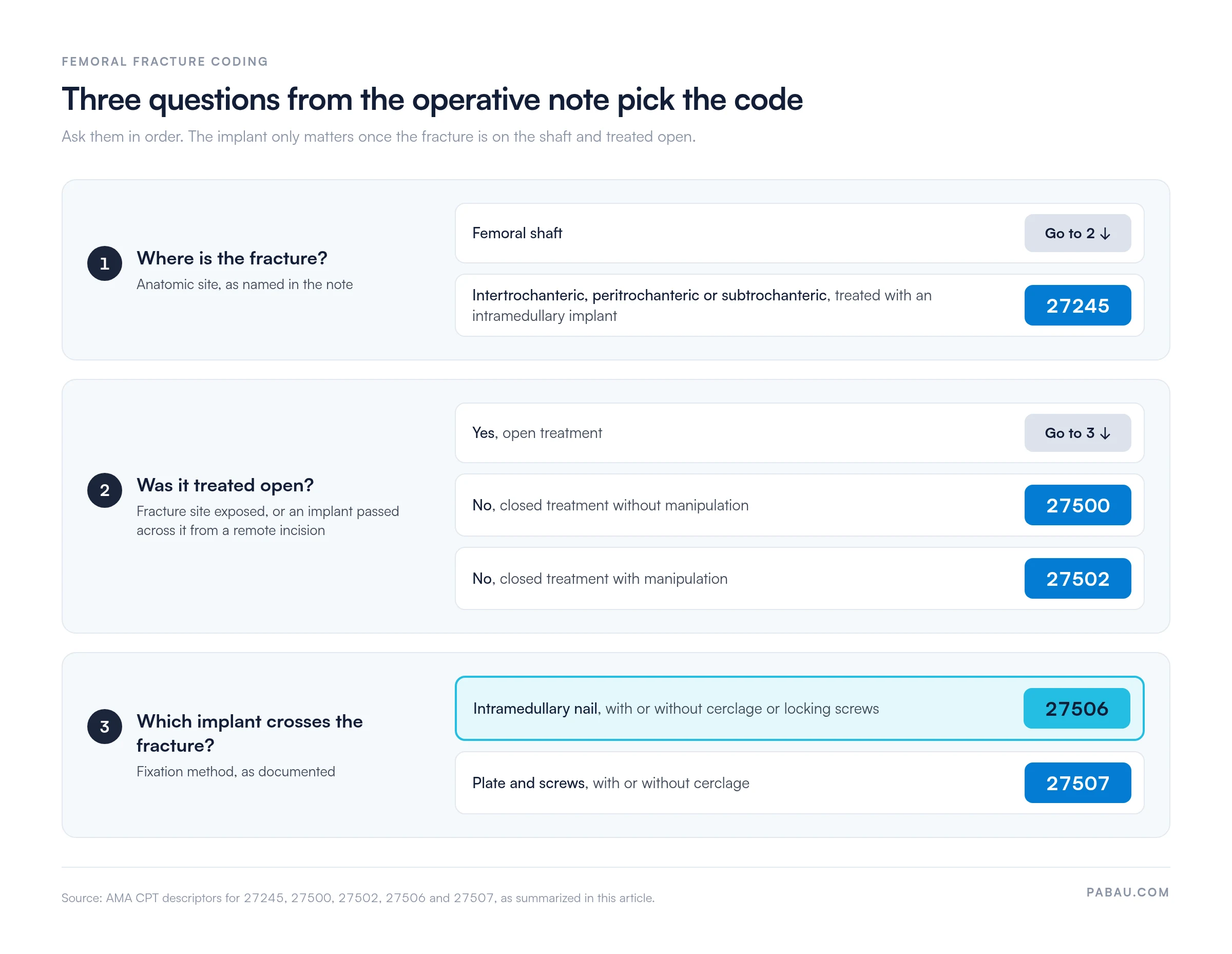
Two facts in the operative note decide the femoral shaft code: the treatment method and the implant. Open treatment with an intramedullary nail is 27506, and open treatment with a plate and screws is 27507. Closed treatment is 27500 without manipulation, or 27502 with manipulation.
CPT 27245 uses the same nailing technique at a different anatomic site. It covers intertrochanteric, peritrochanteric, or subtrochanteric femoral fractures treated with an intramedullary implant. When one nail treats both a shaft fracture and a subtrochanteric or intertrochanteric fracture, an NCCI mutually exclusive edit pairs 27506 with 27245. Report one code, not both, and check the current edit before you choose.
The decision path below puts those rules in the order a coder should check them in the operative note.
Orthopedic billing for femoral shaft fractures rarely involves a single code. The table below covers the codes most commonly billed alongside CPT code 27506 or confused with it, along with their NCCI status and billing conditions.
Every claim for CPT code 27506 requires a valid ICD-10-CM diagnosis code that establishes medical necessity. The primary codes are in the S72.3 series for fractures of the femoral shaft. The 7th character has to match both the encounter and whether the fracture is open. Check each payer’s coverage policy to confirm the diagnosis supports medical necessity for the procedure.
Use an initial-encounter 7th character on the claim for the fracture repair. Use A for a closed fracture and B for an open type I or II fracture. An open type IIIA, IIIB, or IIIC fracture takes C, as in S72.302C for the left femoral shaft. The Gustilo-Anderson type in the note decides which of the two open-fracture characters applies. Using D (subsequent encounter) or S (sequela) on the operative-date claim invites a denial.
Modifier selection for CPT code 27506 directly affects payment and audit risk. Four modifiers come up regularly in orthopedic billing for femoral shaft fractures.
Bilateral IM nailing of both femurs in one session is uncommon but does occur in polytrauma. Before billing 27506-50, confirm the operative note explicitly documents separate surgical exposure and fixation of both legs, including laterality for each. Submitting without that documentation invites a bilateral-modifier audit.
The CMS Medicare Physician Fee Schedule (MPFS) sets the national payment rate for CPT code 27506 based on Relative Value Units (RVUs). Rates update each January 1 with the annual MPFS final rule, so the table below shows the payment structure rather than figures. Confirm current-year values using the CMS MPFS Look-Up Tool or the FastRVU 2026 RVU lookup before billing.
27506 is almost always performed in a hospital facility setting, which means the practice expense RVU is the facility rate (lower than non-facility). The total payment is: (wRVU + PE RVU + MP RVU) x GPCI x Conversion Factor. Orthopedic practices can route 27506 claims electronically through Claim.MD, Pabau’s US clearinghouse integration supporting electronic CMS-1500 claim submission.
The operative note is the single most important document for supporting CPT code 27506. Payer reviewers read it for three facts: a femoral shaft fracture, open treatment, and an intramedullary implant. If the note describes a plate, closed management, or a proximal femur fracture, a different code applies. Even the best claims management software can only submit what the note supports, so capture these elements at the point of documentation.
A compliant operative note for 27506 must document all of the following:
Femoral shaft fractures are usually urgent, and emergency surgery generally cannot wait for a prior authorization. Many commercial payers still expect notification of the admission within a set window. Planned or delayed fixation may need approval before the case date. Traditional Medicare does not require prior authorization for inpatient surgical procedures, but Medicare Advantage plans may impose their own. Verify with the specific plan before scheduling. Good medical billing compliance practices include confirming authorization status before the case date, not after.
Payers typically request the following supporting documentation for prior authorization:
For trauma cases where the fracture requires emergent surgical intervention, most payers allow retrospective authorization. Document the emergent nature in both the surgical note and the authorization request, with the clinical rationale for proceeding without pre-approval.
CPT code 27506 carries a 90-day global surgical period, as established by CMS in the Medicare Physician Fee Schedule global period database. This means the surgeon’s fee for the procedure includes all related post-operative care for 90 days following the operative date. Understanding medical billing fundamentals around global periods prevents the most common billing-during-global errors.
During the 90-day global window, the following services are bundled and cannot be separately billed by the operating surgeon:
Services outside the global package can be billed separately:
Denials on CPT code 27506 claims tend to cluster around a handful of preventable documentation and billing errors. Each one has a specific corrective action, and a structured pre-bill review catches most of them before the claim goes out.
Each denied line on the remittance carries one of the standard denial codes, which points to a root cause below. Logging them in a denial management workflow shows which errors keep coming back on your 27506 claims.
Avoidable 27506 denials usually start before submission. The usual causes are an unchecked authorization, a 7th character that misfits the encounter, or a code that conflicts with the documented implant.
Pabau’s billing software sends claims through Claim.MD, a medical claims clearinghouse, as electronic CMS-1500 submissions. Your team can run real-time eligibility checks before the surgery date. Each prior authorization is stored as a case, so a claim missing its authorization is flagged before it leaves.
Claims are also scrubbed for missing or invalid details before submission. ERA files settle payments against claims, and a rejected claim shows its reason so you can correct and resubmit. The coder fixes a 27506 claim while the operative note is still fresh.

Pabau submits electronic CMS-1500 claims through Claim.MD and runs real-time eligibility checks before surgery. A rejected 27506 claim shows its reason, so your team can correct and resubmit it quickly.

For a femoral shaft fracture, 27506 is the nailing code whether or not the surgeon opens the fracture site. The decision turns on the implant, the treatment method, and the anatomic site. A plate points to 27507, closed care to 27500 or 27502, and a hip-level nail to 27245.
Read the operative note for those three facts before the claim goes out. Pair the code with a valid S72.3 diagnosis and the right 7th character, and the claim matches the documentation the payer will review.
Pabau’s claims management software gives orthopedic billing teams a structured submission workflow, with electronic CMS-1500 claim submission through Claim.MD. Rejected claims show the reason, so you can correct and resubmit. To see how it handles femoral nailing claims from note to payment, book a demo.

Need to understand how clearinghouse submissions work for surgical codes? Medical claims clearinghouse guide covers how 837P files flow from practice to payer and where denials originate.
Want a framework for managing remittance denial codes? Electronic remittance advice (ERA) guide explains how to read 835 files and map CARC denial reasons to billing fixes.
Building a clean-claim checklist for orthopedic procedures? Clean claim requirements outlines the elements every surgical claim must include to avoid front-end rejections.
Billing a femoral nailing case from an inpatient stay? Inpatient billing cheat sheet puts the facility-setting rules for surgical claims on one page.
Need prior authorization before a scheduled fixation? UnitedHealthcare prior authorization form shows the fields a commercial payer expects with the request.
CPT code 27506 is the code for open treatment of a femoral shaft fracture with insertion of an intramedullary nail. It applies even when the nail is inserted through a remote entry incision and the fracture site is never opened.
The two codes cover different parts of the femur. CPT 27506 is intramedullary nailing of a femoral shaft fracture, while CPT 27245 is intramedullary nailing of an intertrochanteric, peritrochanteric, or subtrochanteric fracture. When one nail treats both a shaft and a subtrochanteric fracture, NCCI edits allow only one of the two codes.
CPT code 27506 carries a 90-day global surgical period, as assigned by CMS. Post-operative E&M visits for normal recovery, routine wound care, and standard follow-up imaging are bundled into the surgical fee. The operating surgeon cannot bill them separately during that window.
Append modifier -50 to CPT code 27506 when both femurs are nailed in the same surgical session. Medicare accepts a single claim line with modifier -50 and pays approximately 150% of the single-leg rate. Many commercial payers instead require two separate line items with -LT and -RT, so verify the specific payer’s bilateral modifier policy before submitting.
The primary ICD-10-CM codes sit in the S72.3 series for femoral shaft fractures. Examples include S72.301A and S72.302A for unspecified right and left shaft fractures, and S72.321A for a displaced transverse fracture of the right femur. Use A, B, or C as the 7th character on the initial surgical claim, depending on whether the fracture is closed or open.
The intramedullary nail and locking screws are bundled into CPT code 27506 and are not separately reportable. Bone grafting (CPT 20900 or 20902) may be billed separately when it is medically necessary and documented as a distinct service. Verify the current NCCI quarter edit before submitting both on the same date.