ICD-10 Code T31.77: Burns involving 70-79% of body surface
ICD-10 code T31.77: Quick reference and code details ICD-10 code T31.77 is the b...

Last Updated: Nov 5, 2026
Billable Code Specific Code
S82.263F is the billable ICD-10-CM code for displaced segmental fracture of shaft of unspecified tibia. It covers the subsequent encounter for open fracture type IIIA, IIIB, or IIIC with routine healing. Most tibial shaft fracture codes cover simpler fracture patterns.
A segmental fracture has two fracture lines that isolate a free-floating bone segment, which changes both surgical planning and documentation expectations. Claims with S82.263F draw denials for three common reasons. The 7th character F is swapped for D, the laterality goes undocumented, or a Z47 aftercare code is reported instead of the fracture code.
Let Pabau's smart automation suggest the right codes, reduce claim denials, and keep your practice compliant—effortlessly.
Automate repetitive tasks and focus on what matters most—your patients.
Reduce coding errors and ensure compliance with the latest regulations.
Clean claims, fewer denials, and faster reimbursements.
Powerful insights and reporting to help your practice thrive.
HIPAA compliant SOC 2 certified GDPR-compliant Trusted by 4,000+ clinics worldwide

S82.263F is a billable ICD-10-CM code for a displaced segmental fracture of the tibial shaft, side unspecified. It covers a subsequent encounter for an open type IIIA, IIIB, or IIIC fracture with routine healing.
The 7th character F is not a closed-fracture code. A closed fracture with routine healing is S82.263D, and an open type I or II fracture with routine healing is S82.263E.
In the open type IIIA to IIIC series, C marks the initial encounter. J marks delayed healing, N nonunion, R malunion, and S sequela.
Use S82.263F only when the physician’s note does not specify right or left. Otherwise report S82.261F (right) or S82.262F (left).
Pabau, the practice software we build, runs claim validation that checks claims for missing or invalid details before submission. Its Claim.MD integration returns remittance advice to the billing workflow.
ICD-10 code S82.263F identifies a displaced segmental fracture of the tibial shaft, with the side unspecified. It is reported at a follow-up visit for an open type IIIA, IIIB, or IIIC fracture that is healing as expected.
Use the table below to check the full descriptor, billable status, and code hierarchy before submitting a claim. The CDC/NCHS ICD-10-CM web tool provides the official tabular list by fiscal year.
Every character in S82.263F carries a specific clinical meaning. Misreading one position, such as the 7th character, is enough for a payer to reject the claim.
The hierarchy runs from S82 (fracture of lower leg) to S82.2 (shaft of tibia) and S82.26 (segmental). S82.263 adds displaced and unspecified side, and S82.263F completes the code. Each level narrows the clinical picture, and the physician’s documentation must support every one.
The 7th character carries the most information in S82.263F. Character F carries three facts at once. The patient is at a follow-up visit, and healing is proceeding normally. The fracture was also open, with a Gustilo-Anderson classification of type IIIA, IIIB, or IIIC.
F does not mean treatment has ended. Follow-up visits for routine care during the healing or recovery phase keep the fracture code, per ICD-10-CM Official Guidelines Section I.C.19.c.1. Fractures in category S82 take one of three 7th-character series, set by whether the fracture was closed or open and by the open-fracture type.
Sequela takes S in every series, as S82.263S. Two rules decide the series. A fracture not documented as open or closed is coded as closed. An open fracture with no Gustilo type recorded defaults to type I or II, which is S82.263E at a routine follow-up. F is only supportable when the record names type IIIA, IIIB, or IIIC. The chart below walks through the three questions that settle the letter.
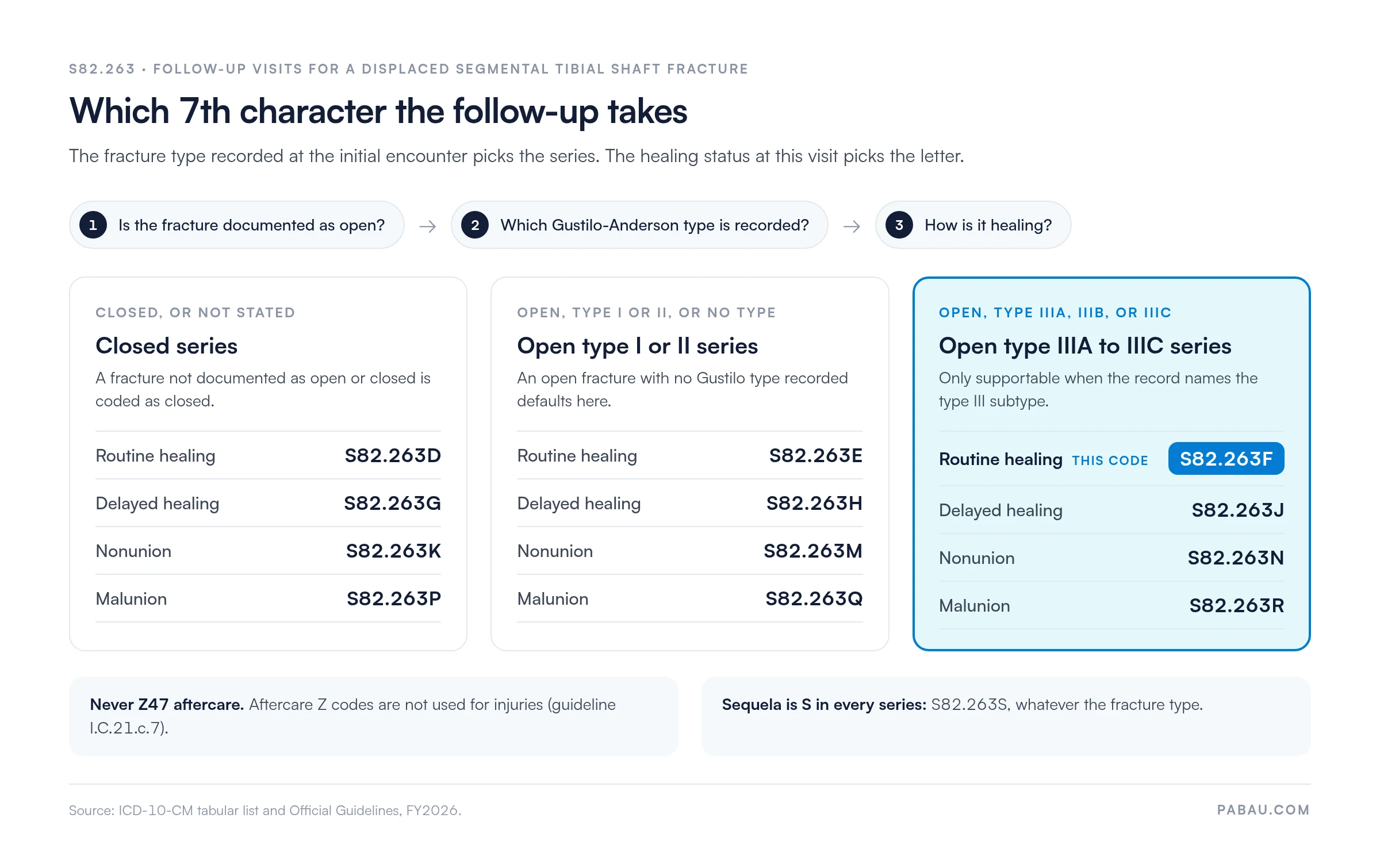
The 7th character must follow the physician’s documentation. Coders should never infer the open-fracture type or the healing status from imaging alone. When documentation is ambiguous, query the treating provider before submitting.
A displaced segmental fracture is one created by two separate fracture lines along the bone, leaving an isolated, free-floating bone segment between them. The fragments have shifted out of their normal anatomical alignment, distinguishing it from a non-displaced fracture where the bone pieces remain roughly in position.
The tibial shaft is the diaphysis of the tibia, the region between the proximal and distal metaphyses. Shaft fractures at this level are common in high-energy trauma such as motor vehicle collisions and sports injuries. Coders need to recognize these descriptors in clinical notes to justify S82.263F over simpler S82.2x codes:
A butterfly fragment or comminution does not make a fracture segmental. Those patterns have their own codes, such as S82.25- for comminuted fractures of the tibial shaft. A sequela of that pattern on the left leg, for example, is S82.255S.
The open-fracture type matters as much as the pattern. Type IIIA keeps adequate soft tissue coverage despite a high-energy wound. Type IIIB involves soft tissue loss and periosteal stripping, which usually needs flap coverage. Type IIIC adds an arterial injury that needs repair.
If the notes say only “tibial fracture,” or leave out the pattern, displacement, or open type, S82.263F is not supportable. The coder should query before assigning the code.
The 6th character position controls laterality. S82.261F covers the right tibia, S82.262F the left, and S82.263F the unspecified side. All three share the same open type IIIA-C, routine-healing 7th character. Some payers, including some Medicare Advantage plans and commercial carriers, flag unspecified laterality codes for review. Some deny them outright when the medical record clearly identifies a side.
Sometimes the note is unclear, but imaging orders, operative notes, or cast application notes identify a specific leg. The coder should then query the physician rather than default to unspecified. Check payer-specific policies on laterality requirements before submission, as requirements vary by plan.
Run a laterality audit on all S82.263F claims before submitting. Pull the imaging report or operative note for each encounter. If either document names a specific leg, the treating physician can amend the encounter note. You can then refile with S82.261F or S82.262F and remove a common denial trigger before it reaches the payer.
The S82 category carries coding notes that govern what can and cannot be coded alongside S82.263F. Missing these leads to claim edits at the clearinghouse level.
Every element of S82.263F must be traceable to the physician’s note for that specific encounter. The CMS ICD-10 coding resources set the documentation standard that payers apply during audits.
At a subsequent encounter for an open type III segmental tibial shaft fracture, the CPT code depends on the service the physician performs. Most of these fractures are stabilized surgically, so many early follow-ups fall inside a 90-day global period. Pabau’s claim validation, part of its error-checking claims software, checks claims for missing or invalid details before submission. Common pairings include the following:
NCCI (National Correct Coding Initiative) edits update quarterly and can bundle certain cast application codes against E&M services. Check the current NCCI edit tables at CMS before billing cast management alongside an office visit for the same encounter.
S82.263F is a subsequent encounter code, so the authorization that covered the initial fracture treatment period typically extends to follow-up visits. That said, payer-specific policies vary considerably. Always check each individual plan before assuming coverage.
Sometimes a claim for S82.263F is denied on medical necessity grounds where authorization was required. The strongest appeal includes imaging that shows callus formation and the physician’s assessment of healing progress. Add the treatment plan with its anticipated discharge date.
Denials on ICD-10 code S82.263F cluster around five consistent patterns. Understanding each one, and what the payer’s remittance advice signals, is the fastest path to a clean secondary claim or successful appeal. Pabau’s integration with the Claim.MD clearinghouse routes electronic 835 remittance data back to the practice. Denial reason codes then appear in the workflow where the original claim was built.
For orthopedic and trauma denial patterns, the denial management in healthcare guide covers the CARC code framework payers use on 835 remittances. The CARC denial codes on an S82.263F rejection show whether the cause is missing documentation, a code-entry error, or a payer policy. Each one needs a different response.
Reaching for a Z47 aftercare code at a fracture follow-up is a common coding error in orthopedic billing, ruled out by Section I.C.21.c.7. Aftercare Z codes are not used for injuries, because the 7th character already identifies subsequent care. Z47.1 is aftercare following joint replacement surgery, so it never applies to a tibial shaft fracture.
The practical test is simple. If the visit is care for this injury, the injury code applies. Its 7th character follows the open or closed status, the Gustilo type, and the healing status. Pabau’s claim validation checks claims for missing or invalid details before submission, which supports clean claim standards. The Claim.MD integration then returns remittance advice to the billing workflow.
Add one line to every fracture follow-up template: open or closed, and the Gustilo type if open. The follow-up note then carries the fact that decides between S82.263D, S82.263E, and S82.263F. The coder no longer has to dig through the initial operative record to find it.
In most orthopedic practices, the open-fracture type is recorded once, in the initial operative note. Weeks later, a coder reads a short follow-up note and picks a 7th character. If the follow-up note never mentions the Gustilo type, the claim often defaults to D, and the payer sees a closed fracture.
Pabau keeps that fact attached to the patient. Structured fields record open or closed status, the Gustilo type, laterality, and healing status in the clinical record. Every follow-up then starts from the same facts. Pabau’s claims management software carries those values into the claim, and claim validation checks for missing or invalid details before submission.
The result is a claim that agrees with the chart it came from. Your team spends less time reconstructing surgical detail when a payer questions the 7th character. Every Pabau subscription includes the full feature set, so documentation, coding, and claims sit in one record.

Pabau records the open-fracture type, side, and healing status in the chart, then checks each claim for missing or invalid details before submission. See how it works for orthopedic and trauma billing teams.

The costliest mistake with S82.263F is reading F as a closed-fracture code. F belongs only to an open type IIIA, IIIB, or IIIC fracture at a routine follow-up. A closed fracture is S82.263D, and an open type I or II fracture is S82.263E. Laterality and the Z47 trap are the other two errors to rule out. Each one is settled by a note that states the open type, the side, and the healing status.
Pabau’s claim validation checks claims for missing or invalid details before submission, and the Claim.MD integration returns remittance advice to the billing workflow. Denial reason codes then surface in the system where the claim was built. To see how that keeps fracture follow-up claims consistent with the chart, book a demo with the Pabau team.

Need a full clearinghouse integration overview? Claim.MD clearinghouse guide explains how the Pabau-Claim.MD connection routes claims, tracks eligibility, and returns ERAs.
Seeing recurring denial codes on orthopedic claims? Denial codes in medical billing decodes the CARC and RARC codes that appear on 835 remittances for fracture claims.
Want to benchmark your clean claim rate? Revenue cycle management overview covers the metrics orthopedic practices use to track denial rates, days in A/R, and first-pass resolution.
Coding a tibial shaft fracture that will not unite? ICD-10 code S82.299K covers the nonunion follow-up for other tibial shaft fractures.
Healing slower than expected? ICD-10 code S82.242H shows how delayed healing changes the 7th character on a displaced spiral shaft fracture.
ICD-10 code S82.263F is the billable ICD-10-CM code for a displaced segmental fracture of the shaft of an unspecified tibia. It is reported at a subsequent encounter for an open fracture type IIIA, IIIB, or IIIC with routine healing. Its characters specify the fracture site, pattern, displacement, laterality, and encounter type.
In the S82.263 series, the 7th character F means a subsequent encounter for an open fracture type IIIA, IIIB, or IIIC with routine healing. At the same visit, a closed fracture takes S82.263D and an open type I or II fracture takes S82.263E. Within the open type III series, J signals delayed healing, N nonunion, R malunion, and S sequela.
S82.261F specifies the right tibia, and S82.263F leaves the side unspecified. Both describe a displaced segmental tibial shaft fracture at a subsequent encounter for an open type IIIA, IIIB, or IIIC fracture with routine healing. Use S82.262F for the left leg, and S82.263F only when the note does not name a side.
Use the injury code with its 7th character for every follow-up visit for this fracture. That includes cast changes and imaging checks while the fracture is still healing. Removal of a fixation device from a still-healing fracture also takes the injury code. Guideline I.C.21.c.7 states that aftercare Z codes are not used for injuries. Z47.1 covers aftercare following joint replacement, so it does not apply to a tibial shaft fracture.
Yes, S82.263F is a valid, billable 7-character ICD-10-CM code confirmed in the CMS tabular list. It is specific enough to report directly on a claim and does not require a more detailed sub-code. Confirm the code remains active in the current fiscal year tabular list via the CDC/NCHS ICD-10-CM web tool.
ICD-10-CM guidelines encourage an additional Chapter 20 external cause code to identify the mechanism of injury. At a follow-up visit that might be W19.XXXD for an unspecified fall. No national rule requires it, but some commercial payers and Medicare Advantage plans deny claims without it. Check each payer’s policy before submission.
The physician’s note must show that the fracture is segmental, with two separate fracture lines, and displaced. It must place the fracture in the tibial shaft and classify it as open type IIIA, IIIB, or IIIC. It must also show a follow-up encounter with routine healing. Laterality should be specified when known.