ICD-10 Code S53.013D: Anterior subluxation of unspecified radial head
ICD-10 Code S53.013D: Quick reference summary Use the table below as your first ...

Last Updated: Nov 6, 2026
Billable Code Specific Code
S62.116B is the billable ICD-10-CM code for nondisplaced fracture of triquetrum [cuneiform] bone, unspecified wrist, initial encounter for open fracture. It covers an open break of the triquetrum, a carpal bone on the little-finger side of the wrist, while the patient is in active treatment.
The 6th character 6 means the record does not say which wrist was injured. When any note names the side, S62.114B (right) or S62.115B (left) is the accurate code.
Let Pabau's smart automation suggest the right codes, reduce claim denials, and keep your practice compliant—effortlessly.
Automate repetitive tasks and focus on what matters most—your patients.
Reduce coding errors and ensure compliance with the latest regulations.
Clean claims, fewer denials, and faster reimbursements.
Powerful insights and reporting to help your practice thrive.
HIPAA compliant SOC 2 certified GDPR-compliant Trusted by 4,000+ clinics worldwide

ICD-10 Code S62.116B reports a nondisplaced open fracture of the triquetrum, a carpal bone, when the record does not say which wrist is injured.
The 6th character 6 means unspecified wrist. Use S62.114B for the right wrist and S62.115B for the left whenever the side is documented.
The 7th character B means an open fracture in active treatment. Category S62 has no Gustilo-based C character, so every open triquetrum fracture takes B.
Fracture care pairs with CPT 25630, 25635 or 25645, and open-wound debridement with 11010 to 11012, depending on the work documented.
ICD-10 Code S62.116B describes a nondisplaced fracture of the triquetrum [cuneiform] bone of an unspecified wrist, coded at the initial encounter for an open fracture. The triquetrum is a carpal bone in the proximal row, on the little-finger side of the wrist. The code applies while the patient is still receiving active treatment for the break.
S62.116B sits in Chapter 19 of ICD-10-CM (S00-T88) under category S62, fracture at wrist and hand level. It is a complete 7-character code, so it is billable as written. The medical billing basics still apply: a specific code only pays when the chart supports every character in it.
Triquetrum fractures are the second most common carpal fracture after the scaphoid. Most are small dorsal avulsion chips from a fall on an outstretched hand (PMC review of dorsal triquetrum chip fractures). Open triquetrum fractures are far rarer. They usually follow high-energy wrist trauma, such as a crush, machinery or saw injury.
Each character in S62.116B narrows the diagnosis one step further. Positions 5 and 6 carry the bone, the displacement and the side, so they cause most coding errors on this code.
In the S62.11- series the 6th character encodes displacement and side together. A 6 is the least specific nondisplaced option, which is why S62.116B should be the exception rather than the default.
The 7th character B means the fracture is open and the patient is receiving active treatment. Under the Chapter 19 guidelines, an initial encounter covers every visit in the active treatment phase, not only the first one. An ED visit and the hand surgeon’s later fixation can both carry B.
Category S62 offers only one open-fracture character. Forearm, femur and lower-leg categories such as S52 split open fractures into B (Gustilo type I or II) and C (type III). Wrist and hand fractures do not, so S62.116C does not exist. Every open triquetrum fracture at the initial encounter takes B, whatever its Gustilo grade.
Two defaults in category S62 also matter here. A fracture not documented as open or closed is coded as closed. A fracture not documented as displaced or nondisplaced is coded as displaced, which would move the code to S62.113B.
The triquetrum series has six subcodes, one for each mix of displacement and side. The grid shows how those two documentation facts route an open fracture to its code.
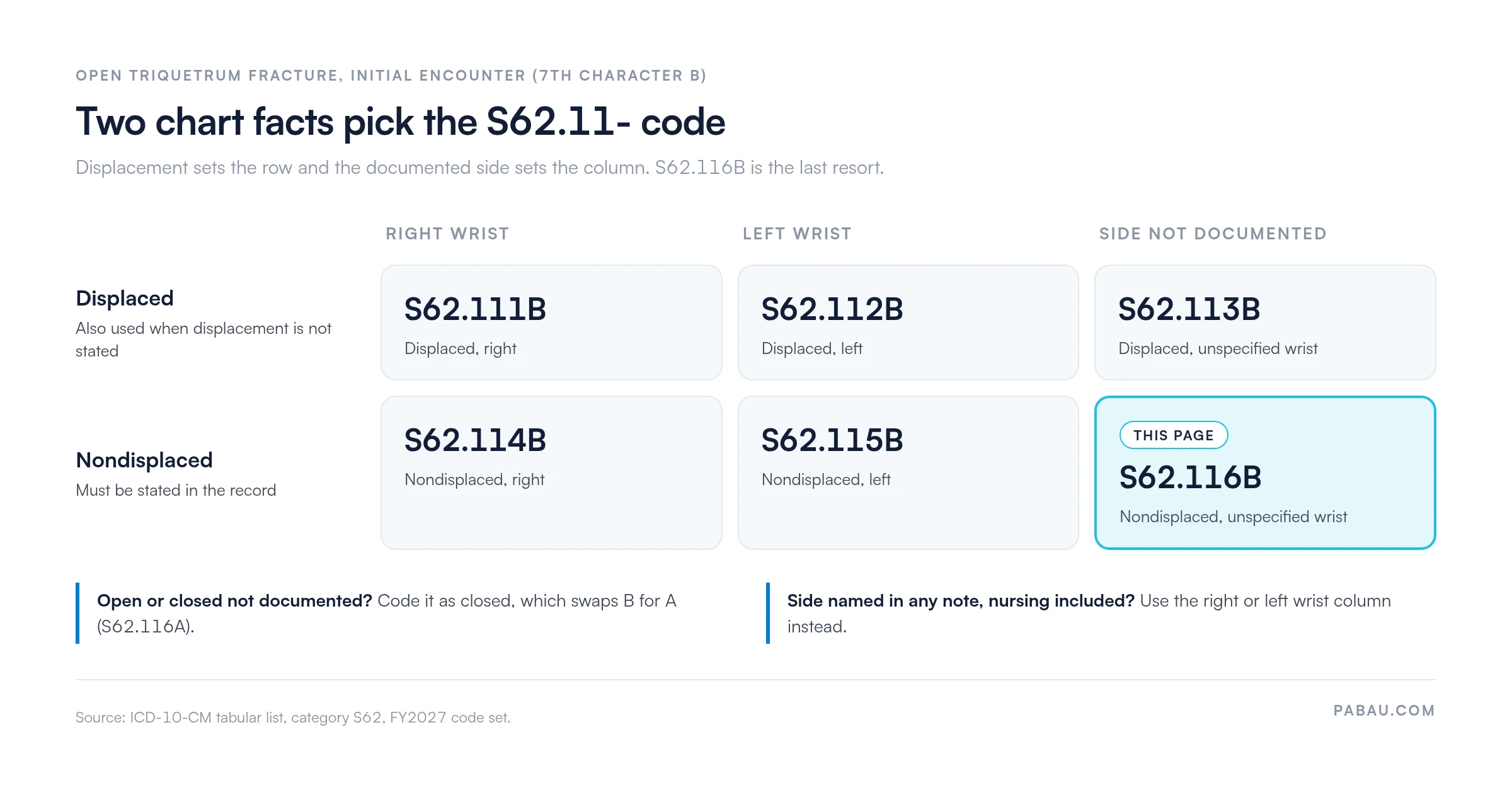
The table lists the open-fracture, initial-encounter member of each subcode, so you can swap S62.116B for the most specific match.
The rest of the S62.116 family follows the 7th character table. S62.116A covers a closed fracture, while S62.116D, G, K, P and S cover follow-up visits and late effects.
A patient arrives at an urgent care center after a table-saw injury to the wrist. X-ray shows a nondisplaced fracture of the triquetrum, and the provider documents a laceration exposing the fracture site.
The wound is irrigated and the wrist splinted before transfer. The urgent care note never records which wrist was injured, and no other note in the chart does either.
That record supports S62.116B. If the triage nurse had written “left wrist”, the coder could use S62.115B instead. The decision steps run in this order:
Coding guidelines let you take laterality from other clinicians’ notes, such as nursing documentation, as long as the provider documents the fracture itself. Check those notes before settling for the unspecified-wrist code.
The tabular notes above S62.116B shape which codes can sit beside it on the same claim:
The CMS ICD-10 resources publish the full tabular list and guidelines for each fiscal year. The codes below cause the most mix-ups with S62.116B:
Every character of S62.116B needs support in the record before the claim goes out. When submitting a clean claim for this code, check the encounter notes for these points:
No. S62.116B reports an unspecified wrist, and the guidelines reserve unspecified-side codes for records that name no side. S62.114B is the right-wrist code and S62.115B the left. If two notes disagree on the side, query the attending provider before choosing either.
ICD-10 Code S62.116B pairs with carpal fracture care and, often, with open-fracture debridement coded from 11010 to 11012. In CPT, open and closed describe the treatment, not the fracture. An open triquetrum fracture that is irrigated and splinted can still pair with a closed treatment code.
Pabau’s claims management software raises the claim from the patient’s invoice. It then submits the claim through the Claim.MD clearinghouse. Check current NCCI edits before billing debridement and fracture care on the same date.
Procedure lines for a wrist usually carry an RT or LT modifier. That modifier names a side the unspecified diagnosis does not, so the pairing invites a payer query. When the procedure note names the side, the diagnosis should name it too.
Claims carrying S62.116B fail for a short list of preventable reasons. Strong denial management workflows catch most of them before submission.
Pair these patterns with a list of medical billing denial codes so your team can read a remittance and fix the claim quickly.
Yes. ICD-10 Code S62.116B is valid and billable in the FY2027 code set, effective October 1, 2026. It has been unchanged since ICD-10-CM took effect in October 2015.
Confirm validity each October 1 in the CDC/NCHS ICD-10-CM browser tool. It shows year-specific descriptors and flags deleted, revised and new codes. Update any internal code lists at the same time, so retired codes never reach a payer.
A practice often codes an open wrist fracture from the ED note, then keys the claim into a separate billing tool. Every handoff is a chance to drop the side, the open-fracture character or the debridement line. The rejection only surfaces weeks later.
Pabau raises the claim straight from the patient’s invoice. Its claim validation scrubs each claim for missing or invalid details before it leaves Pabau. US practices then submit through Claim.MD, and a rejected claim is flagged Needs action with the reason shown.
The outcome is fewer resubmissions and a shorter wait for payment on fracture care. Your billing team works one dashboard instead of chasing claims across systems.
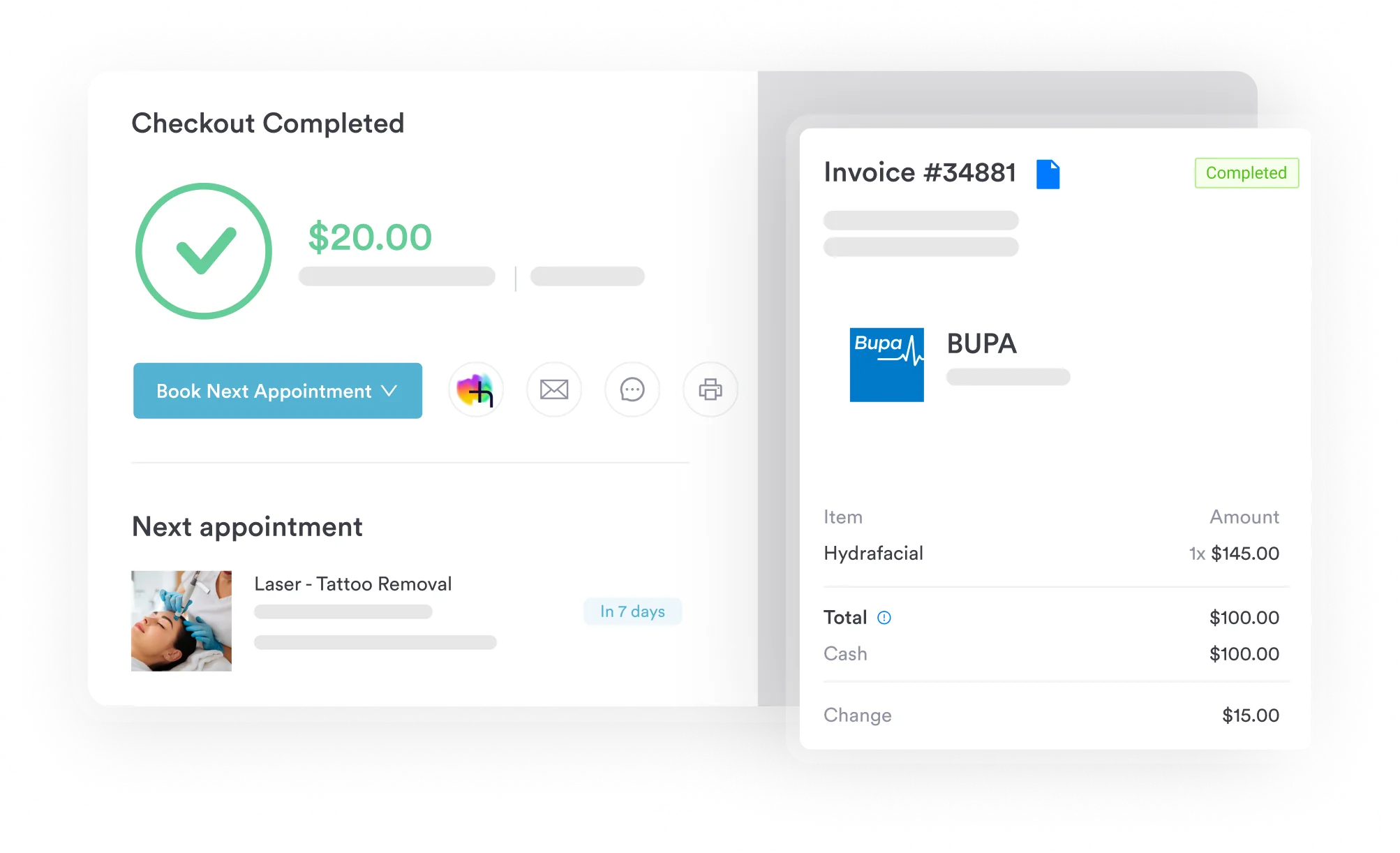

Pabau raises each claim from the invoice and scrubs it for missing or invalid details before submission. Your team spends less time on rework and more time on patient care.

S62.116B is a fallback code. It fits an open, nondisplaced triquetrum fracture only when no note in the record names the injured wrist. Treat every S62.116B on your claims list as a prompt to check the chart for a side first.
The bigger trap sits in the procedure codes. An open fracture does not force an open treatment CPT code, and debridement has its own code range. Coders who keep the fracture type and the treatment type apart avoid both overcoding and lost revenue.
Book a demo to see how Pabau checks each fracture claim for missing or invalid details before it reaches the payer.

Need a reference for denial codes that appear on wrist fracture remittances? Denial codes in medical billing explains the CARC and RARC codes your team will see when S62.116B claims are rejected.
Want to understand how the clearinghouse fits into your claim submission workflow? Medical claims clearinghouse explained covers how EDI transactions, eligibility checks and remittances flow between your practice and the payer.
Looking to build a clean-claim process from the ground up? Revenue cycle management overview walks through the workflow from patient registration to payment posting.
ICD-10 Code S62.116B means a nondisplaced open fracture of the triquetrum bone, with the injured wrist not specified, at the initial encounter. The triquetrum is a carpal bone on the little-finger side of the wrist. Nondisplaced means the fragments stayed aligned, and the 7th character B marks an open fracture still in active treatment.
Yes. S62.116B is a billable, specific ICD-10-CM code, valid in the FY2027 code set and unchanged since October 2015. Because it reports an unspecified wrist, it is the weaker choice whenever the record names a side. Use S62.114B for the right wrist or S62.115B for the left.
The only difference is laterality. S62.114B reports a nondisplaced open triquetrum fracture of the right wrist, while S62.116B leaves the side unspecified. S62.115B is the left-wrist code. Coding guidelines let you take the side from other clinicians’ documentation, such as a nursing note.
Fracture care uses CPT 25630 (closed treatment without manipulation), 25635 (closed treatment with manipulation) or 25645 (open treatment), each per bone. Debridement of the open fracture site is reported with 11010, 11011 or 11012, depending on the deepest tissue removed. An ED evaluation takes an E/M code from 99281 to 99285.
Yes. CPT treats the fracture type and the treatment type as separate ideas. An open triquetrum fracture that is irrigated, debrided and splinted can pair with 25630 or 25635. Use 25645 only when the surgeon surgically exposes and treats the fracture itself.
No. Category S62 has a single open-fracture character, B, so the Gustilo-Anderson grade does not change the code. The B and C split by Gustilo grade applies to other categories, such as S52 forearm fractures. Documenting the grade still supports the medical necessity of debridement.
The usual causes are an unspecified wrist when a note names the side, or a B character with no documented open wound. Billing B at a follow-up visit is another. A procedure line carrying RT or LT beside an unspecified-wrist diagnosis also invites a payer query. Recoding to S62.114B or S62.115B fixes both laterality problems.