









ICD-10 Code S92.526D: Nondisplaced fracture, unspecified toe
S92.526D covers a nondisplaced middle phalanx fracture of an unspecified lesser ...

Last Updated: August 31, 2026


ICD-10 Code S61.210D covers a laceration without foreign body of the right index finger, nail intact, at a follow-up encounter.
Nail status sits in the fourth character, not the last one. S61.21- means the nail is undamaged, while S61.31- means the nail is damaged.
The 7th character D is only valid once active treatment has begun and the patient is receiving routine care. Use A while active treatment is still being delivered.
Missing laterality, nail involvement, or encounter type in the clinical note are the three most common reasons this code triggers a claim denial.
Pabau’s claims management software links with Claim.MD to submit claims, check payer eligibility in real time, track claim status, and post ERA remittances.
ICD-10 Code S61.210D is a billable ICD-10-CM code for a laceration of the right index finger. No foreign body is retained, the nail is undamaged, and the visit is a subsequent encounter. In practice that means the follow-up appointment, not the visit where the wound was cleaned and closed.
The code is claim-ready for FY2026, from October 1, 2025 onward. According to the CMS ICD-10-CM code set, it sits within the S00-T88 injury chapter under open wounds of the wrist, hand, and fingers.
One point deserves flagging up front, because it is where coders most often go wrong. S61.210D is the code for a right index finger laceration with an intact nail.
The very similar S61.310D covers the same finger and the same encounter type, but only when the nail is damaged. The two are not interchangeable, and a single character decides which one applies. This reference works through that character, the documentation checklist, the sibling codes, and the billing steps that keep a follow-up claim moving.
The table below captures the core reference data for S61.210D. Verify the current fiscal year edition when submitting claims, since CDC/NCHS updates the ICD-10-CM tabular annually.
Every character in S61.210D carries specific anatomical or clinical meaning. Misreading even one character produces the wrong code and, often, a denied claim. The AAPC ICD-10-CM code reference confirms each position maps directly to the tabular structure.
Taken together, the code describes a patient returning for follow-up wound care on a clean laceration of the right index finger. The nail is intact and no foreign material was retained. Each of those five elements must be documented in the clinical note to support the code on a claim.
The character order matters more than it looks. Coders often assume nail status is the last thing the code records, because it is the last thing the descriptor mentions. In S61, nail status is fixed at the fourth character, which means it is decided before laterality is even reached.
The map below reads the code position by position, and names the code you land on if you change any one character.
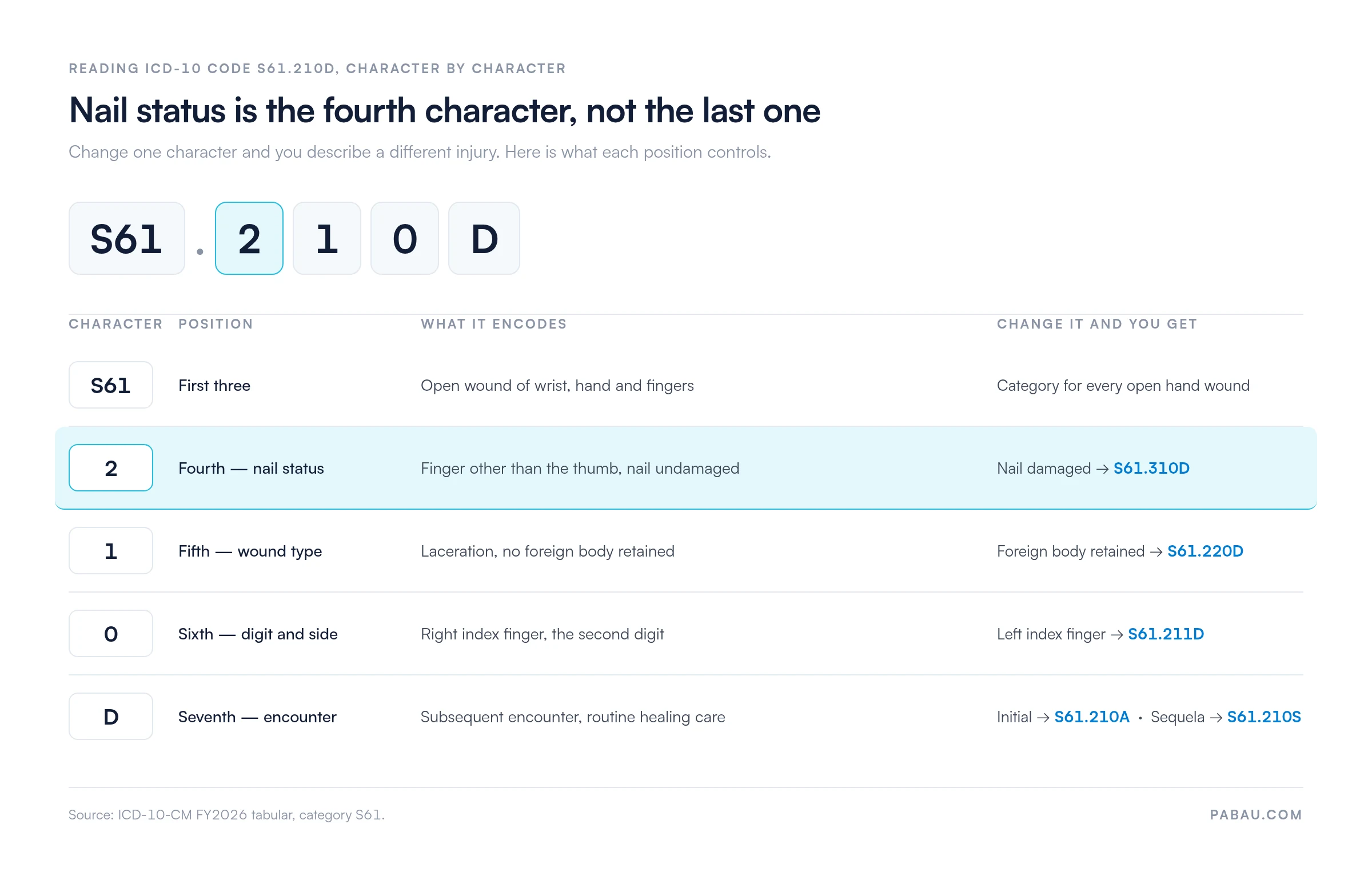
The 7th character is the element coders most often misapply on follow-up visits. Every code in category S61 requires one. According to the ICD-10-CM Official Guidelines for Coding and Reporting, Section I.C.19, the definitions are precise and not interchangeable.
The key distinction between A and D is whether active treatment is being delivered. It is not simply a question of whether this is the first or the second visit. A patient who presents to a second clinician for active surgical debridement still uses A, because that clinician is initiating active treatment. S is reserved for visits where the original wound has fully healed and the patient is now being seen for a late effect.
The clear cases are easy. These are the wound-care follow-ups where the 7th character is genuinely arguable, and how to settle each one.
A practical shortcut for the routine cases: if the note reads “wound healing well, no signs of infection, sutures removed,” then D is correct. If it reads “wound opened, debrided, repacked,” then A applies even at a follow-up visit.
Two variables beyond the 7th character determine the exact code: which finger and side was injured, and whether the nail is involved. Both must be documented explicitly in the clinical note. The table below pairs each digit with its without-nail and with-nail code at a subsequent encounter, for a laceration with no retained foreign body.
Two patterns are worth memorizing from that table. Within the finger codes, the without-nail family runs S61.21- and the with-nail family runs S61.31-, and the sixth character is identical across both. The thumb sits outside that pattern entirely, in S61.0- for an intact nail and S61.1- for a damaged one.
Nail involvement is determined by whether the nail bed, nail plate, or perionychium has been disrupted. A laceration that stops at the fingertip skin without affecting the nail structure uses S61.210D. One that extends into the nail fold or causes nail avulsion uses S61.310D. If the clinical note does not specify nail status, sending a query to the clinician is the right step rather than guessing.
Two instructional notes govern every code in category S61, including S61.210D. Both change what else appears on the claim, so they are worth checking before submission.
Because both exclusions are Excludes1, they are mutually exclusive with S61.210D for the same injury. Reporting an open wound code and an open fracture code for the same finger is the classic version of this error. Clearinghouse edits catch it routinely.
Claim reviewers and auditors check five documentation elements before they accept S61.210D on a claim. A note missing any one of them is a common trigger for a denial or a downcode.
Practices can embed these five prompts directly into their wound-care follow-up note templates. That removes most of the back-and-forth between coders and clinicians at billing time.
Finger laceration codes generate a predictable set of claim edits. Most errors fall into four categories, and each one has a straightforward fix.
A practice that catches these errors before submission usually does one thing differently. The coder queries an incomplete note instead of assuming an answer. When one slips through anyway, the remittance names the reason. A shortlist of denial codes shows which of these four errors the payer caught.
Build a two-question prompt into your wound-care follow-up note template: (1) Is the nail structure intact? (2) Was this patient previously treated for this laceration, here or elsewhere? Answering both in the note removes the two omissions that most often push a claim from S61.210D onto the wrong code.
S61.210D sits within a larger family of finger laceration codes. Knowing the adjacent codes prevents misassignment when the laterality, nail status, wound type, or digit differs from this scenario. The table below pairs each neighbor with what it changes.
Confirm the CPT-to-ICD-10 pairing before the claim goes out, so the procedure and the diagnosis support each other for medical necessity. The simple repair series runs 12001-12018, and finger repairs fall in the 12001-12007 group covering trunk and extremities.
Clinicians and coders may encounter different terminology in notes and superbills that all map to S61.210D. Recognizing these synonyms prevents an unnecessary query when the clinical intent is already clear.
Getting the ICD-10 code right is half the claim. The other half is how it moves through your billing system and reaches the payer without triggering an edit. These tips address the workflow points where S61.210D claims most often stall.
S61.210D at a subsequent encounter typically pairs with evaluation and management CPT codes, usually 99211-99214 depending on medical decision complexity. It can also pair with wound management CPT codes when active wound care is performed at the follow-up. Simple suture removal is generally not separately billable as a procedure by the same provider who performed the primary repair.
If a repair is performed, the simple repair series is 12001-12018, and finger wounds are coded from 12001-12007. The group opens at CPT code 12001, which is where the wound-length thresholds start.
Documenting whether the visit is evaluation and management only, or includes a procedure, decides which CPT code supports S61.210D. Payer-specific edits may disallow certain pairings, so verify with the payer first.
Eligibility is the check worth running before a wound-care follow-up claim leaves the practice. Pabau, our practice management software, connects to the Claim.MD clearinghouse for electronic claim submission, real-time eligibility checks, claim status tracking, and ERA remittance posting.
That connection does not read your diagnosis codes. Nail status and the 7th character still have to be right in the note before the claim is built. That is why the documentation checklist above comes first.
For a practice running a high volume of wound-care follow-ups, checking eligibility before the visit removes a whole class of denial. Software built for cleaner claims management runs that check against the payer without a phone call.
S61.210D can appear on telehealth claims when the subsequent encounter is a virtual wound check. Payer eligibility for telehealth billing of wound-care visits varies. Place-of-service codes and payer-specific telehealth policies govern whether a virtual visit for wound monitoring will be reimbursed. Always verify the individual payer’s telehealth policy before submitting S61.210D with a telehealth place-of-service code.
In most practices, the nail status and the encounter type live in a free-text note, and the ICD-10 code is picked separately at billing time. That is how S61.210D turns into S61.310D, or how D turns into A. Nobody notices until the remittance advice arrives.
Pabau keeps the clinical note and the claim in one record. Wound-care follow-up templates can prompt for nail integrity and prior treatment as structured fields, so the coder reads the answer rather than guessing at it. Diagnosis codes attach to the visit at the point of care.
From there, the Claim.MD integration submits the claim electronically and checks payer eligibility in real time. It also tracks claim status and posts the ERA remittance when the payer responds. The result is a shorter path from wound check to payment.

Pabau connects directly with Claim.MD to submit claims electronically, check payer eligibility in real time, and post ERA remittances. See how wound-care follow-up claims move from the note to the payer.

Finger laceration follow-up visits generate a steady stream of preventable claim denials, and the cause is usually the same short list. Nail status gets read off the wrong character, the 7th character is wrong, or laterality is assumed rather than stated.
ICD-10 Code S61.210D is specific and billable, but it only holds up when all five documentation elements are explicit in the clinical note.
The single highest-value habit is naming the nail status in every wound-care note. That one sentence decides between S61.210D and S61.310D, and no amount of downstream claim scrubbing can recover it if the note is silent.
Pabau links structured ICD-10 documentation to electronic claim submission through Claim.MD, so follow-up codes reach the payer with their supporting data attached. Book a demo to see how your wound-care follow-ups would move from the note to the remittance.

Need to understand how claims clear the payer? Medical claims clearinghouse explained covers how electronic claims are validated, scrubbed, and routed to payers.
Seeing recurring denials on injury codes? Electronic remittance advice (ERA) explains how to read 835 files and trace denial reasons back to specific code errors.
Want to reduce billing errors across your practice? Best medical billing software for US practices reviews the tools that integrate ICD-10 validation into the claims workflow.
ICD-10 Code S61.210D is a billable ICD-10-CM diagnosis code. It covers a laceration of the right index finger, without a foreign body and with the nail undamaged, at a subsequent encounter. The patient is returning for routine care during the healing phase after initial treatment has already been provided. The 7th character D signals that the wound is healing and that this visit is not the first active treatment episode.
Nail status is the only difference, and it sits in the fourth character. S61.210D is a laceration of the right index finger with the nail intact, while S61.310D is the same laceration with damage to the nail. Both are subsequent-encounter codes for the same finger. A note that does not state nail integrity cannot support either code without a query to the clinician.
Use the D 7th character once the patient has already received initial active treatment for the injury. The visit is routine care during the healing phase. Wound checks, suture removal, and dressing changes all qualify. D does not apply when the patient is first seen for the injury. Use A for that visit. Once the wound has healed and the visit addresses a late effect, use S instead.
S61.210A is for the initial encounter, when the patient receives active treatment for the laceration. S61.210D is for subsequent encounters during the healing phase, such as follow-up wound checks or suture removal. S61.210S is for sequela visits. The original wound has healed and the patient is seen for a late complication, such as a scar contracture or reduced finger mobility.
Yes. S61.210D is a billable and specific ICD-10-CM code valid for claim submission in the FY2026 edition, effective October 1, 2025. It can be reported for reimbursement on a CMS-1500 or 837P electronic claim. The documentation must support all five required elements: right index finger, no foreign body, no nail damage, and a subsequent encounter.
The clinical note must document five elements. Name the right index finger as the injured site, and confirm the right hand as the side. Confirm that no foreign body was retained and that the nail structure is intact. Finally, state that this visit is a follow-up rather than the initial active treatment. Missing any one of these is a common trigger for a denial or a coder query.
At a subsequent encounter, S61.210D typically pairs with evaluation and management CPT codes 99211-99214, depending on the medical decision complexity documented at the visit. If active wound management is performed, wound care codes such as 97597-97598 may apply. Simple repair, where it is performed, is coded from the 12001-12018 series, with finger wounds in 12001-12007. Payer-specific edits may restrict certain pairings, so verify with each payer before submitting.
The parent code is S61.210: laceration without foreign body of the right index finger without damage to nail. It specifies no encounter type. S61.210 is a non-billable header code used for reference within the tabular structure. A 7th character of A, D, or S must be added before the code can be submitted on a claim.
Yes. Category S61 carries a code-also instruction for any associated wound infection, so the laceration code and an infection code are reported together. S61.210D describes the wound itself and does not capture the infection. Sequencing follows the reason for the encounter, so if the infection is what brought the patient in, code it accordingly.