ICD-10 Code Y76.0: Diagnostic obstetric and gynecological devices
ICD-10 Code Y76.0: Definition and billable status ICD-10 Code Y76.0 is a valid, ...

Last Updated: Oct 23, 2026
Billable Code Specific Code
S92.526D is the billable ICD-10-CM code for nondisplaced fracture of middle phalanx of unspecified lesser toe(s), subsequent encounter for fracture with routine healing.
The word carrying the most weight in that description is unspecified. S92.526D is the code you fall back on when the record never names the injured foot. It is billable, but it also tells the payer the documentation stopped short.
Let Pabau's smart automation suggest the right codes, reduce claim denials, and keep your practice compliant—effortlessly.
Automate repetitive tasks and focus on what matters most—your patients.
Reduce coding errors and ensure compliance with the latest regulations.
Clean claims, fewer denials, and faster reimbursements.
Powerful insights and reporting to help your practice thrive.
HIPAA compliant SOC 2 certified GDPR-compliant Trusted by 4,000+ clinics worldwide

ICD-10 Code S92.526D reports a nondisplaced fracture of the middle phalanx of an unspecified lesser toe, subsequent encounter with routine healing.
The 6th character 6 means laterality was not documented. Right is S92.524D and left is S92.525D.
The 7th character D signals a follow-up visit where healing is on track. Use A for the initial encounter and S for sequela.
S92.526D is billable and has been in ICD-10-CM since the code set took effect on October 1, 2015. It is not a new code.
Practice management software like Pabau keeps laterality and encounter type in the record, so coders rarely need an unspecified code.
S92.526D is a billable ICD-10-CM code, valid on any claim type that accepts ICD-10-CM diagnosis codes. The table below gathers the administrative details coders check before submission.
S92.526D sits in ICD-10-CM chapter S00-T88, injury, poisoning and certain other consequences of external causes. Confirm the description each October against the CDC/NCHS ICD-10-CM web tool, which gives year-specific tabular lookups from the official source.
Every character in S92.526D encodes one clinical attribute. A coder who knows the positions can build the code from the note instead of memorizing the family.
The 6th character is the one that trips people up, because it carries two facts at once. In the S92.52 group, 1, 2 and 3 are displaced fractures of the right, left and unspecified toe. Then 4, 5 and 6 repeat that order for nondisplaced fractures. The grid below lays out all six.
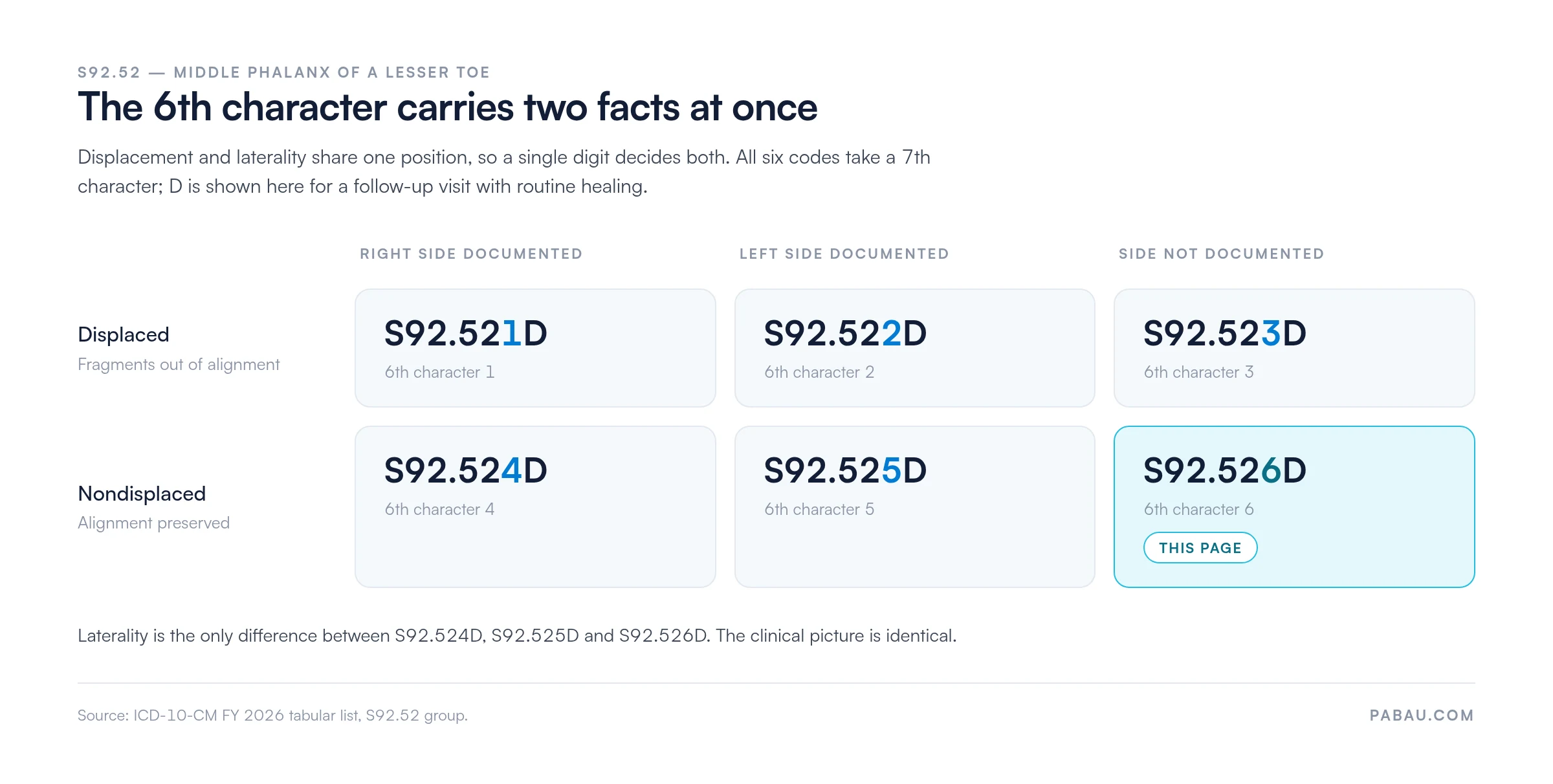
There is no 9 in the 6th position of this group, so a code such as S92.529D does not exist. The parent code S92.526 is a header, and it is not billable without a 7th character.
Each phrase in the official description maps to something a clinician has to write down. Misreading one phrase selects the wrong code family entirely.
One distinction is worth stating plainly. Nondisplaced does not mean minor, it means the alignment is preserved. The note has to say the fracture is nondisplaced, because an imaging line that reads “fracture seen” leaves displacement status unknown.
Under the ICD-10-CM Official Guidelines for Coding and Reporting, section I.C.19, the 7th character encodes the phase of care. It does not describe severity or site. Every valid option for this code appears below.
D covers most follow-up visits for toe fractures. A patient who returns four weeks after buddy taping for a check and an x-ray showing normal callus formation is a D encounter. Moving to G, K or P happens only on documented evidence, never as a precaution.
Subcategory S92.59, other fracture of lesser toe(s), covers injuries the note does not pin to a phalanx level. When one of those heals in a misaligned position, the 7th character P applies and the code is S92.599P.
Coders sometimes read “subsequent encounter” as “second visit”. The character reflects the phase of care instead of a visit count. A patient can have several initial encounters at different facilities before definitive treatment is settled, and every routine follow-up after that takes D.
S92.526D sits at the most granular level of the ICD-10-CM tree for toe fractures. Each level above it adds one piece of clinical specificity.
Parent codes above S92.526D are header codes used for classification and grouping, so they are not billable on their own. Only the full seven-character code carries the specificity that CMS ICD-10-CM requirements expect for reimbursement.
The base code S92.526 takes six 7th characters for closed fractures. Each one maps to a distinct point in the episode of care.
A patient can move from active fracture management to treatment of a residual condition. At that point the 7th character changes from D to S. The sequela character never applies while the fracture is still healing.
Most claims that end up on S92.526D belong on a neighboring code instead. The table below shows the full middle phalanx set at routine healing, plus the adjacent phalanx levels.
The great toe sits outside this range entirely, under S92.4 rather than S92.5. A nondisplaced fracture of the proximal phalanx of the left great toe belongs in S92.415. Seen again for a nonunion, that injury codes to S92.415K. The 7th character K reports nonunion, while the D on S92.526D reports routine healing.
Cross-reference any of these against the AAPC ICD-10-CM code reference before submission. Reading the right and left codes next to each other is the fastest way to see what a note is missing. Our ICD-10-CM code library covers the neighboring foot and ankle codes in the same detail.
Three attributes decide whether S92.526D is right, or whether a sibling code fits better. Each one comes straight from the documentation.
S92.526D is the unspecified option, so it applies only when the record does not name the side. Within the nondisplaced set, 4 is right, 5 is left, and 6 is unspecified. That gives S92.524D, S92.525D and S92.526D.
Unspecified codes are acceptable when the side is genuinely unknown at the time of coding. They are not a shortcut around a thin note. Payers watch unspecified laterality closely, and some request records before they pay.
Displacement shares the 6th character with laterality. S92.523 is the displaced fracture of the middle phalanx of an unspecified lesser toe, and S92.526 is the nondisplaced version of the same injury. If the note names the left foot, a displaced closed fracture at its initial encounter is reported with ICD-10 code S92.522A.
Radiology wording decides this. Reports that describe fragment displacement or an angulated fracture map to the displaced code. Reports that say nondisplaced, or fracture without displacement, map to S92.526 plus the correct 7th character.
S92.526D is specific to the middle phalanx. Proximal phalanx fractures of the lesser toes use the S92.51 group, and distal phalanx fractures use S92.53. Within S92.53, displacement, side and healing status decide the final code. A displaced left distal phalanx fracture at a malunion follow-up takes S92.532P.
Imaging usually settles the level. When the radiology report does not name the phalanx, the treating clinician’s assessment has to clarify it before the claim goes out.
S92.526D is valid for Medicare, Medicaid and most commercial payers. Before it goes on a claim, the note has to establish the fracture, the encounter type, and the healing status.
The 7th character reports the phase of care rather than the complexity of the visit. A long follow-up with new imaging and a change in the plan still takes D, as long as healing is normal.
A referral letter is not enough on its own. The treating clinician’s documentation at this encounter has to support every element above. A missing healing status is a provider query rather than a guess.
Document healing status in words. A note that says only ‘patient returns for fracture follow-up’ leaves the coder without the confirmation the 7th character needs. Add ‘healing progressing normally’ or ‘no evidence of delayed healing, nonunion, or malunion’ to every subsequent fracture visit.
S92.526D is exempt from present on admission reporting. Subsequent encounter codes carry a built-in time element, since the fracture by definition happened before this encounter.
CMS therefore leaves them off the POA requirement for inpatient claims. Facility policies can still add their own rules, so check the current CDC exempt list before you drop the indicator.
A single code never determines an MS-DRG. Assignment depends on the principal diagnosis, secondary diagnoses, procedures, and patient demographics taken together.
Where S92.526D is a principal diagnosis on an inpatient claim, it groups within major diagnostic category 8 for musculoskeletal conditions. Weights change with each fiscal year, so work from the active CMS MS-DRG definitions manual.
In practice this code appears mostly on outpatient claims, where MS-DRG does not apply. Those claims group under the ambulatory payment classification system instead.
A follow-up visit for a healing toe fracture usually pairs an evaluation and management service with imaging or immobilization. The codes below are the ones that show up most often alongside S92.526D.
Watch the global period when fracture care was billed under 28510. Routine follow-up inside that window is already paid, and an unrelated visit needs modifier 24. Check the pairing against the payer’s local coverage determination first, because rules vary.
The ICD-10-CM alphabetical index maps several clinical phrasings to S92.526D. Coders who search by description rather than code number meet these equivalents.
These phrasings help with documentation review and audit prep. Where a note uses different wording, map the documented description through the alphabetical index rather than by memory.
S92.526D is not a new code. It arrived with ICD-10-CM when the code set replaced ICD-9-CM in the United States on October 1, 2015. The description has stayed the same through every annual update since.
Code lookup sites often show a heading like “2026 ICD-10-CM diagnosis code”, which refers to the current edition rather than the year the code appeared. Its FY 2026 validity period runs from October 1, 2025 through September 30, 2026.
Set a reminder each September to review the CMS ICD-10-CM update files for the S92 category. Annual updates occasionally add, revise, or retire codes in this section. Catching a change before October 1 prevents denials on day one of the fiscal year.
Lesser toe fractures look simple, which is exactly why they generate rework. These are the errors that show up most often on subsequent encounter claims.
The first three errors share a root cause. Laterality gets recorded once at the initial visit, then never repeats in the follow-up notes the coder works from.
Build a fracture follow-up template with three prompts: fracture site with laterality, healing progressing normally yes or no, and complications noted yes or no. It takes seconds to complete, and it decides between S92.524D, S92.525D and S92.526D for the coder.
In a split system, laterality lives in the first clinician’s narrative and nowhere else. By the third follow-up the note often says “toe fracture, healing well”, and the coder either queries the provider or codes unspecified.
Practice management software like Pabau keeps the appointment, the treatment note and the claim in one patient record. Pabau’s claims management software carries the diagnosis code from the note onto the claim. The side documented at the initial visit stays visible at every follow-up.
For US practices, Pabau connects to the Claim.MD clearinghouse for electronic submission, eligibility checks and remittance processing. Codes get validated before they reach the payer, which catches format and specificity problems while they are still cheap to fix.

The outcome is fewer follow-up claims going out with unspecified laterality on them. Billing staff spend less time chasing notes, and denial management stops absorbing time that belongs to patients.

Pabau connects clinical notes, ICD-10-CM coding and claim submission in one platform, with Claim.MD for US electronic claims. See how it fits the way your practice already works.

S92.526D is a correct code and a documentation signal at the same time. It says the fracture was nondisplaced, in the middle phalanx of a lesser toe, at a follow-up visit where healing was on track. It also says nobody wrote down which foot.
So the work sits upstream of the claim. Record laterality at every encounter, state displacement status in words, and name the healing status at each follow-up. The coder then reaches S92.524D or S92.525D, and the unspecified code stays where it belongs, as a last resort.
Book a demo to see how Pabau keeps laterality, encounter type and healing status in the record your coders bill from.

Managing denial patterns on fracture claims? Denial codes in medical billing explains the most common CARC reason codes and how to address them before resubmission.
Want to understand the clearinghouse process end-to-end? 837 file format guide covers how ICD-10-CM diagnosis codes are structured in electronic claim submissions.
New to insurance credentialing? How to get credentialed with insurance companies walks through the payer enrollment process required before submitting claims.
S92.526D is the billable ICD-10-CM code for a nondisplaced fracture of the middle phalanx of an unspecified lesser toe. The 7th character D marks a follow-up visit where healing is progressing normally.
No. S92.526D is the unspecified-laterality code in this family. A documented left lesser toe takes S92.525D, and a documented right lesser toe takes S92.524D.
S92.526A covers the initial encounter, when active treatment is provided. S92.526D covers later visits while the fracture heals routinely. The site and the displacement status are identical.
Yes. S92.526D is billable and valid for claim submission. It has been in ICD-10-CM since the code set took effect on October 1, 2015, and is accepted by Medicare, Medicaid and commercial payers.
Use D for any follow-up visit where the fracture is healing without complications. Switch to G for documented delayed healing, K for nonunion, or P for malunion.
D applies while the fracture is still healing during follow-up care. S applies after healing is complete, when a residual condition such as chronic pain or deformity remains.