ICD-10 Code Y76.0: Diagnostic obstetric and gynecological devices
ICD-10 Code Y76.0: Definition and billable status ICD-10 Code Y76.0 is a valid, ...

Last Updated: Oct 23, 2026
Billable Code Specific Code
S96.891S is the billable ICD-10-CM code for other specified injury of other specified muscles and tendons at ankle and foot level, right foot, sequela.
The 7th character S identifies the visit as a sequela encounter. That means the patient is being seen for the residual effects of a prior injury, not for active treatment.
The code is misapplied in two ways. Coders submit the parent S96.891 without a 7th character, or they pick D for a subsequent encounter when the note describes a residual condition.
Let Pabau's smart automation suggest the right codes, reduce claim denials, and keep your practice compliant—effortlessly.
Automate repetitive tasks and focus on what matters most—your patients.
Reduce coding errors and ensure compliance with the latest regulations.
Clean claims, fewer denials, and faster reimbursements.
Powerful insights and reporting to help your practice thrive.
HIPAA compliant SOC 2 certified GDPR-compliant Trusted by 4,000+ clinics worldwide

ICD-10 Code S96.891S covers other specified injury of other specified muscles and tendons at ankle and foot level, sequela. It is billable and valid in the 2026 ICD-10-CM edition.
The 7th character S designates sequela, or late effect. The parent code S96.891 is non-billable without it, so every claim line carries A, D, or S.
Sequela coding needs two facts in the note. The prior injury has resolved, and a residual condition remains.
Using S96.891S for an injury still under active treatment is one of the most common errors in this family. S96.891D covers that visit instead.
Practice management software like Pabau keeps the ICD-10-CM catalog inside the claim screen, so coders select the full code rather than the parent.
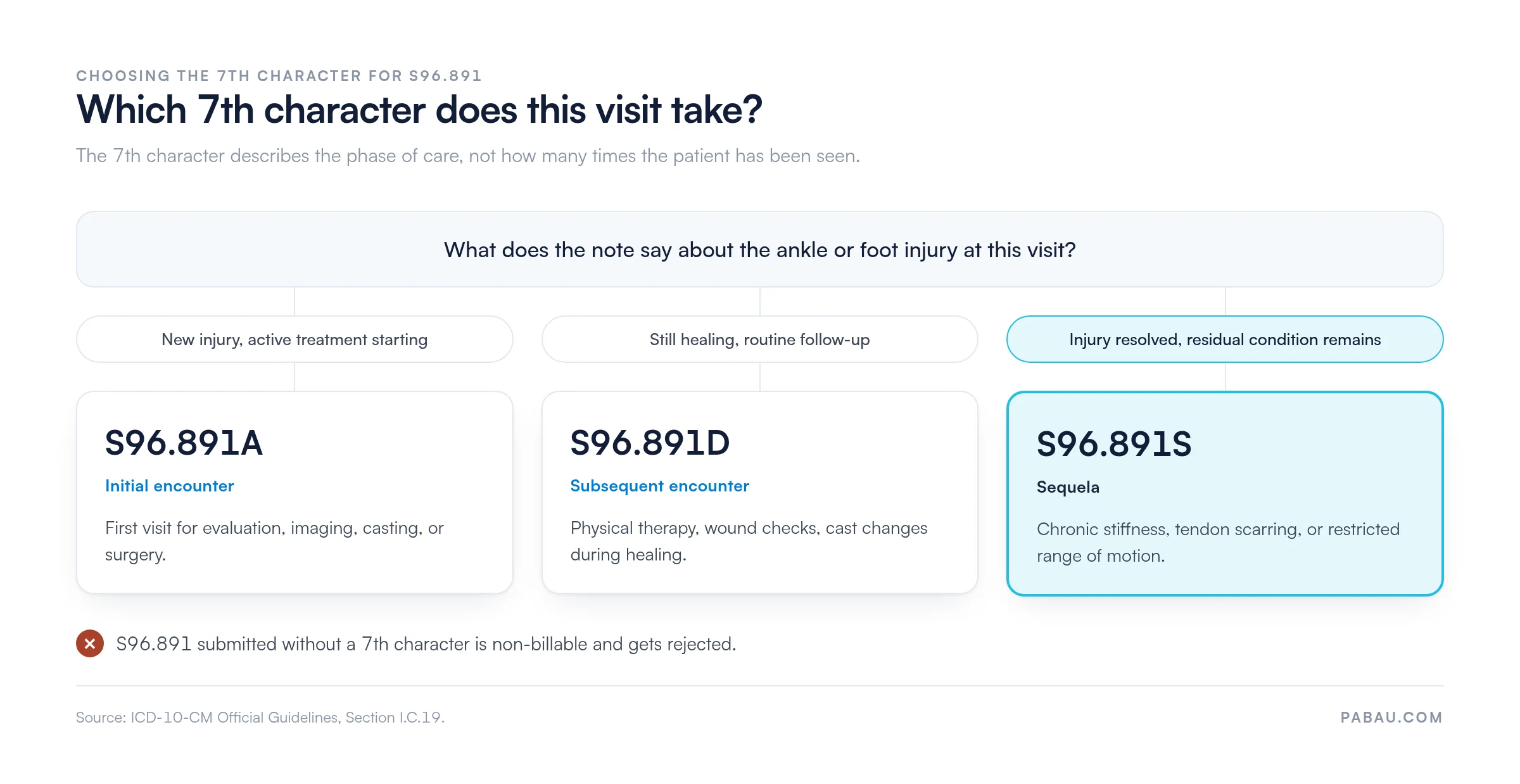
The 7th character is not optional for S96.891. Without it, the claim cannot be processed. Per the CMS ICD-10-CM coding guidelines, injury codes in the S00-T88 range require a 7th character to indicate encounter type. Three options apply to S96.891.
Use S96.891A when the patient is receiving active treatment for a new ankle or foot muscle and tendon injury. This includes the first visit for evaluation, imaging, casting, or surgical intervention. “Initial” refers to the care phase, not the number of visits.
S96.891D applies to follow-up visits during the healing phase, including physical therapy sessions, wound checks, and cast changes. The injury is still active, but the treatment is now routine rather than acute.
ICD-10 Code S96.891S is correct when the original ankle or foot injury has resolved. The patient now presents with a residual condition caused by that injury. Chronic stiffness, tendon scarring, or restricted range of motion months after the acute injury are classic sequela presentations. The original injury must be documented in the patient’s history.
A sequela is a late effect. It is a condition that arises as the direct result of a prior injury, after that injury has itself resolved.
Defaulting to a subsequent encounter code when the note describes a residual condition misstates the phase of care. The same logic applies throughout the S00-T88 injury chapter.
Per ICD-10-CM Official Guidelines Section I.C.19, sequela coding requires two elements to appear on the claim:
There is no mandated timeframe for when sequela coding begins. The decision is clinical. Once the original injury is documented as resolved and a residual condition persists, the sequela code applies. Always document the causal link between the prior injury and the current condition in the clinical notes.
Only the final level of the S96 hierarchy is billable. Every level above S96.891S is a grouping, not a code you can submit.
The “other specified” designation covers structures at the ankle and foot that have no more specific code of their own. The Achilles tendon, for example, is coded elsewhere. Documentation of the specific structure at the initial evaluation is what makes the later sequela code defensible.
Structures commonly documented under this code family include:
Documentation should name the specific structure where possible. Payer review of “other specified” codes can prompt requests for more clinical detail. A specific chart note heads off a medical-necessity query.
S96.891 is the right-side code. Submitting the wrong side is a correctable error, but it still delays payment. The full sibling set under S96.89 is below, with each 7th character variant.
Use “unspecified” only when laterality genuinely cannot be determined from available documentation. Payers increasingly flag unspecified codes for review, so always confirm laterality before submitting.
A sequela claim is reviewed against the note, so the chart has to establish two facts. The original injury has resolved, and a residual condition remains.
These visits usually land in physical therapy and sports medicine practices, months after the acute episode closes. A complete chart note supporting ICD-10 Code S96.891S includes:
Document the causal chain explicitly in your note. For example: ‘Patient presents with [residual condition] as a sequela of [original injury] sustained on [approximate date], which has since resolved.’ That one sentence satisfies payer documentation requirements and supports the sequela code on audit review.
The S96.891 family produces a predictable set of errors. Each is cheaper to catch before submission than to appeal later. Practices that track the denial codes in billing they receive most often can build these five checks into their pre-submission review.
Three of those five errors come down to a single decision at the point of coding.
Coders often cross-reference the sibling codes before settling on S96.891S. Verify current status in the CDC/NCHS ICD-10-CM web tool before submitting, since descriptions and validity change with each annual edition.
Not every ankle and foot sequela starts with trauma. A chemical injury to the same region is coded from category T25 instead. T25.792S covers third-degree corrosion of multiple sites of the left ankle and foot. The 7th character S means sequela in both categories, so mechanism and side are what separate the two codes.
Medicare and commercial carriers may apply coverage policies that limit reimbursement for sequela visits. That risk rises when the note does not separate the sequela encounter from ongoing treatment of the original injury. Understanding the medical billing workflow for musculoskeletal sequelae helps billing teams prepare cleaner claims.
Per the AAPC ICD-10-CM code lookup, S96.891 without a 7th character is non-billable. Submitting the incomplete parent code is a frequent reason claims in this family fail on first submission.
Code selection is ultimately the responsibility of the treating provider and the coding team, working from complete clinical documentation.
In many practices the 7th character is checked by eye, after the note is closed and the claim is already built. The claim screen does not object to a parent code, so S96.891 reaches the clearinghouse intact.
Practice management software like Pabau moves that check earlier. The ICD-10-CM and CPT catalogs sit inside the claim screen, so the coder selects S96.891S from the list rather than typing it from memory.
Eligibility checks run before the visit, and the claim leaves as a CMS-1500 through the Claim.MD clearinghouse to thousands of US payers. Remittance advice comes back into the same record, so a denial on a sequela line is matched to the note behind it.
A physical therapy or sports medicine practice working a run of sequela visits sees fewer rejections to rework. It also spends less time reconciling remittances by hand. Pabau’s claims management software covers the whole path, from code entry to reconciliation.

Pabau’s claims management software integrates with the Claim.MD clearinghouse, supporting ICD-10-CM code entry, real-time eligibility checks, and ERA processing across thousands of US payers. See how it works for musculoskeletal and sports medicine practices.

S96.891S is not a difficult code to get right, but it is easy to get wrong at speed. The suffix has to match the phase of care in the note. The note has to show a resolved injury and a residual condition.
A 7th-character check that happens after the claim is built will always miss a few. Move it to the point of code entry and the same visits stop coming back as denials. Book a demo to see how Pabau handles ICD-10 entry and claim submission for musculoskeletal practices.

Managing ICD-10 claim denials? Denial management in healthcare covers the most common denial triggers and the workflows that prevent them.
Need a clean claim checklist? What makes a clean claim explains the documentation and coding standards that reduce first-submission rejection rates.
Looking for the full medical billing workflow? Revenue cycle management explained walks through the end-to-end billing process from code selection through payment posting.
ICD-10 Code S96.891S is a billable ICD-10-CM diagnosis code for other specified injury of other specified muscles and tendons at ankle and foot level, sequela. The 7th character S designates a sequela, or late effect, encounter. The patient presents with a residual condition from a prior ankle or foot injury that has already resolved. It is valid in the 2026 ICD-10-CM edition.
Yes. S96.891S is a billable, specific ICD-10-CM code. The parent code S96.891 without a 7th character is non-billable and will be rejected on submission. Adding the 7th character S (sequela) makes the code complete and billable.
S96.891A (7th character A) is used for the initial encounter, when the patient first receives active treatment for the ankle or foot injury. S96.891D (7th character D) applies to subsequent encounters during routine healing after active treatment is established. S96.891S (7th character S) is used for sequela visits. The original injury has resolved, and the patient presents with a residual condition such as tendon scarring or chronic stiffness.
Sequela coding applies once the original ankle or foot injury is documented as resolved. The patient must also present with a residual condition caused by that injury. There is no fixed timeframe. The treating provider’s clinical judgment decides, supported by documentation of the prior injury and the current condition.
The immediate parent code is S96.891, which is non-billable without a 7th character. Above it sits S96.89, other specified injury of other specified muscles and tendons at ankle and foot level. Above that come S96.8, S96, S90-S99, and the S00-T88 injury chapter. Only codes at the S96.891A/D/S level are billable in this family.
CPT selection depends on the procedure performed, not on the ICD-10 diagnosis code. Office visits for these sequela encounters are usually billed with evaluation and management codes 99213 to 99215. Physical therapy sessions use procedure codes such as 97110 for therapeutic exercise and 97530 for therapeutic activities. Tendon repair, where the sequela needs surgery, is billed with the relevant surgical code. Confirm medical necessity crosswalks with individual payers before submitting.