ICD-10 Code Y76.0: Diagnostic obstetric and gynecological devices
ICD-10 Code Y76.0: Definition and billable status ICD-10 Code Y76.0 is a valid, ...

Last Updated: Oct 23, 2026
Billable Code Specific Code
S62.022D is the billable ICD-10-CM code for displaced fracture of middle third of navicular [scaphoid] bone of left wrist, subsequent encounter for fracture with routine healing.
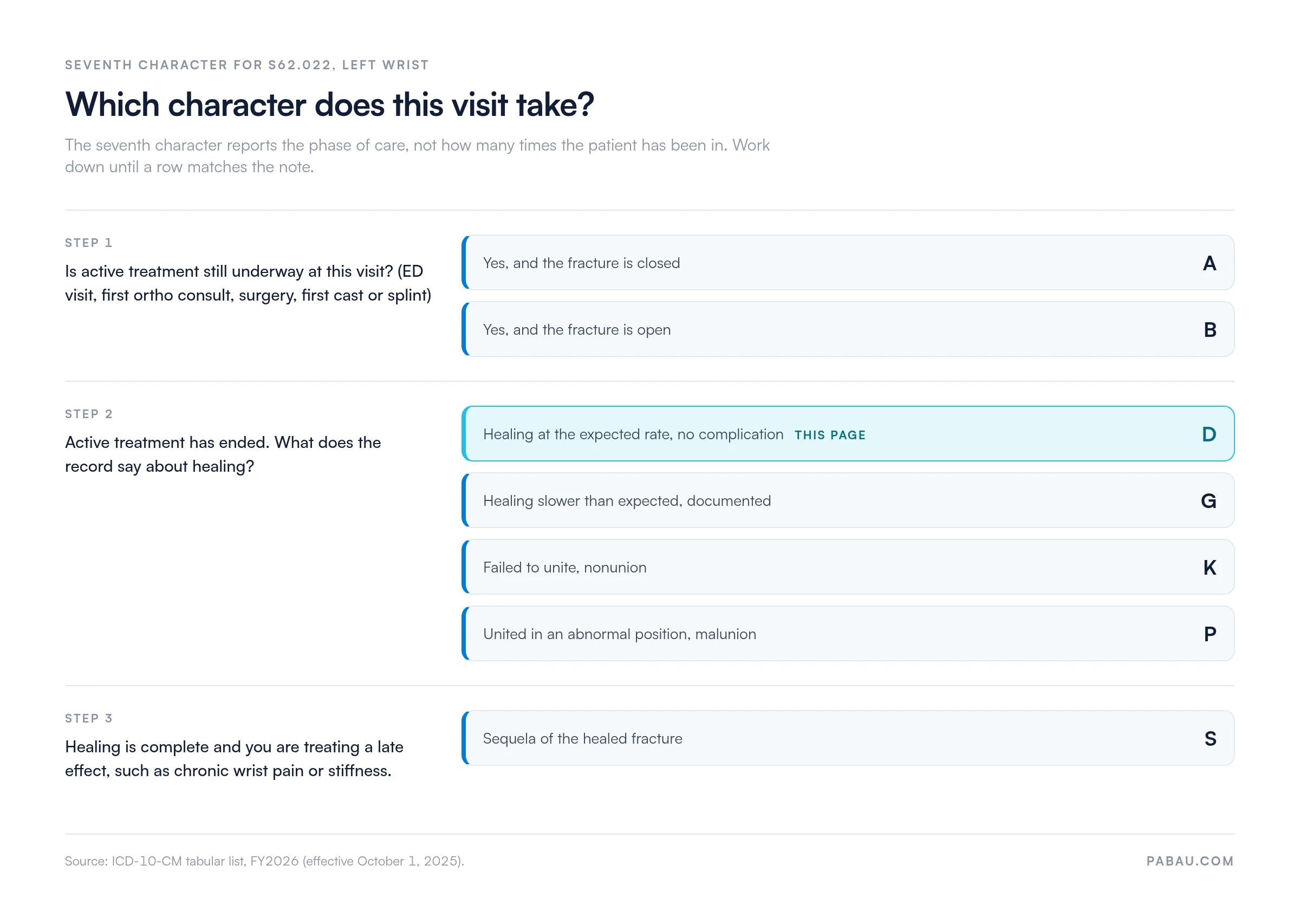
That second condition is where claims go wrong. The seventh character reports the phase of care, not the number of the visit. Leave A in place too long and the payer flags medical necessity.
Scaphoid fractures make up roughly 60 to 70% of all carpal bone fractures. Wrist follow-ups are steady work for an orthopedic biller.
Let Pabau's smart automation suggest the right codes, reduce claim denials, and keep your practice compliant—effortlessly.
Automate repetitive tasks and focus on what matters most—your patients.
Reduce coding errors and ensure compliance with the latest regulations.
Clean claims, fewer denials, and faster reimbursements.
Powerful insights and reporting to help your practice thrive.
HIPAA compliant SOC 2 certified GDPR-compliant Trusted by 4,000+ clinics worldwide

S62.022D is the billable ICD-10-CM code for a displaced left scaphoid waist fracture at a routine-healing follow-up visit.
The seventh character D means subsequent encounter with routine healing, not A for initial care or G for delayed healing.
Switch from A to D once active treatment ends, not after a set number of weeks or visits.
Every S62.022D claim needs a note that states the current healing status, not just the original injury.
Practice management software like Pabau pre-fills the claim from the patient record and flags missing required fields.
The code took effect on October 1, 2025, and it is valid for every HIPAA-covered transaction. Here is the reference card before we get into the detail.
Read S62.022D from left to right and each segment adds one fact. Misread a single character and you have a different diagnosis.
The navicular and scaphoid are the same bone. ICD-10-CM writes it as “navicular [scaphoid]” so both the anatomical and the clinical term are covered. Either one is fine in the note, and the code does not change.
The fifth character sets the fracture zone within the scaphoid. A displaced distal-pole fracture of the right wrist, at the same healing stage, codes to S62.011D instead.
The sixth character carries displacement and laterality together. A 1 or 2 or 3 means displaced, running right, left, unspecified. A 4 or 5 or 6 means nondisplaced in the same order.
Reaching for S62.023D when the record names the left wrist is undercoding. Some payers flag that pattern during an audit, so code to the specificity the record supports.
D marks a visit that happens after active treatment ends, while the bone heals as expected. A patient can attend four appointments under the same character if the phase has not changed. The CMS ICD-10-CM official guidelines are explicit on that point.
Routine healing, defined. The bone is moving toward union at the expected rate. No clinical or radiographic sign of complication appears in the record. The treating clinician’s note has to support that status. If the note only raises a concern about the pace, ask the provider before you assign G.
Sorted by phase of care rather than by letter, the seven characters route much faster at the desk.
Blood reaches the scaphoid from the distal end, so displacement threatens the supply to the proximal pole. The bone sits on the thumb side of the wrist, bridging the two rows of carpal bones. That central position makes it the most commonly fractured carpal bone.
The usual mechanism is a fall on an outstretched hand, which coders often see abbreviated as FOOSH. The middle third, or waist, is the most common fracture zone. Vascular risk in that zone sits in the middle. It is worse than a distal-third injury and better than a proximal pole fracture. A nondisplaced proximal-third fracture of an unspecified wrist, open type I or II at the first visit, codes to S62.036B.
Treatment is usually a thumb spica cast for 8 to 12 weeks, with serial imaging to track union. Laterality is not a nicety either. Dominant hand, functional demands, and sometimes the surgical approach all differ between left and right.
All of that has to land in the note at every follow-up. Laterality, mechanism of injury, and current healing status are the three details a payer looks for. Structured intake and treatment forms keep those fields from going missing when the visit runs short.
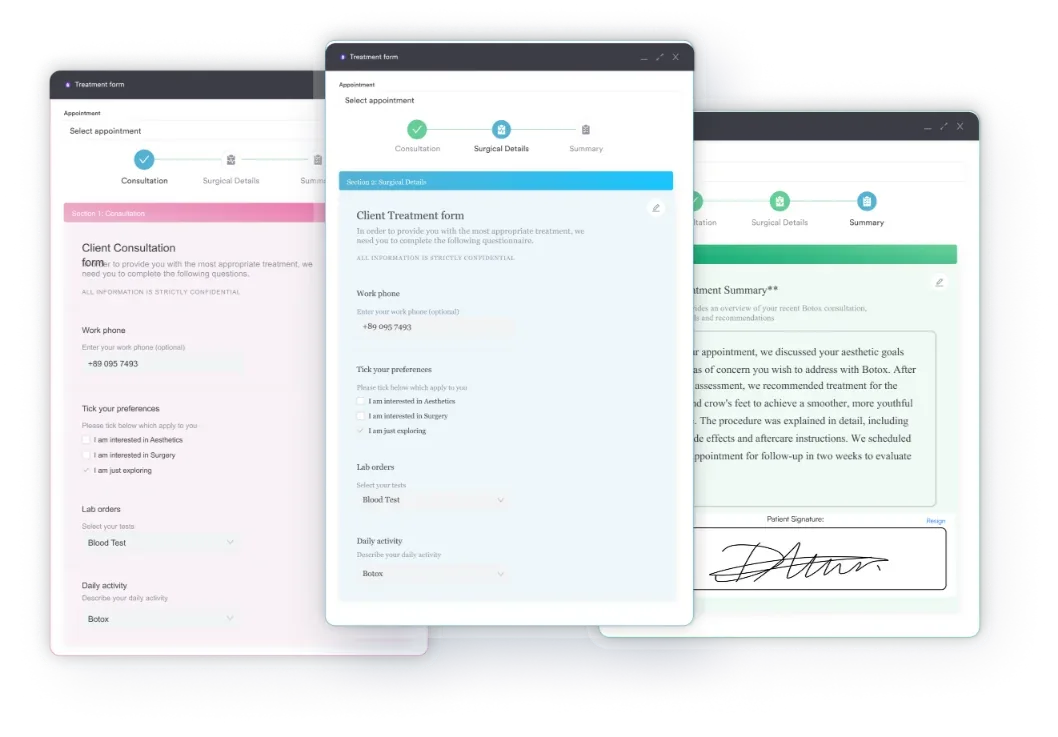
A payer wants the current status of the fracture, not a restatement of the original injury. For this code, the note should confirm that healing is progressing normally. An imaging report or a short provider narrative usually does the job.
The code itself is POA exempt, because a subsequent encounter describes care after the admission event. Verify your MAC’s current POA exempt list before you bill an inpatient claim.
The visit ends with charge capture. The follow-up E/M code goes on line one, and any imaging or casting code follows it. S62.022D is the diagnosis pointer on each line that needs it.
From there the claim goes out as an 837P transaction. A few payers still want a printed CMS-1500. Either way, the clearinghouse runs front-end edits first. A missing seventh character or an incomplete subscriber field bounces back within hours, before the payer sees it.
The payer’s own edits come next, and those are the ones that care about phase of care. An A on a fourth follow-up visit reads as active treatment billed twice. That is the edit most S62.022 claims die on.
Payment or a denial then comes back on the electronic remittance advice, known as the ERA. The reason code there tells you whether to appeal or recode.
Software helps at two points here. A code lookup library saves the trip back to the tabular list. A required-field check stops the claim before a blank subscriber number turns into a rejection.
Document the healing status in every follow-up note, not just the injury. Payers auditing S62.022D claims often ask for the imaging report or the provider narrative that confirms routine healing. A note that reads only ‘wrist fracture follow-up’ gives the reviewer no healing status to confirm. That is how these claims end up on desk review.
S62.022D hangs off S62.022, and S62.022 is not billable on its own. Walking the tree is the fastest way to catch a hierarchy error before submission. You can browse the wider family on the ICD-10-CM code index.
Submit the six-character parent and the claim rejects at the clearinghouse, not at the payer. The CDC ICD-10-CM web tool confirms the full hierarchy for any code against the current tabular list.
S62.02 is the parent for every middle-third navicular fracture, displaced and nondisplaced alike. The sixth character does the sorting. One through three are the displaced codes, four through six the nondisplaced ones.
Displacement is a radiology finding, not a coder’s judgment. If the imaging report does not use the word, query the provider rather than assuming the displaced code. All six siblings take the same seventh characters, so the phase-of-care logic above applies to each of them.
These three codes describe the same fracture at three different phases of care. Pick the wrong one and the payer asks for records, or denies outright.
The transition point. Active treatment ends when the provider has made the definitive treatment decision and the patient moves into monitoring. That decision might be a cast, surgery, or conservative management. It is not tied to a number of weeks or a number of visits.
S62 carries three category-level notes, and each one decides a different thing. Check both the category and the subcategory entries in the tabular list before you add a second code.
One myth is worth killing here. An open fracture does not get a separate open wound code from S61. The seventh character B carries the open status at the initial encounter. After that, the subsequent encounter characters do not split open from closed.
The AAPC code reference prints the full excludes text for each family. It is the quickest way to check whether a second condition can ride along.
S62.022D is a diagnosis, so it needs a CPT code beside it on every claim line. Which CPT code depends on what the provider did at the visit. Coverage and reimbursement vary by payer and MAC region, so treat the table below as common pairings.
Imaging is the pairing that comes up most at a follow-up. Two views bill as 73100, and three or more views bill as CPT code 73110. Read the radiology report before you pick, because the number of views on the film decides it.
CPT 29085 needs its own line in the note. Document that the cast was changed or replaced at this visit, not simply applied. Payers expect a cast code at a subsequent encounter to reflect a distinct service event. Without that, the charge reads as a duplicate of the initial encounter billing.
The code has been valid since October 1, 2015, when the US adopted ICD-10-CM. No annual update has revised, renamed, or retired it since. That stability is convenient, but confirm validity each fiscal year anyway.
Whatever code list your practice works from, check the fiscal year printed on it. Payers adjudicate against the FY2026 tabular list, and a 2024 cheat sheet will not flag a change.
The workflow usually runs across three screens. The clinical note lives in the EMR. The code list sits in a browser tab or on a printed sheet. Then the claim gets keyed into a separate billing tool.
Each hop is a chance for the seventh character to drift out of step with the note. Practice management software like Pabau keeps all three in one record. Our claims management software pre-fills the claim from the visit itself.
The CPT code attached to the service lands on the charge line. ICD-10 slots come from the client’s recorded problem list. Full ICD-10-CM and CPT lookup libraries sit behind a search icon. You stop leaving the claim to look up a code.
Before the Send button unlocks, Pabau checks that the claim’s required fields are complete. Missing membership numbers and authorization codes get caught in the practice, not at the clearinghouse.
Submission then runs through the clearinghouse for your region, with Claim.MD handling US claims. On that pipeline you also get real-time eligibility checks, ERA posting, and claim status tracking.
The outcome is fewer claims that come back for a reason a screen could have caught. That matters on a code like this one. The difference between paid and denied is a single character.

Pabau’s claims management software pre-fills the claim from the patient record. It checks that required fields are complete before you send. ICD-10-CM and CPT lookup libraries sit one click away. Fewer follow-up claims come back for a missing field.

S62.022D rewards one habit above all others. Write the healing status into every follow-up note, then match the seventh character to what the note says. Do that and this code turns boring, which is exactly what you want from a diagnosis code.
The trade-off worth remembering is that no software picks the character for you. A platform can pre-fill the claim from the record and hand you the code libraries. It can confirm the required fields are complete before submission. Reading the note is still your job.
Book a demo to see how Pabau handles fracture follow-up claims, from the note through to the clearinghouse.

Need to decode the denial that came back? Denial codes in medical billing explains the CARC reason codes and how to respond to each one.
Wondering what the clearinghouse actually checks? Claim.MD clearinghouse walks through front-end validation before a claim reaches the payer.
Want to catch coverage problems before the follow-up visit? Insurance eligibility verification covers real-time checks at the front desk.
Chasing a higher first-pass rate? Submitting a clean claim lists the fields that decide whether a claim pays on the first try.
Building out your compliance program? Medical billing compliance maps the frameworks that govern coding and claim edits.
Check the global period on the fracture care code first. If the practice billed global fracture care, routine follow-up visits inside that window are already included. A separate office visit needs a reason unrelated to routine healing, documented as such.
Usually yes. Laterality on the diagnosis does not satisfy a payer edit on the procedure line. If the CPT code you are billing accepts LT or RT, append it and keep the two sides consistent.
S62.022D goes first when the fracture is the reason for the visit. Sequence any other condition after it, unless that condition is what brought the patient in that day.
Yes. The seventh character follows the phase of care, not the provider. A new physician who picks up the follow-up still uses D, once active treatment has ended.
Not directly. A diagnosis code supports medical necessity, and the CPT or HCPCS code plus the fee schedule set the payment. Denials and rework are what a wrong seventh character costs you, not a lower allowed amount.