ICD-10 Code Y76.0: Diagnostic obstetric and gynecological devices
ICD-10 Code Y76.0: Definition and billable status ICD-10 Code Y76.0 is a valid, ...

Last Updated: Oct 23, 2026
Billable Code Specific Code
S60.947S is the billable ICD-10-CM code for unspecified superficial injury of left little finger, sequela.
For billing staff, the 7th character decides the outcome. Put an A or a D on a sequela visit and the payer reads a mismatched encounter type.
Let Pabau's smart automation suggest the right codes, reduce claim denials, and keep your practice compliant—effortlessly.
Automate repetitive tasks and focus on what matters most—your patients.
Reduce coding errors and ensure compliance with the latest regulations.
Clean claims, fewer denials, and faster reimbursements.
Powerful insights and reporting to help your practice thrive.
HIPAA compliant SOC 2 certified GDPR-compliant Trusted by 4,000+ clinics worldwide

ICD-10 code S60.947S covers an unspecified superficial injury of the left little finger, coded as a sequela.
S60.947S is billable in the FY2026 ICD-10-CM edition, effective October 1, 2025, while its parent code S60.947 is not.
The 7th character S separates sequela from initial encounter (A) and subsequent encounter (D), and the wrong pick gets the claim denied.
On a sequela claim the residual condition is listed first, and S60.947S follows it as the cause.
Practice management software like Pabau carries ICD-10-CM and CPT lookup libraries, plus a Claim.MD link for eligibility checks and claim status.
S60.947S sits in chapter S00-T88 of ICD-10-CM, which covers injury, poisoning, and other consequences of external causes.
The Centers for Medicare and Medicaid Services (CMS) lists it as valid for FY2026. Recheck validity every year, because the CDC/NCHS ICD-10-CM tool reflects updates effective each October 1.
The table below pulls the reference data coders reach for most.
S60.947S sits at the bottom of a six-level hierarchy. Each level narrows the description, and only the last one is billable. Walking down it is the fastest way to confirm you have the right code before the claim goes out.
S60.947 on its own is not billable. A claim carrying the parent code alone comes back rejected. The 7th character is what makes the code specific enough to pay.
Practice management software like Pabau supports cleaner claims management with ICD-10-CM and CPT lookup libraries built into the record. Staff pick the billable child code as they chart, and completeness checks on required fields run before submission.
Every injury code in this family needs a 7th character, and it reports the stage of care rather than the injury. Get it wrong and the payer sees a claim that contradicts the note.
Three options apply across the S60.947 family.
A sequela is a condition that follows from a past injury, after the acute phase of that injury has ended. The ICD-10-CM Official Guidelines, Section I.C.19.a, describe it as the residual effect left once the acute phase has terminated. For S60.947S, that means the finger injury is healed.
What remains is something lasting, such as reduced grip, scar tissue or altered sensation.
A sequela encounter therefore carries two diagnosis codes. The residual condition goes first, whether that is the scar, the contracture or the functional limit. S60.947S goes second, naming what caused it. The same order applies to other unspecified sequela codes, so S05.92XS follows the documented residual eye condition.
A subsequent encounter works differently, because there the injury itself is still under treatment.
One question settles it. Is the finger injury still the active problem, or is the visit for something the healed injury left behind? An active problem takes the D code. A lasting effect takes the S code.
The diagram below runs that test across all three characters, and shows the code order a sequela claim needs.
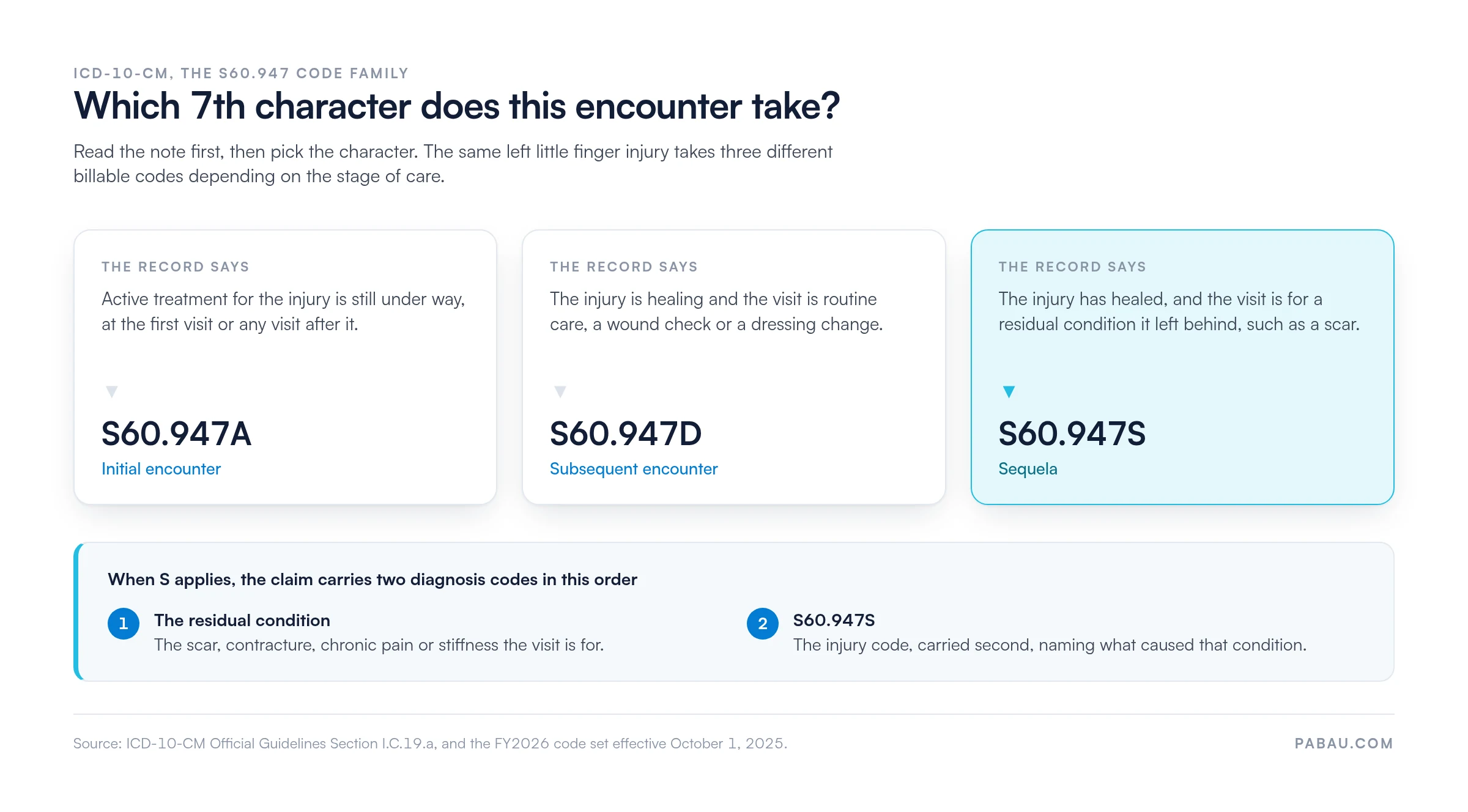
Run a two-line documentation check before you assign S60.947S. First, confirm the record says the original finger injury has healed. Second, confirm the current visit is for a residual condition caused by it. If active-treatment language appears anywhere in the note, S60.947D is the safer call.
Encoder databases and the ICD-10-CM index recognize several clinical descriptions that land on S60.947S. Searching by terminology rather than by code number brings up any of these.
The AAPC notes that its ICD-10-CM code lookup accepts both fifth finger and little finger as index entry terms across this family. Confirm the selection against the full tabular list either way, rather than trusting a keyword result.
Payers cannot process a side-specific anatomical site without a side. The S60.947 family captures left-side injuries only.
A right little finger injury, or a case where the record never names the hand, takes a different code. Here is the full sibling set.
When the record does not name the hand, the unspecified laterality codes S60.949A, S60.949D and S60.949S apply.
Expect a documentation request, though. Payers query an unspecified code when the patient’s own history should have settled which side was hurt.
A sequela claim carries a heavier documentation load than an initial or subsequent one. The payer has to see the chain running from the healed injury to the current condition.
Five things belong in the note:
Clearinghouse checks catch a different class of problem, and they are worth having. Pabau connects to Claim.MD for real-time eligibility checks, remittance advice posting and claim status tracking.
That means you can see what the payer did without phoning to ask. Coding accuracy still sits with the note, though. Building a repeatable clean claim process across the whole injury code family cuts rework further than fixing S60.947S alone.
When a patient presents with something you suspect is a sequela of a hand or finger injury, pull the original encounter note. Check the code used at the time, the date of the injury, and whether earlier encounters ran A or D before active treatment ended. That trail supports the S and heads off documentation requests.
Superficial injuries of the hand and fingers sit in the S60 category. They cover abrasions, blisters, contusions, insect bites and other surface trauma that spares deeper tissue. Primary care, urgent care and occupational health see them constantly.
Most of them resolve without complication. The ones that do leave a sequela tend to follow a few recognizable patterns.
Any of these supports S60.947S once the note ties it to the original left little finger injury. For practices running high volumes of injury follow-up, the workflow step that matters is tracking when a patient moves from active treatment to sequela status.
Miss that transition and a D goes out where an S belonged. That mismatch is a familiar entry on any list of preventable denial codes.
Most practices code an injury follow-up in one system and bill it in another. Someone reads the note, picks the code, retypes it into the billing screen, then hopes the encounter type matches what the clinician wrote. Every hand-off is a chance for an A to travel where an S belonged.
Pabau keeps both jobs in one record. ICD-10-CM and CPT lookup libraries sit next to the note, so the code gets chosen against the documentation rather than from memory.
Completeness checks on required claim fields run before submission, which catches the blank field that would otherwise bounce the claim.
From there the claim goes out electronically through the Claim.MD integration. You get real-time eligibility checks, remittance advice posted back automatically, and claim status you can read without phoning the payer.
The 7th character judgment stays with your coder, where it belongs. What changes is how fast you find out the claim landed.

Pabau integrates with Claim.MD to submit electronic claims to thousands of US payers, check eligibility in real time, and post remittance advice back automatically. See how the workflow fits your practice.

S60.947S turns on one reading of the record. The left little finger injury has healed, and today’s visit is for what it left behind. Document that clearly, put the residual condition ahead of the code, and the claim behaves. Blur it, and the payer sees an encounter type that contradicts the note.
That judgment stays with your coder, and no clearinghouse will make it for them. What software can take off the desk is the retyping and the waiting.
Book a demo to see how Pabau moves an injury claim from the note to the payer without a second system in the middle.

Need guidance on medical billing compliance for injury claims? Medical billing compliance for practices covers documentation standards, payer requirements, and audit risk reduction.
Researching how clearinghouses handle claim validation? How medical claims clearinghouses work explains the validation steps between your practice and the payer.
Working through an insurance eligibility question before submitting? Insurance eligibility verification for practices walks through the pre-claim checks that reduce downstream denials.
Already sitting on denied injury claims? Denial management in healthcare sets out how to work a denial queue without losing the appeal window.
New to the billing side of coding? What is medical billing follows a claim from the encounter note through to payment.
No. ICD-10-CM sets no time limit on sequela coding, so S60.947S stays available years after the original injury. What the record has to show is that the acute phase ended and the current problem follows from it. Keep the original encounter note handy, because payers often ask for it.
Code each side separately. S60.946S covers the right little finger and S60.947S covers the left, and this subcategory carries no bilateral option. Both can sit on the same claim when the documentation supports each one.
No. ICD-10-CM records place of occurrence, activity and external cause status only at the initial encounter for treatment. Once the encounter becomes a sequela, those codes drop off and the claim carries the residual condition plus S60.947S.
Yes. Sequela coding rests on the documentation in front of you, not on who coded the first visit. Record the patient’s account of the injury alongside the current residual condition, and request the prior notes where you can.