ICD-10 Code Z74.8: Other problems related to care provider dependency
ICD-10 Code Z74.8: Definition and code details ICD-10 Code Z74.8 is the billable...

Last Updated: Oct 19, 2026
Billable Code Specific Code
S59.221S is the billable ICD-10-CM code for Salter-Harris Type II physeal fracture of lower end of radius, right arm, sequela.
The "S" seventh character signals that the visit is for a residual condition caused by that fracture, not for the fracture itself. A common cause of sequela denials is sequencing S59.221S ahead of the residual condition code. Another is keeping the "A" or "D" character after active fracture care has ended.
Let Pabau's smart automation suggest the right codes, reduce claim denials, and keep your practice compliant—effortlessly.
Automate repetitive tasks and focus on what matters most—your patients.
Reduce coding errors and ensure compliance with the latest regulations.
Clean claims, fewer denials, and faster reimbursements.
Powerful insights and reporting to help your practice thrive.
HIPAA compliant SOC 2 certified GDPR-compliant Trusted by 4,000+ clinics worldwide

S59.221S describes the long-term residual effects of a Salter-Harris Type II fracture at the distal radius physis, not the acute fracture encounter.
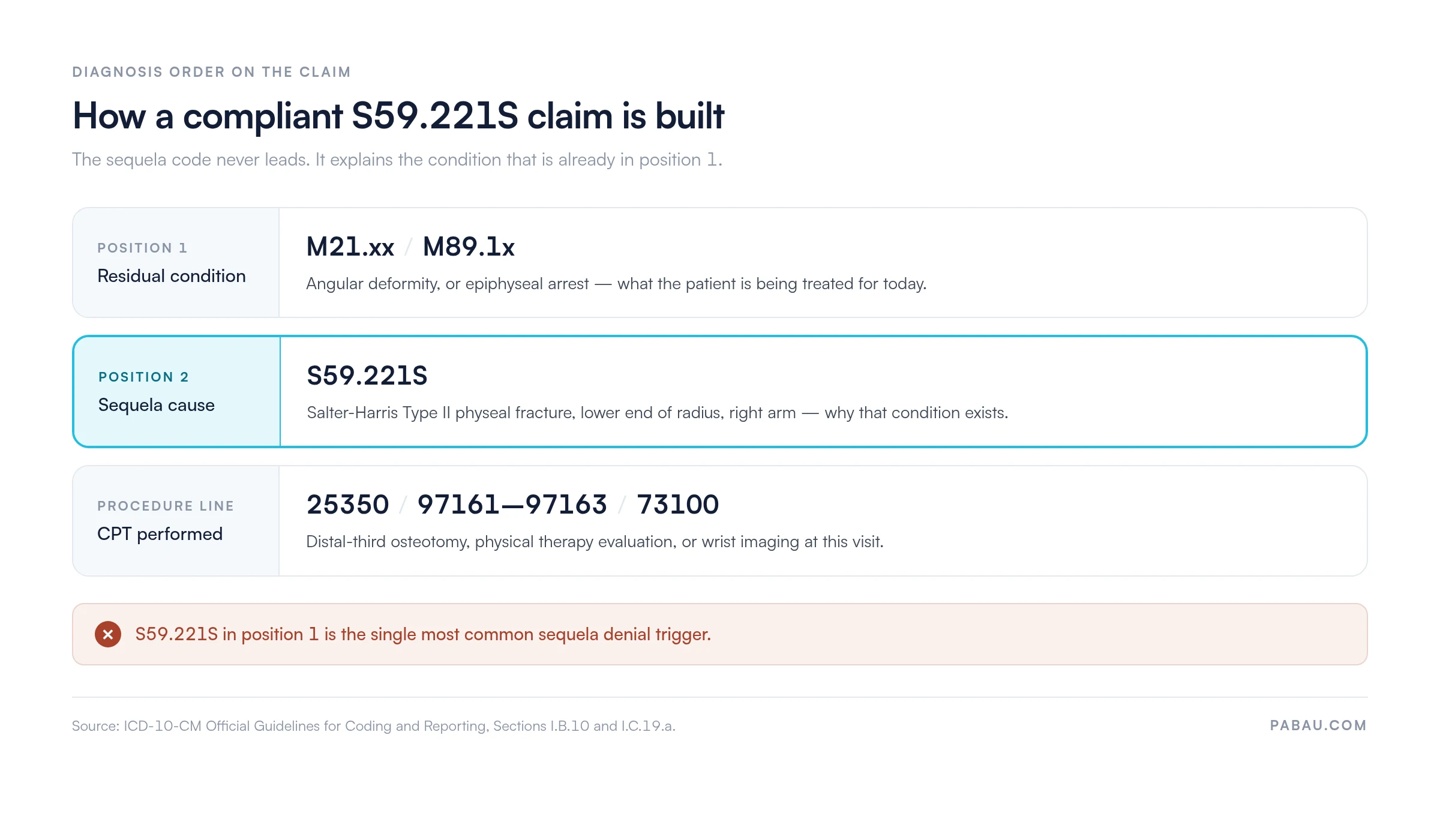
The residual condition code is sequenced first, and S59.221S follows it as the causal code.
Seventh characters G, K and P cover delayed healing, nonunion and malunion while the fracture is still under treatment.
Common denial triggers include wrong character (A or D), missing fracture history in the record, and laterality mismatch.
Pabau, our practice management platform, keeps the clinical note and the claim on one patient record.
ICD-10 Code S59.221S is the billable code for the sequela of a Salter-Harris Type II fracture of the right distal radius. It is reported for a residual condition left by that fracture, once active fracture treatment has ended.
ICD-10 Code S59.221S sits in Chapter 19 of ICD-10-CM, which covers injury, poisoning and certain other consequences of external causes. Its category is S59, other and unspecified injuries of the elbow and forearm. The subcategory S59.22 covers Salter-Harris Type II physeal fractures of the distal radius specifically, with the seventh character “S” completing the code to indicate sequela.
According to the CDC/NCHS ICD-10-CM official web tool, S59.221S is a valid, billable code for the current fiscal year. Coders can verify the full tabular hierarchy and any annual updates directly through that tool before submitting claims.
The seventh character “S” in ICD-10-CM denotes a sequela encounter. The patient is treated for a condition caused by a prior injury, after that injury’s active healing phase has ended. Sequela is not the same as a subsequent encounter (character “D”), which still involves active healing of the original fracture.
Malunion has a seventh character of its own. Report S59.221P while the malunion is still being treated as part of the fracture episode. S59.221S applies once fracture care has ended and the visit is for a lasting consequence of the injury.
Per the ICD-10-CM Official Guidelines for Coding and Reporting (Sections I.B.10 and I.C.19.a), the sequela code is sequenced after the code describing the residual condition. The residual condition is what the patient is being seen for, and ICD-10 Code S59.221S is the causal explanation.
Salter-Harris Type II is the most common physeal fracture type in children. Pediatric orthopedic literature puts it at roughly 75% of all growth plate fractures. The fracture passes through the physis and exits through a metaphyseal fragment, leaving the epiphysis intact.
The distal radius physis is the most frequently injured growth plate in children, typically from a fall on an outstretched hand (FOOSH mechanism). Most acute fractures heal without complication. However, a subset of patients develop sequelae that require ongoing clinical attention.
Each of these conditions can support ICD-10 Code S59.221S as the causal sequela code. The record must document it as a direct consequence of the prior Salter-Harris Type II fracture. The residual condition is coded first, using codes such as M21.xx for angular deformity or M89.1x for epiphyseal arrest.
Laterality is required for S59.221S. Using the unspecified code (S59.229S) when the record documents a side is a documentation error. It can trigger a denial or a request for more information.
The diagnostic codes library carries a full reference page for each of these neighboring codes, with the same sequencing and documentation notes. Checking the neighbor before assigning S59.221S takes less time than reworking the claim.
The ICD-10-CM Official Guidelines for Coding and Reporting require a specific sequencing order for all sequela encounters. Reversing that order is the leading cause of sequela claim denials. Sound medical billing compliance starts with getting the code order right on every claim.
In practice, that order produces a claim line with three layers.
The CMS ICD-10-CM coding guidelines and update files are the primary reference for sequela sequencing rules. Coders should review Sections I.B.10 and I.C.19.a each fiscal year, as guidance may be refined in annual updates.
A sequela claim has to show, in the record, that a current condition follows from an injury treated earlier. Five elements must be present to support ICD-10 Code S59.221S.
A documentation checklist sitting in the billing queue catches missing elements before the claim is transmitted. Most claims management software can attach that checklist to the claim, so the coder sees what is still outstanding.
Sequela claims fail for a short list of recurring reasons, and each one is preventable at the coding desk. Effective denial management depends on knowing those patterns and building a check for each before the claim is submitted.
Denial volume also drops when the first attempt is a clean claim. That means complete patient demographics, the correct payer ID, and every required secondary code in place before the claim leaves the system. One missing field on a sequela claim often triggers a blanket medical necessity denial rather than a request to correct the data.
Run a two-field check before submitting any S59.221S claim. Confirm the residual condition code is in position 1, then verify the code’s laterality against the side documented in today’s note. Those two steps catch most sequela denials at the source.
Medicare does not require prior authorization for evaluation and management visits or for most diagnostic imaging when billed with S59.221S. Medical necessity documentation is still required on every claim, and the usual medical billing standards apply whatever the payer.
Payer requirements for surgical sequelae correction vary by plan year and carrier. Verify individual payer policies directly rather than relying on prior authorization decisions from previous plan years.
The CPT codes submitted alongside ICD-10 Code S59.221S depend on what is being done at the current visit. Pairings run from evaluation and management visits through to surgical osteotomy for malunion correction. Physical therapy practices treating sequela-related wrist stiffness often bill this diagnosis alongside therapy evaluation codes.
CPT pairing decisions affect claim adjudication. A clearinghouse validates the CPT-to-ICD-10 pairing before the claim reaches the payer, which is where a mismatched osteotomy code gets caught. Pabau’s US clearinghouse partner is Claim.MD, and how Claim.MD works covers eligibility verification, 837P submission and ERA remittance in detail.
Practices billing an osteotomy CPT code with S59.221S list the residual condition as the primary diagnosis. The note must also document the functional impairment that makes surgical correction medically necessary. A superbill carrying all three code layers tends to process more cleanly on first pass.
The ICD-10-CM tabular list provides inclusion and exclusion annotations that define the code’s boundaries. Coders should review these before assigning S59.221S to avoid crossover errors.
Verify the specific Salter-Harris type documented in the original operative or imaging report before assigning S59.221S. A Type I or Type III injury documented at the original fracture requires a different sequela code, even at the same distal radius site.
Sequela coding breaks down when the note and the claim live in separate systems. The coder then rebuilds the laterality, the original fracture type and the residual condition from whatever was copied across.
Pabau keeps both on the same patient record. Clinical notes, imaging reports and invoices sit against one patient, so the detail a sequela claim needs is already in front of the coder.
For a practice billing sequela codes regularly, the rework loop gets shorter. Fewer claims come back, and the ones that do point at something the record can answer.

Pabau keeps clinical notes, imaging and invoices on one patient record, and routes claims through the Claim.MD integration for review before submission. Book a demo to see it on your own sequela claims.

The hard part of S59.221S is rarely the code itself. It is proving, on the claim, that today’s deformity or growth arrest traces back to a fracture treated years earlier.
Practices that check sequencing and laterality before transmission recover more on first pass than those that appeal afterwards. The work is the same either way, but it costs less when it happens before the claim leaves.
Pabau keeps the clinical note, the imaging report and the claim on one patient record, so those checks happen where the evidence already is. Book a demo to see how Pabau supports sequela coding in your practice.

Managing claim denials across your practice? Submitting a clean claim walks through the fields and documentation standards that prevent most first-pass rejections.
Need a deeper look at the clearinghouse process? How Claim.MD clearinghouse works explains how 837P validation and ERA processing reduce manual claim follow-up for US practices.
Billing for physical therapy sequela visits? Medical billing fundamentals covers documentation standards that apply across CPT code pairings for rehabilitation encounters.
ICD-10 Code S59.221S is the billable diagnosis code for sequela of a Salter-Harris Type II physeal fracture of the right distal radius physis. It applies when a patient presents with a residual condition caused by a prior growth plate fracture at the wrist. The original injury must have finished healing. The residual condition code is sequenced first; S59.221S follows as the causal explanation.
S59.221A (seventh character A) is used at the initial encounter when the patient is receiving active treatment for the acute Salter-Harris Type II fracture. S59.221S (seventh character S) is used only after healing is complete. The visit is then for a residual condition left by that fracture, such as growth arrest or angular deformity. Using “A” once the acute phase has ended is a coding error that payers typically deny.
Yes. S59.221S is not restricted to pediatric patients. Take an adult who broke the distal radius physis as a child and now presents with angular deformity. S59.221S is the correct causal code, whatever the current age. The physis no longer exists in a skeletally mature adult, but the sequela of the prior physeal fracture remains a valid diagnosis.
Use the seventh character S when the current encounter is for a condition caused by a prior fracture. The fracture itself must no longer be in an active healing phase. The residual condition (stiffness, deformity, growth disturbance) is what prompted the visit; the “S” code explains why that condition exists. If any active fracture treatment is still ongoing, use “D” instead.
Four reasons account for most denials. The first is incorrect sequencing, where S59.221S is listed as the primary diagnosis rather than the residual condition code. The second is using character A or D after the healing phase has ended. The third is no documented history of the original Salter-Harris Type II fracture. The fourth is a laterality mismatch between the code submitted and the side documented in the note.
Common CPT pairings include E&M visit codes 99213-99215 for follow-up evaluations and CPT 25350 for distal-third radius osteotomy when malunion is corrected surgically. Physical therapy evaluation codes 97161-97163 and wrist X-ray codes 73100 and 73110 also pair with this diagnosis. Payer acceptance of each pairing varies, so verify coverage before the procedure.