

ICD-10 Code S53.013D: Anterior subluxation of unspecified radial head
ICD-10 Code S53.013D: Quick reference summary Use the table below as your first ...

Last Updated: Nov 6, 2026
Billable Code Specific Code
S42.293B is the billable ICD-10-CM code for other displaced fracture of upper end of unspecified humerus, initial encounter for open fracture. It covers a displaced proximal humerus fracture that fits no more specific S42.2 code, where the record doesn't name the side.
The 7th character B needs the fracture documented as open. A fracture the record doesn't call open or closed is coded as closed, which is S42.293A. A Gustilo-Anderson grade is good surgical documentation, but the code doesn't require it. S42.293B sits in Chapter 19 (S00-T88) and is valid for active-treatment encounters only.
Let Pabau's smart automation suggest the right codes, reduce claim denials, and keep your practice compliant—effortlessly.
Automate repetitive tasks and focus on what matters most—your patients.
Reduce coding errors and ensure compliance with the latest regulations.
Clean claims, fewer denials, and faster reimbursements.
Powerful insights and reporting to help your practice thrive.
HIPAA compliant SOC 2 certified GDPR-compliant Trusted by 4,000+ clinics worldwide

S42.293B is the billable ICD-10-CM code for a displaced open upper humerus fracture that fits no more specific subcategory and has no documented side.
The 7th character B means an open fracture at the initial encounter. Keying A when the wound is open is a common cause of denials.
A Gustilo-Anderson grade isn’t needed to assign S42.293B, but payers and auditors expect it in the operative note for medical necessity.
In Pabau’s claims management software, each claim is scrubbed for missing or invalid details before it goes through the Claim.MD clearinghouse.
ICD-10 code S42.293B is the billable code for a displaced open fracture of the upper end of the humerus, side unspecified, at the initial encounter. It applies only when the fracture fits no more specific proximal humerus code.
Use the table below as a fast lookup for medical billing workflows and EHR code entry. Every field reflects the current ICD-10-CM Tabular List. Verify it against the CDC/NCHS ICD-10-CM web tool for the applicable fiscal year.
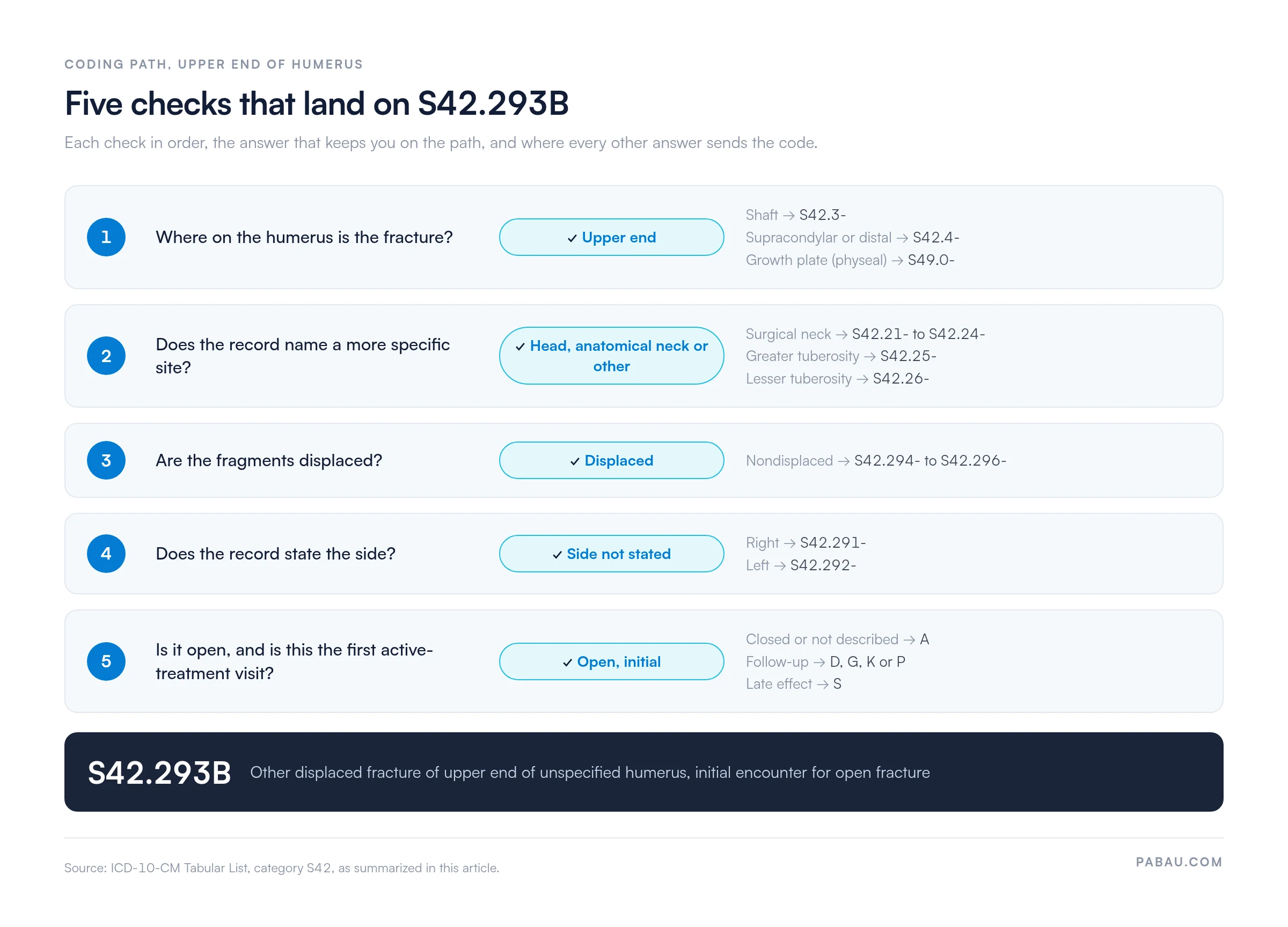
S42.293B describes a displaced fracture at the upper (proximal) end of the humerus that fits none of the more specific S42.2x subcategories. The fracture is open, and the code covers the initial treatment encounter. Each condition below must hold for S42.293B to apply.
Laterality is embedded in the 6th character, not the 7th: S42.291x = right humerus, S42.292x = left humerus, S42.293x = unspecified side. Use S42.293B only when the record doesn’t state the side. Coding it by default when the side is known is a payer audit risk.
The path below runs the five checks in the order a coder meets them. It also shows where each other answer sends the code.
The 7th character for fracture codes in the S42 series specifies both the wound status and the care phase. Selecting A instead of B when the wound is open is a common error on proximal humerus fracture claims. The table below shows every valid 7th character for S42.293x alongside its clinical meaning.
A practical rule: Once the patient moves from active surgical or emergency care to outpatient follow-up, the 7th character changes. It shifts from A or B to D, G, K, or P, depending on healing status. Using B on a post-op follow-up visit is incorrect and will draw scrutiny from the Centers for Medicare and Medicaid Services (CMS).
S42.293B requires documentation that the fracture is open. A Gustilo-Anderson grade isn’t needed to assign the code, but payers and auditors expect it in the operative note for medical necessity. A fracture the record doesn’t describe as open or closed is coded as closed, which makes it S42.293A.
The code itself doesn’t say which Gustilo grade is present. The grade lives in the operative report, and no ICD-10-CM character captures it. Any grade from I through IIIc fits S42.293B, because the code only records that the fracture is open. For audits, the surgeon records the grade and the coder never infers it.
The excludes notes for S42.293B control which codes can and cannot appear on the same claim. Violating Excludes1 restrictions is a common claim edit trigger.
A practical point: Pathological fractures (M84.4-, M84.5-, M84.6-) are coded to the M84 category. That routing comes from the index, not from an Excludes1 note. When the cause is trauma, use S42.293B. When the fracture occurs through bone weakened by disease, such as a metastasis, use the matching M84 code instead.
The S42.2x subcategory contains several anatomically specific codes that coders must rule out before landing on S42.293B. Assigning S42.293B when a more specific code applies is a coding error that can survive automated claim edits but fails human audit review.
CPT code selection depends entirely on what the surgeon documents in the operative report. The pairings below reflect common orthopedic coding practice for displaced open proximal humerus fractures. Operative findings must support each CPT code, and the current AMA CPT codebook confirms it. Verify all pairings via the AAPC Codify ICD-10-CM lookup and crosswalk tools.
Debridement codes (11010-11012) are commonly bundled with ORIF codes by payers unless the debridement is substantial and separately documented. Confirm NCCI edits and the payer’s policy before appending modifier 59 or XU.
Check the physician note or operative report for each element below before assigning S42.293B. A missing element drives the denial patterns covered further down. Building this checklist into a medical billing compliance review keeps it from depending on one coder’s memory.
Send the surgeon a documentation query before submitting any S42.293x claim. Ask them to confirm displacement status, wound communication, and the Gustilo grade. A 48-hour pre-bill query cycle catches common denial triggers on open proximal humerus fracture claims before submission.
Payer requirements for S42.293B vary. Medicare does not require prior authorization for emergency fracture fixation under most fee-for-service policies, but commercial payers and Medicare Advantage plans commonly do. Check the individual payer’s policy, and any applicable LCD or NCD for Medicare claims, before submitting. The requirements below are common across major payers, but none of them is universal.
Eligibility checks before the visit confirm coverage, but check prior authorization requirements with the payer directly. A plan’s public policy page doesn’t always reflect its current authorization rules.
Denials on S42.293B cluster around several root causes. Understanding them as patterns rather than one-off errors is the basis of effective denial management workflows. The table below maps each denial type to its prevention step.
Reviewing the medical billing denial codes on S42.293B rejections shows whether denials concentrate in one error type or spread across several root causes. Patterns across a rolling 90-day claim window are more actionable than reviewing denials one at a time.
Practices also benefit from monitoring electronic remittance advice (ERA) for two claim adjustment reason codes (CARCs). CARC 4 means the procedure code is inconsistent with the modifier, which matters for modifier 59/XU. CARC 16 means the claim lacks information. Both are common on fracture and debridement claims and can be auto-routed into a documentation query worklist before human review.
On an open fracture claim, a coder keys the 7th character, the laterality digit and any debridement modifier from the operative note. One wrong character sends the claim back for rework, and the fix usually waits until the remittance arrives.
Pabau’s claims management software scrubs each claim for missing or invalid details before submission. It then sends the claim through the Claim.MD clearinghouse to thousands of US payers.
Your billing team sees the problem while the operative note is still fresh. A query to the surgeon then takes minutes instead of a resubmission cycle.
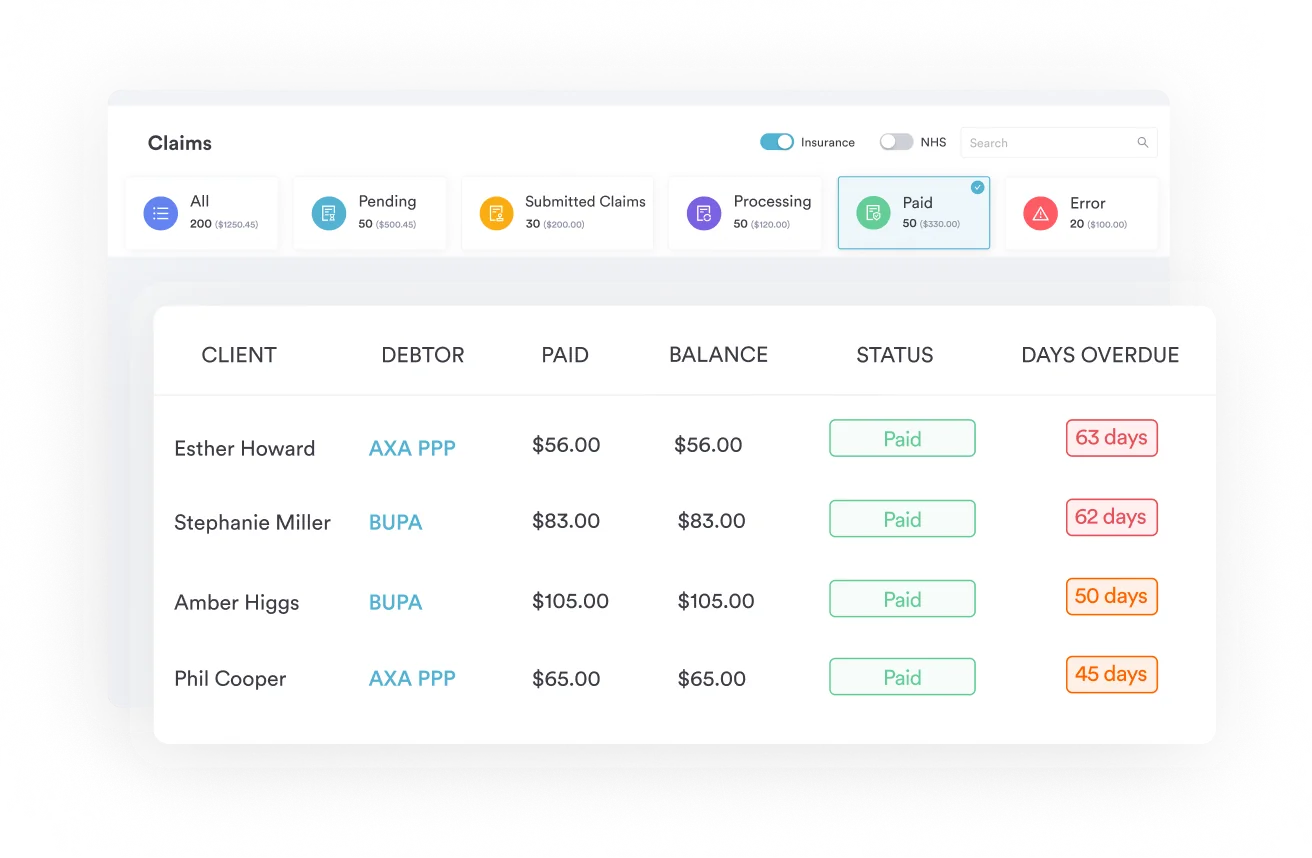

Pabau’s claims management tools scrub claims for missing or invalid details before submission and check US eligibility before the visit through Claim.MD. Claims then route through Claim.MD’s clearinghouse, so S42.293B and related codes reach payers complete.

S42.293B rewards a coder who reads the operative note before touching the code. Confirm the fracture is open, displaced and outside the named proximal subsites. Then check the side, because a stated side moves the claim to S42.291B or S42.292B.
Ask the surgeon for the Gustilo-Anderson grade even though the code doesn’t need it. It costs one query before billing, and it answers the medical necessity question an auditor may ask later.
Book a demo to see how Pabau flags missing claim details on fracture codes like S42.293B before they reach the payer.

Need to understand how clean claims reach payers faster? Clean claim submission requirements walks through the data elements payers validate at the clearinghouse level before adjudication.
Struggling with post-denial appeals on fracture codes? Revenue cycle management fundamentals covers the denial-to-appeal workflow and where missing documentation costs a practice the most.
Want a deeper dive into claim-level error patterns? How Claim.MD clearinghouse works explains how payer edits are applied at the 837P transaction level and which error codes map to ICD-10 character failures.
ICD-10 code S42.293B is the billable ICD-10-CM diagnosis code for other displaced fracture of upper end of unspecified humerus, initial encounter for open fracture. It applies when the fracture is at the proximal humerus but fits no more specific subcategory, such as greater tuberosity or surgical neck. The fragments are displaced, an open wound communicates with the fracture site, and the record doesn’t state the side. The encounter is active treatment rather than follow-up care.
S42.293A is for a closed fracture at the initial encounter, with the skin intact over the fracture site. S42.293B is for an open fracture at the initial encounter, where the wound communicates with the fracture. The anatomical site, displacement status, and encounter type are identical between the two codes. Only the wound status differs, which makes it an important distinction to confirm before code assignment.
No. The code doesn’t specify the grade and the Guidelines don’t require it. Surgeons usually document it, and payers and auditors may ask for it.
S42.293K applies at subsequent encounters when the fracture has failed to unite (nonunion or pseudarthrosis). Use S42.293B only for the initial active treatment visit. Once the patient moves to post-operative follow-up and imaging confirms nonunion, K replaces B as the 7th character. Using B on a follow-up visit is an encounter-type error that draws claim edits.
Traditional Medicare fee-for-service generally doesn’t require prior authorization for emergency fracture fixation. S42.293B claims are accepted without pre-auth when the emergency presentation is documented. Medicare Advantage plans operate under different rules and frequently require authorization for surgical fixation. Always verify the patient’s specific plan policy and check the applicable Local Coverage Determination before submitting.
CPT 23615 covers open treatment of a surgical or anatomical neck fracture with internal fixation. CPT 23616 covers open treatment of a proximal humeral fracture with prosthetic replacement. Which one applies depends on whether the surgeon fixes the fracture or replaces the humeral head. Debridement codes 11010-11012 may be separately reportable when substantial wound debridement is performed and documented. E/M codes 99284-99285 apply when the patient presents through the emergency department before surgery. Always confirm CPT selection against the operative report and the current AMA CPT codebook.



