ICD-10 Code Y76.0: Diagnostic obstetric and gynecological devices
ICD-10 Code Y76.0: Definition and billable status ICD-10 Code Y76.0 is a valid, ...

Last Updated: Oct 23, 2026
Billable Code Specific Code
O71.3 is the billable ICD-10-CM code for obstetric laceration of cervix. It covers a tear of the cervix sustained during labor or delivery, whether spontaneous or caused by forceps or vacuum extraction.
The code sits in category O71, Other obstetric trauma. Assignment turns on the delivery note naming the cervix as the torn site, which separates it from perineal tears (O70.0-O70.3) and high vaginal laceration (O71.4).
Let Pabau's smart automation suggest the right codes, reduce claim denials, and keep your practice compliant—effortlessly.
Automate repetitive tasks and focus on what matters most—your patients.
Reduce coding errors and ensure compliance with the latest regulations.
Clean claims, fewer denials, and faster reimbursements.
Powerful insights and reporting to help your practice thrive.
HIPAA compliant SOC 2 certified GDPR-compliant Trusted by 4,000+ clinics worldwide

ICD-10 code O71.3 describes obstetric laceration of the cervix, which is distinct from perineal tears (O70 category) and high vaginal lacerations (O71.4).
O71.3 is billable for FY 2024, FY 2025 and FY 2026 under the O71 (Other obstetric trauma) category.
The delivery or operative note must document a ‘cervical laceration’ specifically, because generic ‘laceration NOS’ wording won’t support the code.
N88.1 and N88.8 are O71.3’s only Excludes1 pairs, while perineal and vaginal tear codes are differential sites that can share its claim.
Pabau’s claims management software includes built-in ICD-10 and CPT catalogs, which cuts coding errors on complex obstetric claims.
ICD-10 code O71.3 is the diagnosis code for obstetric laceration of the cervix. It describes a tear of the cervical tissue that occurs during labor or delivery. It sits within the O71 category (Other obstetric trauma), which covers mechanical injuries to maternal soft tissue during birth. That category belongs to ICD-10-CM chapter O00-O9A (Pregnancy, childbirth and the puerperium).
Clinically, a cervical laceration typically presents as a full-thickness or partial tear of the cervix, most commonly at the 3 o’clock or 9 o’clock positions.
Spontaneous lacerations occur when the cervix is not fully dilated at the time of expulsion. Instrumental lacerations are associated with forceps or vacuum delivery. Either mechanism qualifies for O71.3, provided the documented anatomical site is the cervix.
O71.3 has been a valid, billable ICD-10-CM code since the United States adopted ICD-10-CM, and it remains active through the current fiscal year. Per the CMS ICD-10 codes page, O71.3 carries no seventh-character extension requirement and no laterality qualifier. That makes it simpler to apply than some other obstetric trauma codes.
Coders can verify current-year validity using the CDC/NCHS ICD-10-CM web tool, which publishes the official tabular list updated each October 1. Always cross-reference against the current fiscal year’s release before submitting claims, because code status can change with annual updates.
O71.3 applies whenever the documented site of obstetric laceration is the cervix, regardless of delivery method or mechanism. The code captures both spontaneous and instrumental scenarios within a single descriptor.
O71.3 carries no degree sub-classifications, unlike the O70 perineal laceration codes, which grade tears from first to fourth degree. The code applies whenever the cervix is lacerated, so the documentation burden falls on anatomical specificity rather than severity grading.
O71.3 carries two kinds of instructional notes, and they work in opposite directions. The table also lists the neighboring obstetric trauma codes, which are differential sites rather than exclusions.
Only N88.1 and N88.8 are Excludes1 pairs for O71.3, so neither can be reported on the same claim. F53.- sits under an Excludes2 note instead. That condition is not part of O71.3, but a patient can have both. A documented postpartum depression, for example, is coded as F53.0 alongside O71.3.
The perineal, vaginal and uterine codes are not Excludes notes at all. They describe injuries at other anatomical sites, and they can share a claim with O71.3. Where a delivery involves both a cervical and a perineal laceration, the note must establish each as a distinct injury. Report O71.3 for the cervix and the appropriate O70.x code for the perineum.
The most common coding error with O71.3 is selecting the wrong anatomical code when the delivery note uses imprecise language. This differential table maps the four most commonly confused codes against O71.3.
O71.3 and O71.4 are the most frequently swapped pair. O71.3 is the cervix, the lower opening of the uterus, while O71.4 is the vaginal wall. When a delivery note reads “laceration of the lower genital tract” without naming the site, query the provider before assigning either code. Defaulting to O71.3 on ambiguous documentation leaves the claim unsupported at audit.
A claim carrying O71.3 will face payer scrutiny at audit if the medical record does not support the cervical-site specificity the code implies. These are the documentation elements that must appear in the delivery note or operative report to make an O71.3 claim defensible.
Meeting these standards before submission is part of building a clean claim submission workflow. When the delivery note contains ambiguous language, coders should send a provider query rather than abstract a code from unclear documentation.
O71.3 is a diagnosis code and must be paired with a procedure (CPT) code when a repair was performed. The appropriate CPT code depends on whether the repair is billable separately or is included within the global obstetric package.
The bundling rule is the critical issue with O71.3 CPT pairings. Under the CMS global obstetric package, repair of a cervical laceration by the delivering physician is bundled into the delivery code. For a vaginal delivery with antepartum and postpartum care, that code is 59400.
Billing CPT 59300 as well, when one physician delivered and repaired, triggers an unbundling denial. Who performed the repair settles the pairing, as the diagram shows.
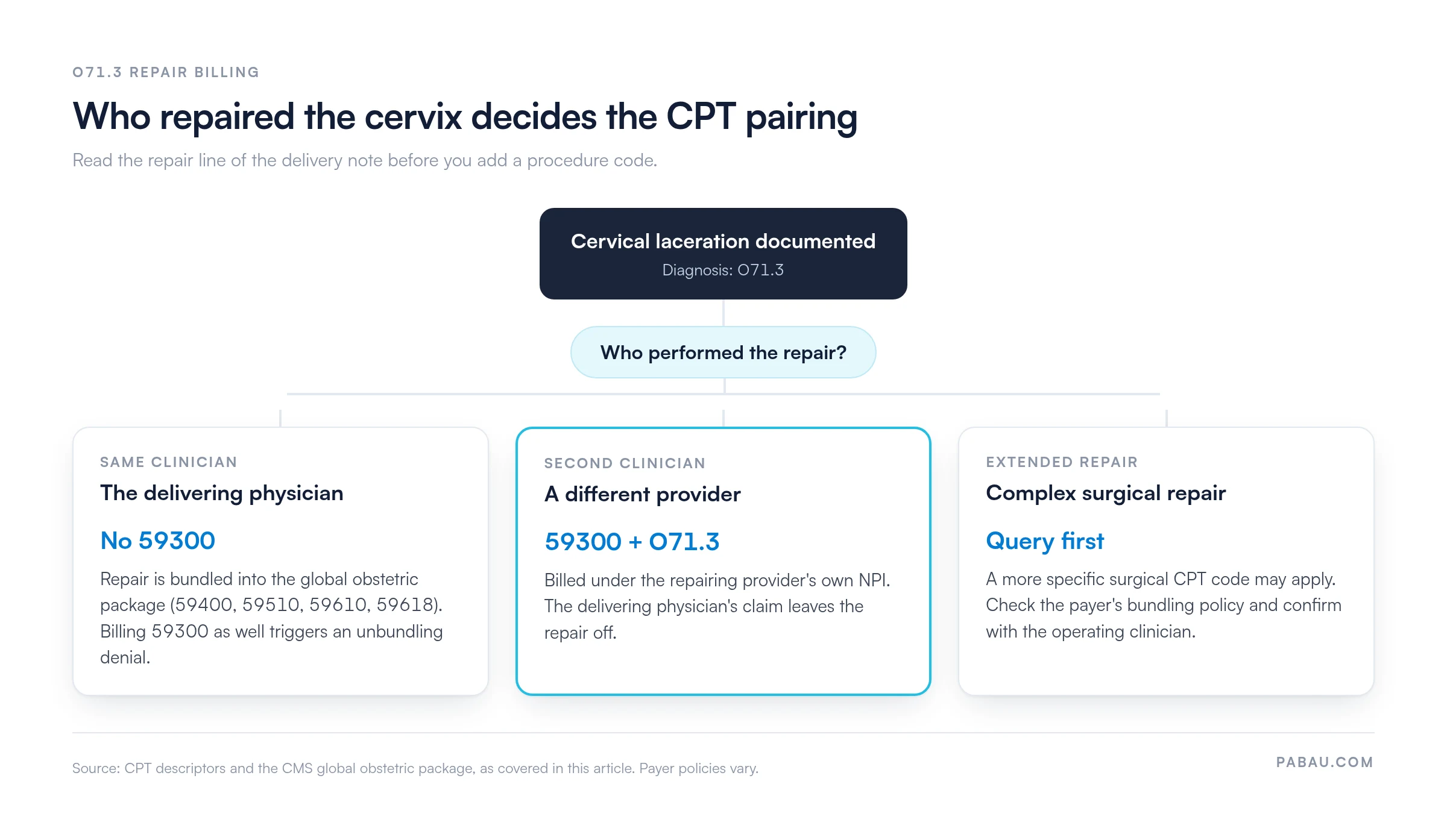
Separate billing is appropriate when a different clinician, such as a surgical specialist called in for a complex repair, performs the laceration repair. In that case, the second provider bills CPT 59300 with diagnosis O71.3, and the claim must clearly identify the performing clinician.
Most cervical laceration repairs need no prior authorization as a standalone item, because payers treat them as part of intrapartum care. The authorization granted for delivery typically covers associated obstetric trauma management. Several payer-specific scenarios can still complicate O71.3 claim submission.
Staying aligned with medical billing compliance rules for obstetric claims means checking each claim against the plan’s policy as well as the procedure’s.
O71.3 denials cluster around five root causes. Each one has a corrective step that fixes it before the claim goes out, rather than at the appeals stage.
A structured denial management workflow that tracks O71.3 denials by reason code will surface these issues quickly. Tracking denials at the code level, rather than by encounter, shows whether the problem is documentation, code selection, or payer bundling policy.
For the reason codes that accompany these rejections, the medical billing denial codes reference covers CARC and RARC codes by category.
A repeatable coding workflow for O71.3 takes the judgment calls out of time-pressured steps on a labor-and-delivery unit.
Keeping documentation, coding and claim submission in one system cuts manual handoff errors between the clinical and billing teams. Reviewing revenue cycle management fundamentals also helps billing managers build the governance that keeps O71.3 claim performance on track.
Run a monthly O71.3 denial audit segmented by denial reason code. If coding errors (wrong anatomical site) and documentation errors (missing cervical specificity) appear at different rates, they need different fixes. Coding errors call for coder training, while documentation errors call for clinician training.
Many OB billing teams code straight from the signed delivery note. Site and bundling errors then surface only when the payer rejects the claim. Each rejection means a provider query, a corrected claim, and another wait for payment.
Pabau, the practice management platform we build, moves those checks to the point of coding. Its error-checking claims management software carries built-in ICD-10 and CPT catalogs that flag pairing issues before submission. Claims then go out through the Claim.MD clearinghouse integration, which runs real-time eligibility and payer edit checks.
The result is fewer O71.3 denials to rework, so your billing team spends its time on new claims rather than corrections.

Pabau’s claims management software includes built-in ICD-10 and CPT catalogs, real-time eligibility checks, and clearinghouse integration. Your labor-and-delivery team submits clean O71.3 claims with fewer denials.

Code O71.3 only when the delivery note names the cervix, and query the provider whenever it doesn’t. Then check who performed the repair before any CPT code goes on the claim.
The trade-off is a slower first submission. A provider query holds the claim briefly, while a denied claim needs a correction, a resubmission and often an appeal.
Book a demo to see how Pabau catches site and bundling errors on obstetric claims before they reach the payer.

Want to know how your O71.3 claims move through the clearinghouse? Claim.MD clearinghouse overview explains real-time eligibility, 837P submission, and ERA reconciliation for OB practices.
Want clearinghouse edits to catch coding errors first? Medical claims clearinghouse guide covers how clearinghouse edits stop coding errors before claims reach the payer.
Billing the delivery without the global package? CPT code 59409 explains the vaginal-delivery-only code and when it applies.
Coding a sphincter injury from the same delivery? ICD-10 code O70.4 covers anal sphincter tears that occur without a third-degree laceration.
ICD-10 code O71.3 is the billable diagnosis code for obstetric laceration of the cervix. That is a tear of the cervical tissue that occurs during labor or delivery. It sits within the O71 category (Other obstetric trauma) and applies regardless of whether the tear resulted from spontaneous delivery, forceps, or vacuum extraction.
Yes, O71.3 is a fully billable ICD-10-CM code valid for FY 2024, FY 2025, and FY 2026. It requires no seventh-character extension and has no laterality qualifier, making it one of the simpler obstetric trauma codes to report from a format standpoint.
O71.3 covers laceration of the cervix, and O71.4 covers obstetric high vaginal laceration (the vaginal wall). The cervix is the lower opening of the uterus, while the vaginal wall is the canal below it. If a delivery note reads “lower genital tract laceration” without naming the torn structure, the coder must query the provider before choosing either code.
The delivery or operative note must explicitly state “cervical laceration” or “laceration of the cervix.” Generic language such as “laceration NOS” or “perineal complex” does not support the code. The record is stronger with the location on the cervix, the approximate extent of the tear, the repair technique, and the provider’s authenticated signature.
CPT 59300 (episiotomy or vaginal repair by other than attending physician) is the most common pairing for separately billable cervical repair. When the delivering physician also performs the repair, it is bundled into the global obstetric package (CPT 59400 and equivalents). It is then not separately billable. Confirm with payer-specific bundling policy before reporting repair codes separately.
The top denial triggers are non-specific documentation, an unbundled repair, coding O71.3 for a perineal tear, and reporting an Excludes1 pair. A repair is unbundled when the attending delivered and repaired but billed both. Non-specific documentation means the note says “laceration” without naming the cervix. Each requires a different corrective action: provider queries for documentation issues, payer policy review for bundling issues, and coding education for anatomical mismatches.
O71.3’s Excludes1 notes are N88.1 (old laceration of cervix uteri) and N88.8 (other specified noninflammatory disorders of cervix uteri). Neither can share a claim with O71.3. F53.- (mental and behavioral disorders of the puerperium) is an Excludes2 note, so both codes may be reported when both are documented. Perineal lacerations (O70.0-O70.3) and high vaginal laceration (O71.4) are differential sites, not exclusions, and can sit alongside O71.3.