Pabau Engage inbox

Pabau Engage is here: every patient conversation in one inbox.

Learn more
Book a demo Book a demo
☰
ICD-10-CM Code

ICD code O74.0 – Aspiration pneumonitis during labor and delivery

Billable Code Specific Code


Code Definition

O74.0 is the billable ICD-10-CM code for aspiration pneumonitis due to anesthesia during labor and delivery. It covers a patient who inhales stomach contents as a complication of anesthesia given during labor or delivery, including Mendelson syndrome.

O74.0 sits in category O74 in Chapter 15. Assignment turns on timing and a documented link to the anesthetic. The same event before labor is coded to O29.-, after delivery to O89.-, and outside pregnancy to J95.4.

Chapter
O00-O9A Pregnancy, childbirth and the puerperium
Category
O74 Complications of anesthesia during labor and delivery
Group
O74.0 Aspiration pneumonitis due to anesthesia during labor and delivery
Billable
Yes
Code also known as
Mendelson syndrome, gastric acid aspiration obstetric, pulmonary aspiration during childbirth, chemical pneumonitis obstetric anesthesia
Save time. Improve accuracy. Get paid faster.
Automate coding with Pabau

Let Pabau's smart automation suggest the right codes, reduce claim denials, and keep your practice compliant—effortlessly.

  • AI-powered code suggestions
  • Real-time compliance checks
  • Faster claims, fewer denials
Why practices choose Pabau
Save hours every week

Automate repetitive tasks and focus on what matters most—your patients.

Improve accuracy

Reduce coding errors and ensure compliance with the latest regulations.

Get paid faster

Clean claims, fewer denials, and faster reimbursements.

Grow with confidence

Powerful insights and reporting to help your practice thrive.

HIPAA compliant SOC 2 certified GDPR-compliant Trusted by 4,000+ clinics worldwide

Key takeaways

Key takeaways

ICD-10 code O74.0 covers aspiration pneumonitis caused by anesthesia during labor and delivery, and no other setting.

Outside pregnancy, aspiration caused by anesthesia goes to J95.4, and aspiration of food, vomit, or gastric secretions goes to J69.0. Both codes exclude O74.0.

Timing decides the obstetric code family: O29.- before labor, O74.- during labor and delivery, and O89.- in the puerperium.

Documentation must name the anesthesia type, confirm the aspiration event, and link the lung injury to the anesthetic before a coder can assign O74.0.

Pabau’s claims management software integrates with Claim.MD to support accurate obstetric claim submission and reduce coding-related denials.

ICD-10 code O74.0: Quick reference

ICD-10 code O74.0 is the billable FY2026 code for aspiration pneumonitis caused by anesthesia during labor and delivery. The table below lists its official descriptor, category, chapter, and validity status. All data reflects the CDC/NCHS ICD-10-CM web tool and the CMS tabular list.

Field Value
Code O74.0
Official descriptor Aspiration pneumonitis due to anesthesia during labor and delivery
Code block O74 (Complications of anesthesia during labor and delivery)
Code range O60-O77 (Complications of labor and delivery)
Chapter Chapter 15 (Pregnancy, childbirth, and the puerperium)
Billable status Yes, billable and valid for submission
FY validity Valid FY2025 and FY2026 (effective October 1, 2025)
Clinical synonym Mendelson syndrome (in obstetric context)

Always verify code validity against the current CMS ICD-10-CM code files for the applicable fiscal year before submission. Code descriptors and valid-code status can change each October 1.

What does O74.0 cover? Code descriptor explained

O74.0 covers pulmonary aspiration of gastric contents occurring as a complication of anesthesia administered during labor or delivery. The classic clinical presentation is Mendelson syndrome. The pregnant patient aspirates gastric acid into the lungs under general anesthesia, which triggers chemical pneumonitis rather than bacterial infection.

The code applies in all of the following scenarios:

  • Aspiration under general anesthesia during vaginal delivery
  • Aspiration under general anesthesia during cesarean section (C-section)
  • Aspiration complicating regional anesthesia (epidural, spinal) during labor or delivery, where airway reflexes were otherwise compromised
  • Emergency induction scenarios where rapid-sequence intubation fails or is delayed, resulting in aspiration
  • Aspiration occurring in the intrapartum period, directly attributable to the anesthetic agent or its administration

Clinical background: Aspiration pneumonitis during obstetric anesthesia

Obstetric patients carry a substantially higher aspiration risk than the general surgical population. Three anatomical and physiological factors drive it, and each one points to what the anesthesia record should capture.

  • Delayed gastric emptying: pregnancy slows gastric motility, so a patient presenting in labor may have a full stomach regardless of nil-by-mouth instructions. Emergency cesarean sections are particularly high risk because pre-operative fasting is often impossible
  • Reduced lower esophageal sphincter tone: progesterone-driven relaxation of the lower esophageal sphincter increases reflux risk, especially in supine positioning during delivery
  • Emergency induction circumstances: non-elective cesarean deliveries often require rapid-sequence induction, where the brief window between loss of consciousness and intubation creates aspiration exposure

When gastric acid reaches the alveoli, it causes a direct chemical burn rather than a bacterial infection. This is why O74.0 describes pneumonitis (chemical inflammation) rather than pneumonia (bacterial infection). The distinction matters for treatment and for coding accuracy.

O74.0 vs. J95.4, J69.0, and J68.0: Choosing the right aspiration code

O74.0, J95.4, J69.0, and J68.0 all describe lung injury from something inhaled, but only O74.0 applies to a patient in labor or delivery. The table below shows when each one applies.

Code Descriptor Patient population Mechanism Use when…
O74.0 Aspiration pneumonitis due to anesthesia during labor and delivery Obstetric patients in labor or delivery Gastric acid aspiration caused by anesthetic administration The patient is in labor or delivery and the aspiration is directly linked to obstetric anesthesia
J95.4 Chemical pneumonitis due to anesthesia Patients who are not pregnant, in labor, or postpartum Aspiration under anesthesia, including Mendelson syndrome and postprocedural aspiration pneumonia Anesthesia caused the aspiration outside the obstetric period
J69.0 Pneumonitis due to inhalation of food and vomit Any patient outside the obstetric anesthesia codes Aspiration of food, vomit, milk, or gastric secretions The aspiration was not caused by anesthesia during pregnancy, labor, delivery, or the puerperium
J68.0 Bronchitis and pneumonitis due to chemicals, gases, fumes and vapors Any patient Inhaled external chemicals, gases, fumes, or vapors The patient inhaled an external chemical agent, not stomach contents

Key distinction: the code follows the patient’s obstetric status first and the cause second. J95.4 and J69.0 both carry an Excludes1 note for O74.0, so neither is reported alongside it for the same event. J68.0 covers inhaled chemicals and fumes rather than stomach contents, so it rarely fits an aspiration under anesthesia.

The O74 code block and neighboring codes

O74.0 sits within category O74 (Complications of anesthesia during labor and delivery). When several O74.x codes seem to apply, review the full block to find the most specific code for each documented complication.

Code Descriptor Key differentiator
O74.0 Aspiration pneumonitis due to anesthesia during labor and delivery Pulmonary complication – gastric acid aspiration
O74.1 Other pulmonary complications of anesthesia during labor and delivery Pulmonary complications other than aspiration pneumonitis (e.g. bronchospasm)
O74.2 Cardiac complications of anesthesia during labor and delivery Cardiac events (arrhythmia, cardiac arrest) attributable to anesthesia
O74.3 CNS complications of anesthesia during labor and delivery Neurological sequelae (seizure, altered consciousness) from anesthetic agents
O74.4 Toxic reaction to local anesthesia during labor and delivery Systemic toxicity from local anesthetic agents (e.g. bupivacaine overdose)
O74.5 Spinal and epidural anesthesia-induced headache during labor and delivery Post-dural puncture headache following epidural or spinal block
O74.6 Other complications of spinal and epidural anesthesia during labor and delivery High block, hypotension, nerve injury from regional technique
O74.7 Failed or difficult intubation for anesthesia during labor and delivery Airway management failure – distinct from aspiration even when aspiration subsequently occurs
O74.8 Other complications of anesthesia during labor and delivery Complications not classifiable elsewhere in O74
O74.9 Complication of anesthesia during labor and delivery, unspecified Use only when documentation does not support a more specific O74.x code

Note on O74.7 and O74.0: a failed intubation coded to O74.7 and aspiration pneumonitis can occur in the same encounter. When both are documented, assign both codes rather than collapsing them into one. Sequencing depends on which complication drove the admission or required the most resources.

Includes, excludes and use additional code notes for O74.0

Category O74’s notes apply to every O74.x code, including O74.0. Check them before assigning any code in this block.

  • Includes: complications of anesthesia during labor and delivery, from general and regional techniques alike
  • Excludes1 and Excludes2: none. The FY2026 tabular list places no excludes note on category O74 or on O74.0
  • Related note on O29: category O29 (Complications of anesthesia during pregnancy) carries an Excludes2 note for O74.- and O89.-. Excludes2 means the conditions are distinct, so O29.- may be reported alongside O74.- or O89.- when both apply
  • Use additional code: if a specific organism causes secondary pneumonia following the initial chemical pneumonitis, assign an additional code for the infectious organism. O74.0 identifies the mechanism, and the organism code identifies the pathogen behind any later infection

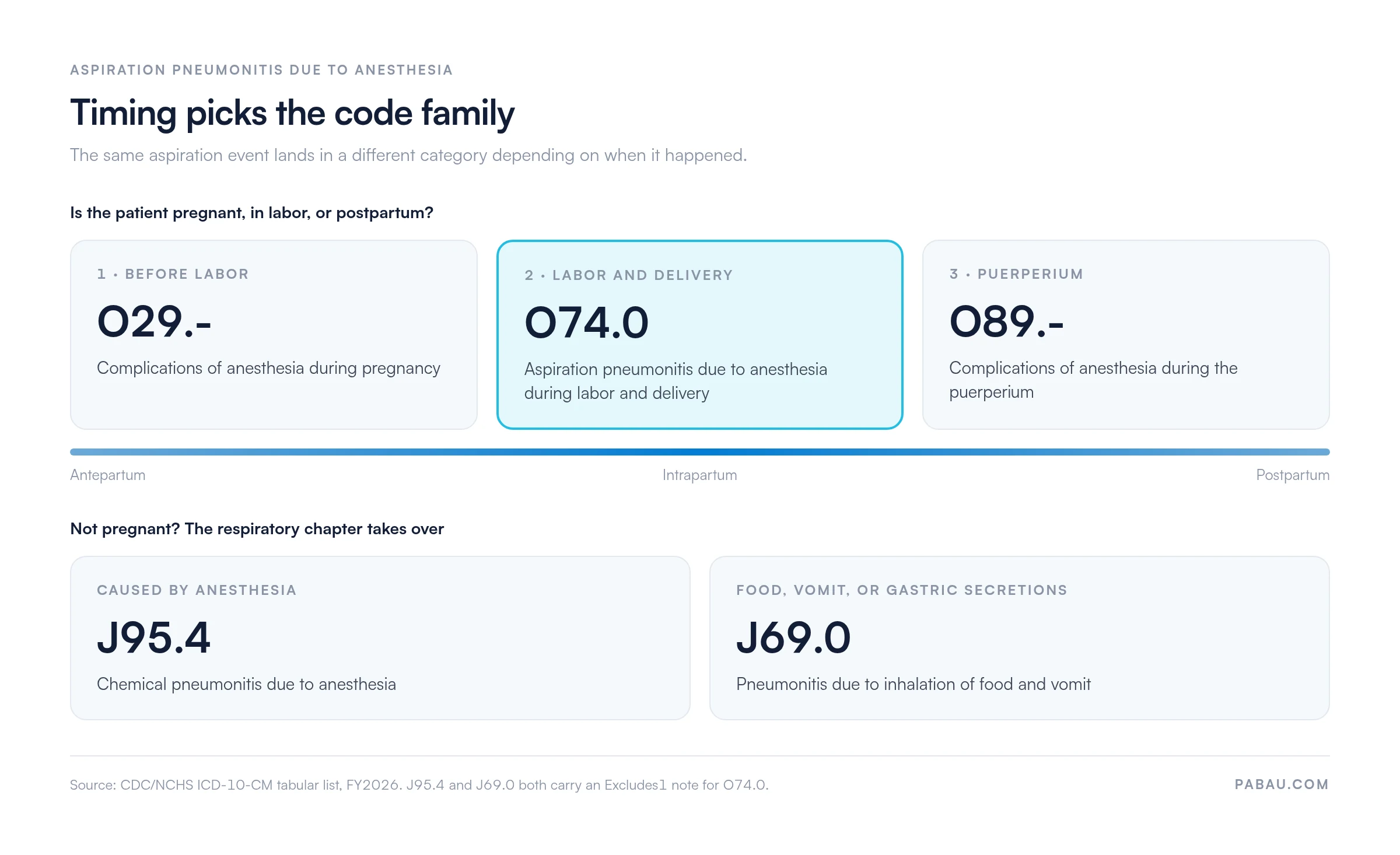
Timing, not an excludes note, sets the boundary between these categories. An anesthesia complication before labor begins goes to O29.-, one during labor or delivery goes to O74.-, and one in the puerperium goes to O89.-. The medical record must document the precise timing so the coder can choose. The diagram below maps each path, including the respiratory codes used outside pregnancy.
Decision diagram for aspiration pneumonitis due to anesthesia
Timing sorts an anesthesia-related aspiration into O29.-, O74.0, or O89.-, while J95.4 and J69.0 cover patients outside pregnancy. Source: CDC/NCHS ICD-10-CM tabular list, FY2026.

Documentation requirements for O74.0

Assigning ICD-10 code O74.0 requires explicit physician or anesthesiologist documentation. Coders cannot infer this code from clinical signs alone. The following elements must appear in the medical record before O74.0 can be assigned.

  • Confirmed aspiration event: the physician or anesthesiologist must explicitly state that aspiration occurred. A note that the patient was “at risk for aspiration” or that “precautions were taken” is not enough
  • Anesthesia type documented: the anesthesia record must identify whether general, regional (spinal, epidural), or combined anesthesia was used. The documentation must support a causal link between the anesthetic technique and the aspiration
  • Timing relative to labor or delivery: the record must confirm the aspiration occurred during labor or delivery, not before labor onset or after delivery completion
  • Pulmonary response documented: clinical findings supporting pneumonitis must be documented, such as hypoxia, wheezing, bilateral infiltrates on chest imaging, or decreased oxygen saturation requiring intervention
  • Linkage statement: the most defensible record states the link outright, for example “aspiration pneumonitis secondary to general anesthesia during cesarean delivery.” The coder should never have to infer it

When documentation is ambiguous, coders should query the attending physician or anesthesiologist before assigning O74.0. Assigning the code without sufficient documentation is an audit risk. According to the AAPC ICD-10-CM coding guidelines, the clinical documentation must support the coded condition, and query is the appropriate mechanism when it does not.

Pro Tip

Run a documentation pre-submission audit: before coding O74.0, check the anesthesia record, operative note, and nursing notes for the five elements above. If any are missing, issue a clinical documentation query before submitting the claim. A single missing element, specifically the timing or linkage statement, is enough for a payer to deny on audit.

Coding guidelines and sequencing rules

ICD-10-CM Chapter 15 governs all obstetric coding, including O74.0. The following sequencing principles apply to encounters where aspiration pneumonitis is documented during labor and delivery. The anesthesia service itself is billed with its own procedure code, such as CPT 01961 for a cesarean delivery.

  1. Principal diagnosis: O74.0 may be the principal diagnosis when, after study, the aspiration pneumonitis determined the admission or dominated the inpatient stay. When the delivery itself was the reason for admission, the aspiration is a complication. Sequence the delivery-related code (from the appropriate O6x-O8x range) as principal and O74.0 as secondary
  2. Delivery outcome code required: for inpatient encounters resulting in delivery, a delivery outcome code from the Z37.- range must be assigned as an additional code. Z37.0 (Single live birth) is the most common. This requirement applies regardless of O74.0 sequencing
  3. Additional codes for organisms: if secondary bacterial pneumonia develops following aspiration pneumonitis, assign an additional code for the causative organism. J15.- or J18.- codes may apply depending on documentation. The O74.0 code identifies the mechanism; the organism code identifies the infection
  4. Inpatient vs. outpatient rules: O74.0 is an inpatient code in practice. Aspiration pneumonitis during labor or delivery requires inpatient management. Outpatient coding scenarios are rare and would require unusual circumstances
  5. Chapter 15 sequencing priority: the Official Guidelines give Chapter 15 codes sequencing priority over codes from other chapters. Do not use J69.0 or J95.4 in place of O74.0 for an obstetric patient. Both carry an Excludes1 note for O74.0, so the substitution is a coding error

Payer requirements and common denial reasons for O74.0 claims

O74.0 claims face a predictable set of denial patterns, and catching them before submission costs less than appealing afterward. Claims management software that flags missing documentation and sequencing errors catches many of them at the source. When a claim does come back, the payer’s denial codes tell you which of the issues below triggered it.

Denial reason Root cause Prevention
Wrong code family (J69.0 or J95.4 submitted instead of O74.0) Coder defaulted to a respiratory chapter aspiration code without checking Chapter 15 Train coders to verify Chapter 15 codes first for any obstetric encounter before using respiratory chapter codes
Missing anesthesia type documentation Anesthesia record did not specify whether general, regional, or combined anesthesia was used Require anesthesia type to be documented in the anesthesia record and operative note before claim submission
No supporting imaging Payer requested chest X-ray or CT report as clinical evidence; absent from medical record Ensure radiology reports are documented and available in the record at time of claim submission
Sequencing error O74.0 coded as principal when delivery code should have been principal Review Chapter 15 sequencing rules and the UHDDS definition of principal diagnosis before sequencing
Missing Z37.- delivery outcome code Delivery outcome code absent from claim; required for all inpatient delivery encounters Build Z37.- inclusion into the coding workflow as a mandatory additional code for all inpatient delivery claims
No physician linkage statement Record shows aspiration and anesthesia but lacks an explicit causal statement connecting the two Issue a physician query to obtain a linkage statement before coding or before appeal submission

Payer-specific requirements vary. Medicare and commercial payers may add local coverage determinations (LCDs) or documentation rules beyond the ICD-10-CM Official Guidelines. Confirm them with each payer before submission. When denials occur, structured denial management workflows and clean claim submission protocols shorten the time between denial and resolution.

How claims management software prevents O74.0 denials

Most O74.0 denials start in the chart. A missing linkage statement, an unrecorded anesthesia type, or an absent Z37.- code surfaces weeks later as a rejection. By then, the encounter details have gone cold.

Pabau, the practice management and billing platform we build, keeps the clinical note, the diagnosis codes, and the invoice in one patient record. Coders can check the anesthesia documentation against O74.0 before the claim goes out. Claims then go electronically through Pabau’s Claim.MD integration, with real-time eligibility checks and claim status tracking.

The outcome is fewer claims bounced back for details the record already held. Your team also sees which delivery encounters are paid, pending, or denied.
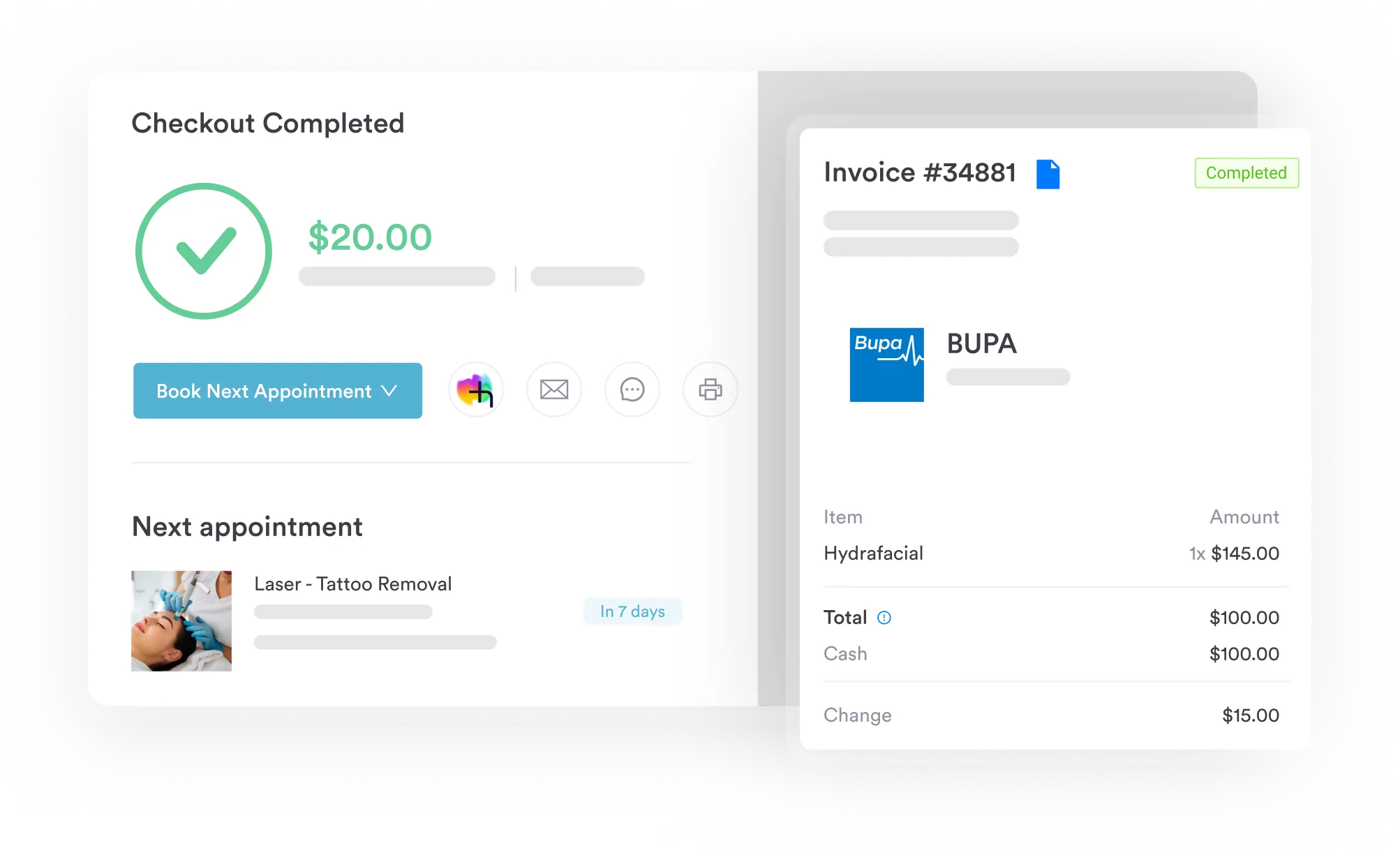

Pabau checkout screen showing a completed payment and an invoice billed to an insurer
Pabau’s invoicing records the insurer against each completed invoice, so your billing team knows who to bill before an O74.0 claim goes out.

Simplify obstetric billing with Pabau

Pabau integrates with Claim.MD for electronic claim submission, real-time eligibility checks, and claim status tracking. See how practices cut coding errors and get paid faster on complex O-code encounters.

Pabau claims management dashboard

Conclusion

Treat O74.0 as a timing and documentation code. The clinical picture is rarely in doubt. The claim stands or falls on whether the record places the aspiration inside labor or delivery and ties it to the anesthetic.

If your team codes obstetric anesthesia complications regularly, build the five documentation elements into the anesthesia template. Query the physician before coding rather than after a denial, when the fix costs far more. Practices that bill high volumes of delivery encounters can fold the same checks into their revenue cycle management workflow.

Book a demo to see how Pabau keeps obstetric documentation and claims in one record, so O74.0 claims go out complete the first time.

Continue your research

Continue your research

Need guidance on obstetric billing workflows? Medical billing fundamentals covers the end-to-end claims process for clinical practices including obstetric and women’s health specialties.

Want to streamline your electronic claim submission? Claim.MD clearinghouse guide explains how the clearinghouse connects practices to thousands of US payers for eligibility checks and claim submission.

Frequently asked questions

What is ICD-10 code O74.0?

ICD-10 code O74.0 is the billable diagnosis code for aspiration pneumonitis due to anesthesia during labor and delivery. It covers aspiration of gastric contents as a direct complication of obstetric anesthesia. It belongs to the O74 block (Complications of anesthesia during labor and delivery) in Chapter 15 of ICD-10-CM and is valid for FY2025 and FY2026.

Is O74.0 a billable ICD-10-CM code?

Yes, O74.0 is a billable, valid-for-submission ICD-10-CM code as of FY2026 (effective October 1, 2025). Always verify against the current CMS tabular list for the applicable fiscal year, as code status can change each October 1.

What is the difference between O74.0 and J69.0?

O74.0 applies when anesthesia during labor or delivery causes the aspiration. J69.0 covers aspiration of food, vomit, or gastric secretions in other settings, and its Excludes1 note bars O74.0. Outside pregnancy, aspiration caused by anesthesia goes to J95.4 instead. Chapter 15 codes take sequencing priority, so an obstetric patient gets O74.0.

Does Mendelson syndrome map to O74.0?

Yes, Mendelson syndrome, the classic clinical presentation of gastric acid aspiration under obstetric general anesthesia, maps to O74.0 in the obstetric context. The syndrome describes the same mechanism and condition the code covers. Verify via the ICD-10-CM alphabetic index under “Mendelson syndrome” to confirm the current-year index entry before asserting the mapping on any specific claim.

Can O74.0 be used for cesarean section deliveries?

Yes. O74.0 applies to both vaginal and cesarean deliveries. The code descriptor does not restrict by delivery type; it requires only that the aspiration event be linked to anesthesia administered during labor or delivery. Cesarean sections under general anesthesia carry particularly high aspiration risk and are a common clinical scenario for this code.

What are the excludes notes for O74.0?

None. Neither O74.0 nor category O74 carries an Excludes1 or Excludes2 note in the FY2026 tabular list. The nearby note sits on O29, whose Excludes2 lets O29.- be reported alongside O74.- or O89.- when both apply. Timing still decides the main code: O29.- before labor, O74.- during labor and delivery, and O89.- in the puerperium.
×