CPT code 52648: Laser ablation of the prostate billing guide
What CPT code 52648 covers, and what it bundles in CPT code 52648 is the code fo...

Last Updated: Oct 21, 2026

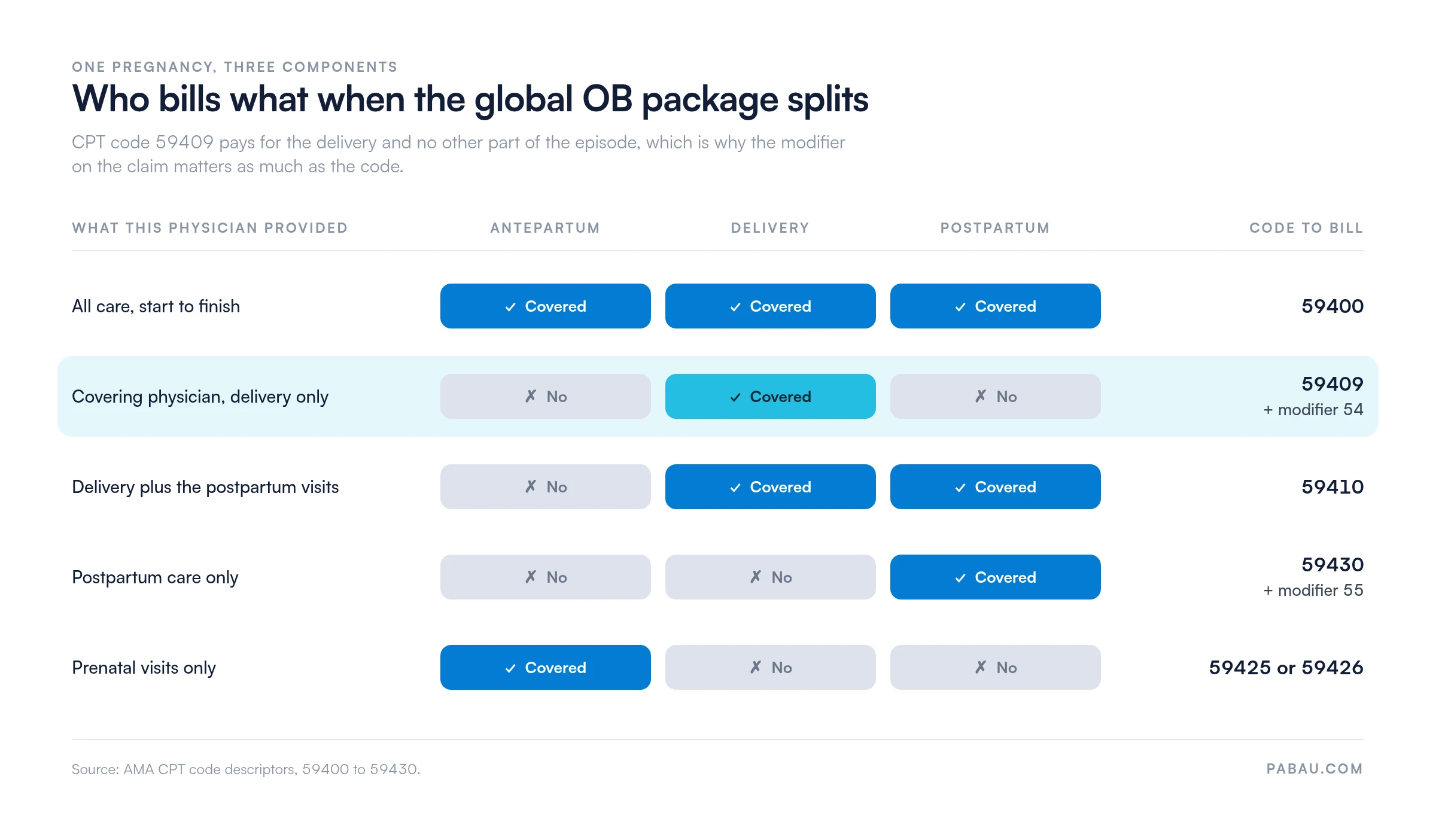
CPT code 59409 covers vaginal delivery only, with or without episiotomy or forceps, and includes no antepartum or postpartum care.
Bill 59409 when a covering or substitute physician performs the delivery and another provider handles the rest of the episode.
Modifier 54 goes on the delivery claim and modifier 55 on the postpartum claim, so the payer can reconcile the split.
Pair the claim with a Z37 outcome code, and reserve O80 for a delivery with no documented complications at all.
Practice management software like Pabau pre-fills claim fields and validates them before submission, which cuts avoidable OB rework.
CPT code 59409 covers vaginal delivery only, with or without episiotomy and forceps. You bill it when one physician delivers the baby while a different provider handles the prenatal visits and the postpartum care. The code pays for the delivery event and no part of the care around it.
That boundary is where the denials come from. If the same physician also provided the antepartum and postpartum care, 59409 unbundles the global package and the payer will claw it back.
The sections below cover the descriptor, the modifier pairs, the diagnosis codes payers expect, and the checks worth running before you submit.
CPT code 59409 describes vaginal delivery only, with or without episiotomy and/or forceps. The American Medical Association (AMA), which maintains the CPT code set, places it in the Maternity Care and Delivery subsection of the Surgery section.
The operative phrase is “delivery only.” Antepartum visits, postpartum care, and hospital admission management all sit outside the code. Episiotomy repair and operative techniques such as forceps sit inside it.
Both are bundled, so neither is ever billed separately alongside 59409.
Most obstetric care is billed under the global OB package (CPT 59400), which bundles antepartum visits, the delivery, and postpartum care into one code.
CPT code 59409 applies when that bundle comes apart. Usually a covering physician performs the delivery while the patient’s own OB provides the surrounding care.
Component billing is an expected scenario in obstetrics rather than an exception. It shows up in group practices, in hospital systems with rotating call schedules, and in rural settings where locum coverage is routine.
The grid below shows which part of the episode each code actually pays for.
Billing 59409 tells the payer that one provider did not complete the global package, and that invites scrutiny. The record has to confirm that this physician provided neither the antepartum nor the postpartum care. It also has to show that another provider is billing those components separately.
Delivery-code selection is the single most common source of OB claim denials. These codes get mixed up constantly, and payers audit the combinations closely. You can check any of them in the AAPC CPT code lookup tool.
59409 vs. 59410: the difference is postpartum care. 59410 covers the delivery plus the postpartum visits, inpatient and outpatient, through the six-week check. If another provider takes over once the baby is born, the delivering physician bills 59409 instead.
A split-care claim passes through more hands than a global one, and every handoff is somewhere it can stall. Here is the route it takes.
Trouble usually starts at step four. The second claim lands after the payer has already processed the first. A missing modifier on either side then reads as duplicate billing rather than a planned split.
Thin documentation is the fastest route to a denial on this code. The record has to show that the billed physician performed the delivery and did not provide the excluded services. Six elements carry the weight during a payer audit.
Payers also run NCCI edits on obstetric claims. Those edits govern which procedures may be reported together. Beyond them, three things have to line up at once. The documentation must support the code, the modifier must be right, and the diagnosis must be correctly paired.
Cervical ripening runs into one of those NCCI edits. When the same provider places a cervical dilator and delivers on the same date, CPT code 59200 is bundled into the delivery.
A modifier is how you show the payer that the global package was divided. Leave it off a 59409 claim and the payer reads the claim as a complete service, then flags duplicate billing when the second claim arrives.
Modifier 54 on the covering physician’s claim signals that another physician will bill modifier 55 for the postpartum care. Payers reconcile the pair and expect both to show up.
When only one does, the claim usually goes to medical review. Commercial payers do not all follow Medicare’s split-care logic, so check the contract before you assume.
Put the transfer-of-care arrangement in writing before the claim is submitted. A short note naming the provider responsible for antepartum care and for postpartum care cuts the odds of a split-billing audit. Some payers also want a formal written agreement between the two physicians on file.
Medicare prices 59409 through the Physician Fee Schedule, which is updated each year and adjusted by locality. The CMS Physician Fee Schedule lookup tool returns the current national and locality rates, along with the work RVUs behind them.
Commercial and Medicaid rates matter more here than Medicare does, since few deliveries are billed to Medicare. Payers frequently negotiate component reimbursement apart from the global OB rate, so the per-delivery math changes as soon as the package splits.
National averages make a poor basis for a commercial negotiation. Some contracts carry specific language about covering-physician billing that overrides the standard component rules, so read the obstetric section before you model the revenue.
Locality is not the only way geography moves a rate. Payment for K0826 turns on whether the supplier sits inside a competitive bidding area, where the national amount may not apply.
Every 59409 claim needs a paired ICD-10-CM diagnosis code. A pairing the payer will not accept fails on medical necessity. That is a coverage decision, set by the plan’s own policy or a local coverage determination.
The pairings below are the ones that come up most often, per CMS ICD-10-CM coding guidance.
O80 comes with a strict rule. It applies only when the delivery is completely uncomplicated, so any documented complication pushes you to a more specific obstetric code. The Z37 series records the outcome of the delivery. It says how many babies were born and whether they were liveborn, not whether the birth was vaginal or cesarean.
Hypertensive disorders are one group that takes a delivery off O80. Where chronic hypertension carries superimposed pre-eclampsia into the birth, the delivery codes to O11.4.
Specificity in the note decides which hypertension code you pick. When the record documents maternal hypertension at the birth without naming the type, O16.4 is the code that fits.
Verify your pairings against the payer’s coverage policy as well. Medicaid programs and commercial plans regularly add requirements of their own, and those are the rules that decide medical necessity.
Most 59409 denials trace back to the same handful of causes, and each one is preventable at the desk. Reading the denial codes on your rejected OB claims tells you which of these your practice keeps repeating.
Six questions take about thirty seconds and catch most of the errors above:
Postpartum care sits outside 59409, so it belongs to whoever provides it. ACOG’s guidance on coding for postpartum services works through the fourth trimester in detail, including visits that fall outside the standard global period.
In a split episode, the physician who managed the antepartum care normally bills CPT 59430. That code covers one routine postpartum visit, usually four to six weeks after the birth. You bill visits beyond it with established-patient E/M codes, since these are returning patients.
Commercial payers do not all follow Medicare’s split-billing logic. Several contracts require notice of a covering-physician delivery within a set window after the birth, so confirm that requirement before the claim goes out.
OB/GYN billing produces some of the most involved claims in outpatient practice, and 59409 sits at the center of it.
A single split episode has to stay consistent across two NPIs, two modifiers, two submission dates, and one set of diagnosis codes. Notes on a whiteboard rarely hold that together for a whole month of deliveries.
Practice management software like Pabau keeps the claim close to the record it came from. Billing staff find the code with built-in code lookup, and the claim pre-fills from the encounter. Field validation then catches a blank NPI or a missing modifier before submission, rather than after a rejection.
Pabau’s reliable claims management then submits the claim through Claim.MD, our US clearinghouse partner, which reaches thousands of US payers with validated 837P files.
Electronic remittance advice comes back into the same system. From there you can watch denial rates by CPT code and fix the documentation before the next billing cycle.
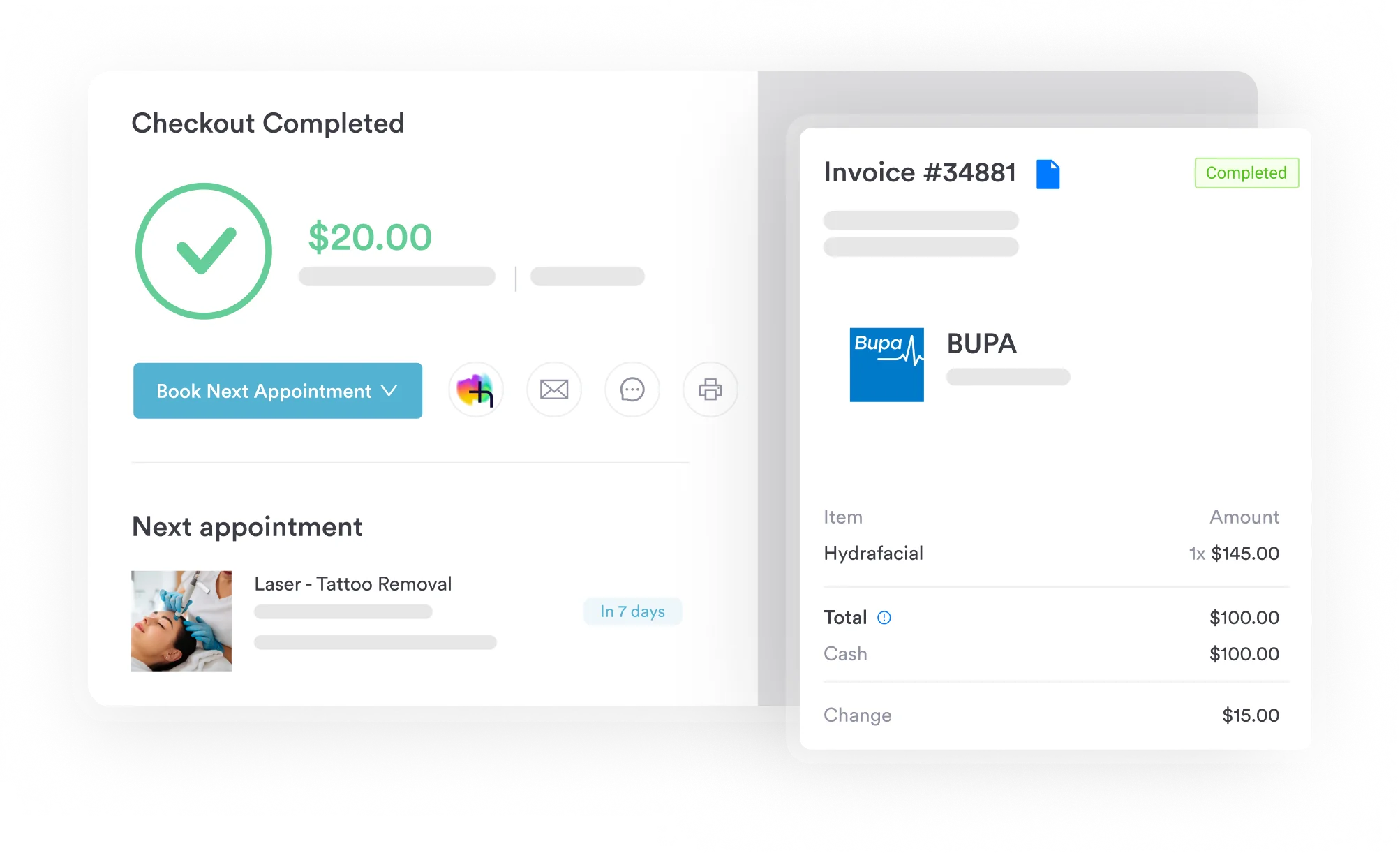

Pabau’s claims management pre-fills claims from the encounter, validates the fields, and tracks denials by CPT code. See how a split-care OB claim moves through it.

CPT code 59409 is simple to define and easy to get wrong. The descriptor is narrow, the modifier pairing is strict, and the diagnosis rules leave little room to improvise. Almost every denial on this code is a workflow problem rather than a clinical dispute.
Settle who owns each component of the episode before the delivery, not after the rejection lands. Practices that answer that question at the point of documentation stop rebilling the same birth twice, and their OB revenue arrives on a predictable schedule.
Book a demo to see how Pabau handles component OB billing from delivery note to remittance.

Wondering how a claim reaches the payer? Medical claims clearinghouse explains how 837P claims are routed and where a split-billing pair gets validated.
Tracking denial rates by code? Denial management in healthcare covers how to spot a repeating pattern and work the appeal.
Want fewer rejections at the first pass? What makes a clean claim sets out the fields payers check before a claim is accepted.
Building the paperwork behind the claim? Superbill guide shows what belongs on the document your coders work from.
Mapping the whole billing cycle? Revenue cycle management walks from documentation through to remittance.
Not as two identical lines. ACOG advises reporting the delivery code for the first baby, then 59409 with modifier 51 for the second. Payer policies differ on twin deliveries, so confirm the pairing before you submit.
Usually not. Medicare and most commercial payers treat same-specialty physicians in one group as a single provider, so the group bills the global package. Component codes apply when the two providers bill under different groups.
59612 is the VBAC version of 59409. It covers vaginal delivery only after a previous cesarean, so reach for it when the record documents an earlier cesarean birth.
Yes. A certified nurse-midwife who performs the delivery reports 59409 under their own NPI, subject to state scope-of-practice law and the payer’s credentialing rules.
Place of service 21 covers an inpatient hospital delivery and 25 covers a birthing center. The code has to match where the delivery actually happened.