CPT code 93503: Swan-Ganz catheter billing and modifiers
CPT code 93503: Official descriptor and procedure overview In the AMA CPT code s...

Last Updated: Oct 23, 2026
Billable Code Specific Code
M32.8 is the billable ICD-10-CM code for other forms of systemic lupus erythematosus.
Coders often default to M32.9 when a note does not specify a lupus subtype. That habit raises audit exposure and, under some payer contracts, pays less than a more specific code. M32.8 exists for exactly these cases.
Let Pabau's smart automation suggest the right codes, reduce claim denials, and keep your practice compliant—effortlessly.
Automate repetitive tasks and focus on what matters most—your patients.
Reduce coding errors and ensure compliance with the latest regulations.
Clean claims, fewer denials, and faster reimbursements.
Powerful insights and reporting to help your practice thrive.
HIPAA compliant SOC 2 certified GDPR-compliant Trusted by 4,000+ clinics worldwide

ICD-10 Code M32.8 describes “other forms of systemic lupus erythematosus” and includes lupus erythematosus NOS
M32.8 is a billable/specific code valid for the 2026 edition of ICD-10-CM, effective October 1, 2025
Use M32.8 when SLE does not meet criteria for M32.0 (drug-induced), M32.1x (organ involvement), or M32.9 (unspecified)
Pabau’s claims management software helps rheumatology practices document and submit M32.8 claims accurately
In short, the table below gives you the essential facts at a glance. All data reflects the 2026 edition of ICD-10-CM, which became effective on October 1, 2025, as confirmed by the CMS ICD-10 codes page.
Before applying ICD-10 Code M32.8, coders need to rule out the more specific subcodes under the M32 parent. The CDC/NCHS ICD-10-CM web tool confirms the full M32 hierarchy below. Selecting the wrong level is the single most common error in SLE coding, and it starts with not knowing what each subcode actually covers.
The hierarchy matters because coders must exhaust more specific options before landing on M32.8 or M32.9. If the clinical note documents lupus nephritis, M32.14 applies, not M32.8.
Therefore, review this table each time you encounter an SLE diagnosis to confirm you are working at the right level of specificity. The same hierarchy-first approach applies to other connective tissue disorder codes in the same M30-M36 block.
In fact, this is where most SLE coding errors happen. M32.9 is not a safe default when documentation is thin. According to The Rheumatologist, using an unspecified code when a more specific one is available increases audit risk and may affect reimbursement outcomes.
The ICD-10-CM Official Guidelines apply that same specificity principle across diagnostic families.
Here is the practical rule. If the treating rheumatologist has documented SLE, reviewed the clinical picture, and made no mention of a drug trigger or organ involvement, M32.8 is the right code. M32.9, the ICD-10 code for lupus unspecified, should be reserved for genuine ambiguity, not convenience.
Sports medicine software helps teams link each injury code to treatment progress and return-to-play timelines.
Drug-induced systemic lupus erythematosus (M32.0) requires specific documentation that a named medication triggered the SLE presentation. Without that attribution in the record, M32.0 is not appropriate. Instead, M32.8 becomes the correct code when SLE is confirmed and no drug cause is established.
The distinction matters for claims because M32.0 encodes a medication-triggered condition, which can affect downstream coding for the adverse effect and potentially the responsible drug. The same principle applies to other organ-involvement codes. Clinical documentation must support the specificity level you select.
By contrast, the M32.1x subcodes cover SLE with documented involvement of specific organ systems. Before assigning M32.8, confirm the clinical notes do not reference any of the following. If they do, use the corresponding M32.1x code instead.
If none of these organ patterns appears in the documentation and the physician has not attributed SLE to a drug, M32.8 is the correct code. The AAPC’s ICD-10-CM code lookup confirms M32.14 as the specific code for lupus nephritis, a distinction that carries major reimbursement implications for nephrology co-management claims.
Cardiac involvement in a transplanted heart sits outside the M32.1x family. Graft vessel disease after a heart transplant is reported with T86.290, not a lupus cardiac subcode.
Check the problem list and active diagnoses in the chart before selecting M32.8. A lupus nephritis diagnosis documented anywhere in the record, even if not the reason for the current visit, signals that M32.14 may be more appropriate as an additional diagnosis code.
M32.8 is a billable code, but the claim will not survive a payer audit without adequate supporting documentation. The following elements must appear in the medical record before submitting a claim with ICD-10 Code M32.8. Pabau’s structured patient records can be configured to prompt capture of each of these elements at the point of care.
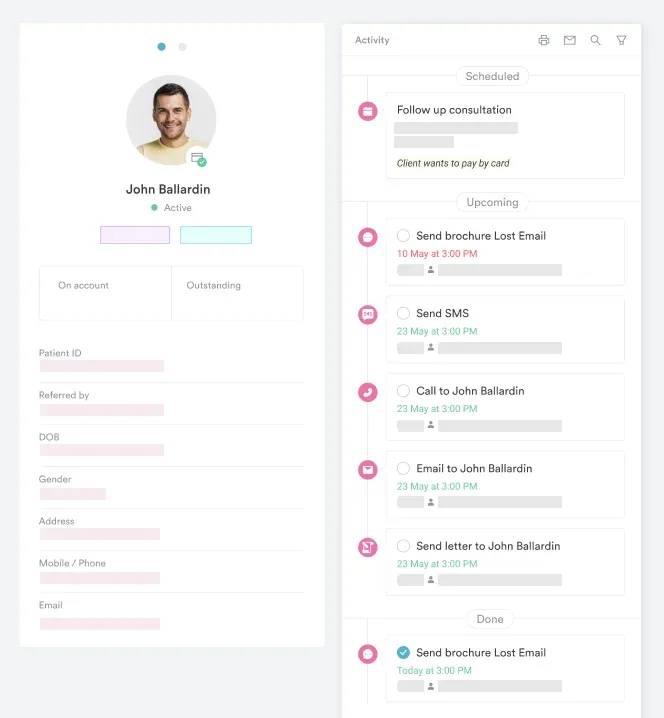
Staying compliant with billing and documentation requirements across complex chronic disease coding depends on structured documentation templates built into the clinical workflow. This reduces the risk of audit findings at the claim level.

Pabau connects ICD-10 diagnosis coding directly to claims submission in one platform. Rheumatology practices use structured clinical note templates to capture the documentation that supports accurate SLE coding and cleaner claims.

The errors below show up repeatedly in rheumatology billing audits. Each one is preventable with a clear code selection protocol and compliance management tools that flag incomplete documentation before claim submission.
For outpatient claims, M32.8 functions like any other billable ICD-10-CM diagnosis code. In particular, it supports medical necessity for rheumatology evaluation and management services, laboratory monitoring, and related procedures. Payer policies on SLE-related claims vary, so always verify coverage and prior authorization requirements with the specific insurer before submitting.
For inpatient hospital claims, M32.8 maps to MS-DRGs depending on the principal diagnosis and any complicating/comorbid conditions (CC/MCC designations). The WHO ICD-10 browser provides additional classification context for international comparison. Key MS-DRG mapping considerations for M32.8:
For HIPAA-compliant clinical documentation workflows in rheumatology practices, connecting the diagnosis coding step to the claim generation step in a single system reduces transcription errors that affect DRG assignment.
Practices managing legacy records or responding to audits covering pre-2015 claims may need to cross-reference ICD-9-CM codes. The table below shows the ICD-9 codes that mapped to M32.8 for historical billing and record-keeping purposes.
The official CMS General Equivalence Mapping (GEM) crosswalk lists M32.10 (systemic lupus erythematosus, organ or system involvement unspecified) as the default target for ICD-9 code 710.0. M32.8, M32.9, and the M32.1x subcodes are valid alternative targets, but only when the historical documentation supports that level of specificity.
In contrast, discoid lupus erythematosus (695.4) does not map to M32.8. It is a skin-limited condition coded under dermatology as discoid lupus erythematosus (L93.0), not systemic lupus. M32.8 carries an Excludes1 note directing discoid lupus to L93.0, so the two codes are never interchangeable.
When responding to a payer audit referencing pre-2015 claims coded under ICD-9 code 710.0, verify the clinical documentation before automatically substituting M32.8. The 710.0 crosswalk covers multiple M32 subcodes. The correct ICD-10 equivalent depends on what the original record actually documents.
Rheumatology practices face a structural challenge with SLE coding. The correct code depends on information captured across multiple sections of the clinical note, including medication history, organ system review, lab findings, and the physician’s diagnostic summary.
When that documentation is spread across disconnected systems, coders miss details and default to unspecified codes.
Pabau’s claims management software connects diagnosis entry to claim submission in a single platform. Clinical note templates can be structured to prompt the treating physician to document drug history, organ system review, and SLE classification criteria, giving the billing team the specificity they need to select the correct M32 subcode at the point of coding rather than after the fact.
Practices also benefit from digital intake forms that capture medication history and symptom patterns before the consultation, reducing the documentation shortfalls that drive M32.9 defaults.
For practices managing functional medicine or physical therapy workflows alongside rheumatology, Pabau’s unified record structure keeps coding-relevant clinical detail visible at the billing stage.
SLE claims coded with M32.9 when M32.8 applies are a recurring source of audit findings in rheumatology billing. Ultimately, the distinction between these two codes comes down to documentation quality. When the physician has characterized the SLE presentation and ruled out drug causation and organ involvement, M32.8 is the appropriate code, and the record should show that clinical reasoning clearly. Coverage verification also surfaces the deductible position, which changes what the practice collects at the desk. Practices treating medical billing as a back-office task find errors at the front desk instead.
Pabau’s structured clinical note templates and integrated claims submission give rheumatology practices a practical way to fix the documentation shortfalls that drive M32.9 defaults. To see how Pabau supports accurate SLE coding workflows from consultation through claim, book a demo or explore our practice management platform.

Need coding guidance for another musculoskeletal condition? M15.9 covers polyosteoarthritis coding when documentation does not support a more specific site.
Managing joint-related comorbidities in SLE patients? M17.0 walks through coding bilateral knee osteoarthritis, a common overlapping diagnosis in rheumatology caseloads.
Need to get equipment billing right too? HCPCS Code E0185 covers billing rules for pressure-reducing mattress pads, useful when a lupus flare requires durable medical equipment.
ICD-10 Code M32.8 is a billable diagnosis code used to document systemic lupus erythematosus (SLE) presentations that do not fit drug-induced SLE (M32.0), specific organ involvement subcodes (M32.1x), or unspecified SLE (M32.9). It applies when SLE is confirmed, no causative drug is documented, and no specific organ system involvement is recorded.
Yes. M32.8 is a billable/specific ICD-10-CM code valid for the 2026 edition, effective October 1, 2025. It is a leaf-node code with no further subdivision, meaning it can be used directly for reimbursement purposes on outpatient and inpatient claims.
M32.8 (other forms of SLE) is used when SLE is confirmed and the clinical record characterizes the presentation, even if it does not fit drug-induced or organ-involvement subcodes. M32.9 (SLE unspecified) is reserved for cases where documentation is genuinely insufficient to characterize the condition further. Using M32.9 when M32.8 is appropriate increases audit exposure under ICD-10-CM Official Guidelines.
The medical record must confirm a systemic lupus erythematosus diagnosis, document that no drug is implicated as a cause, and note the absence of specific organ involvement (or that organ systems were reviewed and found to be uninvolved). A physician statement of “lupus erythematosus NOS” aligns directly with the M32.8 Applicable To note and provides strong coding support.
Yes. M32.8 can be used as the principal or primary diagnosis when SLE is the reason for the encounter. For outpatient visits, it supports medical necessity for rheumatology evaluation and management services, laboratory monitoring, and related procedures, provided the documentation meets the requirements outlined in this article.
When M32.8 is the principal diagnosis on an inpatient hospital claim, it typically groups to connective tissue disorder DRGs (MS-DRG 545, 546, or 547), with the final assignment depending on the presence of complications or comorbidities. Documented comorbidities, such as a concurrent lupus nephritis coded as M32.14, can shift the DRG and affect the reimbursement rate.
Lupus nephritis is coded under the M32.1x organ-involvement subcodes, not M32.8. Glomerular disease in SLE maps to M32.14 and tubulo-interstitial nephropathy to M32.15. Assign M32.8 only when no specific organ involvement, including renal, is documented in the record.
Discoid lupus erythematosus is coded L93.0, not M32.8. M32.8 carries an Excludes1 note directing discoid, skin-limited lupus to L93.0, because it is a cutaneous condition rather than systemic lupus erythematosus.