

ICD-10 Code S42.444P: Medial epicondyle fracture, right humerus
ICD-10 Code S42.444P: full descriptor and code validity ICD-10 Code S42.444P car...

Last Updated: Oct 13, 2026
Billable Code Specific Code
K22.6 is the billable ICD-10-CM code for gastro-esophageal laceration-hemorrhage syndrome.
The tear typically occurs on the gastric side of the gastroesophageal junction. Bleeding ranges from minor spotting to severe hematemesis requiring endoscopic intervention. Alcohol use disorder (coded separately under F10.x) is a frequent comorbidity, as alcohol-related vomiting is a classic precipitating event.
The National Center for Health Statistics, which maintains the CDC/NCHS ICD-10-CM web tool, confirms K22.6 as a valid FY2026 billable/specific code. Claims with dates of service on or after October 1, 2015 require ICD-10-CM codes for reimbursement, per CMS mandate.
Let Pabau's smart automation suggest the right codes, reduce claim denials, and keep your practice compliant—effortlessly.
Automate repetitive tasks and focus on what matters most—your patients.
Reduce coding errors and ensure compliance with the latest regulations.
Clean claims, fewer denials, and faster reimbursements.
Powerful insights and reporting to help your practice thrive.
HIPAA compliant SOC 2 certified GDPR-compliant Trusted by 4,000+ clinics worldwide

ICD-10 Code K22.6 is the billable ICD-10-CM diagnosis code for gastro-esophageal laceration-hemorrhage syndrome (Mallory-Weiss syndrome), valid for FY2026 reimbursement.
K22.6 is classified under Chapter 11, Diseases of the digestive system (K00-K95), within the K20-K31 esophagus, stomach, and duodenum block.
Accurate documentation must distinguish K22.6 from similar upper GI bleed codes such as I85.01 (esophageal varices with bleeding) and K92.1 (melena) to avoid claim denials.
Pabau’s claims management software and digital forms support structured GI documentation workflows, reducing coding errors at the point of care.
Several clinical terms map to ICD-10 Code K22.6 in the ICD-10-CM index. Coders should recognize all of these as valid documentation triggers for this code:
When a physician documents any of these terms, K22.6 is the appropriate code to assign, provided the clinical context supports it.
Understanding where K22.6 sits in the ICD-10-CM hierarchy helps coders navigate adjacent codes – from esophageal entries to other digestive-system categories such as disease of salivary gland, unspecified (K11.9) – and spot sequencing errors. According to the WHO ICD-10 browser, the full hierarchy is:
K22 itself is non-billable. Only the sub-codes within the K22 category (including K22.6) reach the level of specificity required for claim submission. Submitting K22 without a decimal extension will be rejected.
K22.6 is a billable, specific ICD-10-CM code valid for the FY2026 diagnosis year (October 1, 2025 through September 30, 2026). It carries no sub-codes; the four-character code is the terminal node and the only valid submission level for this condition.
There are no Type 1 Excludes notes for K22.6 specifically. The parent category K22 carries a Type 2 Excludes note for certain esophageal conditions, meaning a patient may have both the excluded condition and a K22.x code simultaneously. Coders should review the full K22 tabular list when documenting multiple esophageal conditions in the same encounter.
For legacy audits or historical claims, the General Equivalence Mapping (GEM) links K22.6 directly to ICD-9-CM code 530.7 (Mallory-Weiss syndrome). It is a one-to-one match with no added qualifiers, so older records convert cleanly without splitting the diagnosis across several codes.
Alcohol use disorder is among the most frequent comorbidities documented alongside K22.6. When alcohol use disorder is present and clinically documented as a contributing condition, assign the appropriate F10.x code as an additional diagnosis. The CMS ICD-10-CM Official Guidelines for Coding and Reporting require that comorbidities affecting patient management or resource use be coded in addition to the principal diagnosis.
Sequencing matters. If the Mallory-Weiss tear is the reason for the encounter, K22.6 is the principal diagnosis. The F10.x code for alcohol use disorder is listed as a secondary diagnosis. Reversing this sequence without clinical justification can trigger payer scrutiny.
Run a pre-submission review on all K22.6 claims for missing comorbidity codes. Alcohol use disorder (F10.x) is the most frequently omitted secondary diagnosis in Mallory-Weiss presentations. Incomplete comorbidity coding reduces documented case complexity, which can affect MS-DRG weight and reimbursement accuracy.
A frequent point of confusion is whether a bleeding tear needs a separate “with hemorrhage” code. It does not. The K22.6 description, gastro-esophageal laceration-hemorrhage syndrome, already builds the hemorrhage into the code. So K22.6 is the correct ICD-10 code for a Mallory-Weiss tear with bleeding, and there is no separate non-bleeding variant to choose between.
This sets K22.6 apart from the esophageal ulcer codes, which do split by bleeding status: K22.10 (ulcer of esophagus without bleeding) versus K22.11 (ulcer of esophagus with bleeding). Applying that two-code logic to a Mallory-Weiss tear is a common miscoding. Assign K22.6 whether or not active bleeding is seen on endoscopy.
When the bleed is heavy enough to cause acute blood loss anemia, add D62 as a secondary diagnosis so the record reflects the full clinical picture. Code the precipitating event and any documented alcohol use disorder (F10.x) alongside it.
Selecting K22.6 correctly requires distinguishing it from several adjacent ICD-10 codes that share clinical overlap. The following codes are the most commonly confused with K22.6 in upper GI bleed presentations:
When the bleeding source is confirmed as a Mallory-Weiss tear on upper GI endoscopy (EGD), K22.6 is the specific, correct code. Using symptom codes like K92.1 when a definitive diagnosis is available is a coding guideline violation per the CMS Official Guidelines.
K22.6 sits within the broader K22 category. These sibling codes are sometimes documented in the same patient record:

Pabau’s claims management software and digital intake forms help GI and gastroenterology practices capture the clinical detail needed to code conditions like K22.6 accurately at the point of care, before claims reach the payer.

Digestive conditions mean referrals, scopes, and reviews — patient management software keeps that sequence from stalling.
When K22.6 is the principal inpatient diagnosis, it maps to Medicare Severity Diagnosis Related Groups (MS-DRGs) under Major Esophageal Disorders, within MDC 06 (Diseases and Disorders of the Digestive System). Based on the CMS MS-DRG v43.0 grouper for FY2026, the relevant MS-DRGs are:
The relative weight, and therefore the reimbursement rate, rises across the three tiers. A documented complication or comorbidity (CC) moves the case from MS-DRG 370 up to 369, and a major complication or comorbidity (MCC) moves it to the highest-weighted MS-DRG 368. Coders should query the attending physician when clinical indicators suggest a CC or MCC may be present but is not explicitly documented.
Verify current MS-DRG assignments through the ICD List DRG grouper tool, which mirrors CMS MS-DRG logic and allows code-level lookups. Assignments are updated annually with each CMS fiscal year release.
When a patient with K22.6 also has documented acute blood loss anemia (D62), that secondary diagnosis raises the case’s severity level and can move it into a higher-weighted MS-DRG (369 or 368). Document the anemia explicitly in the discharge summary, confirm its CC/MCC status in the current grouper, and ensure it is coded. Failing to capture it leaves reimbursement on the table.
Accurate use of ICD-10 Code K22.6 depends on clinical documentation that explicitly names the Mallory-Weiss tear or gastro-esophageal laceration-hemorrhage syndrome. The diagnosis should be confirmed by upper GI endoscopy (EGD), with the procedural note describing the mucosal tear at or near the gastroesophageal junction. A coder cannot assign K22.6 based on symptom documentation alone (hematemesis after vomiting) without physician confirmation of the tear. Revenue cycle management treats coding, submission and collection as one process rather than three handoffs.
Key documentation elements that support K22.6 coding include:
Several conditions present similarly but require different codes. When EGD identifies dilated submucosal veins rather than a mucosal tear, code I85.01 for esophageal varices with bleeding instead. Portal hypertension from liver cirrhosis is the usual context for varices; K22.6 is inappropriate in that clinical picture.
When a patient presents with hematemesis but endoscopy is not performed during the encounter, or the source of bleeding is not confirmed, K92.0 (hematemesis) or K92.1 (melena) may be appropriate as working diagnoses. Once the EGD result confirms a Mallory-Weiss tear, update the code to K22.6. Do not code both K22.6 and K92.0 for the same episode of bleeding once the specific diagnosis is established.
Boerhaave syndrome (spontaneous esophageal perforation, coded as K22.3) involves transmural rupture, not just mucosal laceration. It is a separate, more serious condition. Documentation specifying full-thickness perforation points away from K22.6 toward K22.3.
Practices using Pabau’s claims management software can flag GI hemorrhage encounters for documentation review before claim submission, reducing the frequency of down-coded or denied K22.6 claims. Structured clinical notes through Pabau’s AI-assisted documentation tool also capture the key diagnostic elements (EGD findings, precipitating events, comorbidities) that support specific code assignment.
Most K22.6 encounters involve upper GI endoscopy. The relevant CPT codes commonly submitted alongside K22.6 include:
When hemostasis is achieved endoscopically (injection, clip, or thermal coagulation), CPT 43255 is the appropriate procedure code paired with K22.6. Linking the correct CPT to K22.6 as the supporting diagnosis is a medical necessity requirement for most payers. A diagnosis-to-procedure crosswalk review is good practice before submission.
Practices managing high volumes of GI documentation benefit from structured intake workflows. Pabau’s digital forms can be configured to collect pre-procedure and post-procedure documentation fields specific to upper GI hemorrhage encounters, ensuring the clinical information needed for K22.6 coding is captured consistently. This kind of systematic documentation approach also supports HIPAA-compliant medical record keeping across the practice.
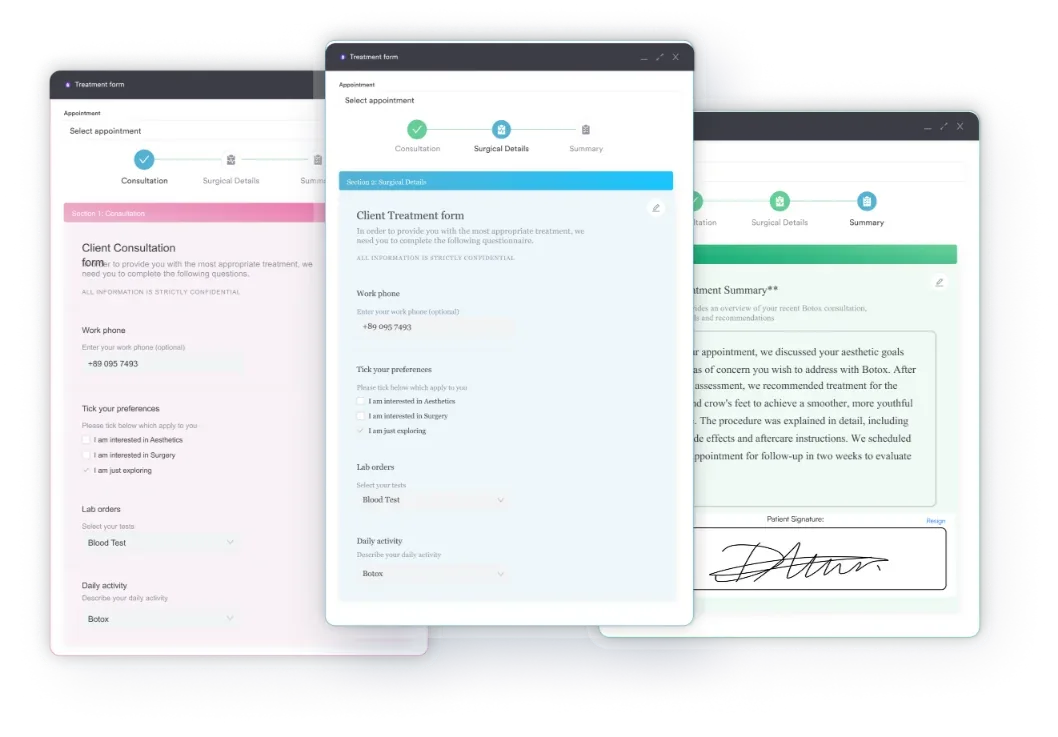
For practices building out GI-specific clinical workflows, Pabau’s client record management tools provide a structured way to organize the endoscopy reports, comorbidity documentation, and coding notes needed to support accurate K22.6 claims. More general guidance on medical forms at healthcare practices covers how digital documentation reduces coding errors across specialties, from gastroenterology to fields like ophthalmology.
Miscoding upper GI bleed presentations is one of the most common sources of avoidable claim denials in gastroenterology billing. ICD-10 Code K22.6 is the precise, billable code for Mallory-Weiss syndrome when an EGD-confirmed mucosal laceration drives the encounter, and applying it correctly (with appropriate comorbidity codes and matched procedure codes) directly affects MS-DRG assignment and reimbursement accuracy.
Pabau’s claims management tools give GI and emergency practices a structured framework for capturing the documentation that supports accurate K22.6 coding, reducing denial rates and improving first-pass claim success. Book a demo to see how Pabau handles GI documentation and billing workflows end to end.

Billing for inflammation across joints? ICD-10 code M06.4 guide covers the code’s billable status, hierarchy, and the Excludes1 note payers check.
Coding an unspecified RA diagnosis? ICD-10 code M06.9 guide explains when to use the unspecified rheumatoid arthritis code and what documentation supports it.
ICD-10 Code K22.6 is the billable ICD-10-CM diagnosis code for gastro-esophageal laceration-hemorrhage syndrome, commonly known as Mallory-Weiss syndrome. It describes mucosal tears at or near the gastroesophageal junction, typically caused by forceful retching or vomiting, resulting in upper GI hemorrhage.
Yes, K22.6 is a specific, billable ICD-10-CM code valid for FY2026 (October 1, 2025 through September 30, 2026). It is a terminal code with no further subcategory options and can be submitted directly on claims with dates of service on or after October 1, 2015.
K22.6 maps to the Major Esophageal Disorders MS-DRGs in MDC 06: MS-DRG 368 (with MCC), 369 (with CC), or 370 (without CC/MCC). Documenting qualifying comorbidities such as acute blood loss anemia or alcohol use disorder raises the case severity and can move it from MS-DRG 370 to the higher-weighted 369 or 368.
K22.6 represents a mucosal tear at the gastroesophageal junction (Mallory-Weiss tear) caused by forceful vomiting or retching. I85.01 represents esophageal varices with bleeding, which arise from portal hypertension, typically due to liver cirrhosis. The distinction is made on EGD findings and underlying etiology; using the wrong code constitutes a medical necessity mismatch.
The most common secondary codes documented with K22.6 include F10.x (alcohol use disorder, when alcohol-related vomiting precipitated the tear), D62 (acute blood loss anemia, when significant bleeding occurred), and applicable CPT procedure codes for upper GI endoscopy with hemostasis. Each secondary code should be clinically supported by physician documentation.
A healed tear with no current bleeding is reported as a personal history of a digestive condition using Z87.19 (personal history of other diseases of the digestive system), not K22.6. Reserve K22.6 for an active laceration that drives the current encounter.




