ICD-10 code E55.9: Vitamin D deficiency, unspecified
ICD-10 code E55.9: Definition and official descriptor ICD-10 code E55.9 is the I...

Last Updated: Nov 10, 2026
Billable Code Specific Code
G62.9 is the billable ICD-10-CM code for polyneuropathy, unspecified. It covers confirmed damage to multiple peripheral nerves when the provider has documented no cause, or the cause is still under investigation.
The code is valid and unchanged for FY2025, FY2026 and FY2027 claims. It sits in category G62, Other and unspecified polyneuropathies. Assign it only when the record names no diabetic, drug, alcohol, toxic or other specific cause.
Let Pabau's smart automation suggest the right codes, reduce claim denials, and keep your practice compliant—effortlessly.
Automate repetitive tasks and focus on what matters most—your patients.
Reduce coding errors and ensure compliance with the latest regulations.
Clean claims, fewer denials, and faster reimbursements.
Powerful insights and reporting to help your practice thrive.
HIPAA compliant SOC 2 certified GDPR-compliant Trusted by 4,000+ clinics worldwide

G62.9 codes polyneuropathy the provider has confirmed but whose cause is not documented or is still under investigation.
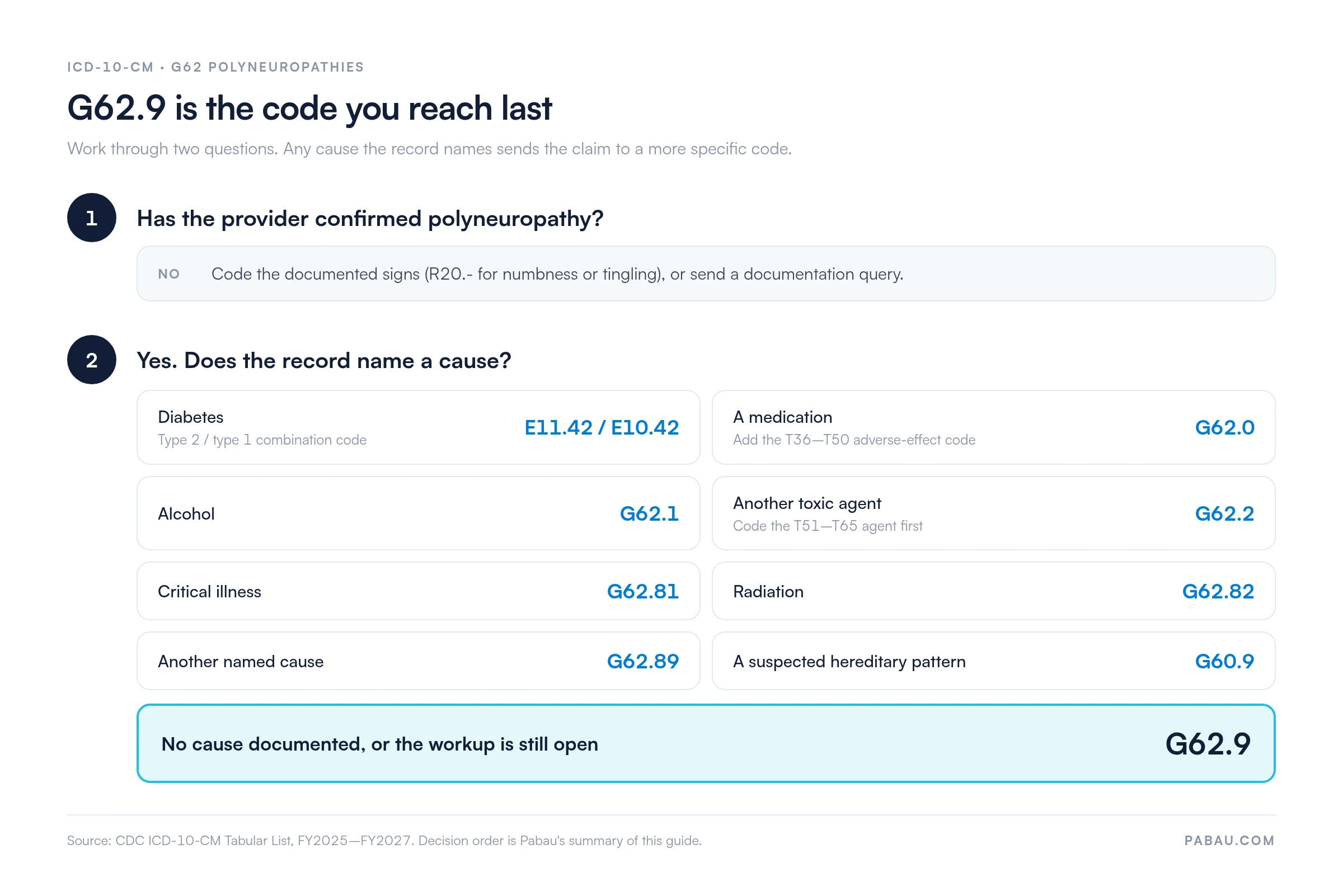
G62.9 has no Excludes notes of its own, but a documented cause such as diabetes (E11.42), a drug (G62.0) or alcohol (G62.1) takes priority.
Documentation must confirm polyneuropathy, not just symptoms, and state that the etiology is unknown or under active investigation.
Pabau sends claims through Claim.MD and posts the payer’s remittance back to the same patient record as the clinical note.
ICD-10 Code G62.9 is the billable ICD-10-CM code for polyneuropathy, unspecified. It covers confirmed damage to multiple peripheral nerves when the record names no cause, or the cause is still being worked up. Any documented cause, such as diabetes, a drug or alcohol, moves the claim to a more specific code.
Every claim in the medical billing process starts with the same check. The code has to be billable, correctly categorized, and valid for the date of service. The table below holds those facts for G62.9.
The CDC/NCHS ICD-10-CM web tool is the authoritative source for verifying code validity by fiscal year. Confirm G62.9 is active for the date of service before submitting.
G62.9 applies when polyneuropathy is the confirmed diagnosis and no specific etiology has been identified or documented. Polyneuropathy means damage to several peripheral nerves at once. It typically presents as symmetrical distal weakness, sensory loss, or autonomic dysfunction.
The “unspecified” label is not a documentation failure by default. It is clinically appropriate in these situations:
Small fiber neuropathy raises a common coding question. When skin punch biopsy or quantitative sensory testing confirms it, it typically falls under G62.9 if no systemic cause is documented. Some practices also consider G64 (other disorders of the peripheral nervous system), so confirm with the treating neurologist before assigning either code.
G62.9 carries no Excludes1 or Excludes2 notes of its own in the ICD-10-CM Tabular List. Its only note is the inclusion term “Neuropathy NOS.” What keeps it off a claim is specificity. When the record names a cause, the code for that cause is the accurate one, and an unspecified code risks a CO-11 denial.
The formal Excludes1 note for diabetic and other disease-related polyneuropathy sits under a different code, G63 (polyneuropathy in diseases classified elsewhere). The table below lists the codes to use when the cause is documented.
Diabetes is the cause that matters most in practice. ICD-10-CM’s “with” convention (Section I.A.15 of the Official Guidelines) presumes a link between diabetes and polyneuropathy.
When both appear in the record, code E11.42 or E10.42 even if the note never says “diabetic,” unless the provider states the two are unrelated.
The CMS ICD-10-CM coding guidelines carry the current version of that convention.
G62.9 is the residual code within the G62 category. Before assigning it, confirm that no sibling code matches the documented condition more precisely.
The G62.9 versus G60.9 distinction trips up many coders. G60.9 covers hereditary and idiopathic neuropathies in category G60, while G62.9 belongs to G62. When the provider documents a suspected hereditary pattern or a family history of neuropathy, G60.9 is the better fit, even without a confirmed genetic diagnosis.
Put together, the choice comes down to two questions a coder answers in order, as the chart below shows.
G62.9 is a legitimate code, but it needs solid documentation behind it. Without the right elements in the clinical note, it will not survive a payer audit. It may also fail to support medical necessity for related procedures like nerve conduction studies.
Submitting a clean claim for neurology services means the supporting diagnosis documentation is in place before the claim leaves the practice. These are the elements to check:
When the clinical note documents only “neuropathy” without a type or distribution, a clinical documentation improvement (CDI) query is appropriate. Ask the provider two things. Is this mononeuropathy, polyneuropathy, or radiculopathy? And is the etiology known? The answers prevent both undercoding and miscoding.
Run a CDI query whenever a neurology note says ‘neuropathy’ without saying whether it is diffuse or focal. Polyneuropathy (G62.9) affects multiple peripheral nerves at once, while mononeuropathy (G58.9) affects a single nerve. That distinction sets the code and the medical necessity case for electrodiagnostic testing.
G62.9 most often appears as the supporting diagnosis for nerve conduction studies (NCS/EMG). Medicare Administrative Contractors (MACs) publish Local Coverage Determinations (LCDs) that govern when electrodiagnostic testing is covered.
G62.9 is listed as a covered supporting diagnosis in several active MAC LCDs, including those maintained by Novitas Solutions and CGS Administrators.
Practices using electronic claims via Claim.MD can run real-time eligibility checks before the encounter. That confirms whether a patient’s plan covers neurology services under G62.9 before the visit happens.
Key coverage rules coders must know:
Section I.B.4 of the ICD-10-CM Official Guidelines for Coding and Reporting covers signs and symptoms. Symptom codes are acceptable only until the provider establishes a related definitive diagnosis.
So once a provider has confirmed polyneuropathy but not its cause, G62.9 is the correct code. A symptom code for tingling or weakness no longer fits.
The workflow below applies to outpatient and physician office encounters, which follow Section IV of the guidelines. Inpatient coding follows Section II instead. Maintaining medical billing compliance during an active workup depends on applying these steps the same way every time.
Flag G62.9 claims in your billing system with a 30-day review trigger. If the patient has a follow-up neurology visit within that window, check whether a specific etiology code has been documented. Billing G62.9 after a specific cause is confirmed is a coding error that a payer audit may treat as overcoding.
Unspecified codes attract scrutiny from payers, and G62.9 is no exception. Denial management workflows that tag G62.9 claims for pre-submission review catch the most common rejection reasons. The table below pairs each scenario with its claim adjustment reason code and the fix.
Reviewing the full chart for diabetes, active medications, and alcohol history before assigning G62.9 prevents the most frequent denial scenario. The check takes a couple of minutes per encounter. It saves the denial, appeal, and rework cycle that follows a CO-11.
Most G62.9 denials start before the claim is built. The coder works from the encounter note and never sees the diabetes on the problem list or the chemotherapy in the medication history.
Pabau’s claims management software builds the claim from the patient record that already holds the treatment notes and history. A coder checking for a documented cause reads one chart. US claims go out through the Claim.MD clearinghouse as CMS-1500 or 837P claims, with eligibility checks run before the visit.
Electronic remittance advice comes back against the same record, so a CO-11 or CO-50 adjustment sits next to the note that caused it. Prior authorization codes for nerve conduction studies are tracked on the patient’s case, with a warning when one is missing.
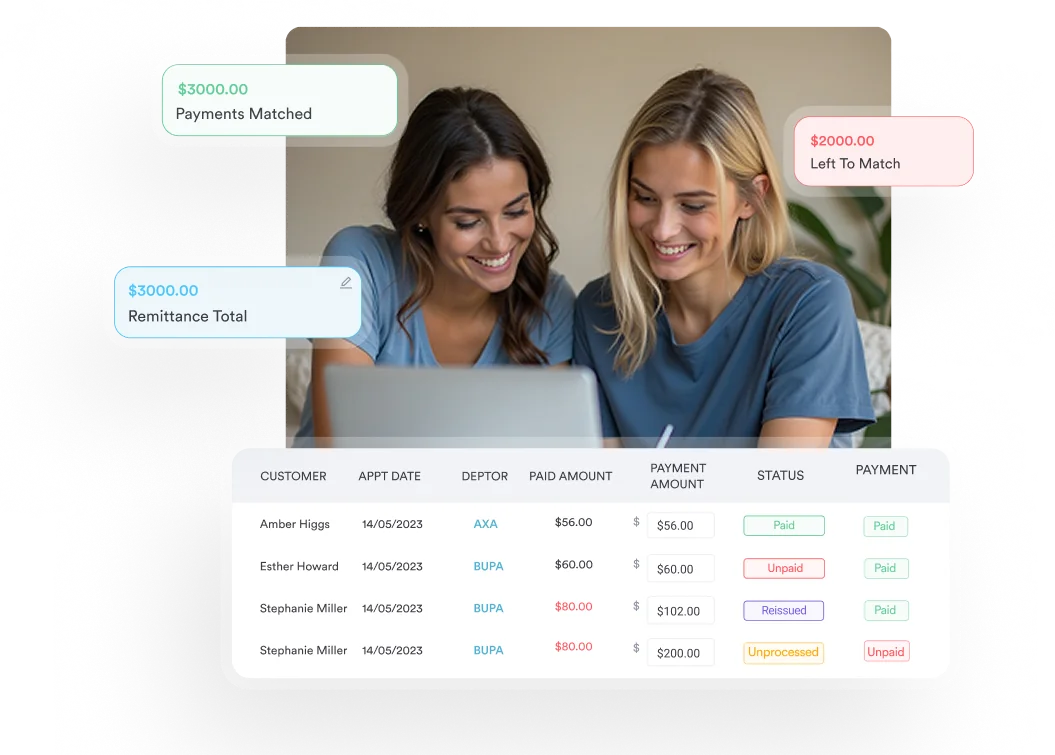

Pabau builds each claim from the patient record and sends it through Claim.MD, with eligibility checks and remittances in the same place. See how it handles neurology billing.

G62.9 is a fair code with a narrow job. It belongs on a claim only after someone has read the whole chart and found no cause, and the note says so in plain words.
The habit that pays is simple. Check for diabetes, medications and alcohol before choosing the code, and replace G62.9 the moment the workup names a cause. Skip either step and the code that looked safe becomes the denial. Book a demo to see how Pabau keeps the chart and the claim in one place for neurology billing.

Need to understand how claims move from submission to payment? Claim.MD clearinghouse overview explains how electronic claims are validated, routed, and tracked through the US clearinghouse system.
Seeing recurring CO-11 or CO-50 denials across your neurology claims? Denial codes in medical billing breaks down the most common claim adjustment reason codes and the corrective actions for each.
Want to see where diagnosis coding sits in the revenue cycle? Revenue cycle management guide covers how diagnosis coding fits into the broader RCM workflow from eligibility to payment posting.
ICD-10 Code G62.9 is the diagnosis code for unspecified polyneuropathy. It covers confirmed damage to multiple peripheral nerves where the etiology is unknown, undocumented, or still under investigation at the time of coding. It is a billable, specific code, valid and unchanged for FY2025, FY2026 and FY2027.
Use G62.9 only after confirming that no specific etiology code applies. That means no diabetic polyneuropathy (E11.42), no drug-induced cause (G62.0), no alcoholic cause (G62.1), and no hereditary pattern (G60.9). If a cause is documented anywhere in the medical record, that specific code takes priority over G62.9.
The CMS General Equivalence Mappings (GEMs) map G62.9 back to ICD-9-CM 357.9, unspecified inflammatory and toxic neuropathy. GEM crosswalks are approximations, not exact equivalents. Confirm current-year code validity before using either code in legacy system comparisons.
Yes, in many cases. Several MAC Local Coverage Determinations list G62.9 as a covered supporting diagnosis for electrodiagnostic testing. Coverage depends on the applicable LCD, the documented clinical indicators (symptom severity, duration, failed conservative treatment), and the procedure billed. Verify the current LCD on your MAC’s website before submitting.
Yes. G62.9 may be reported as either a primary or secondary diagnosis. As a primary diagnosis it needs documentation that confirms polyneuropathy and states that the etiology is unknown or under investigation. Some commercial payers deny G62.9 as a primary diagnosis when their policy requires a specified etiology for the billed service.
No. Diabetic polyneuropathy is coded with the combination codes E11.42 for type 2 and E10.42 for type 1. G62.9 has no Excludes note of its own, but the ICD-10-CM “with” convention presumes diabetes caused the polyneuropathy unless the provider says otherwise. Reporting G62.9 for a diabetic patient’s polyneuropathy invites a CO-11 denial.