









ICD-10 code F71: Moderate intellectual disabilities
ICD-10 Code F71 covers moderate intellectual disabilities (IQ 35–49). Diagnost...

July 6, 2026


ICD-10 Code F71 is a billable ICD-10-CM diagnosis code for moderate intellectual disabilities, characterized by an IQ range of approximately 35-49.
Diagnosis requires evidence of both significant cognitive limitations and deficits in adaptive functioning – IQ score alone is not sufficient.
F71 maps to ICD-9-CM 318.0 and sits within the F70-F79 intellectual disabilities block; related codes include F70 (mild) and F72 (severe).
Pabau’s claims management software and structured clinical records support accurate F71 documentation and streamlined billing workflows.
ICD-10 Code F71 is a billable diagnosis code for moderate intellectual disabilities, defined by an IQ range of approximately 35–49 combined with significant limitations in adaptive functioning. Accurate use of this code requires documented evidence from both standardized cognitive testing and adaptive behavior assessments, with onset confirmed before age 18.
This guide covers diagnostic criteria, applicable-to notes, co-occurring condition coding, documentation requirements, and billing guidance for F71.
ICD-10 Code F71 — moderate intellectual disabilities — requires evidence of both IQ deficits and functional limitations. Payers audit for both, and a record that documents only an IQ score is vulnerable to denial. For clinicians and coders working in psychiatry EMR workflows, capturing that distinction at intake prevents downstream billing problems.
F71 is a billable, specific ICD-10-CM diagnosis code within the F70-F79 intellectual disabilities block. It falls under the broader F01-F99 chapter covering mental, behavioral, and neurodevelopmental disorders. The code is valid for the 2026 ICD-10-CM edition and is accepted for reimbursement purposes by Medicare, Medicaid, and commercial payers. For context on the most severe end of this spectrum, see the profound intellectual disabilities guide.
The applicable-to notes published by CMS specify that F71 covers an IQ level of 35-40 to 50-55, which corresponds to a functional IQ range of approximately 35-49. The code also carries an alternative synonym: moderate mental subnormality. Both terms refer to the same clinical presentation and map to the same billable code.
ICD-10 Code F71 is not assigned on the basis of a single psychometric test. Diagnosis requires a clinician’s assessment of three domains, all present before adulthood.
A critical nuance: IQ score alone does not determine the code. A person with an IQ of 42 who demonstrates strong adaptive functioning in daily life may not meet full criteria for F71. The American Association on Intellectual and Developmental Disabilities (AAIDD) and the ICD-10-CM framework both emphasize the convergence of intellectual and adaptive deficits.
DSM-5-TR uses the terminology “intellectual developmental disorder” rather than “intellectual disability” – a distinction that applies to documentation style but does not change the ICD-10-CM code assignment. Clinicians working in US healthcare settings should use F71 when the clinical presentation meets criteria regardless of which diagnostic language they use in their notes.
The ICD-10-CM F70-F79 block organizes intellectual disabilities by severity. The table below shows where F71 sits relative to adjacent codes.
F79 (unspecified) should only be used when a more specific code cannot be determined. Payers and auditors flag F79 as a high-risk code for upcoding reviews. When a full evaluation supports F71, assign F71 – not F79. For preventive visits in the pediatric population where developmental screening is performed, see the CPT code billing guide for new child patients.
The ICD-10-CM tabular list includes applicable-to notes that expand how F71 is understood and coded. These notes appear in the official CMS code files and are supported by the CDC/NCHS ICD-10-CM web tool.
The term “moderate mental subnormality” appears in older clinical records and legacy documentation. Coders who encounter this term in historical records should map it to F71 – it is the direct ICD-10-CM equivalent. Related behavioral health diagnostic codes such as those for brief psychotic disorder and unspecified behavioral syndromes may also appear in legacy records alongside intellectual disability documentation.
When querying existing records in a structured clinical records system, searching for either “moderate intellectual disability” or “moderate mental subnormality” should return F71 as the applicable code. Both appear in the ICD-10-CM alphabetic index.
Document the specific adaptive behavior assessment tool used (e.g. Vineland Adaptive Behavior Scales, ABAS-3) in your clinical note alongside the IQ score. Payers increasingly request both data points during audits for F71 claims. A note that lists only an IQ score without a named assessment instrument is vulnerable to denial.
The elements below are what payers and auditors look for in a complete F71 record.
For practices using digital intake forms, building a structured intake template that captures developmental history, prior evaluations, and adaptive behavior screening scores at first contact reduces missing documentation before the formal assessment is complete.
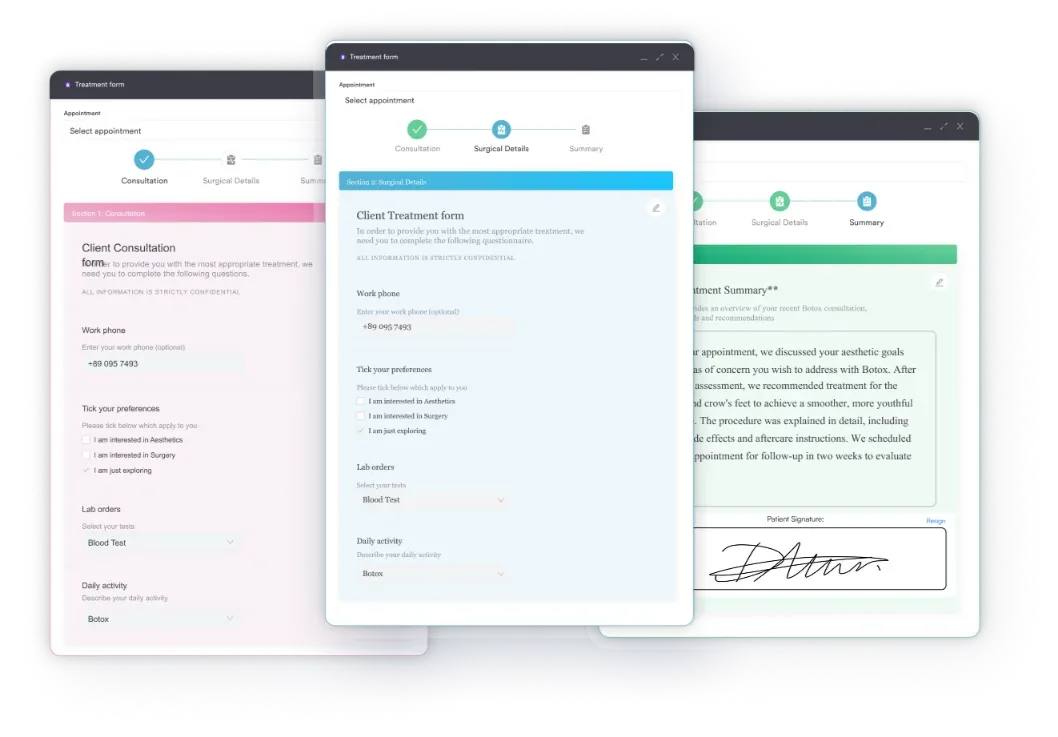
Mental health EMR software that supports customizable note templates and links intake forms to clinical records makes it easier to meet documentation standards without requiring duplicate data entry. This is especially relevant for multi-disciplinary teams where psychologists complete the formal evaluation and psychiatrists or GPs manage ongoing care.

Pabau's structured clinical records, digital forms, and claims management tools support accurate ICD-10 coding workflows from intake through claim submission.

Coding only F71 when a patient has well-documented co-occurring conditions is an under-coding error that affects both clinical completeness and reimbursement accuracy.
Common co-occurring conditions that may warrant additional ICD-10-CM codes alongside F71 include autism spectrum disorder, epilepsy, attention-deficit hyperactivity disorder, cerebral palsy, and behavioral or emotional disturbances. Each requires its own separate ICD-10-CM code when clinically documented and treated. Clinicians may also encounter patients with co-occurring schizotypal disorder or other psychotic disorders, both of which require independent documentation.
F71 may be assigned as a principal diagnosis or a secondary diagnosis, depending on the visit context. When the primary reason for the encounter is management of a co-occurring condition (for example, a seizure disorder in a patient with moderate intellectual disabilities), the seizure code takes principal position and F71 is listed as a secondary diagnosis.
Practices managing patients with both intellectual disabilities and autistic disorder diagnostic codes should verify that documentation supports each coded condition independently. Payers will not accept a single evaluation report as evidence for two distinct diagnoses unless the report explicitly addresses each condition’s criteria separately.
When co-occurring anxiety diagnosis codes are assigned alongside F71, document how the anxiety presentation was differentiated from adaptive behavior limitations inherent to the intellectual disability itself. This distinction matters for medical necessity justification.
Good psychology practice management tools support multi-code tracking across encounters, so that each co-occurring diagnosis is consistently documented and coded at every relevant visit rather than selectively applied.
Review every encounter note for F71 patients to confirm co-occurring conditions are coded consistently across visits. Inconsistent coding (listing autism at one visit but omitting it at the next without clinical justification) creates audit risk and may signal incomplete documentation to payers.
F71 converts directly to ICD-9-CM 318.0 (Moderate intellectual disabilities) under the CMS General Equivalence Mappings (GEMs). This is a one-to-one forward map: every F71 diagnosis in the ICD-10-CM system corresponds to 318.0 in ICD-9-CM.
Practices reviewing historical records, conducting clinical audits, or working with payers still referencing legacy data will encounter 318.0 in older files. Both codes describe the same clinical population.
For reference, the complete ICD-10 diagnostic coding crosswalk methodology is described in the CMS GEM documentation. When using specialty billing software to run crosswalk reports, verify that the mapping source is the current-year GEM file to ensure ICD-9 legacy codes are correctly translated to active ICD-10-CM codes.
The WHO ICD-10 browser uses a slightly different code structure than the US ICD-10-CM edition. The WHO international version includes subcodes (such as F71.0 and F71.1) that indicate associated behavioral disturbances, while the US ICD-10-CM edition uses F71 as a single billable code without these subcategories.
US-based clinicians and coders should use ICD-10-CM (the clinical modification), not the WHO international version, for claims submitted to US payers.
Accurate billing for F71 depends on three workflow checkpoints: correct code selection, complete supporting documentation, and appropriate pairing with procedural codes for the services rendered during the encounter.
F71 is a diagnosis code, not a procedure code. It supports – rather than replaces – CPT codes for the specific services provided. Common procedure codes submitted alongside F71 include psychological testing codes (96130-96133), evaluation and management codes (99202-99215), and adaptive behavior treatment codes where applicable.
Practices using claims management software can set up code pairing rules to flag encounters where F71 appears without an appropriate procedural code, improving clean-claim rates and reducing denial risk.
Medicaid is the primary payer for many patients with moderate intellectual disabilities, and state Medicaid programs have varying coverage policies for behavioral health, habilitation, and adaptive skill training services billed under F71. Verify local coverage determinations (LCDs) and state-specific Medicaid manuals for applicable service types.
Community support service billing codes such as HCPCS Code H2015) are commonly paired with F71 in Medicaid claims.
Medicare coverage for F71-related services is more limited and typically applies only when specific medical conditions (such as co-occurring psychiatric disorders) are being treated. Document the medical necessity for each service clearly, separate from the baseline diagnosis of moderate intellectual disabilities.
Compliance documentation tools that track local coverage determinations and flag coding combinations that may not meet medical necessity criteria help practices avoid preventable denials.
The ICD-10-CM chapter notes for F70-F79 include an instructional note to “Code first any associated physical or developmental disorder.” This means that if a patient has a known genetic or physical condition associated with their intellectual disability (such as Down syndrome), that condition should be coded first, with F71 as an additional diagnosis.
Practices serving patients with complex profiles benefit from automated clinical workflows that prompt clinicians to review and update the full problem list at each encounter, reducing the risk of missing a primary-position code.
The F70-F79 block does not carry Type 1 Excludes notes that would prohibit using F71 with other mental and behavioral disorder codes. However, coders should confirm that co-occurring diagnoses are independently supported in documentation rather than inferred from the intellectual disability presentation itself.
For related reference material on neurodevelopmental disorder coding within this category, practitioners working with pediatric populations may also review diagnostic codes for autistic disorder, which commonly co-occur with intellectual disabilities and require separate documentation for each condition coded.
Practices working with patients who carry an F71 diagnosis typically span psychiatry, psychology, developmental pediatrics, and neurology. Each specialty has documentation expectations that align with what payers require: a clear record of the qualifying evaluation, updated adaptive behavior data, and consistent code assignment across encounters.
Pabau’s structured clinical records support multi-provider documentation within a single patient file, so a psychologist’s full evaluation and a psychiatrist’s follow-up note both live in one accessible record. The digital forms library can be configured with neurodevelopmental assessment templates that capture the specific data points payers audit for F71 claims, reducing the time clinicians spend on retrospective documentation requests.
For multi-location practices or those billing across different payers with different coverage rules, Pabau’s claims management workflows provide a structured layer between clinical documentation and claim submission. This means coders can review encounter data, confirm F71 code pairing with appropriate CPT codes, and flag any missing documentation before a claim goes out, rather than responding to a denial notice weeks later.
F71 claim denials are almost always documentation problems, not eligibility problems. Payers accept the diagnosis; they reject records that do not prove it was reached correctly. Capturing both IQ scores and adaptive behavior assessment results at evaluation, applying sequencing rules for co-occurring conditions, and coding the primary physical disorder first when instructional notes require it. These are the steps that produce clean claims.
For practitioners using co-occurring disorder screening tools, the AC-OK screen for co-occurring disorders template provides a structured intake resource that complements F71 documentation workflows.
Pabau’s structured clinical records and digital forms support the documentation standards that F71 billing requires. To see how Pabau handles neurodevelopmental and behavioral health documentation workflows, book a demo.

Need structured documentation workflows for neurodevelopmental diagnoses? Mental health EMR software from Pabau supports integrated note-taking and multi-provider records for behavioral health practices.
Working with patients who have co-occurring psychiatric diagnoses? Psychiatry EMR workflows built on Pabau help clinicians document complex, multi-code presentations accurately.
Want to reduce claim denials for intellectual disability codes? Compliance documentation tools in Pabau flag missing codes before claims are submitted.
ICD-10 Code F71 is a billable ICD-10-CM diagnosis code for moderate intellectual disabilities, representing an IQ range of approximately 35-49 combined with significant adaptive behavior limitations. It is valid for the 2026 ICD-10-CM edition and is accepted by Medicare, Medicaid, and commercial payers.
The IQ range for F71 is approximately 35-49, corresponding to the applicable-to note of IQ level 35-40 to 50-55 in the ICD-10-CM tabular list. An IQ score alone is not sufficient for diagnosis – significant adaptive behavior limitations must also be documented.
ICD-10-CM F71 maps directly to ICD-9-CM 318.0 (Moderate intellectual disabilities) under the CMS General Equivalence Mappings. This is a one-to-one conversion with no additional mapping complexity.
Yes. Intellectual disabilities and autism spectrum disorder are distinct diagnoses and may be coded together when documentation independently supports each condition. Each diagnosis requires its own evaluation data – a single report must explicitly address both conditions’ diagnostic criteria separately to justify dual coding.
F70 covers mild intellectual disabilities (IQ approximately 50-55 to 70), F71 covers moderate intellectual disabilities (IQ approximately 35-49), and F72 covers severe intellectual disabilities (IQ approximately 20-25 to 35-40). All three are billable ICD-10-CM codes requiring documented IQ scores and adaptive behavior deficits for accurate assignment.
F79 should only be assigned when intellectual disabilities are clinically evident but the level of severity cannot be determined – typically because formal psychometric testing has not yet been completed. Once evaluation results are available, the more specific code (F70, F71, F72, or F73) should replace F79.