ICD-10 code S61.201A: Open wound of left index finger without nail damage
ICD-10 code S61.201A covers a left index finger wound of unstated type ICD-10 co...

Last Updated: Oct 16, 2026
Billable Code Specific Code
A70 is the billable ICD-10-CM code for chlamydia psittaci infections.
Integrative medicine practices and occupational health practices see these cases, particularly when patients work with birds professionally
A70 sits within ICD-10-CM section A70-A74 (Other diseases caused by chlamydiae), which falls under chapter A00-B99 (Certain infectious and parasitic diseases). The CMS ICD-10-CM code set confirms A70 carries no subclassifications - the code stands alone as a single-level, fully specified entry
Let Pabau's smart automation suggest the right codes, reduce claim denials, and keep your practice compliant—effortlessly.
Automate repetitive tasks and focus on what matters most—your patients.
Reduce coding errors and ensure compliance with the latest regulations.
Clean claims, fewer denials, and faster reimbursements.
Powerful insights and reporting to help your practice thrive.
HIPAA compliant SOC 2 certified GDPR-compliant Trusted by 4,000+ clinics worldwide

ICD-10 code A70 is the billable, specific code for Chlamydia psittaci infections, including psittacosis, ornithosis, and parrot fever.
Transmission occurs via inhalation of dust-borne particles from infected bird droppings, feathers, or secretions; high-risk groups include veterinarians, poultry workers, and pet shop staff.
When antimicrobial resistance is clinically relevant, add code Z16.- alongside A70 per ICD-10-CM instructional notation.
Pabau’s claims management software supports accurate diagnostic code entry and claim submission for rare zoonotic infections like psittacosis.
Three inclusion terms appear under A70 in the official ICD-10-CM tabular list. All three describe the same underlying infection and are coded identically.
The pathogen is Chlamydia psittaci, a gram-negative obligate intracellular bacterium. Humans acquire infection by inhaling dust-borne particles contaminated with infected bird nasal secretions, droppings, or feather dust. Person-to-person spread is rare but documented in healthcare settings.
Clinically, psittacosis presents as a febrile illness with prominent respiratory symptoms. The onset is typically abrupt, with fever, severe headache, and myalgia preceding cough by several days. Radiographic findings show patchy or lobar infiltrates consistent with atypical pneumonia, though respiratory symptoms may be milder than the systemic presentation suggests.
Occupational exposure drives most psittacosis cases in the United States. Knowing the at-risk populations helps clinicians maintain a higher index of suspicion when the history fits.
Psittacosis is a nationally notifiable disease in the United States, and reporting requirements vary by state jurisdiction. Clinicians should check their state public health department’s requirements before assuming federal-level reporting alone is sufficient.
Some coders add Z57.5 (Occupational exposure to toxic agents in other industries) when documenting work-related bird exposure. Apply this with caution: Z57.5 describes exposure to toxic agents, not biological or infectious agents, so it is an imperfect fit for a zoonotic infection and is never required for an A70 encounter. Confirm your payer accepts it in this context before assigning it.
Document the specific bird species and occupational or household exposure history in the clinical note. This detail supports medical necessity for diagnostic testing and provides the payer with context that an atypical pathogen workup was clinically justified, not a routine step.
Coding A70 correctly starts with the physician’s documented diagnosis. Coders cannot assign a specific infectious disease code based on symptoms or lab results alone – the clinician must name the condition in the medical record.
The following elements strengthen the A70 claim and reduce the risk of denial or audit scrutiny. Use digital intake and clinical forms to capture this information at the point of care rather than reconstructing it after the visit.

Maintaining thorough patient record documentation for zoonotic infections protects providers during payer audits. Psittacosis is rare enough that an undocumented exposure history can prompt a payer to question whether the atypical workup was medically necessary.
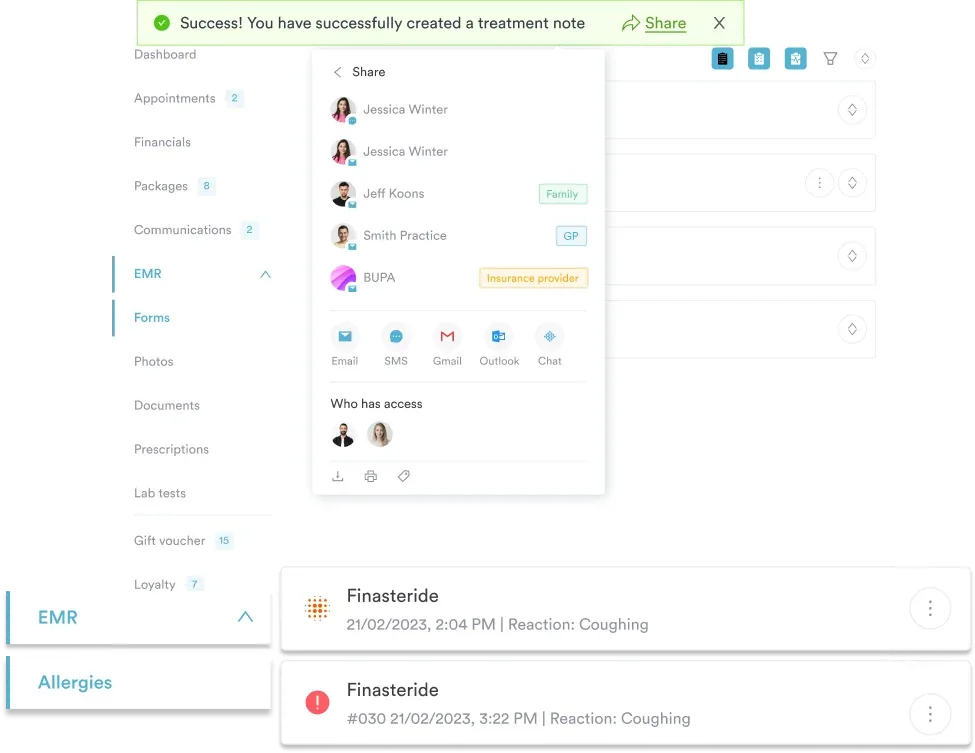
For HIPAA-compliant medical documentation, ensure all records related to the diagnosis, treatment, and any public health reporting are stored securely and accessible only to authorized personnel. Structured clinical documentation software makes it easier to capture exposure history and testing details consistently.

Pabau’s claims management tools help practices document rare infections like psittacosis accurately, reducing denials and keeping billing workflows on track from first visit to paid claim.

Inside software for GP practices, an infection diagnosis connects to its test result and any notifiable-disease steps.
The ICD-10-CM tabular list carries one instructional notation at A70: use an additional code from Z16.- to identify resistance to antimicrobial drugs when this is clinically relevant and documented.
Z16.- is an additional code, not a sequencing requirement for every A70 claim. Assign it only when the medical record documents confirmed or suspected antimicrobial resistance affecting treatment decisions. Routine psittacosis cases treated successfully with doxycycline do not require a Z16.- code.
Psittacosis is typically sensitive to tetracyclines and macrolides. However, treatment failures have been reported, and resistance documentation may arise in immunocompromised patients or cases involving unusual strains. When resistance is documented, the Z16.- code supports accurate epidemiological tracking and may affect authorization for alternative antibiotic regimens.
When psittacosis is the confirmed reason for the outpatient visit or inpatient admission, A70 is the principal diagnosis. Assign respiratory complications (such as pneumonia with respiratory failure) as secondary codes if they meet the criteria for additional diagnosis reporting under UHDDS guidelines.
If the patient presents with pneumonia that is later confirmed as psittacosis during the admission, A70 becomes the principal diagnosis at discharge, superseding a provisional pneumonia code assigned at admission.
The US ICD-10-CM code A70 aligns with the WHO ICD-10 browser classification, but practices outside the United States should verify code applicability under their national version. ICD-10-CM is the US-specific clinical modification maintained by CMS and NCHS. International practices may use country-specific ICD-10 adaptations that differ in structure or descriptor language.
Review the A70 claim before submission against your payer’s medical necessity criteria for infectious disease workups. Some commercial payers require documentation of failed initial antibiotic therapy before approving extended inpatient stays for atypical pneumonia – capturing this in the note at the time of clinical decision-making prevents claims delays.
Psittacosis presents as atypical pneumonia, which overlaps clinically with several other infectious conditions. Getting the code right depends on documented diagnostic confirmation, not just symptom pattern. Miscoding an atypical pneumonia carries audit risk, particularly when the pathogen workup is incomplete.
These are the most common differential codes for clinicians and coders to distinguish from A70. For a closely related atypical pneumonia example.
For reference, the legacy ICD-9 code for psittacosis was 073. When converting older records or crosswalking for payer reporting, A70 is the direct equivalent. For a related chlamydial infection.
A70 is a standalone, fully specified code. No additional ICD-10-CM subcode exists under it. Coders can assign A70 directly without needing a 5th or 6th character extension.
Psittacosis encounters typically fall into two billing contexts: outpatient evaluation and management visits (usually with a CPT E/M code reflecting moderate to high complexity given the infectious disease workup) and inpatient admissions when the patient requires hospitalization for pneumonia management.
Pair A70 with the appropriate E/M CPT code at the appropriate complexity level. The atypical pneumonia workup – including serology, chest imaging, and antibiotic initiation – generally supports medical decision-making complexity documentation at the moderate or high level.
Rare zoonotic codes like A70 are where billing workflows either hold together or fall apart. A practice relying on manual code entry or disconnected systems faces higher denial risk simply because coders have fewer reference checks in the workflow. If your team is refining its end-to-end process, this overview of how medical billing works is a useful reference.
Pabau’s claims management software supports structured ICD-10-CM code entry linked directly to the clinical record, reducing transcription errors between the physician’s documented diagnosis and the submitted claim. The platform also supports additional code tracking, so Z16.- entries are captured when resistance documentation exists in the encounter note rather than being overlooked at billing time.

For practices concerned about practice software HIPAA requirements when handling notifiable disease records, Pabau’s architecture supports HIPAA-compliant data handling across diagnostic documentation and claims workflows. Also relevant for occupational health practices is Pabau’s AI-powered clinical documentation capability, which supports faster, more accurate note generation for complex infectious disease presentations. First-pass rate measures how often a claim is paid without anyone touching it again. Keeping a code lookup current matters more than keeping it comprehensive.
For additional coding tools, the AAPC Codify ICD-10-CM lookup provides a searchable reference that coders can use to verify A70 alongside adjacent chlamydial and atypical pneumonia codes before submission.
Protecting patient diagnostic records for rare notifiable infections requires both clinical documentation accuracy and secure data handling practices throughout the claims lifecycle.
Rare zoonotic infections like psittacosis test the limits of a billing team’s code familiarity. A70 is billable, specific, and supported by a clear set of inclusion terms – but it requires solid occupational exposure documentation, careful differential coding, and an understanding of when to add Z16.- for resistance notation.
Pabau’s claims management software keeps ICD-10-CM code entry connected to the clinical record, so the path from documented psittacosis diagnosis to accurate, submitted claim is shorter and less error-prone. To see how Pabau handles diagnostic coding workflows for complex and rare infection encounters, book a demo.

Need to review other ICD-10 diagnostic code references? ICD-10 code A55 (chlamydial lymphogranuloma) covers the coding structure, documentation requirements, and clinical criteria for a related chlamydial infection.
Coding a carotid artery injury sequela? carotid artery injury sequela code is billable for FY2026, and most coding errors come from the 7th character.
Coding a C2 vertebra fracture? nondisplaced C2 fracture coding guide covers the 7th character options and the open versus closed fracture distinction.
ICD-10 code A70 is the billable diagnosis code for Chlamydia psittaci infections, covering psittacosis, ornithosis, and parrot fever. It is used by clinicians and coders to classify confirmed infections caused by Chlamydia psittaci transmitted from birds to humans. The code applies to outpatient, inpatient, and emergency encounters where the physician has documented the diagnosis.
Yes, A70 is a fully billable and specific ICD-10-CM code. It carries no subclassifications and does not require an additional character for specificity. Coders can assign it directly once the physician documents psittacosis, ornithosis, or parrot fever as a confirmed diagnosis.
The ICD-10-CM tabular list instructs coders to add a code from Z16.- to identify resistance to antimicrobial drugs when resistance is documented. Z57.5 (occupational exposure) may also be relevant for patients with professional bird exposure. These are conditional additions, not universal requirements for every A70 claim.
Coding accuracy depends on documented laboratory confirmation. A70 (psittacosis) requires bird exposure history and supporting serology or PCR. Q fever (A78) is ruled out by Coxiella serology and livestock exposure, Legionellosis (A48.1) by urinary antigen testing and water-source history, and Mycoplasma pneumonia (J15.7) by cold agglutinins and Mycoplasma serology. Assign the code that reflects what the physician documented as the confirmed diagnosis.
Psittacosis is a nationally notifiable condition in the United States. Reporting requirements vary by state, so clinicians should confirm local obligations with their state public health department at the time of diagnosis. Federal-level reporting to the CDC occurs through state health departments, not directly from individual providers.