ICD-10 Code Y76.0: Diagnostic obstetric and gynecological devices
ICD-10 Code Y76.0: Definition and billable status ICD-10 Code Y76.0 is a valid, ...

Last Updated: Oct 23, 2026
Billable Code Specific Code
A55 is the billable ICD-10-CM code for chlamydial lymphogranuloma (venereum).
Most claims errors involving sexually transmitted infection diagnoses trace back to one root cause: providers and coders using the wrong code from a closely clustered group of chlamydial disease codes. ICD-10 Code A55 sits in a tight neighborhood alongside A56 and A64, and mixing them up results in denials, audit flags, and incomplete public health reporting. According to the Centers for Medicare and Medicaid Services (CMS), accurate diagnosis coding underpins both reimbursement and surveillance integrity.
Lymphogranuloma venereum (LGV) is a notifiable disease in both the United States and the United Kingdom. That means accurate A55 assignment carries public health obligations beyond the claim itself. Getting the code right protects the patient record, satisfies payer requirements, and feeds accurate surveillance data to the CDC and UK Health Security Agency (UKHSA).
Let Pabau's smart automation suggest the right codes, reduce claim denials, and keep your practice compliant—effortlessly.
Automate repetitive tasks and focus on what matters most—your patients.
Reduce coding errors and ensure compliance with the latest regulations.
Clean claims, fewer denials, and faster reimbursements.
Powerful insights and reporting to help your practice thrive.
HIPAA compliant SOC 2 certified GDPR-compliant Trusted by 4,000+ clinics worldwide

ICD-10 Code A55 is a billable diagnosis code for Chlamydial lymphogranuloma (venereum), caused by Chlamydia trachomatis serovars L1, L2, and L3
Inclusion terms for A55 include Durand-Nicolas-Favre disease, esthiomene, and lymphogranuloma inguinale – all refer to the same condition
A55 excludes other chlamydial diseases under A56 (Type 1 Excludes), so these codes can never be assigned together for the same encounter
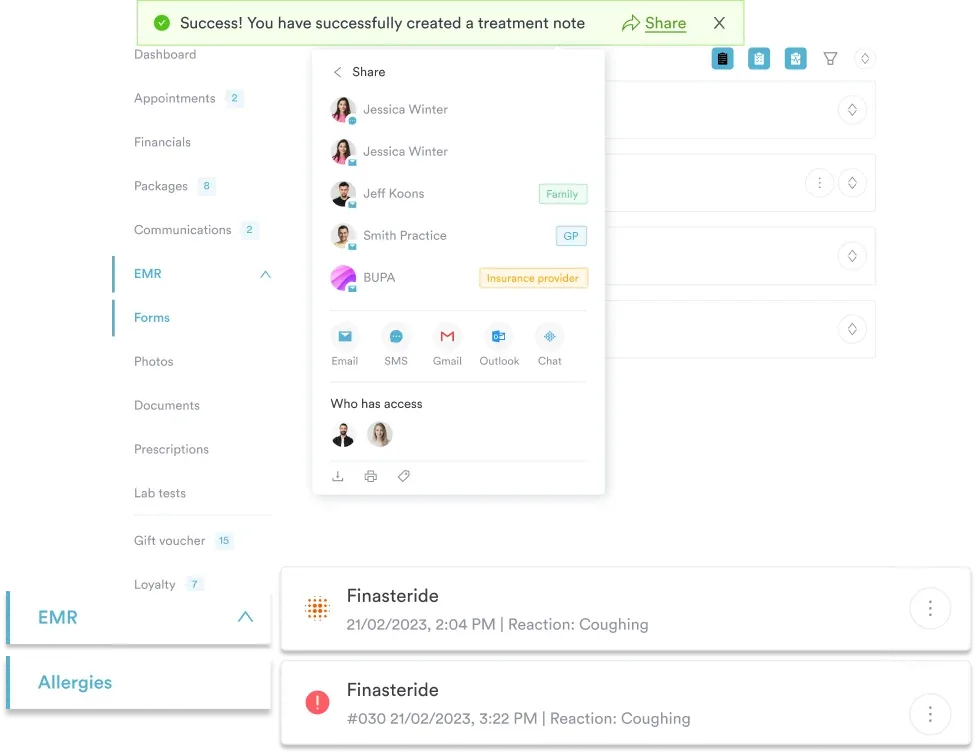
Pabau’s clinical records system and claims management software help sexual health clinics capture A55 accurately at the point of care
ICD-10 Code A55 is the billable ICD-10-CM diagnosis code for Chlamydial lymphogranuloma (venereum). It captures a specific systemic STI caused by invasive serovars of Chlamydia trachomatis, distinct from the more common urogenital chlamydia infections that fall under A56. A search for the lymphogranuloma venereum ICD-10 entry, or for LGV ICD-10, resolves to this single category with no subdivisions to choose from.
The pathogen responsible for LGV is Chlamydia trachomatis, but specifically serovars L1, L2, and L3, as CDC/NCHS ICD-10-CM guidance confirms. These invasive L-serovars differ biologically from the non-invasive D-K serovars that cause common urogenital chlamydia. The L-serovars spread to regional lymph nodes and can cause chronic, destructive inflammation without treatment, making accurate coding essential for clinical management. The clinical hallmark that separates LGV from routine chlamydia is regional lymphadenopathy: tender inguinal or femoral buboes, and the groove sign, a furrow that forms when enlarged nodes straddle the inguinal ligament. Documenting that finding is what supports A55 over A56 when the lab cannot type the serovar. Practice management software like Pabau, with a clinical records system built for STI-specific documentation, lets sexual health providers capture serovar information and these physical findings directly in the encounter note, supporting both the code assignment and downstream audit requirements. Coding sits in the middle of the revenue cycle, between registration and payment posting. A code lookup that lives beside the desk gets used; one buried in a shared drive does not.
ICD-10 Code A55 sits within the following hierarchy in the ICD-10-CM tabular list:
| Level | Classification |
|---|---|
| Chapter | Chapter 1: Certain infectious and parasitic diseases (A00-B99) |
| Block | Infections with a predominantly sexual mode of transmission (A50-A64) |
| Category | A55 – Chlamydial lymphogranuloma (venereum) |
| Billable? | Yes – A55 is a full-detail, billable code with no required subcategory |
Because A55 has no further subdivisions, it is always the final code assignment. There is no A55.0 or A55.1. Coders should never assign a truncated or parent-only version; A55 itself is the correct and complete code.
The ICD-10-CM tabular list includes several inclusion terms under A55. These are not separate codes; they are all valid clinical synonyms for the same condition and map directly to A55.
If a provider documents any of these terms in the encounter note, the correct code is A55. Coders working in sexual health clinic software environments should configure these synonyms as ICD-10 search aliases so that provider documentation flows cleanly to the right code without manual lookup every time.
Configure all A55 inclusion terms (Durand-Nicolas-Favre disease, esthiomene, lymphogranuloma inguinale) as code search aliases in your practice management system. When providers use these legacy terms in their notes, the alias mapping routes the encounter to A55 automatically, preventing mis-coding to A56 or A64.
ICD-10 Code A55 carries a Type 1 Excludes note for A56 (Other sexually transmitted chlamydial diseases). This is the most important boundary rule for coders working in sexual health settings.
A Type 1 Excludes note means the two codes are mutually exclusive. They cannot be assigned together for the same encounter because they represent fundamentally different conditions, even though both involve Chlamydia trachomatis. A55 captures invasive LGV (L-serovars); A56 captures non-invasive common chlamydial infections (D-K serovars) affecting the lower genitourinary tract, pharynx, rectum, and other sites.
| Criterion | A55 (LGV) | A56 (Other chlamydial STI) |
|---|---|---|
| Causative serovars | L1, L2, L3 | D, E, F, G, H, I, J, K |
| Disease behavior | Invasive, systemic, lymphatic involvement | Non-invasive, mucosal surfaces |
| Can be coded together? | No – Type 1 Excludes applies | |
| Notifiable disease (US/UK)? | Yes | Yes (chlamydia generally) |
A64 (Unspecified sexually transmitted disease) should not be used when clinical documentation is sufficient to support A55. Defaulting to A64 because it feels safer is a documentation failure, not a coding solution. Payers and auditors are giving closer attention to A64 usage as a flag for insufficient specificity. Avoid it when the encounter meets A55 criteria. Review related ICD-10 diagnosis codes in nearby sections, which address comparable specificity decisions.

Pabau helps STI-focused practices capture accurate ICD-10 codes at the point of care, attach them to the correct encounter, and submit claims without manual re-keying. See how it works for your clinic.

The right software for primary care practices handles the surge of infection-related visits without documentation falling behind.
Accurate A55 coding starts with the clinical note, not the billing system. Providers need to document enough to support both the specific code and the public health reporting that follows.
The note should cover three things. First, describe symptoms consistent with LGV: swollen, tender groin lymph nodes (bubo formation), genital or anal sores, or proctocolitis in higher-risk patients. Second, record lab confirmation when you have it — specifically a positive NAAT result for Chlamydia trachomatis. Third, explain how you connected that positive result to the LGV-specific presentation, rather than treating it as just a routine chlamydia screen.
Two CPT codes commonly pair with A55 on LGV encounters:
Note that a positive CPT 87491 result alone does not confirm LGV. Standard NAAT testing detects Chlamydia trachomatis broadly, including both LGV and non-LGV serovars. Serovar typing or an LGV-specific NAAT distinguishes L-serovar from D-K serovar infection. The provider’s clinical judgment, drawing on presentation and epidemiology, determines whether A55 or A56 is the appropriate code when the lab cannot confirm the serovar. Providers should document this reasoning explicitly in the note to support the coding decision. Maintaining HIPAA-compliant documentation practices matters especially for STI encounters, where patient privacy and reporting obligations intersect.
The three stages of lymphogranuloma venereum each leave a different footprint in the record, and documenting the stage supports coding specificity and justifies treatment decisions to payers:
Documentation that names the stage and describes the anatomical involvement gives auditors and payers the clinical context they need to adjudicate the claim. Vague notes like “LGV, treated” are technically sufficient for the code but leave the practice exposed during retrospective review. Robust ICD-10 coding documentation practices, as outlined in the ICD-10 coding documentation practices guidance Pabau publishes for clinical teams, follow the same specificity principle across all diagnostic code categories.
Document stage, anatomical site, and laboratory basis (NAAT positive, serovar-confirmed, or clinical diagnosis) in every LGV encounter note. This three-part structure supports A55, satisfies audit reviewers, and pre-empts payer queries without additional chart requests.
A55 is rarely the only code on an LGV encounter. Several additional codes support complete and accurate claim submission.
Z11.3 (Encounter for screening for infections with a predominantly sexual mode of transmission) applies when a patient presents for STI screening and LGV emerges incidentally. It should not be used as the primary code when the provider establishes an active LGV diagnosis; A55 takes priority in that scenario.
Providers working in sexual health settings regularly encounter co-infections. A55 may appear alongside codes from the following categories, provided the provider documents each condition independently. The differential drives the code choice too: chancroid versus lymphogranuloma venereum, and granuloma inguinale versus lymphogranuloma venereum, turn on the causative organism rather than how the ulcer looks.
A55, A57, and A58 can all be assigned in the same encounter if the documentation supports each diagnosis. They do not exclude each other. Practices with robust claims management software can map these multi-code encounters correctly and flag any conflicting code combinations before submission, reducing denial rates on complex STI claims.
| Code | Description | Relationship to A55 |
|---|---|---|
| A50-A53 | Syphilis | Different organism; can co-occur, no exclusion relationship |
| A54 | Gonococcal infection | Different organism; co-infection common in high-risk populations |
| A55 | Chlamydial lymphogranuloma (venereum) | Primary code – this article |
| A56 | Other sexually transmitted chlamydial diseases | Type 1 Excludes with A55 – cannot be used together |
| A57 | Chancroid | Different organism; may co-occur, no exclusion relationship |
| A58 | Granuloma inguinale | Different organism; may co-occur, no exclusion relationship |
| A64 | Unspecified sexually transmitted disease | Fallback only – avoid when A55 criteria are met |
The AAPC Codify ICD-10-CM lookup provides a searchable reference for the full A50-A64 block, including inclusion notes and excludes relationships for each code in the sexually transmitted diseases range.
LGV is a notifiable condition in both the United States and the United Kingdom. Coding a patient encounter with A55 triggers a reporting obligation that extends beyond the payer claim.
In the US, providers must report LGV to the relevant state health department under the CDC’s nationally notifiable disease surveillance framework. Reporting timelines and methods vary by state, but most require submission within 24-72 hours of diagnosis confirmation. The WHO ICD-10 classification browser provides the international reference framework that aligns US ICD-10-CM coding with global surveillance systems, supporting cross-border epidemiological tracking of LGV outbreaks.
In the UK, LGV is notifiable under the Public Health (Control of Disease) Act. The UK Health Security Agency (UKHSA) publishes annual LGV surveillance data, and clinical coders and sexual health providers feed into it through accurate A55 coding. NHS coding standards follow the WHO ICD-10 edition, so A55 maps directly across both systems. Practices that use digital clinical forms with built-in notifiable disease prompts can flag encounters at the point of documentation, reducing the risk of missing a reporting obligation when the clinical workload is high.
A55 is a diagnosis code, so it does not carry its own reimbursement amount or CPT-style modifiers. Payment attaches to the evaluation-and-management (E/M), laboratory, and procedure codes performed at the visit, and A55 supports medical necessity for those service lines. On the claim, list A55 in the diagnosis field and link each relevant service line to it with a diagnosis pointer.
A simplified LGV claim illustrates the structure:
Because A55 itself has no assigned fee, confirm the payable amounts for the CPT service lines against your Medicare Administrative Contractor or commercial payer’s current fee schedule for your locality. Do not estimate or invent a reimbursement figure for the diagnosis code.
ICD-10 code A55 identifies a specific, invasive STI that stands apart from routine chlamydial infections. Getting it right depends on three things: documentation that clearly distinguishes LGV from other chlamydial and ulcerative STIs, correctly applying the Type 1 Excludes relationship with A56, and recognizing the public health reporting duties that come with the diagnosis.
Pabau’s integrated practice management platform helps sexual health and STI-focused clinics build these coding steps directly into the consultation process. From structured clinical notes to automated claim checks, every feature works to close the gap between the clinical encounter and accurate code submission. Book a demo to see how Pabau handles STI coding workflows end to end.

Coding low breast milk production? hypogalactia diagnosis and documentation guide applies when a postpartum mother produces some milk but not enough for her infant.
Looking for a claims management solution? Claims management software explains how Pabau reduces denials on multi-code encounters including complex STI billing.
Coding disseminated intravascular coagulation in a newborn? DIC of newborn coding guide covers billable status, code hierarchy, related codes, and the documentation this diagnosis requires.
ICD-10 Code A55 is the diagnosis code for Chlamydial lymphogranuloma (venereum), also known as LGV. It covers an invasive sexually transmitted infection caused by Chlamydia trachomatis serovars L1, L2, and L3, classified under Chapter 1 (A00-B99) of ICD-10-CM.
Yes. A55 is a full-detail, billable ICD-10-CM code with no required subcategory. Providers assign A55 directly as the final diagnosis code; there are no A55.0 or A55.1 subdivisions to select from.
No. A55 carries a Type 1 Excludes note for A56 (Other sexually transmitted chlamydial diseases), meaning the two codes are mutually exclusive. They represent different Chlamydia trachomatis serovars with different disease behavior and cannot be assigned for the same patient encounter.
CPT 87491 (Chlamydia trachomatis NAAT) is the most common pairing for A55, as molecular testing is standard for LGV diagnosis. CPT 87110 (chlamydia culture) may also appear. Note that a positive NAAT alone does not confirm LGV; serovar typing or clinical judgment is needed to distinguish A55 from A56.
Yes. LGV is notifiable in both the United States and the United Kingdom. In the US, it must be reported to the relevant state health department. In the UK, reporting falls under the Public Health (Control of Disease) Act and feeds into UKHSA surveillance data.
The ICD-10-CM tabular list includes three inclusion terms for A55: Durand-Nicolas-Favre disease (the historical eponym), esthiomene (a late-stage manifestation), and lymphogranuloma inguinale (an older descriptive term). All three map directly to A55 and should never be coded separately.
LGV is the usual shorthand. Older records also call it Durand-Nicolas-Favre disease or lymphogranuloma inguinale, and its late-stage genital form is known as esthiomene. Each of these names maps to the same code, A55.
Diagnosis starts with a positive Chlamydia trachomatis NAAT, followed by serovar typing or an LGV-specific NAAT to confirm the L1-L3 serovars. When typing is unavailable, clinical findings such as buboes or the groove sign support the call. Only a confirmed L-serovar picture justifies A55 over A56.