The clinical audit cycle: Stages, challenges, and how to complete it
The clinical audit cycle is a repeating process for measuring care against an ag...

Last Updated: Nov 10, 2026
A relative value unit (RVU) is the standardized weight Medicare assigns to each CPT code to reflect the resources that service takes to deliver. Every code carries three RVUs: physician work, practice expense, and malpractice insurance. Medicare adjusts each one for geography, adds them up, and multiplies the total by a dollar conversion factor to set the payment.
For 2026 that factor is $33.4009 for most clinicians, so a 99214 office visit with 4.06 total RVUs pays about $135.61 before the geographic adjustment. Work RVUs (wRVUs) also matter on their own, because many employed physicians are paid a set rate for each wRVU they generate.

An RVU is the weight CMS assigns to each CPT code, split into physician work, practice expense, and malpractice components.
Work RVUs (wRVUs) are the unit most productivity-based physician pay is built on, and MGMA and AMGA publish benchmarks by specialty.
Medicare payment is each RVU adjusted by a geographic index (GPCI), summed, then multiplied by the conversion factor, $33.4009 for most clinicians in 2026.
The same code earns fewer total RVUs in a facility, because the hospital is paid separately for overhead, so 99214 drops from 4.06 to 2.53.
wRVU analysis means mapping each billed CPT code to its CMS RVU values, then comparing providers against specialty benchmarks.
An RVU is a numeric weight that represents the resources a practice uses to deliver one service, and every payable CPT code has one. CMS publishes these weights each year in the Medicare Physician Fee Schedule (MPFS). They form the basis of the Resource-Based Relative Value Scale (RBRVS), which Medicare introduced in 1992.
Before RBRVS, Medicare paid physicians on “usual, customary, and reasonable” charges, which varied widely by region and specialty. RVUs replaced that with one national scale that reflects the effort and cost behind each procedure or visit.
RVUs do two jobs. They set what Medicare pays for each CPT code, and many commercial payers price their contracts against that rate. They are also the unit many physician compensation plans count. A hospitalist contracted at $60 per wRVU who generates 5,000 wRVUs a year earns $300,000 from that component alone. That is why medical billing fundamentals like RVUs matter to anyone negotiating or managing physician contracts.
Every CPT code carries three separate RVU components. Together they add up to the total RVU used in the Medicare payment formula.
The wRVU matters most to employed physicians. It captures physician time, clinical skill, technical complexity, and the mental effort a service takes. When MGMA and AMGA publish specialty compensation benchmarks, the productivity metric they use is wRVUs per year, not visits or procedures.
A family medicine physician at the 50th percentile generates roughly 4,500 to 5,000 wRVUs a year, while a procedural specialty like gastroenterology may exceed 8,000. These benchmarks shape the dollar-per-wRVU rates practices offer at hiring.
Because wRVUs reflect the physician’s own contribution, most compensation plans leave out peRVUs and mRVUs. When an employer says “we pay $55 per wRVU,” they mean the work component only. The practice covers practice expense and malpractice costs separately.
The Medicare payment formula turns RVU components into a dollar amount. It applies a geographic adjustment to each component, then multiplies the total by the conversion factor CMS sets each year.
The formula: Payment = [(wRVU x wGPCI) + (peRVU x peGPCI) + (mRVU x mGPCI)] x Conversion Factor
The Geographic Practice Cost Index (GPCI) is a locality-specific multiplier CMS updates regularly. It adjusts each component for regional cost differences. A physician in Manhattan faces higher overhead than one in rural Mississippi, so the peGPCI is higher in Manhattan. Congress has set a temporary 1.0 floor on the work GPCI, extended periodically. As a result, work value in lower-cost localities is not adjusted below the national average.
For 2026, CMS set two conversion factors: $33.4009 for most clinicians and $33.5675 for qualifying APM participants. Congress can still change the factor through legislation after the final rule, so confirm the current figure in the CMS relative value files each year. Our Medicare billing guide covers how that payment reaches the practice once a claim is filed.
Understanding revenue cycle management means seeing how this formula pays different amounts for the same CPT code. The amount depends on where the practice is located and whether the service happens in a facility or an office.
The table below shows 2026 national non-facility RVUs from the CMS relative value file, with payment at the $33.4009 conversion factor before any GPCI adjustment. Values change every year, so confirm them in the current file before billing. To estimate any code yourself, look up its RVUs and multiply the total by the conversion factor.
Broken into its parts, the gap between an office visit and a procedure is mostly practice expense. A colonoscopy carries 2.4 times the work RVUs of a 99213 visit but more than five times the practice expense.
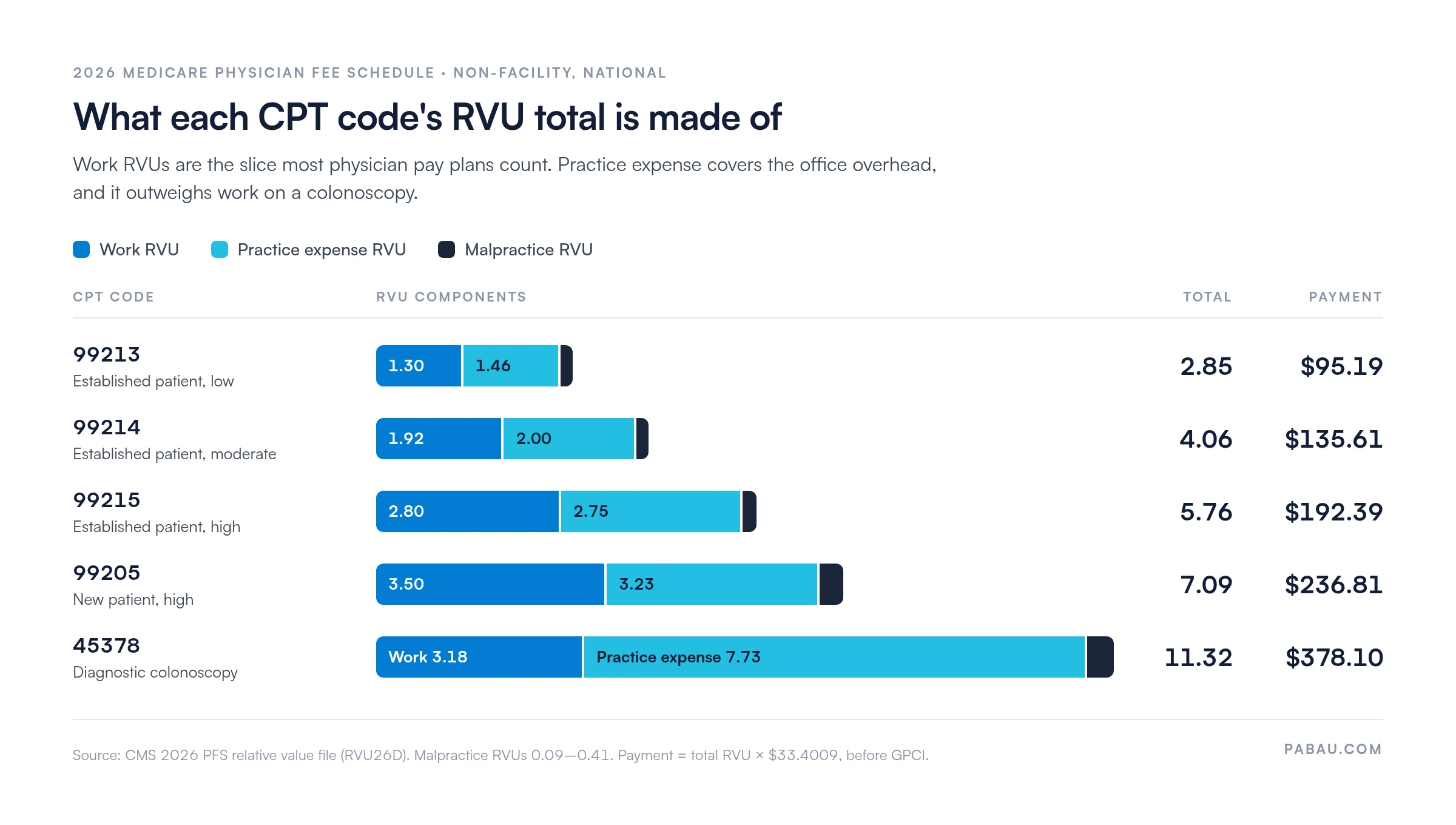
The 1.30 wRVUs on 99213 show the core tension in primary care. Each visit earns few work units next to a procedure. A physician seeing 20 patients a day across 99213 and 99214 logs between 26 and 38 wRVUs.
Check wRVU values in the CMS relative value file each fall, when CMS releases the next year’s final rule. Values for high-volume codes like 99213 and 99214 shifted with the 2021 E/M overhaul. Private payer contracts may also pay a multiplier above or below the Medicare rate.
The same CPT code carries different total RVUs depending on where the service is delivered. Only the peRVU changes, because it follows whoever pays the overhead.
In a non-facility setting, such as a physician’s office or independent practice, the practice pays for staff, equipment, and supplies. The peRVU is higher, which raises the total RVU and the Medicare payment. In a facility setting, such as a hospital outpatient department or ambulatory surgical center, the facility receives its own payment for overhead. The physician’s peRVU is lower as a result.
The wRVU for 99214 is identical in both settings. For employed physicians paid on wRVUs only, the site of service does not change their payout. For practices billing Medicare directly, the facility rate pays about $51 less per visit at the national rate.
RVU-based physician pay usually follows one of three structures, each with its own incentives.
MIPS (Merit-based Incentive Payment System), CMS’s quality payment program, adds another layer. Clinicians who score well may receive a positive adjustment on their Medicare Part B payments, applied two years after the performance period. Poor scores trigger negative adjustments. CMS publishes the adjustment percentages each year through its Quality Payment Program.
For practices tracking physician income closely, MIPS changes what each RVU billed is worth. Standard compensation calculators often leave it out.
The AMA’s RVS Update Committee (RUC) recommends RVU values to CMS. CMS then accepts, modifies, or overrides them in its annual fee schedule rulemaking.
The AMA RUC is a 32-member advisory panel made up mostly of specialty society representatives. A new CPT code, or a code whose clinical work seems to have changed, triggers a survey. The relevant specialty society asks its members about the time and effort involved. That survey data feeds a RUC recommendation. CMS is not legally bound to accept it, but historically accepts most recommendations.
Primary care specialties have long criticized the process. Procedural specialties have more code-specific survey data and RUC representation, so critics argue that office visits and preventive care are undervalued next to procedures. The 2021 E/M revisions were a partial correction, raising wRVU values for office visits. The RUC reviews hundreds of codes each year, and specialties can submit survey data to argue for changes.
For practice owners and managers, the RVU is also a management metric. Tracking wRVUs per provider turns clinical activity into one productivity unit you can compare across specialties, roles, and locations.
Three uses stand out for multi-provider practices.
wRVU tracking usually starts as a spreadsheet. Someone exports billed services, matches each CPT code to the CMS file, and totals the result by provider. With several locations or tools, that export has to be stitched together from each system first.
Pabau, the practice management platform we build, keeps appointments, services, invoices, and claims in one system. Its reporting, included in every plan, shows activity by provider, service, and location. The export for your wRVU model then comes from one place instead of several.
Pabau does not calculate wRVUs itself. Mapping CPT codes to RVU values still happens outside Pabau, in the CMS file or your own model. The difference is that the activity data you map comes from one consistent source across every site.

Pabau’s reporting shows appointments and services by provider, service, and location across every site. Your wRVU model starts from one consistent dataset instead of separate exports.

RVUs price every CPT code and measure most productivity pay, so the figure worth watching depends on your seat. An employed physician should read an offer in wRVUs and dollars per wRVU. A practice billing Medicare directly lives on total RVUs, where the site of service moves the number.
For practice owners, the payoff comes from comparing providers on one unit. Refresh the CMS values before you rebuild a model each year, since 2026 brought two conversion factors. Book a demo to see how Pabau’s reporting gives you one source of provider activity for that analysis.

Need to understand the billing side of RVUs? What is medical billing explains how coding, claims submission, and reimbursement connect in everyday practice operations.
Billing Medicare directly? Medicare billing walks through how a fee schedule payment travels from claim to deposit.
Choosing between office visit levels? CPT code 99214 sets out the documentation behind a moderate-complexity visit.
Capturing codes at the visit? Encounter form template gives providers one sheet for the CPT and diagnosis codes billed.
An RVU in medical billing is a standardized unit that measures the resources needed to deliver a specific service. CMS and many commercial payers use it to set a consistent payment for each CPT code. It has three components: work (wRVU), practice expense (peRVU), and malpractice (mRVU). Each is adjusted for geography, summed, and multiplied by the conversion factor to produce the payment.
The work RVU (wRVU) reflects physician time and skill. The practice expense RVU (peRVU) covers overhead such as staff and equipment. The malpractice RVU (mRVU) reflects professional liability insurance cost for the service’s risk. Across the fee schedule, work accounts for roughly 51% of RVUs, practice expense about 45%, and malpractice about 4%.
In healthcare compensation, an RVU (specifically the wRVU) is the productivity unit used to calculate employed physician pay. A physician is typically offered a dollar-per-wRVU rate, often $45 to $80 depending on specialty. That rate is multiplied by their annual wRVU output to set the variable part of their income. MGMA and AMGA publish annual benchmarks by specialty so practices can set competitive rates.
MIPS (Merit-based Incentive Payment System) adjusts Medicare Part B payments up or down based on quality, improvement activities, interoperability, and cost measures. A high score earns a positive adjustment, applied two years after the performance period. A low score triggers a negative one. The percentages change each year, so check the CMS Quality Payment Program for current figures.
The Medicare conversion factor is the dollar amount CMS multiplies by the total adjusted RVU to calculate payment. For 2026 there are two: $33.4009 for most clinicians and $33.5675 for qualifying APM participants. CMS publishes the proposed rule each summer and the final rule each November. Congress has sometimes overridden proposed cuts, so confirm the current rate at cms.gov before financial planning.