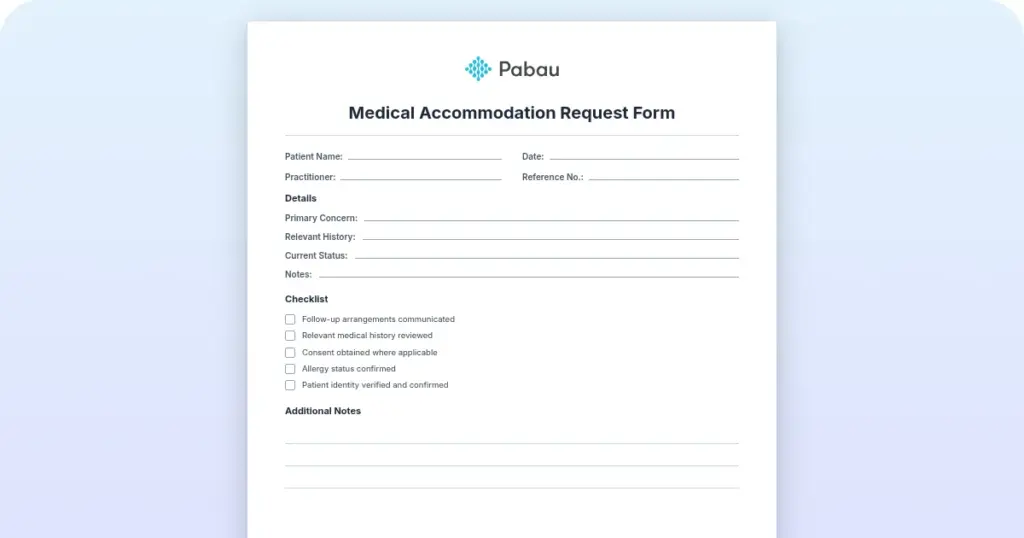
Health appraisal form
A health appraisal form is a record a licensed provider signs to document someon...

2
Last Updated: Oct 13, 2026

SimplePractice pricing starts at $49/month (Starter), with Essential and Plus plans priced higher – but the headline figures exclude several add-on costs.
Additional clinicians, ePrescribe, credit card processing, and an annual CPT code fee can significantly raise your true monthly bill.
Group practices face steep per-seat costs: each clinician added beyond the primary subscription costs $69-$74/month on the Plus plan.
Pabau is purpose-built for aesthetic, wellness, and multi-discipline clinics, offering inclusive pricing without layering in per-claim or per-seat fees for core features.
SimplePractice pricing looks straightforward on the surface. Three plans, clear monthly figures, and a free trial. For thousands of solo therapists, that simplicity is genuinely appealing. But if you run a group practice, bill insurance regularly, or work outside mental health therapy, the full cost picture looks quite different. This guide breaks down every charge, explains what each plan actually includes, and helps you decide whether SimplePractice is the right fit for your budget and practice type.
Whether you are evaluating SimplePractice for the first time or reconsidering after a price increase, understanding the real cost requires looking beyond the subscription line. Practice management software pricing varies widely by model, and SimplePractice uses an add-on-heavy approach that rewards solo practitioners but scales steeply for teams.
SimplePractice pricing is structured around three subscription tiers. Based on the rates published on the SimplePractice website, the current prices are:
Prices confirmed on the official SimplePractice pricing page as of mid-2026. New accounts can claim 50% off for the first 3 months when a paid plan is started within 7 days of beginning the trial.
The Starter plan at $49/month covers the essentials for a solo practitioner: scheduling, documentation, a client portal, and telehealth. New users who start a paid plan within 7 days of beginning the free trial receive 50% off for the first 3 months, as listed on Capterra’s SimplePractice pricing guide and confirmed on the official pricing page.
The Plus plan is where most insurance-billing practices end up. Third-party reviewers consistently describe it as “the only tier that feels complete” for practices doing regular insurance work. At roughly $99/month before add-ons, that is a reasonable entry point for a solo clinician. For a team, the numbers shift dramatically.
The subscription price is only part of what you pay. SimplePractice layers several additional charges on top of the base plan, and these are where practices most commonly get surprised. For context on how this compares across the market, Jane App pricing uses a similar tiered approach with per-practitioner scaling, while Vagaro pricing bundles some of these extras.
None of these fees are unusual in healthcare SaaS. The issue is that SimplePractice’s headline pricing omits them, so the difference between what the plan costs and what you actually pay can catch practices off guard. This is particularly true for any practice moving from a flat-fee model. For comparison, Mindbody pricing and Phorest pricing both use similar variable-fee structures alongside base subscriptions.
The per-seat add-on model has a compounding effect at scale. A solo practitioner on the Plus plan pays $99/month. A five-clinician practice on the same plan pays $99 + (4 × $74) = approximately $395/month before processing fees or ePrescribe costs.
The upper end climbs quickly: a 15-clinician group on the Plus plan runs the $99 base plus 14 additional clinicians at $72/month each, totaling roughly $1,107/month before usage-based fees are added. That figure grows further once you factor in ePrescribe for multiple prescribers and per-claim charges beyond the free monthly allowance.
Here is how the base subscription scales by practice size, before any usage-based add-ons:
*Estimated base cost before credit card processing, ePrescribe, managed billing, the annual CPT code fee, and per-claim charges beyond each plan’s free allowance.
This is not a criticism unique to SimplePractice. Healthbridge pricing and Zenoti pricing also scale by seat and module. The key is comparing the best practice management software on total cost, not headline price, before you commit. Two questions worth asking before signing up:
Also worth noting: SimplePractice has raised prices over time. Reddit discussions in r/therapists from early 2025 reference earlier pricing of $29/month for new users on the Starter plan. The current $49 figure represents a meaningful increase for existing subscribers and reflects a wider trend in EHR software pricing as vendors expand feature sets and infrastructure costs rise.
Before finalizing your plan, map out your actual monthly usage: number of clinicians, approximate insurance claims, ePrescribe seats, and payment processing volume. Build a realistic total cost estimate before comparing headline prices across platforms.
Two services sit outside the plan tiers and pull in opposite cost directions, so they are worth separating out.
SimplePractice credentialing is offered free of charge. You choose which insurance payers you want to join, and SimplePractice handles the paperwork to get you paneled, with the panel staying with you rather than the practice. For a solo clinician starting to accept insurance, that removes a cost other platforms often charge for, so it is one of the few line items here that works in your favor.
Managed billing is the opposite story, and it is the single largest add-on for an insurance-heavy practice. It is a done-for-you service that submits claims and handles rejections, denials, and appeals, and it is priced as a percentage of what you collect rather than a flat fee. Third-party reviewers report a rate of around 6% of insurance collections with a roughly $750/month minimum, and the service is available only on the Plus plan. A practice collecting $30,000/month from insurance would pay about $1,800/month for managed billing alone, which dwarfs the base subscription.
The takeaway on managed billing cost is to run the percentage against your actual collections before opting in. Below a certain claim volume, handling billing in-house on the Plus plan’s included claim allowance is far cheaper. The same test applies to eClinicalWorks pricing, where the outsourced billing tier also charges a percentage of collections.
SimplePractice has earned its reputation. With over 250,000 practitioners according to their website, and a Capterra rating of 4.6/5 from 2,800+ reviews, it clearly works for a large segment of the market. Reviewers consistently praise the client portal experience, document storage, and the insurance filing workflow once initial setup is complete. Our SimplePractice review examines those strengths and weaknesses in more depth.
The frustrations cluster in two areas. First, users on lower tiers frequently find they need to upgrade to access features they assumed were standard. Calendar color-coding, group appointment scheduling, and full insurance billing functionality each sit behind higher-tier paywalls. Second, existing subscribers who predated the price increases have noted the jump from earlier rates to current ones on forums like r/therapists.
For whom does SimplePractice make the most sense?
For practices outside those parameters, especially larger groups or practices in disciplines like aesthetics, physical therapy, or wellness, the value calculation shifts. The claims management tools and workflow design that SimplePractice optimizes for mental health therapy may not map cleanly onto other clinical workflows.

Pabau is purpose-built for aesthetic, wellness, and multi-discipline clinics. See how inclusive pricing and built-in automation can reduce your monthly software spend.

SimplePractice is built for mental health. Its documentation templates, insurance billing workflows, and client portal are all designed with therapists, counselors, and psychologists in mind. That focus is a genuine strength for that audience and a genuine limitation for anyone else.
Practitioners in aesthetics, physical therapy, occupational therapy, or multi-discipline wellness practices will often find they are paying for features they cannot use while lacking others they need. Injection plotting, before-and-after photography, treatment-specific consent workflows, and multi-location scheduling are not part of what SimplePractice delivers. If those capabilities matter to your practice, the platform’s pricing model becomes a secondary concern.
The per-clinician add-on model also deserves scrutiny for growing practices. A practice planning to add two or three practitioners over the next year should model the full-year cost before committing to a plan, including the annual CPT code fee per clinician and any ePrescribe costs for prescribing staff.
If you are running an aesthetic clinic, medical spa, physical therapy practice, or multi-discipline health and wellness business, Pabau, an all-in-one practice management system, is worth a close look. It is designed from the ground up for those clinical environments, with built-in tools for aesthetic clinic management, injectable and treatment documentation, digital consent forms, and multi-location scheduling.
Pricing starts from $65/month, and the platform’s model is designed to avoid the layered add-on costs that can inflate SimplePractice bills for growing teams. Pabau holds a 4.7/5 rating from 600+ verified reviews on Capterra.
For practices evaluating their options beyond the mental health EHR space, Pabau’s feature set, including automated patient engagement workflows, digital consent forms, and multi-clinician scheduling, maps more directly to those operational needs.
SimplePractice works well for its target audience: solo and small-group mental health therapists who value a polished, purpose-built EHR with strong insurance billing support. For that use case, the cost is justified. For everyone else, especially practices in aesthetics, wellness, or multi-discipline settings, or those scaling beyond three or four clinicians, the true monthly cost is meaningfully higher than the headline figure suggests.
If you are not a mental health therapist and you are evaluating your options, it is worth considering platforms designed for your specific clinical environment. Book a demo with Pabau to see how a clinic management platform built for aesthetics, wellness, and multi-discipline practices handles the workflows SimplePractice was not designed for.

Choosing between Aesthetic Record and GlossGenius? Aesthetic Record vs GlossGenius compares clinical documentation strength against simple booking for beauty professionals.
Wondering what Boulevard costs each month? Boulevard pricing breaks down plan tiers, fees, and add-ons beyond the sticker price.
SimplePractice pricing starts at $49/month for the Starter plan, with higher tiers at $79/month (Essential) and $99/month (Plus), as published on the official SimplePractice pricing page as of mid-2026.
Yes. The Plus plan includes approximately 35 free insurance claims per month, according to third-party sources. Practices exceeding that allowance face per-claim charges. Lower-tier plans include fewer or no free claims, and eligibility checks (Coverage Reports) carry per-use fees on the Starter plan.
Additional clinicians can be added only on the Plus plan and cost $74/month each for practices with 2-5 clinicians, $72/month for 6-15, and $69/month for 16 or more. A five-clinician practice therefore adds roughly $296/month to the base plan before usage fees.
Yes. SimplePractice offers a 30-day free trial. If you start a paid plan within 7 days of beginning the trial, you receive 50% off for your first 3 months. Current terms are listed on simplepractice.com.
SimplePractice costs $49/month on the Starter plan, $79/month on Essential, and $99/month on Plus for a single clinician, per the official pricing page. Group practices add $69-$74/month for each clinician beyond the first, so the monthly total rises with team size.
SimplePractice’s done-for-you billing service is priced as a percentage of collections rather than a flat rate. Third-party reviewers report roughly 6% of insurance collections with an approximate $750/month minimum, and it is available only on the Plus plan. Confirm current terms with SimplePractice, since the rate is not published on its pricing page.
No. SimplePractice offers insurance credentialing free of charge: you select the payers you want to join and its team handles the paperwork to get you paneled. It is one of the few services here that does not add to your monthly cost.
The most common additional charges are: credit card processing (3.15% + $0.30 per transaction), additional clinicians ($69-$74/month each on the Plus plan), ePrescribe ($49/month per clinician plus a one-time $89 setup fee), the AI Note Taker add-on ($35/month per clinician), and a $20 annual CPT code fee per clinician. Appointment reminders, including SMS, are included at no extra cost. These charges are separate from the base subscription price.