GLP-1 diet plan
A GLP-1 diet plan is a structured eating framework for patients taking semagluti...

2
Last Updated: Oct 13, 2026

ABPTS recognizes 10 board-certified physical therapy specialties, from orthopedics to oncology, and each one has its own certification pathway.
Board certification requires documented direct patient care hours in the specialty, plus a passing score on the ABPTS examination.
Seven of the 10 specialties were certified between 1985 and 1992, and no new one appeared for the next 17 years.
Specialty choice reshapes scheduling, documentation templates, and CPT billing, so generalist software rarely handles a multi-specialty caseload well.
Pabau’s physical therapy EMR supports specialty-specific forms, clinical notes, and automated workflows across several PT disciplines in one platform.
Physical therapists spend three or more years earning a Doctor of Physical Therapy (DPT) degree. They then find that “physical therapist” is not one job description. A PT treating post-surgical knee patients works in a different clinical world from one managing pediatric developmental delays or cancer-related fatigue and lymphedema.
According to the American Physical Therapy Association (APTA), the American Board of Physical Therapy Specialties (ABPTS) recognizes 10 board-certified physical therapy specialties. Each has its own examination pathway and clinical requirements.
This guide covers what those physical therapy specialties are, what each involves clinically, and how board certification works. It also covers how specialty focus shapes the operational demands of running a PT practice. Whether you are a PT weighing your first post-residency credential or an owner staffing several specialties, the distinctions matter. They decide how the practice runs day to day.
The ABPTS, governed under APTA, has offered board certification since 1985. Each specialty area is overseen by a specialty council that sets eligibility requirements, examination content, and recertification standards.
Requirements vary by specialty. They consistently include hours in general physical therapist practice and direct patient care hours in the specialty. Documented competency in CPR and emergency care is also required, per the ABPTS official certification guidelines.
The 10 recognized specialties break down as follows.
The order in which those exams arrived says something about how the profession has grown. Cardiovascular and pulmonary PT went first in 1985. Seven of the 10 specialties were certified within eight years, and then the list stopped moving for nearly two decades.
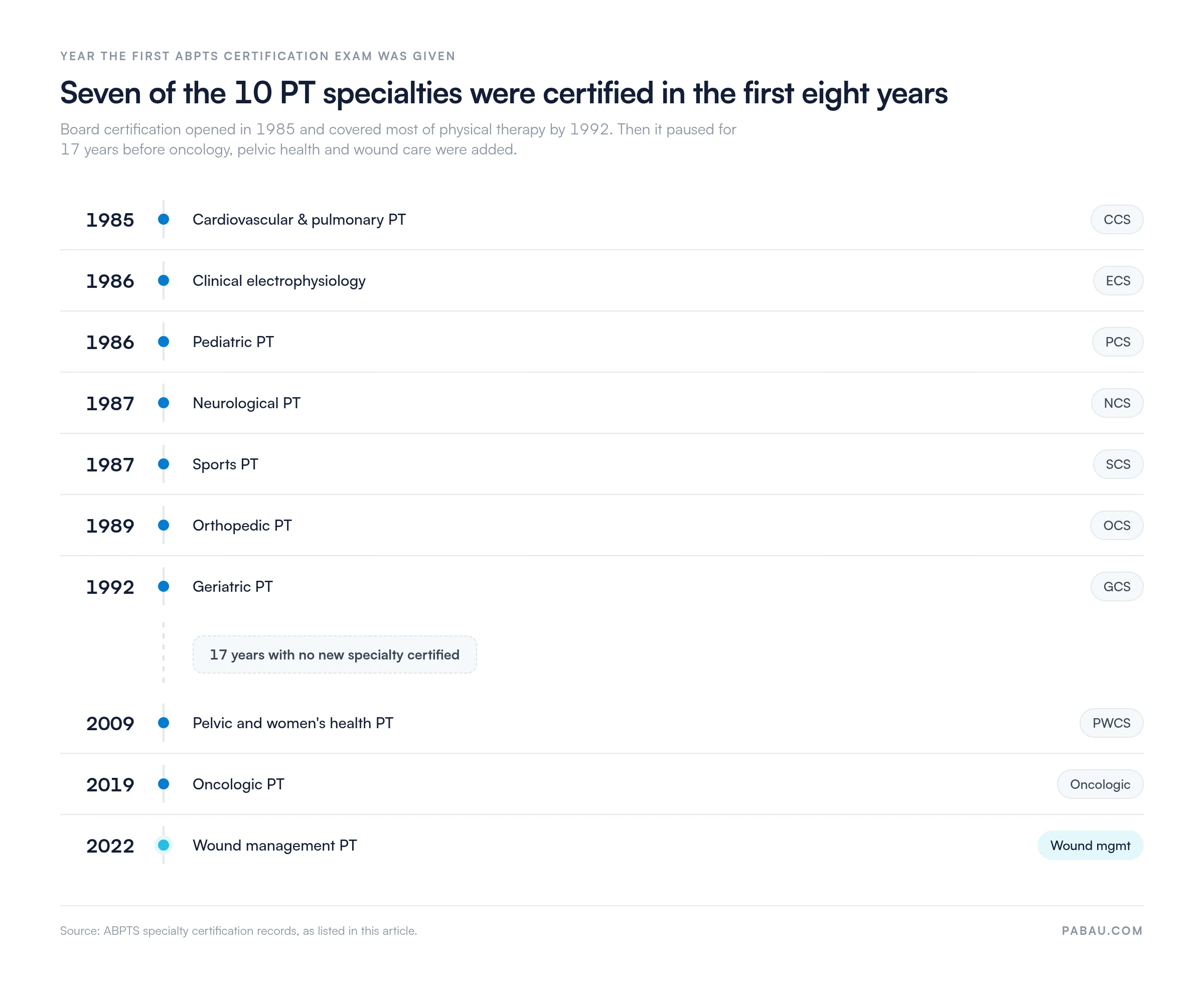
Oncologic PT was approved by the APTA House of Delegates in 2016, with the first exam in 2019. That addition reflects growing recognition that cancer survivors face movement, fatigue, and lymphedema challenges general PT workflows were not built for.
Practices weighing a physical therapy EMR often find that specialty documentation requirements drive the software decision more than scheduling or billing does. Specialty-specific fields either exist in the template library or they do not.
Three specialties account for most outpatient PT volume in the United States: orthopedic, sports, and neurological physical therapy. They draw on overlapping anatomy knowledge, but serve distinct patient populations with different functional goals, documentation needs, and reimbursement patterns.
Orthopedic specialists treat neuromusculoskeletal dysfunction. Caseloads include post-surgical patients recovering from ACL repair, joint replacement, rotator cuff procedures, and spinal surgery. They also manage chronic conditions such as degenerative joint disease, tendinopathy, and hypermobility disorders. Special tests such as the hip scour test and the Hornblower test help confirm hip and rotator cuff pathology before treatment planning starts.
OCS is the most widely held ABPTS certification, partly because orthopedic PT draws the largest referral pipeline from surgeons and primary care. Orthopedic practice also requires structured functional outcome measures such as KOOS, DASH, and LEFS, built into the plan of care. A baseline knee examination establishes the findings those outcome measures track over time.
Documentation must capture baseline functional scores, weekly progress, and response to manual therapy. That includes joint mobilization, dry needling, and therapeutic exercise progressions. Before cervical manual therapy, many orthopedic PTs also run a quick alar ligament test to rule out upper cervical instability.
Sports PTs serve athletes from recreational to elite levels. They manage acute injuries such as sprains, fractures, and concussions, and they guide return-to-sport protocols. The SCS credential requires documented experience with athletic populations, often in sideline or team coverage settings.
Many sports-focused PTs also hold the Certified Strength and Conditioning Specialist (CSCS) credential from the National Strength and Conditioning Association. The two complement each other for performance-focused rehabilitation.
Sports PT practices need scheduling that handles athlete-driven booking patterns. That means early morning pre-training slots, blocks for post-competition assessments, and same-day injury triage. Documentation templates must support functional movement screening, hop test results, and return-to-sport clearance criteria. For a suspected Achilles rupture, a Matles test gives a fast bedside check before imaging is ordered.
Practices offering sports rehabilitation alongside broader orthopedic services benefit from sports medicine software that accommodates both populations in one system.
Neurological PTs work with patients recovering from stroke, traumatic brain injury, Parkinson’s disease, multiple sclerosis, and spinal cord injury. The NCS credential demands fluency in neuroplasticity principles, gait analysis, and compensatory movement strategies. A positive Lhermitte sign test often prompts closer evaluation for cervical cord or multiple sclerosis involvement.
Treatment sessions run longer and more complex than orthopedic appointments. That reflects the cognitive and motor demands placed on both patient and clinician. Tools like the interlocking fingers test help flag apraxia that slows motor relearning after a stroke.
Billing reflects the same complexity. Neurological PT often involves higher-complexity CPT codes and longer treatment durations, which changes revenue cycle math and staffing models. A practice management system that cannot handle variable session lengths and multiple ICD-10 combinations will generate billing errors.
Three ABPTS specialties are defined by patient population rather than anatomical focus. Each calls for a distinct understanding of age-related physiology, life stage context, and culturally sensitive communication.
Pediatric PTs address developmental delays, cerebral palsy, spina bifida, juvenile arthritis, and post-surgical recovery from birth through adolescence. Work settings include neonatal intensive care units, early intervention programs, school-based therapy, and outpatient pediatric practices.
The PCS examination emphasizes developmental milestones, play-based assessment tools, and family-centered care models. Practices treating children also face administrative demands that adult caseloads never raise.
Consent workflows require guardian signatures. Scheduling has to account for school hours and therapy frequency mandates under IEP or IFSP plans, and documentation has to support school district coordination. Physiotherapy compliance requirements for minors add parental consent protocols that belong in the intake workflow from day one.
Geriatric PTs specialize in mobility, balance, fall prevention, and functional independence for older adults. Common conditions include osteoporosis, dementia-related gait disorders, post-hip-fracture recovery, and frailty syndrome. Settings span skilled nursing facilities, home health agencies, assisted living communities, and outpatient geriatric practices. Early mobility checks after hip fracture often include a Homans sign test to flag possible deep vein thrombosis.
Geriatric PT generates significant Medicare billing volume. CMS guidelines for skilled PT services require clear functional limitation documentation tied to medically necessary goals, progress notes at defined intervals, and discharge criteria. Practices with a high geriatric caseload need billing systems with built-in Medicare compliance checks rather than manual claim review.
Pelvic health PTs address pelvic floor dysfunction, urinary incontinence, pregnancy-related musculoskeletal pain, postpartum recovery, and vulvodynia. The credential covers a broad scope, including men’s pelvic health and pediatric incontinence, though most caseloads remain female.
Treatment involves internal assessment techniques. Those require specific informed consent documentation and private treatment spaces that other PT specialties do not need.
Practices adding a pelvic health PT to an existing orthopedic or sports service need to review room allocation, consent form templates, and scheduling logic. Double-booking policies that work for standard orthopedic treatment are inappropriate for pelvic health sessions.
Physiotherapy clinic management software that supports specialty-level scheduling rules, not just global settings, makes that transition far less disruptive.
Review your practice management software’s scheduling rules before adding a pelvic health or pediatric PT to your team. Default double-booking logic, appointment duration settings, and intake form routing are often set at the practice level and will need specialty-level overrides. Audit these settings before the first patient appointment, not after.
Three physical therapy specialties operate in tightly focused clinical niches where general-practice workflows rarely suffice. Demand in these areas has grown as health systems extend rehabilitation coverage beyond acute orthopedic care.
Oncologic PTs address the rehabilitation needs of cancer patients before, during, and after treatment. Chemotherapy fatigue, peripheral neuropathy, post-mastectomy range of motion limits, lymphedema, and bone metastasis precautions all appear in the caseload. Each calls for clinical reasoning that general PT training only partly covers.
The specialty is the second newest on the ABPTS list. Its arrival reflects recognition that cancer survivors carry distinct functional needs across a survivorship period that can run for decades.
Wound management PTs apply electrical stimulation, ultrasound, and debridement to chronic wounds. Typical cases include diabetic ulcers, pressure injuries, and post-surgical wounds. Clinical electrophysiology PTs use electromyography and nerve conduction studies to evaluate and treat neuromuscular dysfunction.
Both specialties require procedural documentation tied to CPT codes that differ sharply from standard therapeutic exercise billing. Practices adding either service need claims handling that covers modifier application and medical necessity documentation beyond a routine PT evaluation note.
Specialty choice is not only a clinical decision. It restructures documentation templates, scheduling logic, staff credentialing, room equipment, billing code sets, and software requirements. Factoring those shifts into the plan early prevents expensive re-tooling after launch.
Specialty focus also shapes the payment model. Sports and pelvic health practices in particular lean toward cash-based physical therapy, where longer one-on-one sessions are easier to sustain outside insurance visit caps.
A practice running several specialties under one roof needs a platform built for clinical complexity, not appointment booking alone. Specialty-specific intake forms and AI-assisted clinical notes cut the administrative load when one team covers orthopedic, sports, and pelvic health caseloads at once.
Most multi-specialty PT practices run on a stack rather than a system. The orthopedic team uses one note template, and the pediatric therapists keep consent forms on paper. Medicare documentation for the geriatric caseload lives in a separate billing tool. Every handoff between them is manual.
Practice management software like Pabau puts those workflows in one record. You build a digital intake form per specialty, so a pediatric guardian consent and a pelvic health consent route to the right patient file automatically.
Scheduling rules sit at the specialty level, so a 60-minute pelvic health session and a 30-minute orthopedic follow-up book against the right room. Pabau Scribe, our AI scribe, drafts the clinical note from the session, and the therapist edits and signs it.
Claims run from the same record, with the CPT and ICD-10 combinations each specialty uses already attached to the encounter. Every subscription includes every feature, so adding a pelvic health or wound care service does not mean buying a new tier.

Pabau supports specialty-specific documentation, automated scheduling, and claims management for orthopedic, sports, neurological, pediatric, and geriatric PT practices. See how it works for your practice.

Board certification tells you what a physical therapist can do. It does not tell you what a practice needs in order to support them, and that is the harder question for an owner.
Pick the specialty mix first, then audit the systems against it. Check whether your note templates carry the outcome measures that specialty uses. Then check whether scheduling can hold two session lengths, and whether billing knows the code set. Fixing that after the first patient is booked costs more than fixing it before.
The trade-off worth remembering is that specialty depth pays in referrals and rates, and it charges in operational overhead. Book a demo to see how Pabau handles documentation, scheduling, and claims across several PT specialties at once.

Planning a new PT practice? Opening a physiotherapy clinic walks through licensing, equipment, staffing, and the compliance work that comes before your first patient.
Need specialty-aware practice management? Pabau’s physical therapy EMR covers specialty documentation, outcome measure tracking, and multi-discipline scheduling in one platform.
Assessing fall risk in balance-impaired patients? Berg Balance Scale template is a free 14-item tool for scoring a patient’s static and dynamic balance.
Writing the numbers down? Physical therapy business plan covers the financial model, staffing assumptions, and service mix a lender expects to see.
Practicing in Arizona? Physical therapy clinic requirements in Arizona details supervision ratios and scope-of-practice documentation for that state board.
ABPTS recognizes 10 board-certified physical therapy specialties. They are orthopedic (OCS), cardiovascular and pulmonary (CCS), neurological (NCS), pediatric (PCS), and sports (SCS). The list also covers geriatric (GCS), clinical electrophysiology (ECS), pelvic and women’s health (PWCS), wound management, and oncologic PT. Each requires a separate examination and documented hours of specialty practice.
PTs must meet the eligibility requirements set by each specialty council. Those cover accumulated hours of general PT practice, direct patient care hours in the specialty, and current CPR certification. Candidates then sit for the specialty examination. Completing a CAPTE-accredited residency in the specialty can reduce the required practice hours for some certifications.
PT salaries are relatively consistent across settings, according to U.S. Bureau of Labor Statistics occupational data. Home health and travel PT positions typically pay more. Sports PT roles at elite athletic organizations and some specialty hospital positions also carry premiums over standard outpatient orthopedic work. The premium is largest where a board-certified specialist credential is required for hire.
Yes. PTs can pursue multiple ABPTS certifications in sequence, provided they meet the eligibility requirements for each specialty. Sports-focused PTs commonly hold both the SCS and the CSCS credential from the National Strength and Conditioning Association. The two address complementary sides of athletic rehabilitation and performance training.
Each specialty generates a different CPT billing profile. Orthopedic PT relies heavily on timed therapeutic exercise and manual therapy codes. Neurological PT uses higher-complexity evaluation codes and longer session durations. Wound management involves procedural codes for debridement and electrical stimulation. Geriatric PT generates substantial Medicare volume, which requires specific functional limitation documentation. A multi-specialty practice needs a billing system that supports code variation by specialty.