CRM for chiropractors: how to manage patients, bookings and marketing
A CRM for chiropractors is a patient relationship management system built around...

Last Updated: Oct 13, 2026

DOs and MDs are fully licensed physicians with identical practice rights in all 50 US states.
Payer credentialing, privileging, and CPT billing treat both degrees the same, so neither needs its own workflow.
Osteopathic doctors complete about 200 extra hours of OMT training beyond the standard medical curriculum.
OMT visits are the one operational difference, running 15 to 30 minutes longer than a standard consultation.
DOs can sit both COMLEX and USMLE, while MDs take the USMLE only.
Residency has run under one ACGME accreditation system since 2020, so verification follows a single path.
The DO vs MD distinction runs through the operational stack of a multi-provider practice. It shapes hiring decisions, payer credentialing, and the questions patients ask at the front desk. According to AACOM, nearly 30% of US medical students are now enrolled in osteopathic colleges. The question lands in more hiring queues every year.
Two questions usually arrive together. What does DO mean for a doctor in daily practice, and what is the difference between DO and MD once both hold a license? A DO is a doctor of osteopathic medicine, licensed to diagnose, prescribe, and operate on exactly the same terms as an MD.
Both pathways produce fully licensed physicians with identical practice rights in all 50 states. The training does diverge, but the divergence is curricular. For scheduling, credentialing, and scope of practice, the operational consequences are smaller than the marketing copy suggests.
The comparison fits in eight lines. The right-hand column is the one that matters if you are hiring, credentialing, or building a schedule around both degrees.
| Dimension | DO | MD | What it changes in your practice |
|---|---|---|---|
| Medical school length | 4 years | 4 years | No change. Same time to a licensable hire. |
| OMM/OMT training hours | About 200 extra hours | None | The only line that changes appointment length. |
| Licensing exam | COMLEX, with USMLE optional | USMLE | DO files may carry two sets of score reports. |
| Residency accreditation | ACGME since 2020 | ACGME | One verification path for both degrees. |
| State practice rights | Unrestricted in all 50 states | Unrestricted in all 50 states | No scope carve-outs to schedule around. |
| Payer credentialing and claims | Same panels, same CPT codes | Same panels, same CPT codes | No separate enrollment or billing workflow. |
| Entering primary care | About 56% of graduates | About 40% of graduates | Shapes your candidate pool, not your workflow. |
| Typical OMT visit length | 15 to 30 minutes longer | Standard length | Needs its own scheduling template. |
The difference between DO and MD degree programs comes down to about 200 hours of osteopathic manipulative medicine (OMM). The rest of the curriculum runs parallel, with four years covering anatomy, physiology, pharmacology, pathology, and clinical rotations.
Those OMM hours are hands-on. Students learn to assess and treat musculoskeletal dysfunction through manual techniques, which is training an allopathic curriculum does not include at all.
The philosophy stems from Andrew Taylor Still’s 1874 founding principle. He held that the body functions as an integrated unit and possesses self-healing mechanisms when properly aligned. Allopathic medical schools focus instead on traditional diagnosis and pharmaceutical or surgical intervention.
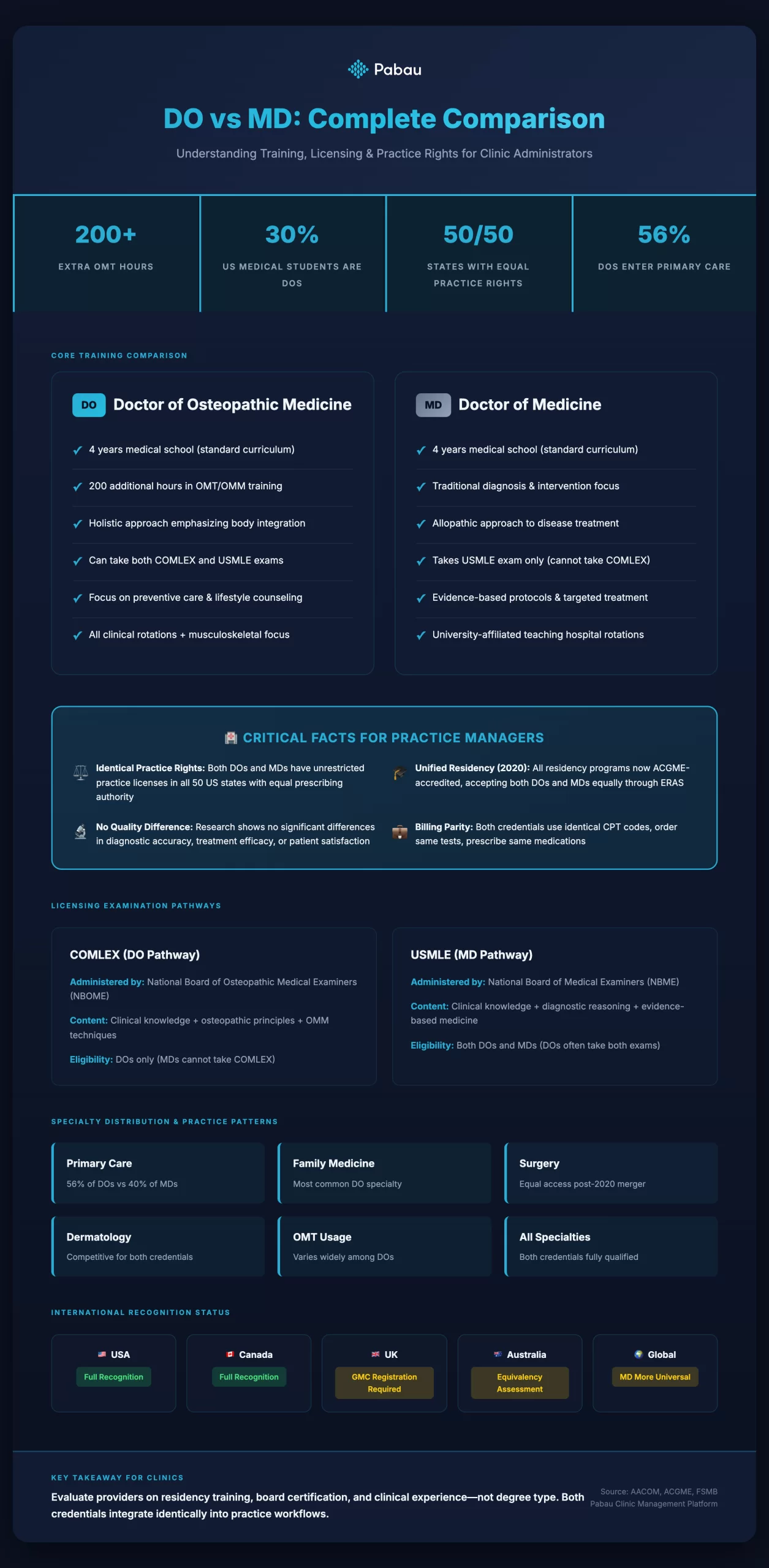
The infographic below collects the differences that surface inside a practice, from training hours through to international recognition.
Clinical rotations are where the osteopathic and allopathic paths stop diverging. Both cohorts complete clerkships in internal medicine, surgery, pediatrics, psychiatry, obstetrics, and family medicine.
Osteopathic students may rotate at osteopathic medical centers or community hospitals. Allopathic students typically rotate through university-affiliated teaching hospitals. Neither pattern reliably changes clinical competence or residency competitiveness.
The integrated approach in osteopathic training emphasizes preventive care and whole-person assessment. Many DOs add lifestyle counseling, nutrition guidance, and biomechanical evaluation to conventional treatment. Plenty of allopathic physicians practice the same way, so the distinction is curricular emphasis rather than an absolute difference.
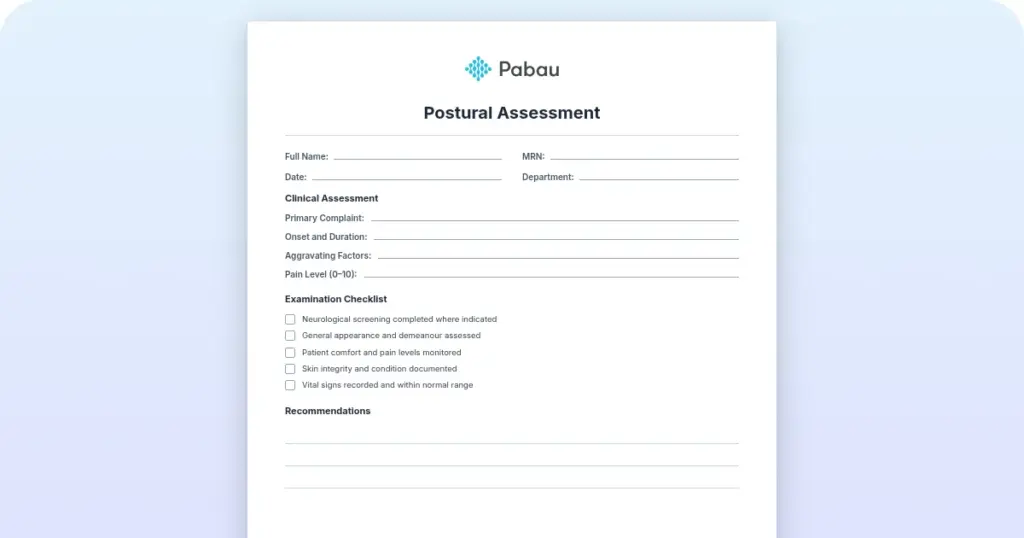
That whole-person exam can include balance and neck screening too. A modified Romberg test checks postural balance, and a smooth pursuit neck torsion test screens for dizziness that follows a neck injury.
Medical licensing in the United States requires passing a comprehensive board examination. MDs take the United States Medical Licensing Examination (USMLE), administered by the National Board of Medical Examiners (NBME). DOs take the Comprehensive Osteopathic Medical Licensing Examination (COMLEX), administered by the National Board of Osteopathic Medical Examiners (NBOME).
Both exams assess clinical knowledge, diagnostic reasoning, and patient management across all medical disciplines. One asymmetry matters for hiring. DOs may take both COMLEX and USMLE, while MDs cannot sit for COMLEX.
Many osteopathic students take both to broaden residency options, particularly for competitive specialties historically dominated by allopathic graduates. COMLEX also includes questions on osteopathic principles and OMM techniques, which the USMLE does not test.
Otherwise the content overlap is substantial. Both exams cover pharmacology, pathophysiology, clinical reasoning, and evidence-based medicine. Pass rates are not directly comparable, because the two exams use different scaling methodologies.
State medical boards grant unrestricted practice licenses to both DOs and MDs who pass their respective exams. The Federation of State Medical Boards (FSMB) confirms that DOs hold identical practice rights in all 50 states. No state restricts osteopathic physicians to musculoskeletal care or limits their prescribing authority.
That equivalence carries into your systems. For compliance management software used by multi-location practices, both credentials are treated identically in credentialing and privileging workflows.
Track provider licensing renewal dates in your practice management system to avoid lapses. Set automated reminders 90 days before expiration for both MDs and DOs, so state board requirements are met without disrupting clinical schedules.
Until 2020, osteopathic and allopathic residency programs ran under separate accreditation systems. The American Osteopathic Association (AOA) accredited DO-specific programs, while the Accreditation Council for Graduate Medical Education (ACGME) oversaw MD programs.
In 2020, residency training unified under a single ACGME-accredited system. All residency programs now accept both DOs and MDs through the same application process, the Electronic Residency Application Service (ERAS).
The merger removed the perception that DOs faced limited residency options. Both credentials now compete equally for positions in surgery, radiology, dermatology, orthopedics, and every other specialty.
Match rates remain slightly lower for osteopathic graduates in certain competitive fields. That reflects applicant pool strength rather than systemic exclusion. Program directors increasingly weigh USMLE scores, research output, and clinical performance over degree type.
Osteopathic graduates have historically gravitated toward primary care. AACOM data shows approximately 56% of DOs enter primary care compared to 40% of MDs. That distribution reflects the osteopathic mission to address physician shortages in underserved areas, not a restriction on specialty access.
Osteopathic physicians now practice in every medical specialty, including competitive fields like neurosurgery and cardiothoracic surgery.
For practices hiring providers, residency training matters more than medical school type. A DO who completed an ACGME-accredited dermatology residency at a major academic center has the same clinical preparation as an MD from that program. Evaluate candidates on residency pedigree, board certification, and procedural volume.
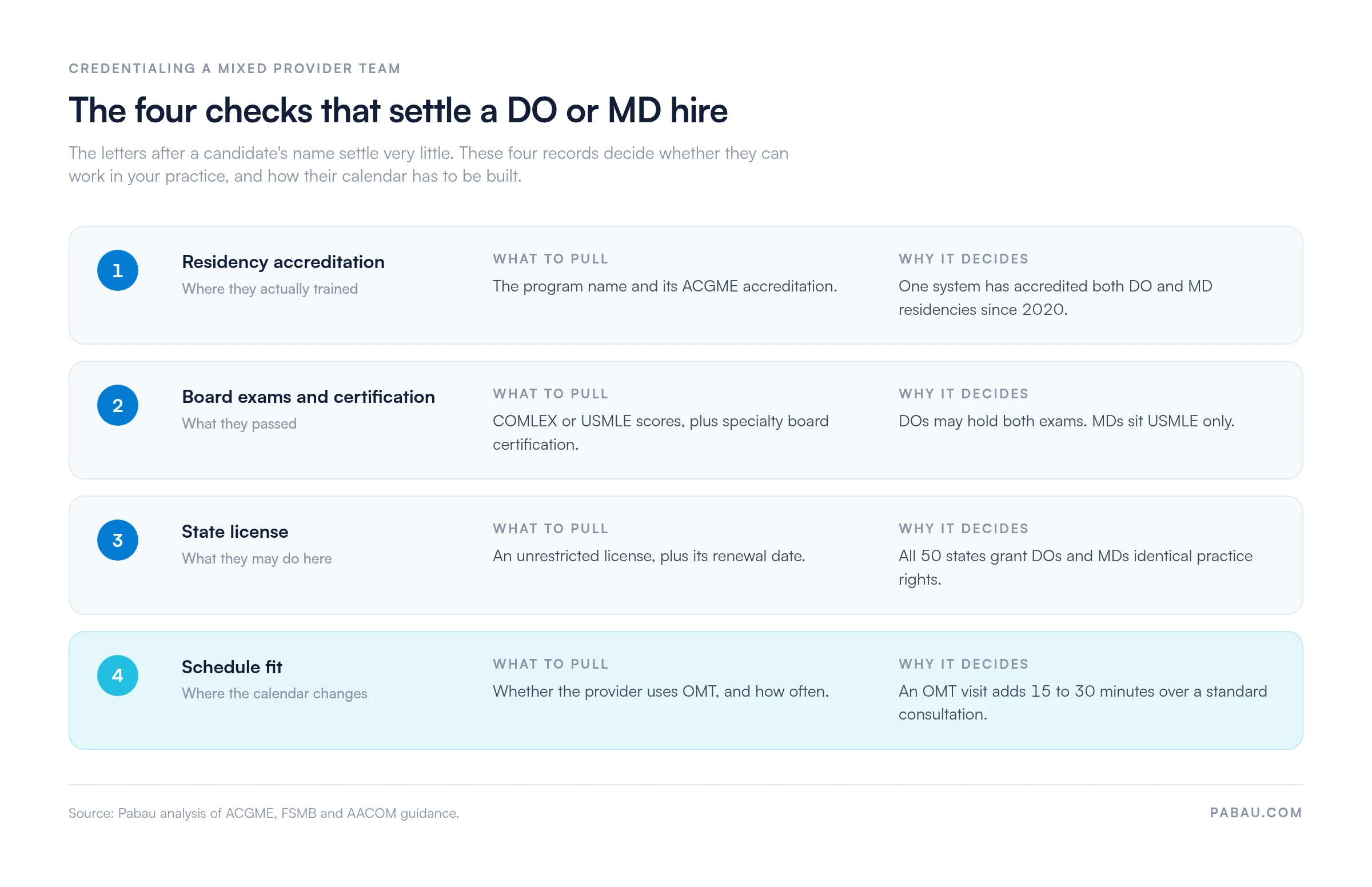
In practice, that turns into four records to pull before the offer goes out.
Osteopathic manipulative treatment (OMT) is what separates DO training from MD education. OMT covers hands-on techniques to diagnose and treat musculoskeletal dysfunction, improve circulation, and support the body’s self-regulating mechanisms.
Techniques include high-velocity low-amplitude manipulation, similar to chiropractic adjustments, plus muscle energy techniques, myofascial release, and cranial osteopathy.
Those techniques address specific findings from a standard orthopedic exam. A trapezius tear test isolates a shoulder tear, and a Thessaly test screens for a meniscus injury, before OMT addresses the surrounding tissue.
Not all DOs use OMT. Many osteopathic physicians work entirely from conventional diagnosis and treatment, particularly in hospital-based or surgical specialties. Family medicine and primary care DOs use it most often, usually for back pain, neck stiffness, headaches, or sports injuries.
A DO or an MD might confirm an Achilles rupture with a Thompson test. A tight hip flexors test then flags the tightness OMT is meant to correct.
Frequency varies widely. Some DOs apply the techniques daily, and others never use them again after training. So ask a DO candidate how often they expect to bill an OMT code before you build their template.
Ankle injuries follow a similar pattern. A fovea sign test checks for syndesmotic instability, and the Danis-Weber classification grades any accompanying fracture, before manual treatment starts.
Evidence for OMT efficacy remains mixed. Some studies show benefit for lower back pain and tension headaches, while research on other conditions is modest or inconclusive. The American Osteopathic Association supports OMT as a complement to conventional care, not a replacement.
Patients seeking manual therapy may ask for a DO for that reason. Many MDs also refer patients to physical therapists, chiropractors, or osteopathic specialists for hands-on treatment.
From an operational standpoint, OMT adds time to appointments. A typical OMT session takes 15 to 30 minutes beyond a standard consultation. Practices that run OMT alongside physical therapy or chiropractic visits book those longer slots from one calendar. A physical therapy EMR is built to hold both.
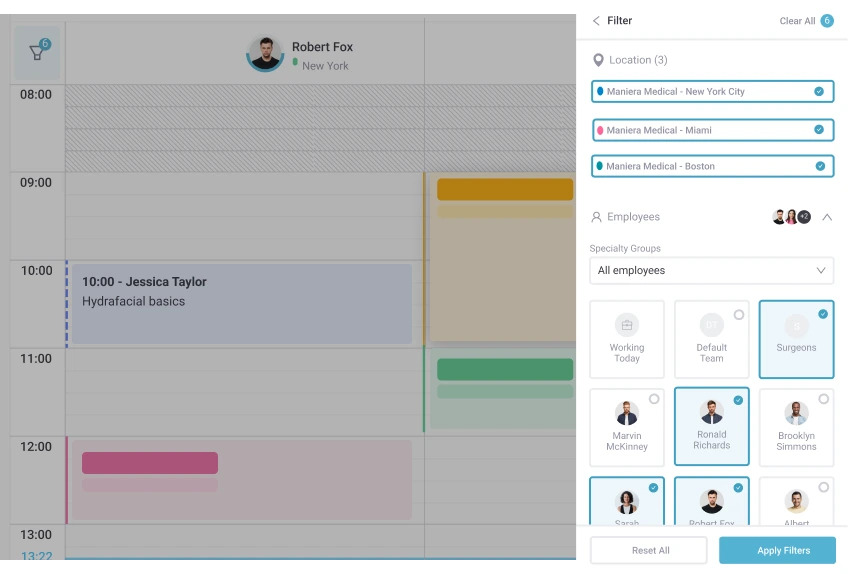
Practices employing DOs who use OMT regularly should adjust their scheduling templates. Practice management software like Pabau lets you set a longer default block for those providers. Booking those visits through medical scheduling software then stops depending on whoever picks up the phone.
The osteopathic philosophy centers on treating the patient as a whole rather than addressing isolated symptoms. It weighs lifestyle factors, emotional health, environmental influences, and biomechanical dysfunction alongside disease pathology.
Osteopathic medical schools teach students to view the body as an interconnected system, where dysfunction in one area affects overall health. That whole-person lens shows up in how a DO frames a treatment plan, not in what they are licensed to do.
Inside conventional medicine, allopathic training points a clinician toward disease-specific diagnosis and targeted intervention. That means pharmaceutical treatment, surgical correction, or radiation therapy.
The term “allopathic” refers to treating disease by producing a condition incompatible with the disease state. The approach prioritizes evidence-based protocols, diagnostic precision, and measurable clinical outcomes.
The allopathic vs osteopathic split reads sharper on a school brochure than it does in an exam room. Many MDs now practice integrative medicine, combining conventional treatment with nutrition counseling, stress management, and lifestyle modification. Many DOs rely on pharmaceuticals and surgery without manual techniques.
Patient experience differences between a DO and an MD usually come down to individual practice style rather than degree type.
For practice operators, the philosophical difference rarely changes workflow or operational structure. DOs and MDs order the same diagnostic tests, prescribe the same medications, perform the same procedures, and bill using the same CPT codes.
The distinction matters mostly for marketing positioning and patient communication. A practice emphasizing preventive care, wellness, or integrative approaches may highlight DO credentials to signal that philosophy. That is a branding choice, not a clinical necessity.
International recognition of osteopathic degrees varies significantly by country. The MD degree holds near-universal recognition across healthcare systems. The DO degree, fully equivalent inside the United States, meets more complex acceptance abroad.
Some countries require DOs to complete additional examinations or certifications before granting practice rights. Others do not recognize the osteopathic credential at all.
Within the United States and Canada, DOs meet no barriers. All 50 US states grant identical licensure to DOs and MDs, and Canadian provinces license osteopathic physicians through standard medical board pathways.
The United Kingdom recognizes DO degrees but requires additional General Medical Council registration (GMC) steps that can extend the credentialing timeline.
Australia, New Zealand, and several European nations require equivalency assessments or supervised practice periods before granting full registration. Middle Eastern countries vary. Some accept DO credentials with minimal additional requirements, and others ask for extensive documentation and clinical examinations.
For US-trained physicians considering international positions, the MD pathway is often the simpler credentialing route.
These recognition differences do not reflect quality concerns. International medical regulators are simply less familiar with osteopathic training standards, and recognition is improving as osteopathic education expands. DOs planning international careers should research destination country requirements early and keep both COMLEX and USMLE scores on file.
Either degree works. Both produce competent, licensed physicians who deliver evidence-based care across all medical specialties. Research comparing clinical performance between DOs and MDs shows no significant differences in diagnostic accuracy, treatment efficacy, or patient satisfaction.
Patients who ask which degree is better want a ranking, and the evidence does not supply one. A narrower question serves them better. Does this physician offer the treatment I came in for?
Patients who want manual therapy, or a provider trained in musculoskeletal assessment, may prefer a DO who actively uses OMT. Many DOs do not, so it is worth confirming at the first consultation.
Patients with complex conditions requiring subspecialty care should weigh board certification, clinical experience, and hospital affiliations ahead of degree designation.
For routine primary care, preventive medicine, and chronic disease management, the distinction rarely changes care quality. Communication style, appointment availability, insurance acceptance, and office location matter more. Practices should tell patients plainly that both credentials represent full medical licensure and equivalent training depth.
Pick the school you can get into and afford, because the degree no longer decides where you can train. Since the 2020 ACGME merger, both cohorts apply to the same residencies through ERAS.
Two practical asymmetries survive. A DO can sit the USMLE as well as COMLEX, which is worth doing for competitive specialties. An MD travels more easily through international licensing bodies.
From the employer’s side, none of this shows up on a resume review. Practices hire on residency accreditation, board certification, and procedural volume, so choose the pathway that gets you to a strong residency.
Patient preference should not drive hiring unless the practice specifically markets osteopathic principles. Evaluate providers on clinical competence, patient satisfaction scores, procedural skills, and cultural fit.
One question is worth asking a DO candidate and not an MD. How often do they intend to use OMT? That answer sets their appointment length, and appointment length sets your daily capacity.
If most of your providers work that way, weigh osteopathy practice management software against a general system. The difference shows up in scheduling defaults and in how manual therapy gets documented.
Team management software should track provider credentials, board certifications, and license renewal dates identically for both degree types.

Most multi-provider practices keep this in two places. Board certifications and license renewal dates live in a spreadsheet or an HR folder, and appointment lengths live in the calendar. Neither file warns the practice manager when a license is about to lapse.
Pabau holds both in the same system. Each provider record carries their credentials and renewal dates, so a report tells you who is due before a payer or an inspector does. Automated reminders go out ahead of every expiry date.
Scheduling works the same way. You set a longer default appointment length for the DOs who run OMT sessions. The rest of the team keeps the standard length, on the same calendar. Front desk staff then book from provider availability rather than from memory.
Billing needs no fork at all. Both degrees enroll on the same payer panels and bill the same CPT codes. One set of claim templates and fee schedules covers the whole team.
The outcome is one credentialing record per provider and one calendar that already knows how long each of them needs. Adding a DO to the team becomes a recruiting decision rather than a scheduling project.

Pabau keeps every provider’s license and board certification in their record with automatic renewal reminders, and lets you give OMT visits their own appointment length. Your credentialing file and your calendar stop disagreeing.

The letters after a candidate’s name are rarely the deciding factor. Residency accreditation, board certification, and an unrestricted state license tell you what a provider can do. The degree only tells you how they were taught.
So the work sits in the records. Build the credential tracking and the OMT-aware scheduling templates once, and the DO-to-MD ratio on your team stops being an operational question.
Patients will still ask why the letters differ, and payers will still want clean credential records. Both are easier to answer from one system than from three.
Book a demo to see how multi-provider practices handle credentialing, scheduling, and compliance in one workspace.

Choosing software for an osteopathic practice? Osteopathy practice management software compares the systems that handle longer manual-therapy visits.
Documenting manual therapy across a rehab team? Physical therapy EMR software reviews the platforms built for shared notes and treatment plans.
Adding a chiropractor to the roster? Chiropractic liability insurance explains the coverage a manual-therapy provider needs before their first patient.
Billing OMT visits outside insurance? Cash-based physical therapy walks through pricing, payment and documentation without a payer contract.
No. Both degrees require four years of medical school covering the same core subjects. Anatomy, physiology, pharmacology, pathology, and clinical rotations sit in both curricula. Osteopathic programs add about 200 hours of OMM training on top, so the DO pathway runs slightly longer in total instructional hours. Acceptance rates, academic rigor, and clinical training depth are comparable between osteopathic and allopathic medical schools.
No. Both credentials represent full medical licensure with identical practice rights in all 50 US states. DOs and MDs prescribe medication, perform surgery, lead patient care teams, and qualify for all medical specialties. The degrees reflect different training philosophies, osteopathic and allopathic, but they carry equal legal authority and clinical responsibility.
Technically yes, though extremely rare and impractical. A physician would need to complete two separate four-year medical school programs and pass both USMLE and COMLEX board examinations. No clinical or professional advantage exists for holding both degrees since they grant identical practice rights. Most physicians choose one pathway and focus on postgraduate specialty training instead.
A patient presents with chronic lower back pain. An osteopathic physician might assess posture, pelvic alignment, and spinal mobility through physical examination. They would then apply osteopathic manipulative treatment (OMT), such as muscle energy techniques or myofascial release, to address the biomechanical dysfunction. The DO would also prescribe pain medication or physical therapy as needed, integrating manual treatment with conventional care rather than replacing it.
Yes. DOs take COMLEX administered by the National Board of Osteopathic Medical Examiners, while MDs take USMLE administered by the National Board of Medical Examiners. DOs may optionally take both exams, while MDs cannot sit for COMLEX. Both exams cover clinical knowledge, diagnostic reasoning, and patient management, with COMLEX including additional questions on osteopathic principles and OMM techniques.
Yes. Both DOs and MDs are fully licensed physicians with unrestricted practice rights in all US states. The Federation of State Medical Boards confirms that both hold identical legal authority. That covers diagnosing, prescribing, performing surgery, and practicing in any medical specialty without limitation.