GLP-1 diet plan
A GLP-1 diet plan is a structured eating framework for patients taking semagluti...

1
Last Updated: Oct 13, 2026

Amniotic injections use processed tissue from donated placental membranes, collected after elective caesarean deliveries.
The FDA regulates them as minimally manipulated 361 HCT/P tissue products, so they carry no premarket approval.
Practices use them mainly for osteoarthritis and tendinopathy after conservative care and steroid injections stop working.
Evidence is thin. One 2025 randomized trial held its gains at 12 months, and larger trials are still pending.
Expect $800 to $2,500 per injection, all patient-pay, since Medicare and most plans call the treatment investigational.
Roughly 33.2 million US adults live with osteoarthritis. Many of them reach a point where physical therapy, NSAIDs, and corticosteroid injections stop delivering lasting relief. Amniotic tissue injections are one of the regenerative options patients now ask about by name, often before clinicians have a clear position on them.
Practices weighing whether to offer the therapy face a harder set of questions than the marketing copy admits. The evidence base, FDA classification, contraindication list, and consent obligations are all unsettled enough to deserve a careful look before the first injection.
This guide is written for the practice rather than the patient. It covers the regulatory category you are working in and the screening that predicts who responds. It also covers the nine elements a defensible consent needs, and the cost when no payer helps.
Amniotic injections contain processed tissue from the amniotic membrane and fluid surrounding a fetus during pregnancy. Donors provide placental tissue after elective caesarean deliveries. Tissue banks screen donors, process the material, and distribute it to healthcare facilities as a sterile injectable product.
The FDA classifies these products as Human Cells, Tissues, and Cellular and Tissue-Based Products (HCT/P) under Section 361 regulations. This classification applies when tissue undergoes minimal manipulation and remains structurally similar to its original form. Products meeting 361 HCT/P criteria do not require pre-market approval as drugs or biologics.
Processed amniotic tissue contains growth factors, cytokines, hyaluronic acid, and extracellular matrix proteins. Marketing materials often reference stem cell content. But FDA guidance and peer-reviewed literature both debate whether viable stem cells survive processing and cryopreservation. Avoid claiming regenerative properties beyond what published evidence supports.
Tissue sourcing follows strict protocols. The American Association of Tissue Banks (AATB) and FDA’s Current Good Tissue Practice (CGTP) regulations govern donor screening, testing, processing, and storage. Accredited tissue banks test for infectious diseases and maintain traceability records for every donation.
The proposed mechanism centers on bioactive molecules within amniotic tissue. Growth factors such as platelet-derived growth factor (PDGF), transforming growth factor-beta (TGF-β), and fibroblast growth factor (FGF) may support tissue repair pathways. Cytokines present in the tissue can modulate inflammatory responses at injection sites.
Hyaluronic acid provides viscosupplementation effects similar to traditional joint injections. The extracellular matrix components may create a scaffold that supports cellular migration and tissue remodeling. The clinical weight of these properties still varies across product formulations and patient populations.
Practices offering regenerative medicine services document treatment protocols using structured intake forms and progress tracking. Standardized documentation helps you monitor outcomes and identify which patient profiles respond to therapy.
Research into amniotic injection efficacy remains ongoing, and small-scale studies show mixed results. A 2025 double-blind randomized trial by Pill et al., published in JAAOS Global Research and Reviews, compared a morcellized amniotic tissue allograft against triamcinolone. The 81 patients all had severe knee osteoarthritis, and both groups improved at six weeks. Only the amniotic group kept improving out to 12 months on the Single Alpha Numeric Evaluation, Lysholm, and KOOS subscales. Larger randomized controlled trials are still needed before broader efficacy claims can be made. Longevity clinic software keeps results, protocols and review appointments against one patient record. Longevity clinic software keeps results, protocols and review appointments against one patient record.
Injection technique mirrors standard intra-articular or soft tissue injection protocols. Clinicians use ultrasound guidance for accurate placement in joints, tendons, or soft tissue sites. The typical injection volume ranges from 0.5 mL to 2 mL depending on the anatomical site and product formulation.
Post-injection protocols vary by practice. Some clinicians recommend activity modification for 24-48 hours. Others allow immediate return to normal activities. Physical therapy often complements injection therapy, particularly for tendon and ligament conditions.
Orthopedic practices primarily use amniotic tissue injections for degenerative joint conditions and soft tissue injuries. Osteoarthritis represents the most common indication, particularly in knees, hips, and shoulders. Clinicians also treat plantar fasciitis, Achilles tendinosis, rotator cuff tendinopathy, and lateral epicondylitis.
Sports medicine clinics integrate amniotic injections into treatment plans for athletes managing chronic overuse injuries. Documentation systems track pre-treatment imaging, functional assessments, and validated outcome measures to quantify treatment response.
The literature consists mainly of case series, retrospective reviews, and small prospective studies. High-quality randomized controlled trials comparing amniotic injections to established treatments remain scarce. Systematic reviews note wide variation in study design, outcome measures, and product formulations.
Published studies often originate from practices with financial relationships to tissue product manufacturers. That conflict of interest introduces potential bias. Peer-reviewed journals increasingly require disclosure of industry sponsorship and relationships, so check the declaration before you weigh a result.
Outcomes track closely with how rigorously patients are screened before treatment. A short intake confirming diagnosis severity, prior conservative care, and medical comorbidities is the strongest predictor of who responds.
Practices typically reserve amniotic injections for patients with mild to moderate joint degeneration on recent imaging, taken within 12 months. Bone-on-bone advanced disease shows limited response and is usually referred for surgical evaluation instead.
Most protocols also require documented failure of at least one conservative pathway. That means 6-12 weeks of physical therapy, a trial of NSAIDs or acetaminophen, and at least one prior intra-articular injection. Skipping this step is the most common cause of insurance denials and unmet patient expectations.
Unexplained weight loss, night pain, recent fever, and rapidly progressive joint destruction all warrant workup before any regenerative injection. These features often point to infection, inflammatory arthritis, or occult malignancy rather than osteoarthritis.
Patients whose expectations run ahead of the evidence also deserve extra screening time. Review the imaging together, name the functional gain they can reasonably expect, and confirm they understand this is not a cure. That conversation clarifies the decision before consent.
Amniotic tissue injections generally show a favorable safety profile in published case series. Serious adverse events remain rare when products meet AATB accreditation standards and FDA CGTP requirements. Most reported complications mirror those seen with any injection procedure.
Common side effects include temporary injection site pain, swelling, and stiffness lasting 24-72 hours. These reactions typically resolve without intervention. Patients manage the symptoms with ice application and over-the-counter analgesics.
Infection risk exists with any invasive procedure. Sterile technique, proper skin preparation, and adherence to aseptic protocols minimize it. Practices maintain infection surveillance protocols and report adverse events according to regulatory requirements.
Allergic reactions to amniotic tissue products appear uncommon in published reports. Tissue banks screen for common allergens and process material to reduce immunogenic potential. Patients with known tissue allergies require additional counseling before proceeding.
Physical therapy practices incorporating regenerative therapies document adverse events systematically. Digital forms capture symptom onset, severity, and resolution timeframes to support safety monitoring and quality improvement.
Follow-up studies beyond 12 months remain limited. The durability of treatment effects has not been established through rigorous longitudinal research. Some patients report sustained improvement, while others experience symptom recurrence requiring repeat injections.

Comparative effectiveness against corticosteroid injections, hyaluronic acid, or platelet-rich plasma (PRP) needs more research. Head-to-head trials would clarify which regenerative approach suits which condition and patient population.
Practitioners weighing amniotic tissue against PRP, hyaluronic acid (HA), or a corticosteroid injection ask three questions. How does each mechanism work, what does the evidence show, and how do the regulatory and cost pictures compare?
PRP is autologous and concentrates the patient’s own platelets, releasing growth factors at the injection site. Amniotic products are allogeneic, supplying donor-derived growth factors, cytokines, hyaluronic acid, and extracellular matrix in a single dose.
Hyaluronic acid viscosupplementation lubricates the joint without delivering signaling molecules. Corticosteroids suppress inflammation chemically and offer the fastest short-term symptom relief, with no tissue-repair effect.
Some practices also weigh a BMAC injection alongside these options, since it uses the patient’s own marrow-derived cells rather than donor amniotic tissue.
| Therapy | FDA classification | Approval pathway |
|---|---|---|
| Amniotic tissue injection | 361 HCT/P (when minimally manipulated) | No premarket approval required |
| PRP (autologous) | Not an HCT/P. Centrifuge devices are 510(k) cleared | Device clearance only. The product itself is unregulated |
| Hyaluronic acid (Synvisc, Euflexxa, etc.) | Medical device, Class III | PMA-approved as a Class III medical device |
| Corticosteroid (triamcinolone, methylprednisolone) | Approved drug | NDA-approved, generic available |
Corticosteroid and HA injections have the largest randomized-trial datasets, backed by decades of comparative effectiveness research. PRP has a growing trial base, with the strongest evidence in knee osteoarthritis and lateral epicondylitis.
Amniotic injection evidence is the smallest and youngest of the four. The Pill et al. trial is the highest-quality head-to-head against corticosteroid so far, and broader meta-analyses are still in progress.
The four options separate more cleanly on coverage than on price. Three of the four ranges overlap. So the number a patient hears at the front desk says little about which therapy they are being offered.
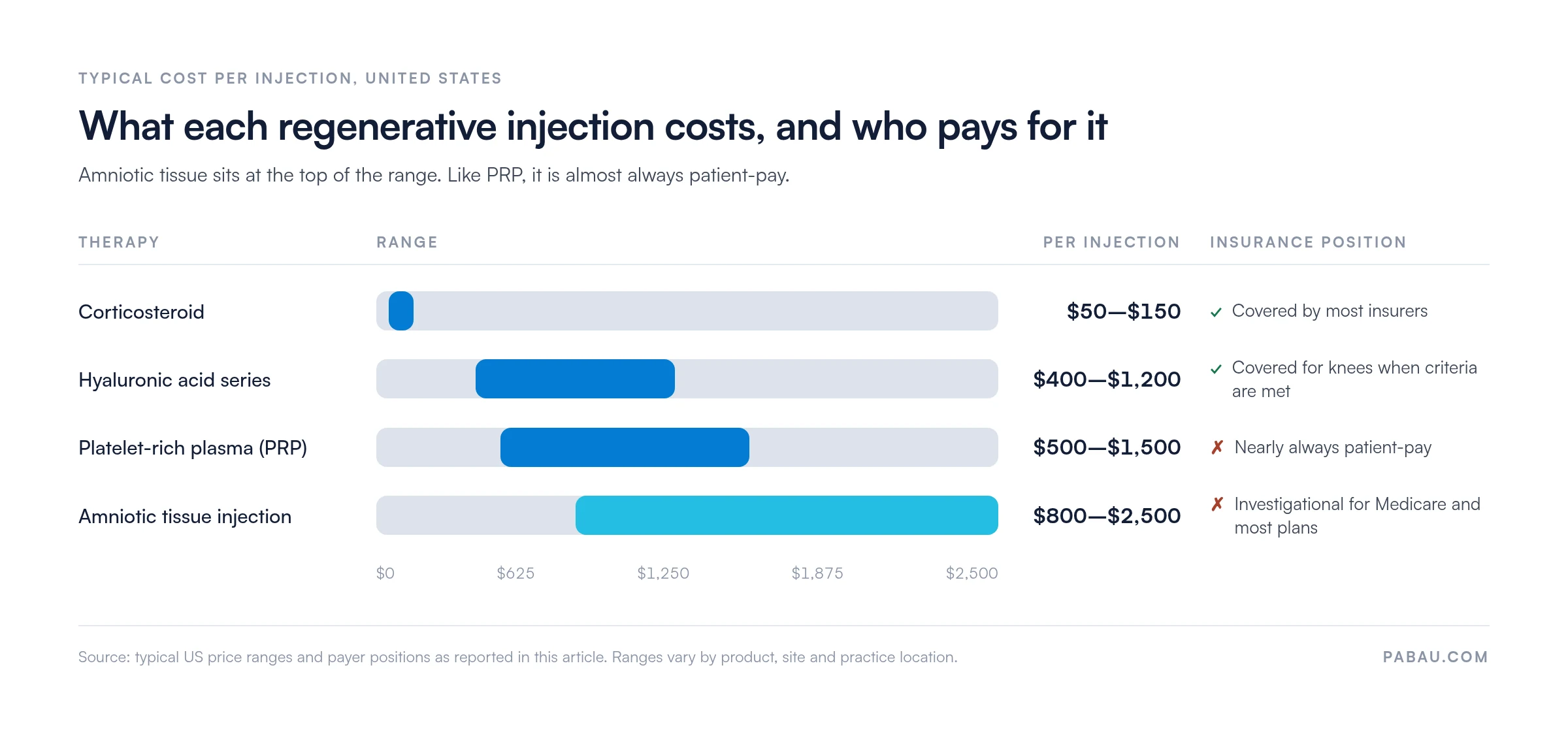
The overlap matters when you quote a patient. A $900 injection could be an HA course, a PRP shot, or an amniotic injection. Only the HA course has a realistic path to reimbursement. Coverage, not price, is what the consent conversation has to cover. A quotation management system creates a transparent quote for that price and shares it securely with the patient.
Amniotic injection therapy is a significant out-of-pocket expense for most patients. Costs typically run from $800 to $2,500 per injection depending on product selection, anatomical site, and practice location. Multi-injection protocols raise the total further.
Coverage is restricted almost everywhere. US Medicare does not cover amniotic injection therapy for musculoskeletal conditions, and Blue Cross Blue Shield networks issue similar determinations. Major UK private insurers, including Bupa, AXA, Aviva, and Vitality, class the treatment as investigational or not medically necessary.
The absence of Category I CPT codes specific to amniotic products creates billing complexity. Practices typically bill using unlisted procedure codes with detailed documentation justifying medical necessity.
Prior authorization requirements, where coverage exists at all, demand extensive clinical documentation. Practices submit imaging results, failed conservative treatment records, and peer-reviewed literature supporting the indication. Denial rates stay high even with comprehensive submissions.
Because the patient carries the whole cost, pricing transparency is worth more here than in almost any other treatment you offer. Digital quoting tools give an itemized breakdown covering product, injection procedure, imaging guidance, and follow-up visits. Clear financial communication reduces disputes and improves patient satisfaction.
Practices pursuing insurance reimbursement keep meticulous clinical documentation. Medical necessity justification covers treatment history, diagnostic imaging reports, functional limitation assessments, and failed conservative therapy records spanning at least 3-6 months.
Appeals on denied claims require peer-reviewed evidence supporting the specific indication. Practices compile literature searches, clinical guidelines, and policy exception requests. Success rates vary widely across payers and geographic regions.
Informed consent is the document practices most often rewrite after their first medico-legal review. A generic procedure consent is not enough. The form has to address the regulatory category, the limits of the evidence, and the financial exposure the patient is accepting.

Capture consent on a dated, patient-signed form retained in the medical record. A separate financial consent acknowledging the out-of-pocket total, signed before the appointment rather than at the door, prevents disputed charges.
State medical boards in Texas, Florida, and California have specific advertising and consent rules for regenerative therapies. Check your state’s stem cell and regenerative medicine guidance before you finalize your consent template.
Most practices run this workflow across three disconnected places. The screening evidence sits in an imaging report and the signed consent goes into a filing cabinet. Outcome scores land in a spreadsheet nobody opens until a payer asks.
Practice management software like Pabau keeps all three in one client record. Digital forms carry your contraindication checklist and the nine consent elements above, so the patient signs before the appointment rather than at the door. Measurement tracking stores KOOS and Lysholm scores against the same record, dated and ready to pull.
That gives you the audit trail an appeal needs, and a straight answer to the question every regenerative program eventually faces. You can see which patient profiles improved at 12 months, so you know which ones to keep offering the injection to.

Pabau’s digital forms and compliance tools handle amniotic injection consent, automate follow-up reminders, and archive patient education records. Nothing goes missing between the screening visit and the 12-month review.

Amniotic injection therapy carries more administrative weight than a steroid injection, with no payer to share it. The practices getting predictable outcomes screen rigorously and document consent as though an auditor will read it. They also track results long enough to see which patient profiles respond.
Admin is where most practices leak time and revenue on regenerative cases. Intake screening, contraindication checks, a dated consent, outcome scoring, and an itemized financial agreement all have to happen for every injection. Building that into the EMR rather than around it pays back on the first patient.
Book a demo to see how regenerative medicine intake, consent, and outcome tracking run inside one connected system.

Looking to grow your functional medicine practice? Attract more functional medicine patients covers acquisition strategies for patients who spend months researching before booking a first visit.
Managing multi-location regenerative medicine protocols? Multi-Location Management ensures consistent treatment documentation and outcome tracking across clinic sites.
Want to track injection therapy outcomes systematically? Measurements Tracking captures validated outcome measures and pain scores for longitudinal analysis.
Amniotic tissue injections show a generally favorable safety profile in published case series, when products meet AATB accreditation and FDA CGTP standards. Common side effects include temporary injection site pain and swelling lasting 24-72 hours. Serious adverse events remain rare. Infection risk exists with any injection procedure, but sterile technique minimizes it.
Corticosteroid injections reduce inflammation directly but provide only temporary symptom relief. Hyaluronic acid offers viscosupplementation for joint lubrication. Amniotic tissue injections contain growth factors and cytokines that may support tissue repair, though comparative effectiveness data remains limited. Treatment selection depends on condition severity, patient factors, and prior treatment response.
Duration of effect varies across patients and conditions. Some published studies report improvement lasting 6-12 months, while others show shorter-term benefits. Long-term outcome data beyond 12 months remains limited. Some patients need repeat injections when symptoms recur. Controlled trials comparing durability to established treatments are still needed.
Response timelines vary. Some patients report symptom improvement within 2-4 weeks, while others improve gradually over 8-12 weeks. Initial post-injection discomfort lasting 24-72 hours is common. Clinicians typically schedule follow-up assessments at 4-6 weeks and 3 months, to evaluate response and decide whether more treatment is needed.
Coverage is highly restricted, so patients typically pay out-of-pocket. US Medicare and most commercial payers, including Blue Cross Blue Shield networks, class amniotic injections as investigational. Major UK private insurers such as Bupa, AXA, Aviva, and Vitality reach the same conclusion. Expect $800 to $2,500 per injection depending on product and practice location.