CRM for chiropractors: how to manage patients, bookings and marketing
A CRM for chiropractors is a patient relationship management system built around...

Last Updated: Oct 13, 2026

Professional liability insurance covers claims about your treatment, while general liability covers premises accidents like a slip in the waiting room.
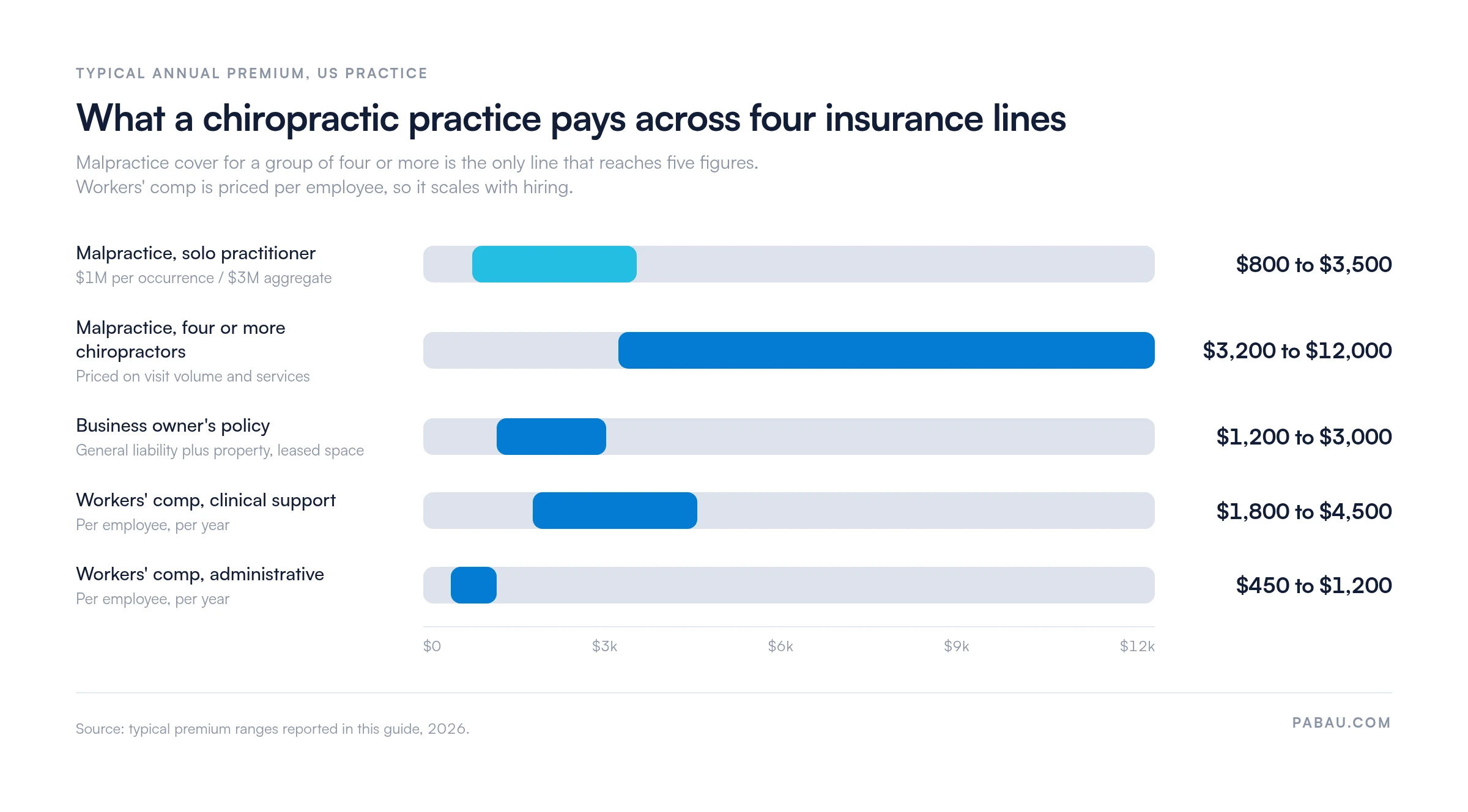
Solo practitioners pay $800 to $3,500 a year for $1 million per occurrence and $3 million aggregate limits.
State rules differ sharply, so Florida sets a $100,000 per-claim minimum while California and Texas mandate no coverage at all.
Claims-made policies start 40-60% cheaper but need tail coverage, which costs 150-300% of your final annual premium.
Signed consent, dated SOAP notes, and a written treatment plan defend a claim years later and can earn a 5-15% premium discount.
One malpractice allegation can generate $50,000 or more in legal defense costs before settlement discussions even begin. Every paid claim against a chiropractor in the US is reported to the National Practitioner Data Bank. It becomes a permanent federal record that surfaces at every license renewal, credentialing review, and underwriting cycle.
Chiropractic liability insurance decides whether that exposure becomes a manageable claim or a practice-ending payout. Coverage limits, claims triggers, and tail rules vary widely between carriers. The wrong policy structure leaves you exposed even when premiums are paid in full.
Liability insurance for chiropractors covers two separate exposures. Professional liability insurance, also called malpractice insurance, answers allegations about patient treatment, clinical judgment, and documentation. General liability answers claims about your premises and your property.
Once a claim lands, the policy pays for attorney representation, expert witness fees, court costs, and any settlement or judgment up to your limit. The carrier stands in for you financially, so a patient’s demand does not come out of practice revenue.
Professional liability policies respond whether the allegation is negligence, treatment error, or failure to refer to a specialist. Coverage applies to claims that treatment caused injury, failed to deliver the expected result, or breached informed consent standards.
Defense costs consume policy limits before settlement discussions begin. A claim alleging spinal manipulation injury typically generates $30,000 to $80,000 in legal fees during discovery and expert witness preparation. Policies respond even when treatment followed accepted protocols and the notes support the clinical decision.
Digital consent forms cut disputes over what treatment the patient authorized and which risks were disclosed to them.

The difference is the reporting trigger. Claims-made policies cover allegations reported during the active policy period, whatever the treatment date. An injury from 2023 treatment is covered only if it is reported while the 2024 policy is still active.
Occurrence policies work the other way. They cover treatment delivered during the policy period, whenever the claim arrives. A 2023 occurrence policy still answers a claim filed in 2026 about treatment given in 2023.
Claims-made premiums start 40-60% lower than occurrence coverage, then rise each year as the retroactive date extends backward. Switching carriers or retiring means buying tail coverage to protect past treatment. Tail coverage typically costs 150-300% of the final annual premium.
Occurrence policies cost more upfront and remove the tail coverage question entirely. Over a full career the two forms often even out, so the choice usually turns on how soon you expect to switch carriers or retire.
No federal rule applies, so your state chiropractic board sets the requirement. Some boards mandate proof of coverage for licensure, some require it only for certain practice arrangements, and a minority set no requirement. Where a minimum applies, most states set it at $1 million per occurrence and $3 million annual aggregate.
The table below shows how differently three large states treat the same question. Verify current rules with your own board, since they can change between licensing cycles.
| State | Mandate for licensure | Minimum limits | What still forces coverage |
|---|---|---|---|
| California | No statutory mandate | None set by the board | Landlords, lenders, and healthcare networks require proof by contract. |
| Texas | No statutory mandate | None set by the board | Workers’ comp networks and employers often require it contractually. |
| Florida | Required | $100,000 per claim / $300,000 aggregate | Set by the Florida Board of Chiropractic Medicine. |
| Most other mandate states | Required | $1 million per occurrence / $3 million aggregate | Hospital credentialing routinely asks for more than the state floor. |
Hospital credentialing committees and group practices typically require higher limits than state minimums. Facilities often mandate $2 million per occurrence and $6 million aggregate before granting admitting privileges or an employment contract.
Chiropractic software tracks insurance certificates, renewal dates, and coverage limits across locations, so each state and facility requirement stays visible.
Policies define covered services by your state-authorized scope of practice. Standard coverage includes spinal manipulation, soft tissue therapy, physical examination, diagnostic imaging interpretation, and nutritional counseling within chiropractic training.
Physical examination coverage extends to standard orthopedic and vascular tests, such as the Halstead maneuver for thoracic outlet syndrome. Extended coverage endorsements address dry needling, acupuncture, functional medicine testing, and weight loss programs where state law permits them.
Scope creep generates claim denials. A chiropractor performing injection therapy without the right license or endorsement faces denial if a patient alleges an injection-site infection. Carriers require advance notice and underwriting approval before you add services outside traditional chiropractic practice. Annual reviews should confirm covered services match what you now offer.
Review policy exclusions annually against the services you now offer. A $2 million policy with a dry needling exclusion provides zero coverage when a needling allegation arises. Request written confirmation from your carrier before adding any service that requires additional certification or state authorization.
General liability insurance, sold to practices as business liability insurance, covers property damage and bodily injury unrelated to treatment. A patient slipping on a wet floor or tripping over equipment in the waiting room generates a general liability claim, not a malpractice claim.
Coverage also extends to allegations of false advertising, copyright infringement, and defamation from non-clinical communications. A commercial general liability insurance policy usually provides $1 million per occurrence and $2 million in annual aggregate limits.
Slip-and-fall claims typically settle for $15,000 to $75,000, depending on injury severity and lost wages. Property damage claims from equipment failure or a water leak run $5,000 to $50,000. Industry data puts general liability claims at roughly three times the frequency of malpractice allegations, at far lower cost per incident.
A business owner’s policy, or BOP, bundles general liability with property coverage for building damage, equipment replacement, and business interruption. That bundle runs $1,200 to $3,000 a year for a solo practitioner in leased space.
Brokers quoting a small practice usually price a BOP first, since bundling costs less than two standalone policies. Practitioners who own their building need a separate commercial property policy with replacement cost coverage. Dated records of premises incidents, maintenance logs, and safety inspections support the defense of a slip-and-fall allegation.
The line between professional and general liability decides which policy responds. A treatment table collapsing during spinal manipulation triggers professional liability, because the injury happened during clinical care. The same table collapsing in the waiting room triggers general liability.
An allergic reaction to a treatment product is professional liability, while a reaction to a cleaning product in a common area is general liability. Some allegations trigger both policies at once.
A patient alleging assault during treatment may generate a professional liability claim for a boundary violation and a general liability claim for emotional distress. Carriers coordinate defense through shared counsel, but the two limits stack separately. Knowing which trigger applies stops a practitioner from assuming one policy covers what the other handles.
Workers’ compensation covers employee injuries and occupational illness arising from employment. Every state except Texas mandates coverage under state workers’ compensation laws once a practice employs a minimum number of staff. Most states require it from the first employee.
Solo practitioners with no employees can buy voluntary coverage for work-related injuries their health insurance excludes. Premiums vary by state, employee classification, and payroll. Administrative staff cost less to cover than massage therapists or chiropractic assistants delivering physical therapy.
Expect $450 to $1,200 a year per administrative employee and $1,800 to $4,500 per clinical support employee. Experience modification rates then move the premium up or down on claim history, rewarding practices with a clean safety record.
Cyber liability insurance covers breach response costs, ransomware payments, and regulatory fines after an electronic health record compromise. The IBM/Ponemon Cost of a Data Breach Report 2025 again put healthcare at the highest average breach cost of any sector. The 2025 figure was $7.42 million per incident.
Notification, credit monitoring, forensic investigation, and regulatory penalties can total hundreds of thousands of dollars for a small practice. Any HIPAA breach affecting 500 or more individuals must be reported to the HHS OCR breach portal within 60 days of discovery.
Cyber policies carry $1 million to $5 million limits. First-party coverage pays your notification, forensics, and business interruption costs. Third-party coverage defends patient lawsuits alleging weak data security. Practices must show compliance with HIPAA Security Rule requirements to avoid penalties after a breach investigation.

Most solo chiropractors pay $800 to $3,500 a year for $1 million per occurrence and $3 million aggregate limits. Group practices with four or more chiropractors pay $3,200 to $12,000, depending on treatment volume and services offered. Set beside the other policies a practice carries, malpractice is the line that moves most with headcount.
Malpractice insurance cost comes down to geography, years in practice, claim history, coverage limits, and treatment modalities. High-risk jurisdictions with plaintiff-friendly courts charge 40-80% above national averages.
New York, California, and Florida chiropractors pay $2,100 to $3,800 a year for standard coverage. Montana, Iowa, and South Dakota practitioners pay $800 to $1,400 for identical limits. Urban practices pay more than rural ones, because litigation rates and settlement values run higher.
Carriers classify practices by annual patient visits rather than revenue. A practice seeing 3,000 patients a year pays 25-40% more than one treating 1,200 with the same services and limits. A single paid claim in the past five years typically adds 15-35% to the base rate, whatever the fault finding.
Standard policies offer $1 million per occurrence and $3 million aggregate. Higher limits cost 30-50% more but decide the outcome in a catastrophic claim. A spinal manipulation injury causing permanent paralysis can generate settlement demands above $2 million. Practices running higher-risk procedures should price $2 million/$6 million or $3 million/$9 million limits.
Aggregate limits are your total annual payout capacity across all claims. Three separate $500,000 settlements sit inside a $1 million per-occurrence limit and leave $1.5 million of aggregate capacity. A fourth claim in the same policy year draws on what remains.
Excess liability coverage is the cheaper way to reach a high ceiling. The excess layer sits on top of the primary policy and only responds once the primary limit is exhausted. Add a $2 million excess layer above a $1 million/$3 million policy, and a $2.5 million demand is covered in full.
Excess layers usually cost less per dollar of protection than raising the primary limit, because they pay only after a large loss. Ask your broker to quote both routes before you accept a bigger primary policy.
Owners also need one running view of incident reports, patient complaints, and claim notifications. That is how you see aggregate exposure closing on the policy limit before the next renewal.
Calculate annual exposure based on treatment volume, not just patient count. A practice performing 6,000 spinal adjustments a year carries a different risk profile than one delivering 2,000 adjustments plus 4,000 soft tissue treatments. Match coverage limits to procedure counts rather than total patient visits.
Specialist carriers writing only for chiropractors understand the profession’s risk profile and price their policies around it. NCMIC, ChiroSecure, and CM&F Group all sell chiropractic malpractice coverage and keep relationships with defense attorneys who have tried these cases.
CM&F Group underwrites through MedPro Group, so a MedPro-backed policy can arrive under the CM&F brand. Knowing who carries the risk matters, because the financial strength rating belongs to the underwriter rather than the website.
A.M. Best ratings of A- or higher indicate the capacity to defend several claims at once. Carriers rated B+ or lower may struggle to fund defense costs in a bad loss year. State insurance departments publish complaint ratios, which reveal carriers with high denial rates or slow claim handling.
Every detail below comes from the carrier’s own website. Where a column reads “not published”, the carrier does not state it publicly, which is itself worth knowing before you request a quote.
| Carrier | Who it insures | Notable coverage feature | Policy forms and tail | A.M. Best rating |
|---|---|---|---|---|
| NCMIC | Chiropractors and naturopaths | True consent to settle, so no settlement without your authorization (not permitted in Maryland) | Occurrence, claims-made, and tail coverage all sold | A (Excellent) |
| ChiroSecure | Chiropractors and massage therapists | Unlimited defense for sexual misconduct, plus defense for board, HIPAA, and payer audits | Not published, so ask which form your quote uses | Not published |
| CM&F Group with MedPro Group | Healthcare professionals across specialties, chiropractors included | Coverage follows the practitioner across settings, including contract and per diem work | Not published, so confirm form and tail terms at quote | A++ (Superior), held by MedPro |
Work through this list with the quote in front of you, not after the binder arrives. Premium is the last line to compare, because two policies at the same price can behave completely differently once a claim is filed.
Independent brokers reach several carriers at once and compare terms as well as price. Brokers who specialize in healthcare professional liability spot the exclusions a generalist agent reads straight past.
An annual review keeps coverage aligned with new services, new hires, and changing state rules. A records system built for musculoskeletal care, such as a physical therapy EMR, holds policy schedules and certificates beside the clinical file. A claim investigation then does not start with a search.
Leading carriers run risk management education on the allegations they see most. Online modules cover informed consent documentation, appropriate referrals, scope-of-practice boundaries, and professional boundaries with patients. Some carriers award continuing education credit for finishing them.
Carrier data attributes 40-60% of malpractice allegations to inadequate documentation. Dated treatment notes, a consent form that records the risk discussion, and referral letters to medical specialists are the defense evidence. Capturing each visit in a structured chiropractic SOAP note format keeps those notes consistent enough to survive a claim review.
Claims arrive years after treatment, when memory has faded and staff have moved on. Notes written during the visit are the only reliable account of what was decided and what the patient was told. A chiropractic treatment plan that records goals, visit frequency, and re-evaluation dates shows the reasoning behind a course of care.
The same records also lower the premium. Carriers offering a risk management credit of 5-15% want evidence, not intentions. A typical credit application asks you to attest to a documented consent process, equipment maintenance logs, and staff training records. Then it asks for samples.
Sampling is the part that decides the discount. Consent forms in a filing cabinet and maintenance logs in a desk drawer are hard to produce inside an underwriter’s deadline. Automated workflows standardize consent, appointment confirmations, and post-treatment instructions, so the evidence that defends a claim is also there at renewal.

A claim notification usually lands three or four years after the visit it concerns. The carrier asks for the consent form, every note from that episode of care, the treatment plan, and any message sent to the patient. In a paper or part-digital practice, that means a filing cabinet, an email account, and somebody’s memory.
Practice management software like Pabau keeps those records on one patient timeline. The signed consent, each visit note, the treatment plan, and before-and-after photos sit against the same record. Each one carries the date and the user who created it. Note versions are kept, so an amended note reads as an amendment rather than a rewrite.
Policy certificates and renewal dates can be stored as documents against staff and practice records, so the insurance paperwork sits beside the clinical file. Automated workflows send pre-treatment instructions and aftercare on schedule, and each send is logged against the patient.
The payoff shows up twice. When a demand letter arrives, the file gets assembled in one sitting instead of one week. At renewal, the same records are the evidence your carrier wants to see for a risk management credit.


Pabau keeps consent forms, visit notes, treatment plans, and policy certificates in one patient record. When a carrier asks for the file three years later, you send it the same day.

Coverage absorbs the money side of a claim. Documentation decides whether the claim is defensible in the first place. Notes written during the visit, a consent form that records the risk discussion, and timestamped patient messages are what a carrier leans on years later.
So buy the policy on its terms rather than its price. Check who underwrites it, whether defense costs sit outside the limit, and what tail coverage will cost when you retire. Then make the documentation that defends a claim a byproduct of the working day.
The trade-off worth remembering is that a cheap claims-made policy borrows against your future. You settle the difference the year you switch carriers or close the practice. Book a demo to see how Pabau keeps consent, notes, and compliance records claim-ready for your practice.

Need a structured intake before the first adjustment? Chiropractic intake form template collects patient history, contraindication screening, and signed consent in one document.
Opening a practice this year? Starting a chiropractic practice walks through licensing, insurance, and the setup decisions that follow.
Comparing documentation systems? Best chiropractic EHR reviews the platforms that keep visit notes and signed consent claim-ready.
Yes, the exposure makes coverage essential even where state law does not require it. Some boards demand proof of professional liability for licensure, others only for certain practice arrangements, and a minority set no requirement. Where a minimum applies, $1 million per occurrence and $3 million aggregate are common. Chiropractors in states without a mandate still face $30,000 to $80,000 in defense costs per claim, plus contract requirements from landlords, lenders, and networks.
Professional malpractice insurance covers allegations arising from patient treatment, clinical judgment, and documentation. General liability covers property damage and bodily injury unrelated to professional services. A patient injured during spinal manipulation is a malpractice claim. The same patient slipping on a wet floor is a general liability claim.
Annual premiums run $800 to $3,500 for solo practitioners holding $1 million per occurrence and $3 million aggregate coverage. Group practices pay $3,200 to $12,000 a year, depending on treatment volume and services offered. High-risk jurisdictions such as New York and California charge 40-80% above national averages.
Requirements vary by state. California does not require malpractice insurance for licensure, though landlords, lenders, and healthcare networks usually require proof by contract. Texas does not require it for licensure either, although workers’ comp networks and employers may. Florida requires at least $100,000 per claim and $300,000 in annual aggregate, set by the Florida Board of Chiropractic Medicine. Verify current rules with your own state board.
General liability covers patient injuries unrelated to professional treatment. Premises accidents like slip-and-fall incidents, equipment-related injuries in waiting areas, and property damage from facility failures fall under general liability. Treatment-related injuries from spinal manipulation, therapy applications, or clinical procedures require professional malpractice coverage.
Professional liability insurance addresses the highest-cost exposure chiropractors face. Malpractice claims generate defense costs of $30,000 to $80,000 and settlements frequently above $100,000. Many state boards also require proof of professional liability before they authorize practice. General liability, workers’ compensation, and cyber liability all matter, but they supplement professional malpractice coverage rather than replace it.