









Cosmetic clinic for sale: A buyer’s and seller’s guide for Australia
A cosmetic clinic for sale transfers equipment, lease and goodwill, but not AHPR...

Last Updated: September 2, 2026


A cosmetic clinic for sale in Australia is usually listed at an asking price plus stock at valuation, with no earnings figure attached.
Australia has no Corporate Practice of Medicine doctrine, so a non-clinician can own a cosmetic clinic outright.
The Australian Handover Test names the six things you are buying, and what happens to each one at settlement.
The only publicly verifiable Australian valuation is the SILK Laser deal, at roughly 7.6 times FY23 adjusted EBITDA.
From November 5, 2026, a NSW cosmetic business must name a responsible provider and hold risk management policies.
A cosmetic clinic for sale in Australia commonly lists between about $240,000 and $780,000, plus stock at valuation. Almost none of those listings publishes an earnings figure. So you cannot work back to a multiple from the asking price alone.
This page is a guide, not a listings feed. We do not broker clinics and there is no inventory here. The Australian marketplaces that do carry listings are named further down. All figures below are in Australian dollars.
Below you get what these clinics sell for here, who may legally own one under Australian law, and The Australian Handover Test. That test is the six things you are buying, and what happens to each one on settlement day. Both sides of the table get answers, buyers reading listings and owners preparing to exit.
One thing worth saying up front, because most guides skip it. No Australian dataset publishes a valuation multiple for a single cosmetic clinic. Exactly one transaction in this sector is publicly verifiable, and it was a network of more than 140 clinics.
A cosmetic clinic for sale is an operating business selling non-surgical cosmetic treatments. That runs from a cosmetic nurse renting one room to a multi-site group with its own management team.
Australian listings cluster into three recognizable shapes. A skin clinic for sale is usually a facial and laser practice with no prescriber attached. An injectable-led clinic concentrates its revenue in one or two nurses. Larger listings bundle several sites under a shared brand.
The label on the listing matters far less than what is on the treatment menu. A beauty business offering facials, waxing and massage carries no medical layer at all. Add botulinum toxin or dermal filler and the transaction changes category completely.
That single change pulls in three separate rulebooks. Ahpra governs the practitioners, state poisons law governs the medicine, and the Therapeutic Goods Administration governs how the clinic may advertise. Each one leaves a trace in the deal documents.
Most Australian clinic sales at this size are asset sales. The buyer takes named assets and leaves the old company behind, which avoids inheriting unknown liabilities. Sellers often prefer a share sale for tax reasons, so take that question to your accountant before the letter of intent.
Australian clinic listings sit at asking prices of roughly $240,000 to $780,000 plus stock at valuation. No published dataset gives a valuation multiple for a single Australian cosmetic clinic.
Those figures come from reading the clinic category on businessforsale.com.au, which carried about 160 clinic listings in September 2026. A Sydney teeth whitening business sat at $240,000. A Melbourne cosmetic and skin clinic sat at $349,000 plus stock, and a Canberra skin clinic at $780,000 plus stock.
Learn to read the two letters that follow most of those numbers. SAV means stock at valuation, so the injectables and skincare on the shelf get counted separately at settlement. The headline number is not the price you pay.
Only one Australian transaction in this sector gives you a real multiple to anchor against. Wesfarmers’ Australian Pharmaceutical Industries acquired SILK Laser Australia by scheme of arrangement on November 29, 2023.
Read that 7.6 as a ceiling rather than a benchmark. SILK ran more than 140 clinics, a national brand, a franchise arm and ASX-grade financial reporting. A single treatment room in a suburban strip does not trade on those economics.
Adjusted EBITDA also sits after the accounting standard for leases, while the net debt figure excludes lease liabilities. So treat the multiple as an order of magnitude, not a precise number. It is still the most defensible Australian anchor available.
Work down from there using the clinic’s own stage. Our breakdown of how much cosmetic clinics make in Australia puts a solo operation at $150,000 to $400,000 of turnover. A multi-practitioner group runs at $1 million to $4 million.
Five specifics then move a clinic up or down inside its own band.
Watch which earnings figure any Australian listing quotes. Smaller owner-operated clinics often quote profit before the owner’s own wage for their clinical days. Put the market rate for that work back in and the number moves a long way.
Buying is also priced against building. Our line-by-line guide to the cost to open a skin clinic in Australia puts a rented room at about $19,000. A four-room build lands near $1 million.
Anyone can. Australia has no Corporate Practice of Medicine doctrine, and nothing in the National Law reserves clinic ownership to registered health practitioners.
This is the biggest difference between an Australian deal and an American one. Ahpra registers individuals, not businesses, and no National Board issues an ownership credential. An investor, a practice manager or a dermal therapist can hold the shares.
What Australian law restricts is supply, not ownership. A registered nurse cannot prescribe, so the business needs a medical practitioner or nurse practitioner writing every Schedule 4 script. Our guide to the medical director rules for an Australian cosmetic clinic sets out who has to wear which hat.
Then a state layer sits on top of that, and it is where buyers get caught. Three jurisdictions put an obligation on the premises or the business rather than only on the practitioner.
So the legal gate is open in Australia, and the commercial gate is narrower. That gap shows up most clearly at the bank, which is covered further down.
The Australian Handover Test is one question asked six times. For each thing you think you are buying, ask what actually happens to it at settlement.
None of these six items appears in generic Australian business-acquisition guidance. Each one can delay a settlement or reprice a deal.
The same six items read faster as a grid, because the answer is not simply yes or no.
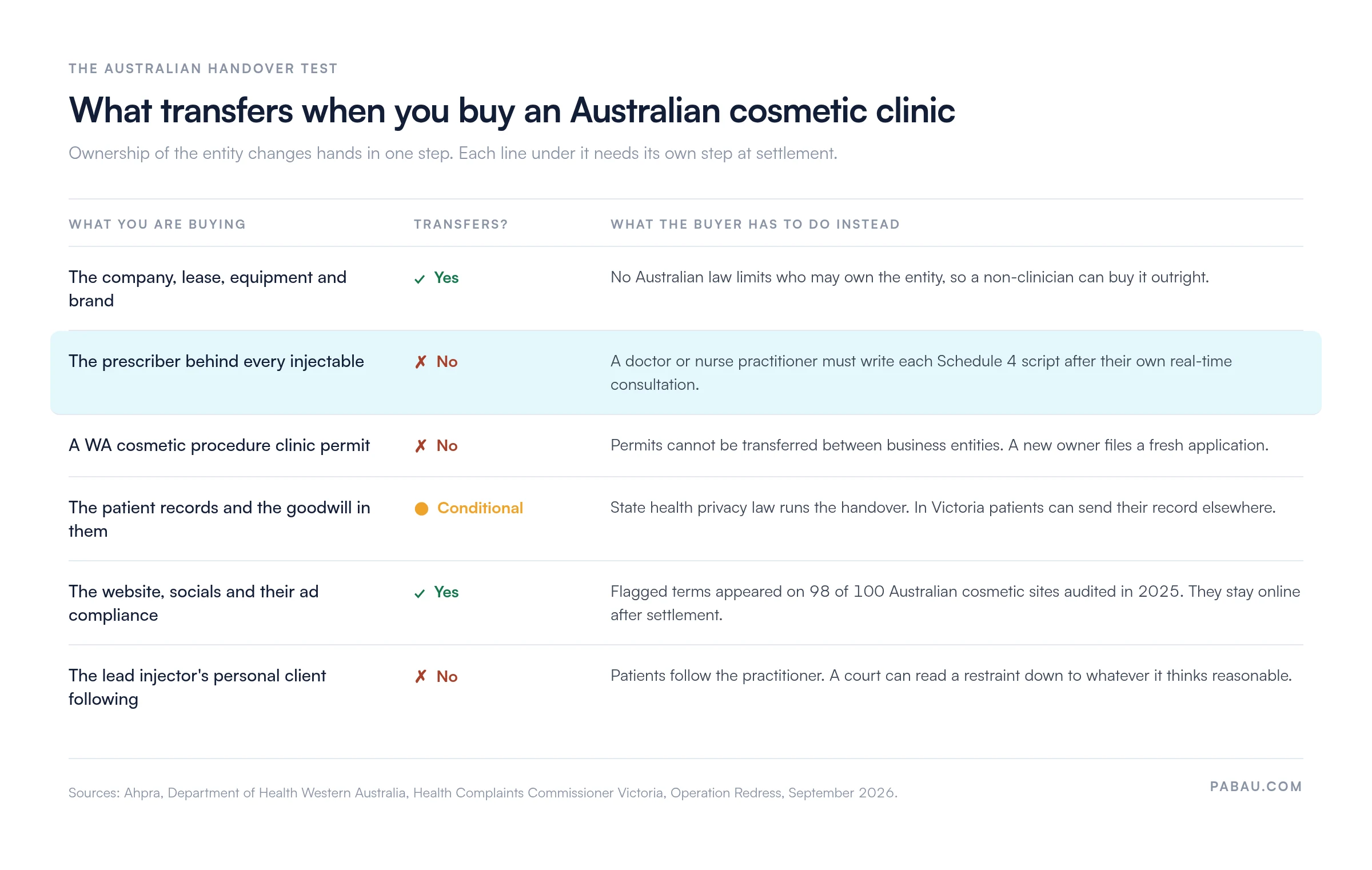
Since September 2, 2025, Ahpra has required a real-time consultation before every Schedule 4 cosmetic injectable prescription. That consultation happens in person or by video, with the prescriber themselves.
The same guidelines rule out prescribing by text or online form, and rule out one prescription covering several patients. So prescriber time is a per-patient cost line in every Australian clinic now.
Work out what that means if the seller was also the prescriber. The day they walk out, the clinic has no lawful supply of product for its injectable list. Bookings do not pause politely while you recruit.
The Department of Health Western Australia is blunt about this on its own change-of-details form. Permits cannot be transferred between one business entity and another.
A change of business owner is one of the changes the form specifically refuses. The new owner has to submit a completely new application for a Cosmetic Procedure Clinic Permit instead.
Treat that approval as a condition of settlement rather than post-completion paperwork. The Department of Health WA publishes the application forms, and the assessment includes qualifications, a criminal check and financial resources.
The Privacy Act 1988 and the Australian Privacy Principles set the national baseline for handling health information. Every clinic holding health information is covered, whatever its turnover.
The handover mechanics on a sale sit in state law instead, and they differ. The OAIC guide to health privacy covers the day-to-day duties, not the sale itself.
Victoria is the clearest example, and the one buyers should read first. Under the Health Records Act 2001, a provider transferring or closing a practice gives public notice plus written notice to current clients.
Not earlier than 21 days after that notice, the seller elects what happens to each record. It stays with them, goes to the buyer, or goes to a provider the patient nominates. The Health Complaints Commissioner publishes the statutory guidelines.
Sit with what that third option means for a buyer. The patient list you are paying goodwill for is legally leaky during the handover window. Australian clinic deals rarely price that risk at all.
Retention clocks then come with the records. In NSW, section 25 of the Health Records and Information Privacy Act 2002 sets seven years from the last service for an adult. Information collected while the patient was under 18 is kept until they turn 25.
Whoever holds the file after settlement inherits that clock. So a storage cost the seller had been carrying quietly becomes the buyer’s cost, for up to two decades on a teenager’s record.
Sections 42DL and 42DLB of the Therapeutic Goods Act 1989 prohibit advertising prescription-only substances to the public. That covers brand names, nicknames, abbreviations and hashtags a consumer would read as a specific product.
Most Australian cosmetic websites are not compliant with that today. Operation Redress reviewed 100 Australian cosmetic business websites in March and April 2025. Flagged terms appeared on 98 of the 100, and 59% advertised injectables as safe.
Civil penalties under the Act reach $1.65 million per breach for an individual and $16.5 million for a corporation. The website and social accounts come across in the sale, and non-compliant pages stay live after settlement.
So add one cheap step to due diligence. Search the seller’s site and socials for prescription-only product terms, count the pages, and put the clean-up cost in your offer. Our guide to the AHPRA advertising guidelines covers the second rulebook that runs alongside the Act.
Most of the valuation risk in an Australian cosmetic clinic sits with the injector rather than the brand. Patients here follow the person who treated them.
Check that every injector you inherit meets the cosmetic nurse requirements in Australia. An injector working outside those rules is a repricing event, not a staffing note.
New South Wales is the only state with dedicated restraint of trade legislation. Under the Restraints of Trade Act 1976, a court can read an unreasonable restraint down to a reasonable one instead of striking it out.
Elsewhere in Australia an overreaching restraint is more likely to fail outright. So the governing-law clause in an injector’s contract quietly decides how much protection you actually bought.
Australia has no equivalent of the American Small Business Administration. There is no standing government-guaranteed acquisition loan, so the money comes from a bank, the vendor, or your own equity.
The closest thing we had has closed. Treasury’s SME Recovery Loan Scheme stopped taking loans on June 30, 2022, and nothing replaced it for acquisitions.
What exists instead is a specialist health lending market, and this is where the ownership question bites. BOQ Specialist lends up to 100% of the purchase price of an existing practice, secured on goodwill and equipment rather than your home.
NAB Health advertises borrowing up to 100% of the purchase price too, subject to eligibility. Both products are built for registered health professionals buying into their own profession.
So the practical answer flips the American one. Australian law lets a non-clinician own the clinic, and the lending market makes it much easier for a clinician to buy it. The restriction is commercial rather than legal.
A non-clinician buyer goes to a general commercial acquisition loan instead. Published terms there are thin, because banks quote these deal by deal against the buyer’s security and the clinic’s cash flow.
Treat any deposit percentage you read on a broker’s blog as a starting guess, not a rule. Ask two lenders for an indicative structure before you agree a price.
One structure comes up repeatedly in Australian clinic deals. Vendor finance, or an earnout, ties part of the price to performance after settlement. It answers the injector retention risk above and gives the seller a route to a fuller price.
Bring the lender the same file the buyer wants. Three years of financials, the lease, the client book and revenue per practitioner are the baseline. Ask early how the lender treats a clinic whose prescriber is a contractor rather than an employee.
Australian cosmetic clinics for sale appear in three places, and where a listing sits tells you the size of the deal.
General business-for-sale marketplaces carry most single-site listings. Bsale, businessforsale.com.au and SEEK Business all publish clinic and beauty listings, and the commercial property portals carry some too.
Those platforms are self-serve classifieds, so financial depth varies listing by listing. Bsale, which is partnered with the Australian Institute of Business Brokers, reports an average asking price of $656,000 across the small businesses it lists.
Business brokers sit above the classifieds and run a confidential process for one seller. A handful of Australian brokers specialize in health and medical practices, and they tend to hold the listings with real financial packs behind them.
Off-market is the third route, and it is more common here than the classifieds suggest. Suppliers, device reps, training academies and indemnity brokers all hear about an exit before a listing goes up.
One reading rule applies across all three. An Australian clinic listing quotes an asking price, often plus stock at valuation, and rarely quotes earnings at all. You cannot rank listings by multiple, so ask for three years of financials before you rank anything.
Filter by state before you filter by suburb. Crossing a border changes the permit, the poisons law and the record-retention clock, which matters more than the rent does.
Australian buyers work through six areas, and every one of them is checkable from records. A seller who cannot produce the records loses the argument about price.
Average client spend is the lever that compounds fastest. SILK lifted annual spend per client from $914 to $969 in a single year. That is a 6% revenue increase with no new clients at all.
A buyer reads that number as proof the clinic can grow without the owner. Packages, memberships and rebooking discipline are what move it, and all three leave a trail in the system.
Four of those six areas are answered out of the clinic’s own software. They either sit in one report or get reconstructed by hand under a deadline someone else set.
Most Australian clinics reach a sale with their evidence scattered. Bookings sit in one tool, card takings in a terminal, stock in a spreadsheet, and retention in the owner’s head.
Assembling three years of clean, practitioner-level detail out of that takes weeks. It also happens at the worst possible moment, while you are still treating a full list of patients.
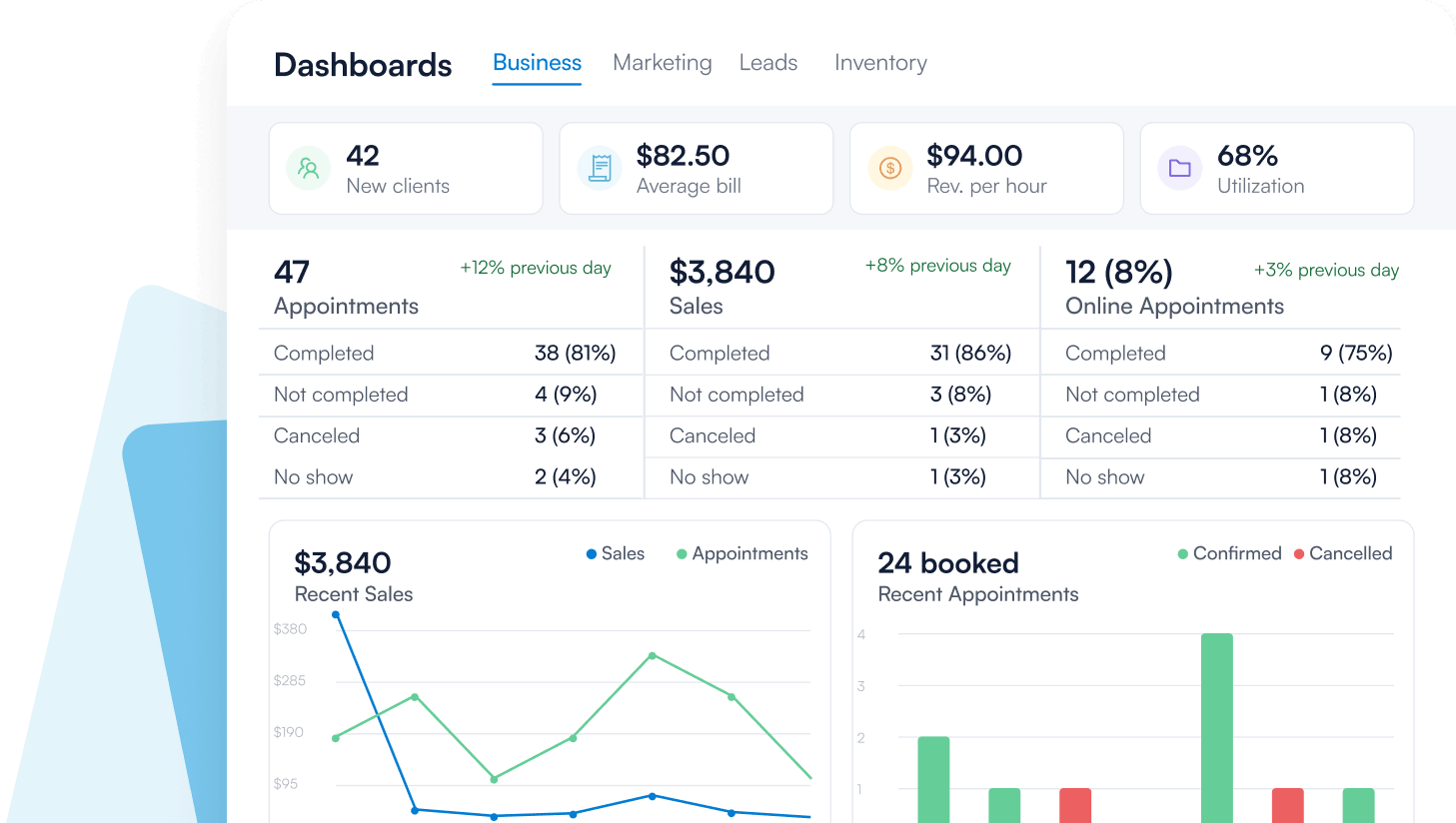
Practice management software like Pabau holds the client record, the appointment, the treatment note and the invoice in one system. Membership and prepaid package revenue sit against the client who bought it. So the numbers a buyer asks for are already in one place.
Consent forms, treatment notes and batch records sit against the same client timeline. So the records side of the handover is a report rather than an excavation, whichever state’s notice process applies.
That cuts both ways at the table. A seller shows retention instead of asserting it. A buyer sees revenue per practitioner before settlement, so the injector risk gets priced rather than discovered.
Australian clinics start with structured onboarding rather than a free trial, which is the part that migrates a full client history without losing weeks. Every subscription includes every feature, and pricing scales with locations and users.

Pabau holds client records, appointments, memberships, stock and invoices in one system, so retention and revenue per practitioner are a single report. Australian sellers can back up the price they are asking, and buyers see how the clinic actually performs before settlement.

The price is the easy part of an Australian cosmetic clinic deal. Asking prices cluster between about $240,000 and $780,000 plus stock, and the SILK transaction gives you a ceiling to work down from.
The Australian Handover Test is what decides whether the deal settles on the agreed date. The prescriber, the state permit, the records notice, the advertising audit and the injector restraint each need an owner and a deadline.
One date belongs in every NSW timetable right now. From November 5, 2026, the business itself has to name a responsible provider and hold risk management policies. A buyer settling this year inherits that deadline.
Whichever side of the table you are on, the clinic with clean, exportable records wins the argument about price. Book a demo to see how Pabau keeps retention and revenue per practitioner ready for a buyer’s diligence list.

Sizing up the earnings first? How much do cosmetic clinics make in Australia? sets out revenue, margin and owner take-home at three clinic stages.
Wondering who has to prescribe after settlement? Medical director for a cosmetic clinic in Australia explains why no Australian law requires the title.
Checking the injectors you are inheriting? Cosmetic nurse requirements in Australia covers the Ahpra and NMBA rules each one has to meet.
Building instead of buying? The cost to open a skin clinic in Australia prices the fit-out, licensing, stock and working capital line by line.
Cleaning up the advertising you inherit? AHPRA advertising guidelines for cosmetic clinics shows where the Ahpra and TGA rules overlap.
Australian clinic listings commonly ask between $240,000 and $780,000 plus stock at valuation. No dataset publishes a multiple for a single clinic. The one verifiable Australian transaction is the SILK Laser scheme, at roughly 7.6 times FY23 adjusted EBITDA for a 140-clinic network.
Yes. Australia has no Corporate Practice of Medicine doctrine, and nothing in the National Law reserves clinic ownership to registered practitioners. The constraint is supply rather than ownership, because a doctor or nurse practitioner still has to prescribe every Schedule 4 injectable.
No Australian law requires a cosmetic clinic to appoint a medical director. What the law requires is a named prescriber. In Western Australia an individual cosmetic procedure clinic permit holder must be a medical practitioner or nurse practitioner. That permit does not transfer with the sale.
State health privacy law runs the handover. In Victoria the seller gives public and written notice first. No earlier than 21 days later, they elect to keep each record, transfer it, or send it to a provider the patient nominates. NSW requires seven years of retention for adults, and until age 25 for under-18s.
Australia has no Small Business Administration equivalent, and Treasury’s SME Recovery Loan Scheme closed on June 30, 2022. Registered health professionals can borrow up to 100% of a practice purchase price from BOQ Specialist or NAB Health. Other buyers use a commercial acquisition loan, vendor finance, or both.