Free model waiver form + what it is and when your practice needs one
A model waiver form is a signed document that lets a healthcare practice use a p...

4
Last Updated: Sep 29, 2026

The UK aesthetics sector has no audited profit-margin benchmark, so a borrowed percentage cannot tell you whether your own number is healthy.
The three-layer margin check separates treatment margin, practice operating margin and net margin after tax, so you can see which layer leaks.
In our illustrative model, a £300 filler appointment keeps 72% after product, 23% after overheads and 12% after VAT and Corporation Tax.
Staff time and the marketing cost of filling a slot move Layer 2 further than product pricing ever moves Layer 1.
HMRC treats purely cosmetic treatments as standard-rated, so one sixth of a VAT-inclusive price never belongs to your practice.
Published aesthetic clinic profit margin figures run from 20% to over 70%. Both ends hold up, because each one measures a different layer of the same business. Almost none of them say which layer. Owners adding software to their overheads can find each platform’s total cost of ownership in our guide to med spa management software.
A 72% margin on a filler appointment and a 12% margin after tax can describe the same £300 booking. So an owner comparing the wrong layer either panics over a healthy practice or relaxes over a leaking one.
Below, the three-layer check runs one appointment through three subtractions. By the end you will know which layer is costing you money, and where to look first.
There is no audited UK benchmark for aesthetic margins, so a healthy number depends on which of three layers you are measuring.
Every margin figure we could find for this sector traces back to an individual consultant’s blog. One published worked example lands at 20% on a single filler treatment. Another site puts typical injectable margins at 60% to 70%. Neither is lying.
They just stop counting at different points. So pin down what a figure includes before you measure yourself against it. Ask which costs came off before the percentage was worked out.
Is 30% a lot? After VAT and Corporation Tax, 30% would be a strong result for a UK practice. On a single syringe of filler, before staff and rent, 30% points to a pricing problem.
The same trap catches the wider question of how profitable an aesthetics business is. A solo injector renting a room by the day carries different overheads from a three-room practice with six salaried staff. Their treatment margins can still be identical.
So the useful move is to work the numbers yourself, starting with the two formulas every accountant already uses.
Two formulas, one period. Run both over the same month or quarter, from the same set of figures.
Gross profit margin is revenue minus the direct cost of delivering treatments, divided by revenue, then multiplied by 100.
The gross profit formula for a practice is short. Take revenue, then take off cost of sales. Cost of sales means product, consumables and any fee paid per treatment to a visiting practitioner.
On £40,000 of monthly revenue with £11,000 of product and consumables, gross profit is £29,000. Gross margin is 72.5%.
Rent, salaried staff, software and marketing stay out of this line. Put them in and the number is no longer a gross margin.
Net profit margin is what remains after every cost, including rent, salaries, marketing, VAT and Corporation Tax, divided by revenue.
The net profit formula runs the same way with a longer subtraction. Take revenue, take off cost of sales, then every fixed and variable overhead, then tax. Divide the net profit by revenue and multiply by 100.
Keep both sides of the sum in the same period. A month of revenue set against a quarter of rent produces a flattering number and a nasty January.
Those two figures tell you a lot, and they sit inside the wider set of med spa KPIs worth tracking. Neither one explains why a busy practice can still feel poor.
Revenue is money that passed through your practice. Profit is money that stayed. A full diary only grows the first.
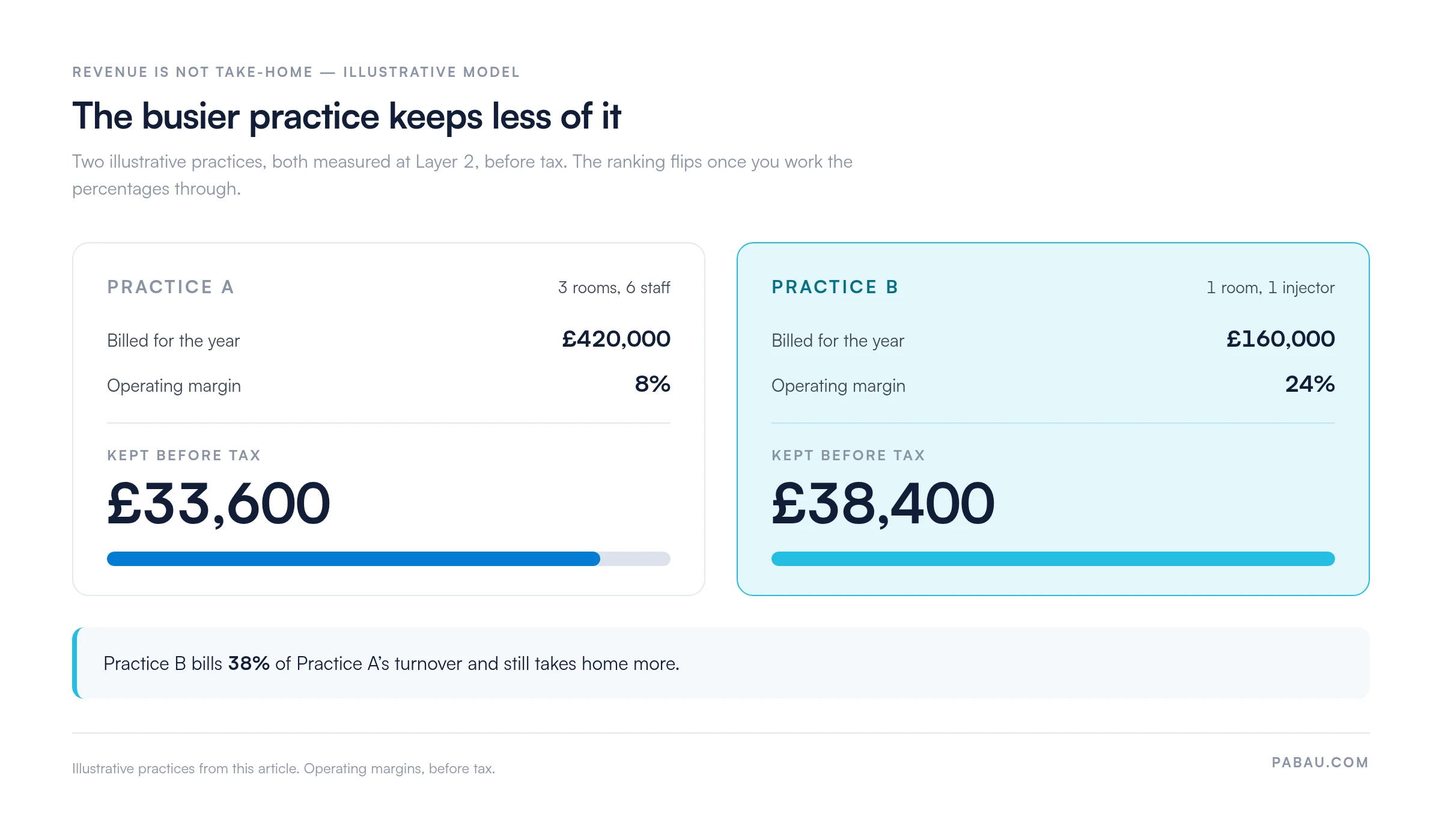
Two illustrative practices make the point. Practice A bills £420,000 a year across three treatment rooms with six staff. Practice B bills £160,000 from one room and a single injector.
Practice A keeps 8% once salaries, rent on three rooms and £45,000 of marketing are paid. Practice B keeps 24%, because the injector’s own time is the only staff cost. Both figures are operating margins, before tax.
Now work the percentages through, and the ranking flips. £420,000 at 8% is £33,600. £160,000 at 24% is £38,400. The smaller practice takes home more on 38% of the turnover.
In practices we onboard, the first report an owner asks for is revenue by month. The report that changes decisions is profit per treatment, and it is usually the one nobody has built yet.
A treatment can carry a 72% margin and still leave a 12% net margin, because overheads and tax sit between the two figures.
The check runs one appointment through three subtractions and names what came off at each one. Published benchmarks disagree with each other because each one stops at a different layer.
The check only works on figures from your own books, so pull these together first.
Most owners find the first two in minutes, then stall on the third. Overheads tend to sit across bank statements and supplier invoices. Our roundup of med spa accounting software will help you pull them into one place.
Here is one appointment through all three layers. The model is illustrative and the numbers are round on purpose, but the unit costs follow published figures.
Dr Marcus Mehta of Harley Academy puts a filler syringe at roughly £70 to £80. The usual retail price runs £250 to £300 for cheek, jaw or chin filler.
The model assumes a VAT-registered practice, a standard-rated cosmetic treatment, and Corporation Tax at the 19% small profits rate. Wages and rent carry no recoverable VAT, so only £145 of the costs generate input VAT.
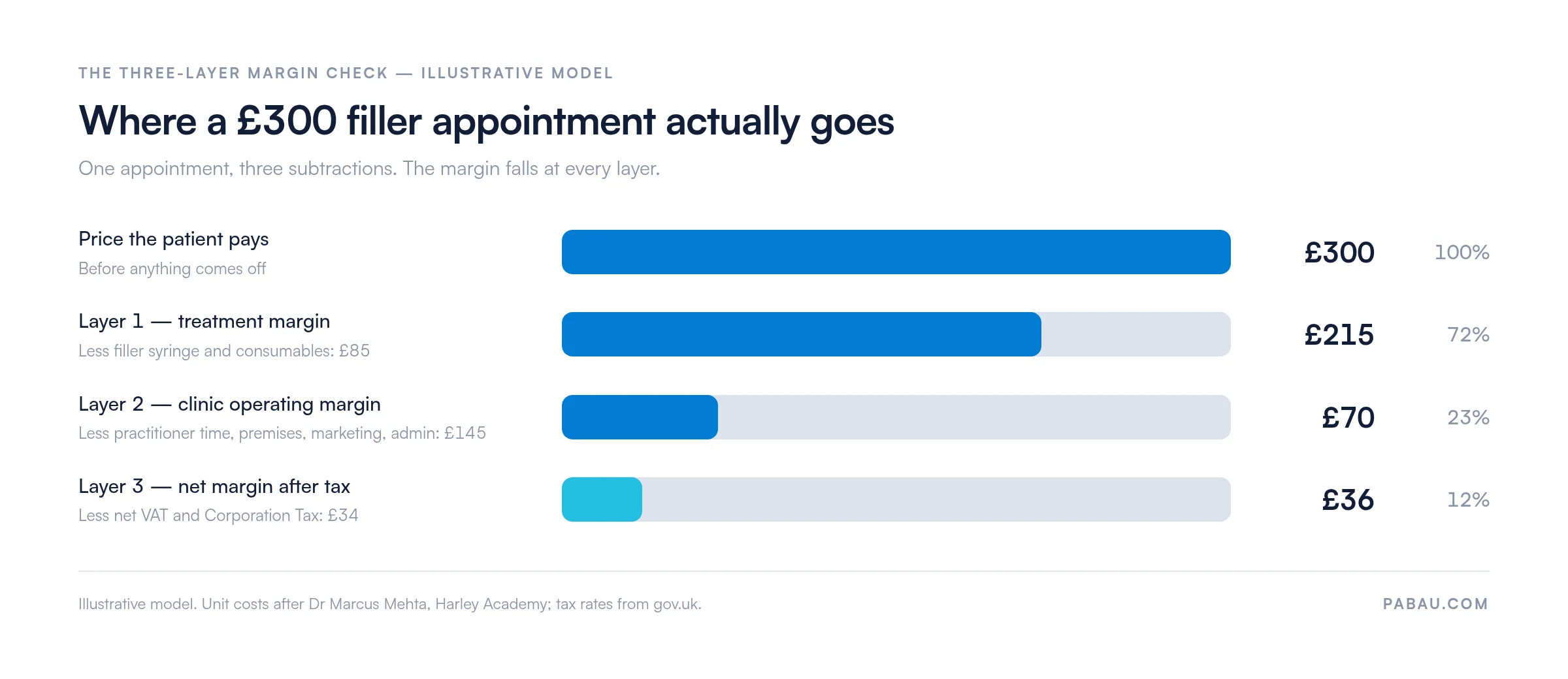
That table is the aesthetic clinic profit margin calculator most searchers are after. Swap in your own price, your own product cost and your own overhead per slot. The same four rows do the work.
Notice what happened across the three layers. The 72% at Layer 1 is the number a supplier rep quotes you. The 23% at Layer 2 is close to that published £300 filler example. The 12% at Layer 3 is what your accountant sees.
Below the £90,000 VAT registration threshold, the same appointment behaves differently. No output VAT leaves the practice, so Layer 3 lands near 19% instead of 12%.
Crossing that threshold on standard-rated treatments costs roughly seven points of net margin, and no supplier negotiation gets them back.
A three-area toxin treatment follows the same pattern. Dr Mehta puts a vial of neurotoxin at roughly £60 to £80, with three areas at about £300 retail. So Layer 1 sits in the same band as filler, and Layer 2 is where the two treatments separate.
Our figures on what Botox clinics make work the toxin side through in detail.
Layer 1 barely moves once your supplier terms are settled. Six things drive Layer 2, and only two of them touch your price list.
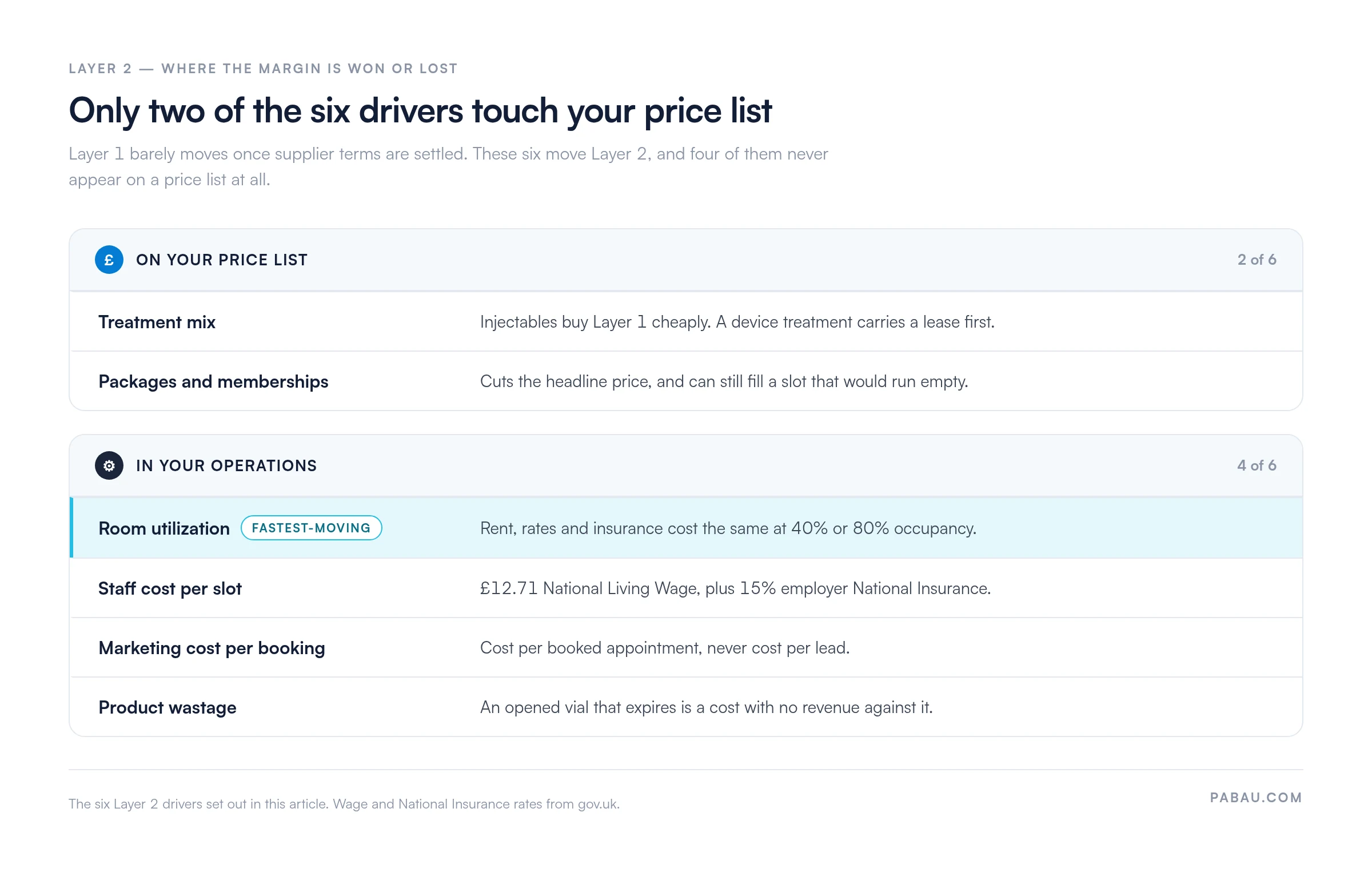
Two more factors sit in the background. UK diaries thin out over the summer and peak before Christmas. A few months of operating costs held in reserve stops a quiet August forcing a discount. And patient acquisition cost only makes sense against lifetime value, not against a first visit.
Your profit and loss account will not split any of this out. The operating profit margin your accountant reports is Layer 2 under a different name, averaged across every treatment you sell.
Corporation Tax runs at 19% on profits up to £50,000 and 25% above £250,000, and purely cosmetic treatments carry VAT at 20%.
Layer 3 subtracts those figures, so they are worth checking rather than borrowing. The rates below are the gov.uk figures for the 2026 to 2027 tax year.
The bands and the Marginal Relief taper sit on gov.uk’s Corporation Tax rates page. The £90,000 figure comes from the VAT registration guidance, and it is measured over any rolling 12 months rather than your accounting year. Eligible employers can also set Employment Allowance against that National Insurance bill.
HMRC exempts a treatment from VAT only when a registered health professional supplies it and its primary purpose is protecting, maintaining or restoring health.
Both conditions sit in section 2.3 of VAT Notice 701/57. Section 4.4 is blunter. Where services are undertaken purely for cosmetic reasons, they will be standard-rated.
That line is being litigated right now. In Illuminate Skin Clinics Ltd v HMRC, the Upper Tribunal set the First-tier Tribunal’s decision aside on October 13, 2025 and sent the case back. The practice, run by a GMC-registered doctor, offered Botox, dermal fillers, Aqualyx and thread-vein treatment.
What the tribunal said matters more than the outcome. Where a supply has both a therapeutic and a cosmetic purpose, a tribunal must identify the principal purpose through a multi-factorial analysis. It also held that the First-tier Tribunal set the bar too high on evidence of a diagnosis. Other cases are stayed behind this one.
For Layer 3, that means two practical things. Standard-rated is the safe assumption on a purely cosmetic treatment. And the consultation record is what supports any therapeutic claim, so a cursory note will not do the job.
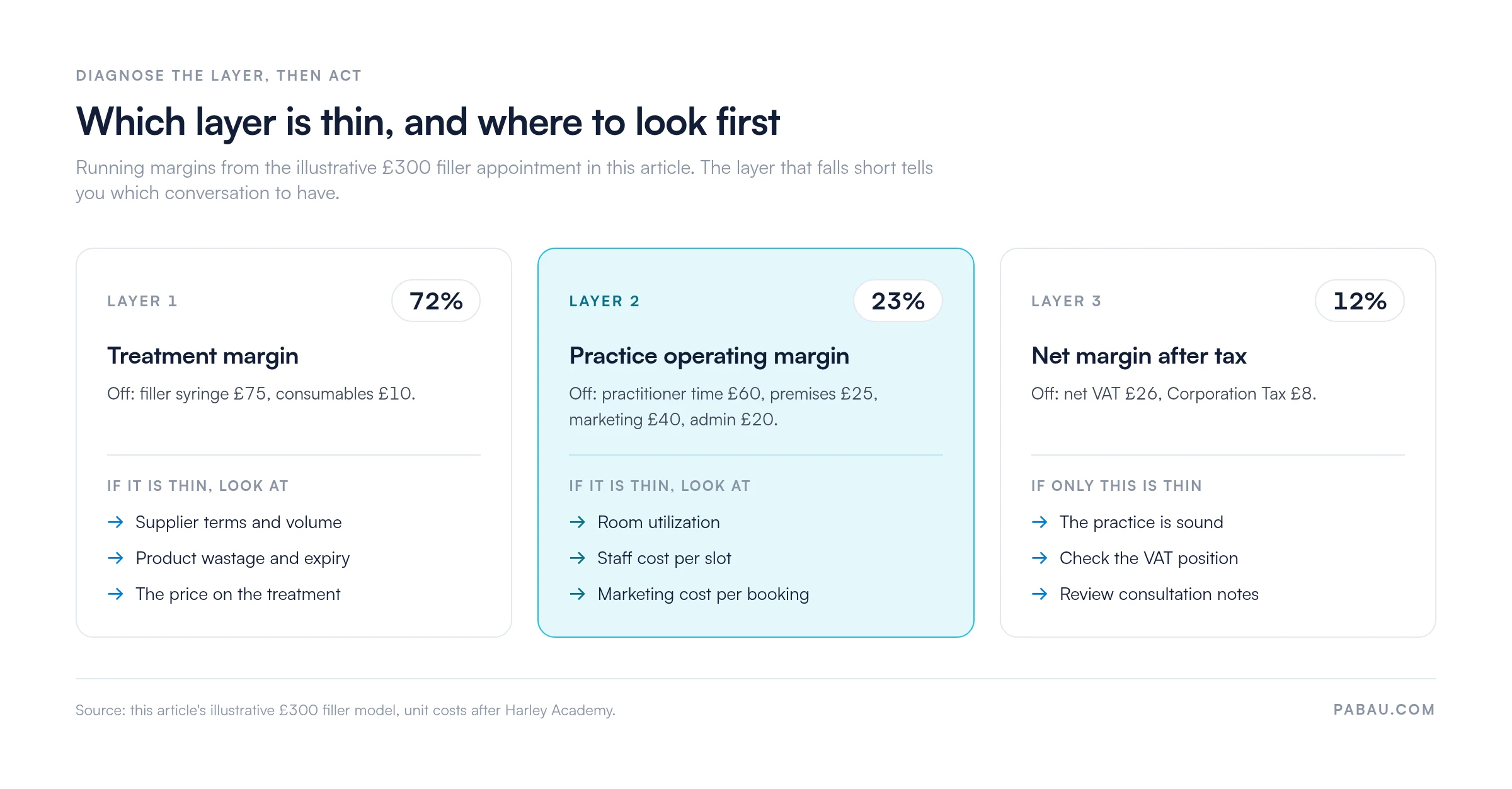
Start with Layer 2. Staff time, room utilization and marketing cost per booking shift far more margin than product pricing does.
Which layer you attack depends on which one came back thin. The panel below matches each layer to the first place worth looking.
Three mistakes come up again and again. Owners discount to fill a quiet week, then never put the price back. They track cost per lead instead of cost per booking. And they set this month’s revenue against last quarter’s costs.
Ask a practice owner for last month’s revenue and you get it in seconds. The same question about margin by treatment takes a week and three spreadsheets.
Meanwhile the booking system holds the appointments, a spreadsheet holds the product costs, and the two only meet when the accountant reconciles the quarter. By then the pricing decisions are three months old.
Practice management software like Pabau holds both in one system. Its stock tracking logs the product used against the treatment, so consumption sits beside the revenue that produced it. The reporting side then breaks income down by treatment and by practitioner, rather than by month alone.
That gives you Layer 1 from your own records instead of from a coach’s blog. Layer 2 still needs your overheads, and Layer 3 still needs your accountant. Matching per-treatment cost to per-treatment revenue is the slow part, and Pabau removes the manual step.
Running the check every month becomes realistic once purpose-built med spa software holds the stock, the appointment and the invoice in the same place.

Pabau links stock usage, treatment revenue and invoicing in one record. So you can see what each appointment earned after product, and turn the three-layer check into a monthly report.

The number worth chasing is your own, at each of the three layers, taken from your own accounts. A percentage somebody published without a source says more about their practice than yours.
Run the check once and the leak names itself. Do it monthly and you catch a drift in room utilization or marketing cost while it is still small.
The trade-off worth remembering is that Layer 1 is the easiest number to improve and the least worth chasing. Book a demo to see how Pabau ties product usage to treatment revenue, so your margin check runs off your own records.

Want the metrics that sit above margin? The med spa KPI guide sets out which numbers to track weekly and which to leave to the quarter.
Looking for predictable Layer 2 income? How to build a med spa membership program covers pricing tiers, billing and the retention numbers behind them.
Product wastage eating Layer 1? The best med spa inventory management software compares tools that track batch numbers and expiry dates.
Repricing without losing bookings? Increase spa profits with smart pricing works through raising prices on the treatments that can carry it.
Need the numbers out of spreadsheets? Nine medical spa accounting software options reviews the tools that reconcile treatment revenue against costs.
Build the price up from your costs rather than working a margin down from a price. Start with the product cost, add your overhead per appointment slot, then add the profit you want. If the treatment is standard-rated, multiply that total by 1.2 to cover the VAT.
It removes the revenue and leaves every Layer 2 cost in place. The room, the practitioner’s hours and the marketing that won the booking were paid for already. So a no-show costs you the whole slot, not just the treatment’s margin.
No. EBITDA sits before interest, tax, depreciation and amortization, so it lands closest to Layer 2. Net profit margin sits after all four. Lenders and buyers usually ask for EBITDA, while your filed accounts report net profit.
Setup cost turns on premises, equipment and whether your treatment list needs CQC registration. Device leases and fit-out usually dominate year one. Our breakdown of what it costs to open a med spa covers fit-out, equipment and licensing.
Earnings track hours treated, treatment mix and whether the practitioner owns the business. An owner’s drawings come out of Layer 3, so a thin net margin caps them directly. Our figures on med spa owner salary compare owners with employed injectors.