Free model waiver form + what it is and when your practice needs one
A model waiver form is a signed document that lets a healthcare practice use a p...

5
Last Updated: Sep 29, 2026

A solo cosmetic nurse renting one room typically turns over $150,000 to $400,000 a year in Australia.
A multi-practitioner cosmetic clinic can reach $1 million to $4 million, but on a much thinner margin.
Margin narrows as a clinic grows, because the owner’s own unpaid clinical hours leave the cost base.
Each employed cosmetic nurse needs roughly $250,000 to $363,000 of turnover to stay inside the ATO labor benchmark.
TGA rules ban advertising injectables to the public, so laser and skin work has to carry the marketing plan.
Cosmetic clinics in Australia make roughly $150,000 a year at the solo end, where one cosmetic nurse rents a single room. A multi-practitioner site can clear $1 million or more. Profit margin runs the other way, and it is widest at the solo stage. Margin gets thinnest once you employ injectors. Employing injectors raises the question of staff commissions, which our comparison of medical spa software covers along with total cost of ownership.
Search this question from Australia and you mostly get cosmetic nurse pay pages. Those report an employee number, not a business number. None of the pages ranking today gives a clinic-level revenue figure, a margin, or an owner’s take-home.
So this guide builds the answer from published Australian sources. We call the result the Clinic Profit Ladder. It sets out revenue, margin and owner take-home at three clinic stages, with every input on show. All figures are in Australian dollars.
In the Australian practices we onboard, the number that moves earnings is rarely the price list. Chair utilization on a quiet weekday matters more.
An Australian cosmetic clinic typically turns over $150,000 to $400,000 as a solo operation, and $1 million to $4 million as a multi-practitioner group.
No Australian dataset publishes cosmetic clinic revenue as its own line, because these businesses straddle two industry classifications. IBISWorld puts Plastic Surgeons in Australia at $1.7 billion in 2026, across about 513 businesses. Hairdressing and Beauty Services runs to $12.5 billion across more than 38,000 businesses.
A skin clinic with an injecting nurse and a laser platform sits between the two. So the Clinic Profit Ladder below is built from sourced inputs rather than lifted from a published statistic. Every figure in it is an estimate.
| Clinic stage | Annual revenue (estimated) | Margin before the owner’s own wage | Owner take-home (estimated) | What sets the ceiling |
|---|---|---|---|---|
| Solo cosmetic nurse, one rented room | $150,000–$400,000 | 31%–52% under $200,000, 17%–31% above it | $45,000–$125,000 | The owner’s own chair hours |
| Small team, 2–3 injectors, own premises | $400,000–$1,000,000 | 12%–23% | $50,000–$230,000 | Chair utilization for every employed injector |
| Multi-practitioner or multi-location | $1,000,000–$4,000,000 | 12%–23%, with 25% as the network ceiling | $120,000–$900,000 | Management overhead and the compliance load |
The spread reads faster as a chart, because revenue and margin move in opposite directions.
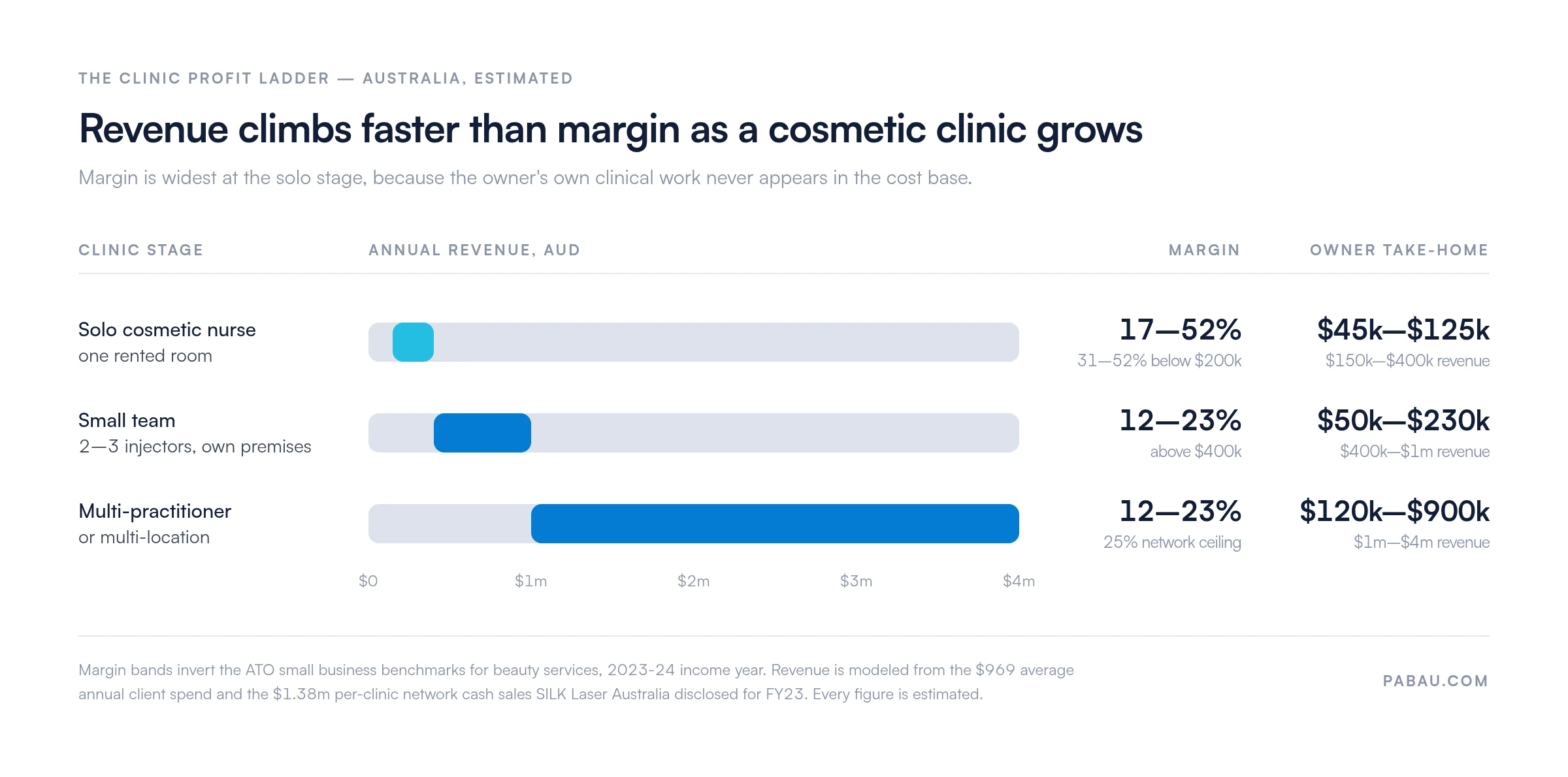
Here is exactly how each column was built, so you can swap in your own numbers.
Read the margin column before the revenue column, because the shape is counterintuitive. The ATO expense ratio climbs as turnover climbs, so margin falls as a clinic grows.
Waste is not what causes it. A solo operator’s own clinical hours never appear as an expense, which flatters the margin. Hire two injectors and that same clinical labor lands on the payroll at market rates.
Two caveats belong with the table. The ATO class covers beauty services and excludes hairdressers, so a medical-led cosmetic clinic is not a perfect fit. Treat the bands as directional.
For market context, Grand View Research forecasts Australia’s facial injectables market to reach USD 9.08 billion by 2030. That is a 19.3% compound annual growth rate from USD 2.7 billion in 2023. The forecast prices product sales in US dollars, so it does not measure clinic turnover.
Chair utilization, treatment mix and staffing cost move an Australian cosmetic clinic’s earnings more than price does. Rent and marketing matter, but less than most owners expect.
Start with staffing, because staffing is the largest line in every clinic. The Nurses Award 2020 sets a floor of $1,504.40 a week for a registered nurse at level 2. The award floor works out at about $78,200 a year before superannuation.
Market pay sits above that floor. Indeed Australia reports a national average of $76,740 for a cosmetic nurse, and SEEK reports $87,500 from salary ranges employers disclosed in job ads.
Now add the 12% superannuation guarantee. An $87,500 cosmetic nurse costs the clinic about $98,000 a year before commission. The ATO benchmark puts labor at 27% to 39% of turnover above $400,000.
So each employed cosmetic nurse needs to generate roughly $250,000 to $363,000 a year for the clinic to stay inside that labor band. That is the number to run before you hire, not after.
The rest of the cost base then decides how much of the remainder you keep.
Average client spend is the lever that compounds. SILK lifted annual spend per client from $914 to $969 in a single year. The lift is a 6% revenue increase with no new clients at all.
Packages, memberships and retail are how a clinic moves that number, and pricing structure decides whether it sticks. Our guide to choosing a clinic pricing strategy works through the trade-offs. Benchmarks for a single-treatment model sit in our breakdown of laser hair removal income.
Only an AHPRA-registered nurse, nurse practitioner or doctor may inject Schedule 4 cosmetic medicines in Australia. Each patient needs an individual prescription written after a real-time consultation.
The guidelines that took effect on 2 September 2025 changed the economics, not just the paperwork. AHPRA now requires that only a registered nurse or nurse practitioner conduct the patient assessment.
Batch prescriptions are gone. One prescriber can no longer sign off a day’s list in bulk. Prescriber time became a per-patient cost line rather than a fixed weekly fee.
A registered nurse also has to practice for at least a year outside non-surgical cosmetic work before moving into it. That constraint slows hiring, which is the practical answer to whether becoming a cosmetic injector is hard.
The TGA restriction hits the marketing budget hardest. Sections 42DL and 42DLB of the Therapeutic Goods Act 1989 prohibit advertising Schedule 4 medicines to the public.
So an Australian clinic cannot publish injectable prices, name a toxin brand, or run before-and-after photos for injectable results. Laser, IPL and skin treatments can be marketed by name, provided the device is listed on the Australian Register of Therapeutic Goods.
Penalties reach $1.65 million per breach for an individual and $16.5 million for a corporation. Influencer testimonials for a regulated health service were banned outright from 2 September 2025.
Premises and device rules then vary by state, so the same clinic costs different money in different capitals.
Registration itself is cheap, and one widely-copied figure is wrong. The Nursing and Midwifery Board charges $193 for general registration from 1 June 2026 to 31 May 2027. The Medical Board charges $1,102 from 1 August 2026.
Neither matches the $1,548 AHPRA registration fee quoted on several Australian clinic cost guides. Check the board’s own schedule before you budget from a blog.
A solo Australian clinic owner often takes home less than an employed cosmetic nurse does. Estimated owner take-home at the solo stage is $45,000 to $125,000, against a national employed average of $76,740 to $87,500.
The two employed figures come from different methods, which is worth knowing before you benchmark against either. Indeed Australia reports $76,740 from its own aggregated data. SEEK reports $87,500 from employer-disclosed job ads.
Treat the SEEK number as national rather than local. That same $87,500 repeats on every location row of SEEK’s page, from Adelaide to the Albury area. The uniformity reads like a fallback rather than regional data.
Commission changes the comparison again. Australian injector roles commonly carry 5% to 15% commission on top of base pay. A productive employed nurse can out-earn a solo owner without carrying the lease, the stock or the compliance load.
Ownership pulls ahead once the second and third chairs fill reliably. At the small-team stage, take-home is a wage for the owner’s own clinical days plus a share of profit. That mix is where the two paths separate.
Experience level moves the employed figure more than location does. Our breakdown of aesthetic nurse earnings sets out those bands in full.
Opening an Australian cosmetic clinic costs about $19,000 for a rented room and up to $1 million for a four-room build. Breakeven is better measured in active clients than in months.
Those totals are our own Australian build-up, line by line, in our guide to skin clinic startup costs. A two-room clinic on its own lease sits between them, at roughly $160,000 to $460,000.
No Australian dataset publishes a time to breakeven for cosmetic clinics, so anyone quoting one in months is guessing. Client count is the better unit, and the arithmetic is short.
Divide your annual fixed costs by $969, the average annual client spend SILK disclosed for FY23. The answer is the active client base the clinic needs before overhead is covered.
The $180,000 and $400,000 inputs are illustrative, not benchmarks. Swap in your own rent, wages, insurance and equipment finance, then rerun the division.
Treatments follow from clients, but only once you know your own average visit frequency. Pull that from your booking history rather than borrowing a US benchmark.
One cash-flow point sits outside every startup total. Four to six months of rent is usually paid before the first client walks in, so working capital runs out before revenue starts.
Australian clinics we onboard can usually quote their turnover, but not their margin by service. Bookings sit in one tool, card takings in a terminal, stock in a spreadsheet, and commission in a payroll file.
Practice management software like Pabau brings those four into one system. Pabau is cosmetic clinic software built for medical aesthetics rather than adapted from salon booking.
Appointments, client records, consent, treatment notes, stock and payments sit against a single client timeline. So the revenue side and the cost side reconcile without a second spreadsheet.
The Clinic Profit Ladder needs three numbers a clinic can rarely produce quickly. Pabau’s reporting shows revenue by service. Stock is recorded against the treatment that consumed it, and package and membership sales appear as their own line.
Commission tracking against each practitioner closes the loop. An owner can see what each chair earned, what it cost to staff, and whether the second treatment room is paying for itself.
New Australian clinics start with structured onboarding rather than a free trial. Onboarding is the part that migrates a full client history without losing weeks. Every subscription includes every feature, and pricing scales with locations and users.

Pabau brings bookings, payments, stock and commission into one system. An Australian cosmetic clinic owner can see what each treatment room earns and what it costs to staff.

The headline number matters less than which rung you are standing on. A solo room-renter and a three-site group both call themselves cosmetic clinics. Their margin bands do not even overlap.
So benchmark against your own stage rather than a national average. If a second injector is the next decision, the figure to run first is $250,000 to $363,000 of turnover per nurse.
The trade-off worth remembering is that growth buys revenue and sells margin. Owners who scale without watching chair utilization end up running a bigger business on a thinner margin.
Book a demo to see how Pabau shows an Australian cosmetic clinic what each treatment room earns and what it costs to staff.

Sizing up the build cost first? How much does it cost to open a skin clinic in Australia? costs the fit-out, licensing and equipment against published Australian rates.
Deciding between employment and ownership? How much can you earn as an aesthetic nurse or practice owner? sets out the pay bands by experience level and by route.
Running a single-treatment model? Laser hair removal clinic income breaks monthly revenue down per machine and per operator.
Want to protect margin without raising prices? Clinic workflows: 5 automations to boost revenue shows which reminders and rebooking prompts recover the most chair time.
Comparing the systems that report on all this? 7 best aesthetic clinic software solutions compares the platforms on reporting, stock and payments.
An Australian cosmetic clinic typically turns over $150,000 to $400,000 as a solo operation. A multi-practitioner group reaches $1 million to $4 million. Estimated owner take-home runs from $45,000 at the solo stage to about $900,000 across three or four sites.
Estimated margins run 31% to 52% below $200,000 of turnover, and 12% to 23% above $400,000. Those bands invert the ATO small business benchmarks for beauty services. Margin narrows as a clinic hires, because the owner’s own clinical hours join the payroll.
Opening costs start at about $19,000 for a cosmetic nurse renting a furnished room. A four-room premium build reaches about $1 million. A two-room clinic on its own lease sits at roughly $160,000 to $460,000. Fit-out is the biggest single line, at $1,500 to $3,000 per square meter.
Often yes, at the solo stage. An employed cosmetic nurse averages $76,740 to $87,500 nationally, while estimated solo-owner take-home is $45,000 to $125,000. Commission of 5% to 15% widens that further. Ownership pulls ahead once a second and third chair fill reliably.
Count active clients rather than treatments. Divide annual fixed costs by $969, the average annual client spend SILK Laser Australia disclosed for FY23. A two-room clinic carrying $180,000 of fixed costs needs about 186 active clients. Convert that to treatments using your own average visit frequency.